Licorice Plant

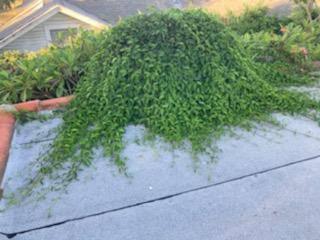
Licorice plant can become vegetative mulch.

This is not the genuine licorice of confectionery. This more popular home garden licorice plant, Helichrysum petiolare, is more of an ornamental plant than a culinary herb. Its mild foliar aroma resembles that of genuine licorice, but is very faint. Without disruption of the foliage, the aroma is imperceptible. Since the foliage can be toxic, the flavor is irrelevant.

Licorice plant is popular for its appealingly silvery foliage. Some cultivars are variegated. ‘Limelight’ is strikingly pale silvery chartreuse. The small, rounded and evergreen leaves are distinctly tomentous (slightly fuzzy). The sprawling stems tend to disperse over older growth, and might get deeper than a foot and a half. Mature plants get wider than six feet.

Licorice plant is susceptible to extremes of temperatures. Within more severe climates, it appreciates a bit of partial shade during excessively warm and arid weather. Foliage can roast from harsh exposure. Where winters are cool, foliage appreciates shelter from frost. Roots are susceptible to rot with excessively frequent watering, or inadequate drainage.

Mulch Retains Moisture And Insulates

Mulch helps to insulate the soil.

Nature is smart. It should be. It has been operating efficiently since the beginning of time. That is certainly longer than anyone has been gardening in defiance of nature. Imported plants that need unnatural watering and soil amendment continue to benefit from nature. Some assets, such as weather, are direct from nature. Some, such as mulch, are copied.

Summers are long, dry and somewhat warm here. Without rain, there is plenty of time for the soil that roots inhabit to become dry. Warmth and aridity increase the consumption of moisture by plant species that are not accustomed to such extensively dry weather. That is precisely why landscapes and home gardens are so reliant on supplemental irrigation.

Because water is expensive, plants that do not require much of it are popular. Automated irrigation systems should operate as efficiently as possible to minimize waste. Since turf grass is very consumptive, lawns should not be overly expansive. Conservation of water is common here. There are several techniques for doing so. Mulch is one of the simplest.

Although adding mulch to a garden is unnatural, it works like the natural detritus within a forest. It retains moisture and insulates the surface of the soil. Without mulch, surface soil can become uncomfortably dry and warm for roots. Mulch also inhibits the proliferation of weeds. Because weeds consume moisture, their absence indirectly conserves moisture.

Mulch generally goes into the garden during early spring, before weed seed germinates, and after the removal of the detritus of winter. It can be practical at any time though, even as the soil becomes dry and dusty through summer. Various forms of mulch are available from garden centers. Home compost works splendidly, but costs nothing more than labor.

Alternatively, several types of groundcover can function as mulch. Some types consume more moisture than they conserve, but exclude weeds. Some types, such as ceanothus, lantana and licorice plant, might not crave any more water than the plants they surround. Their maintenance should involve less effort than removal of weeds which they displace. They are more visually appealing anyway.

No Cherry On Top

After three years, this tree is developing a healthy upper canopy with adequate clearance above walkways.

tonytomeo's avatarTony Tomeo

P90811Weeping flowering cherry is another type of tree that almost never gets appreciated like it should. Like so many Japanese maples, they get planted into situation where so-called ‘gardeners’ shear them into nondescript globs of worthless foliage that only get in the way. Some get shorn so regularly that they are deprived of bloom. Their form and bloom are their two main assets.

The climate here is not easy on them either. Although comfortably mild, the climate is also arid. This aridity enhances the potential for sun scald of exposed bark. Because upper limbs bend over to hang back downward, their bark is more exposed than that of upright flowering cherries. Consequently, upper limbs are often scalded and ruined, disfiguring the remaining canopy.

Pruning can be complicated. Removal of scalded upper growth exposes inner growth that is more sensitive to scald. It is sometimes necessary to leave damaged upper growth…

View original post 269 more words

The Grass Is Not Always Greener

After three years, this artificial lawn is still in reasonably good condition. A few more melted patches appeared, and some areas are more worn than others, but in regard to the traffic that the lawn experiences, such damage and wear is expected.

tonytomeo's avatarTony Tomeo

P90810KThe lawn around the three small but gnarly oaks that were featured this morning in ‘Six on Saturday: Do Not Sit On Tree‘ was not always so perfectly green and uniform. Only a few months ago, it was real grass. Well, it was ‘sort of’ real grass. It was mostly dusty sand with some grass growing it in. There were weeds too, but even they were not very happy to be there.

Maintenance was ridiculous. Because some of the grass was actually alive, it needed to be mown regularly, which sometimes rutted damp soil, but more often blew dust from dry soil into the surrounding buildings. Because the soil retained such minimal moisture, the lawn needed to be irrigated regularly; but because of the old oaks trees, it could not be irrigated too generously.

The only reason that the lawn was there at all was because it got…

View original post 247 more words

Six on Saturday: Bad Habit

Growing horticultural commodities can be a very rewarding occupation, even if not very lucrative. Growing random plants merely because they are available may be a bad habit. Sometimes, I procure propagation stock intentionally because I want to grow copies of a particular plant. Perhaps more often, I grow something merely because I can not bear to discard good propagation stock or actual plants. That is why there are so many homeless cannas here now! After I prune zonal geraniums, I feel obligated to process all the scraps into cuttings rather than simply discard them into the compost.

1. Opuntia (of unidentified species or hybrid), prickly pear lives at a clinic in Santa Cruz. Someone with a weed whacker busted off a few pads. It is good for both nopal and tuna. It is shabby and canned because someone with a weed whacker here kept cutting it also.

2. Clivia miniata, Natal lily was pulled from a trailside prior to weed whacking. I do not know if it is feral from seed or a cultivar from landscape debris. They have not bloomed.

3. Iris pseudacorus, yellow flag is naturalized in a roadside ditch in Ben Lomond. It is an invasive species in some regions. Therefore, it must be contained and deadheaded here.

4. Platanus racemosa, California sycamore was a sucker on one of the big trees at work. It pulled off with roots attached, so got canned. Its trunk died, so is now replacing itself.

5. Washingtonia robusta, Mexican fan palm needed to be removed from a yard in Santa Clara. Many were in pavement. Someone else got most that were salvageable. I got eight.

6. Cinnamomum camphora, camphor tree seedlings grew out sidewalk expansion joints at a job in San Jose. I pulled some out. A few came out with roots, and grew up like this.

This is the link for Six on Saturday, for anyone else who would like to participate: https://thepropagatorblog.wordpress.com/2017/09/18/six-on-saturday-a-participant-guide/

Peach

Fresh tree ripe peaches are best.

Of all the stone fruit trees like apricot, plum and cherry, none need more aggressive and specialized pruning while dormant in winter than peach, Prunus persica. The distinctively fuzzy fruit is so big and heavy that the weight of too much fruit tears limbs down. Pruning not only limits fruit production, but improves structural integrity, fruit weight distribution, fruit quality, and tree health. Mature trees should be kept less than ten feet tall, but often get twice as tall with much of the fruit out of reach.

Squirrels Fear The Unknown Too

Pierre Francois dutifully protects ripening fruit.

It is embarrassing when my mother teaches me a practical gardening technique that I should have known about, especially if the particular technique is as simple and downright silly as what my mother does to protect ripening fruit from squirrels. A friend of hers suggested it; and it seems to be significantly more effective than the few fancier ideas that I recommended.

I should first mention that there is nothing new about repelling animal pests with effigies of other animals that they are afraid of. Scarecrows and stuffed snakes and owls have been around for centuries. As the name implies, scarecrows scare crows who perceive them to be potentially troublesome people. Rats and terrestrial rodents avoid snakes. Squirrels and some birds are afraid of owls.

When I was in about the fourth grade, I remember that National Geographic World magazine (which is now National Geographic Kids) featured a silhouette of a predatory bird that could be cut out and taped to windows to deter birds that might otherwise break their necks as they tried to fly through the clear glass. The associated article explained that the cut-out silhouette was effective because birds instinctively knew what to fear. A silhouette of a harmless seagull would not have been as effective.

However, some deterrents are not so specific, but instead rely on the fear of the unknown. Beach balls outfitted with decals of huge eyes look weird in the garden, but work because so many birds have bird brains that think such contraptions are big, scary and possibly predatory animals. Flash tape and old compact discs work simply because birds do not know what the reflected flashes are.

Scarecrows and other inanimate effigies should be relocated occasionally so they seem to be alive. They should stay near what they are in the garden to protect, and not loiter when it is gone. For example, if protecting ripening fruit, they should leave after the last of the fruit is gone. Otherwise, the target pest animals realize that they are fake or dead. Beach balls, flash tape and compact discs are more animated, so need not be moved so much, if at all, but are too tacky to stay all year.

All this may seem complicated, but can be simple enough for my mother to master with . . . well, allow me to explain.

Pierre Francois is a cute, fuzzy and seemingly French plush toy bunny made in China, who knows all about protecting ripening fruit from squirrels. (‘Stuffed animal’ is no longer politically correct.) After seeing how expensive a fake owl would be, my mother put Mr. Francois in the peach tree. He and his sort are free if borrowed (stolen) from the grandchildren, or very cheap at garage sales or thrift stores. Although cute and soft to us, Mr. Francois is big, intimidating and unfamiliar to squirrels. Before the squirrels get acquainted with him, the peaches will have been harvested, and Pierre Francois will have been reassigned to an apple tree.

Horridculture – Stinky Flowers

This recycled article seems to be less objectionable than most other Horridculture rants. This ugly . . . whatever it is, actually grew and bloomed for the season after this article posted, and continues to do so.

tonytomeo's avatarTony Tomeo

P90807Wednesday is my day to rant. However, I neglected to get out to find a picture or even a topic to rant about. Instead, I found this ugly little . . . what I believe to be a dormant rhizome. It looks more like a tuber or a tuberous root, and very well could be. Someone at work brought it from his home garden, where countless more naturalized and became aggressively invasive.

I do not know for certain what it is. I only know that it is some species of Arum. We refer to it as the ‘death arum’ because, while in bloom, it smells like death. Yet, it seems to be immune to death. It is extremely resilient. All attempts to eradicate any of it have only angered it, and accelerated its migration into other formerly uninfested parts of the garden. Now we have it here.

I am told…

View original post 267 more words

Sweet Flag

Sweet flag might enjoy wasteful watering.

If unpaved drainage ditches and collection ponds were more common locally, sweet flag, Acorus gramineus, might be also. It can provide a nicely neat border for such waterways, where the ground is too steep and damp for mowing. It can migrate into muddy situations and even into shallow water. Its dense network of fibrosus rhizomes helps to retain mud.

‘Variegatus’, with elegantly elongated and variegated leaves, is the most popular cultivar locally. It is rare in nurseries, but occasionally shared by friends and neighbors who grow it. Propagation by division is very easy. Single shoots or clumps of shoots grow if merely plugged into damp soil or mud. ‘Pusillus’ lacks variegation, and develops stouter leaves.

Sweet flag aggressively excludes other herbaceous vegetation, but does not migrate too rapidly. Plucking shoots and plugging them elsewhere accelerates migration. The dense foliage might get a foot deep. Individual leaves are very narrow, like grass. The mundane bloom is easy to ignore and is uncommon where the soil is not often saturated or muddy.

Saturation Of Soil Distresses Roots

Some riparian plants tolerate soil saturation.

Saturation of the soil should be a rare problem within the local chaparral climates. Water is a limited resource. That is why plants that are not native or endemic to other chaparral or desert climates rely on supplemental irrigation. Many exotic species would not survive through the locally long and dry summers without it. Water is only sufficient during winter.

The unfortunate reality is that soil saturation is among the more common problems within landscapes that rely on gardeners. Although most gardeners are proficient with irrigation, some are not. They would prefer to irrigate too generously than risk desiccation. They do not assume the expense of the water, or of the plant material that succumbs to saturation.

Although significantly less common within home gardens that do not rely on professional gardeners, soil saturation is possible. It occasionally happens within pots or planters that lack adequate drainage, or if the drainage becomes clogged. Saucers that contain water that would otherwise damage decking or flooring might inhibit drainage if constantly full.

Besides within pots and planters, saturation is more likely within dense garden soil than within coarser soil. Downspouts could saturate surrounding soil through the rainy winter season. Leaky plumbing might do the same at any time, even if it is merely irrigation pipe that leaks only while operating. Of course, excessive irrigation produces most saturation.

Saturaturation deprives soil or medium of aeration. Roots avoid soil or medium that lacks adequate aeration. Trees and large shrubbery therefore disperse most of their roots near the surface of saturated soil. Such shallow root dispersion limits stability. The expansion of such shallow roots displaces and fractures pavement and curbs, and heaves lawn turf.

Excessive irrigation causes soil saturation during summer. Excessive frequency is more likely to cause saturation than excessive volumes of water. Unfortunately, it is impossible to prescribe appropriate irrigation schedules and application rates. Climate, soil type and plant material are all relevant considerations. Moisture requirements change seasonally, and from year to year, as plants mature.