California poppies are like no other wildflower. They are so perfectly bright orange, and look almost synthetically uniform in profusion, as if painted onto coastal plains and hillsides. They may be a bit more yellowish in some regions, or a bit deeper orange in others, but they are always bright and strikingly uniform.
Genetic variation is naturally very rare. I can remember hiking with my Pa up to the (lesser known) Portola Monument in the hills behind Montara, and finding a few pale white poppies, and even fewer pale purple poppies. It was like finding four leaf clovers! Genetic variants among California poppies are not quite as rare as four leaf clovers are, but finding a few of both white and purple was really strange. I never found a pink one though. Nowadays, poppies can bloom in all sorts of shades and hues or orange, yellow, red, pink and soft…
Such silvery foliage provides a bold display on such a substantial tree. Most comparably silvery foliage is of smaller perennials or shrubbery, such as agaves or artemisias. Agyle apple, Eucalyptus cinerea, grows intimidatingly fast to nearly thirty feet tall and almost as wide. Although shorter than most other eucalypti, it can get a hundred feet tall in the wild.
Paired juvenile leaves of young trees are circular and sessile (clinging directly to stems, without petioles). Unpaired adult leaves are lanceolate and as silvery as juvenile leaves. Coppicing or pollarding force juvenile growth and temporarily eliminate adult growth, but also ruin structural integrity. Trees subsequently rely on repetition of the same technique.
Trunks and limbs can be disproportionately bulky, and create an illusion of a bigger tree. Irregular branch structure can be sculptural. Fibrous brown bark is handsomely furrowed. Juvenile foliage is a popular accessory to cut flowers. Adult foliage is likewise delightful. Incidentally, the Latin name of this species often transposes for Eucalyptus pulverulenta.
Windy weather sometimes breaks limbs from trees, or blows entire trees over. Evergreen trees are innately more susceptible to such damage than deciduous trees are. Wind can blow more easily through deciduous trees while they are bare through winter, when most wind occurs. However, deciduous trees are now more susceptible to sudden limb failure.
Sudden limb failure, or spontaneous limb failure, is a result of gravity rather than of wind. It is actually more likely without wind, during mild or warm weather, particularly with high humidity. It consequently has potential to be more hazardous than limbs that blow down. More people go outside among trees during mild weather, and fewer expect falling limbs.
Sudden limb failure occurs if limbs become unable to support their own increasing foliar weight. Warmth accelerates vascular activity, which sustains foliar growth. High humidity and a lack of wind inhibit evapotranspiration (evaporation from foliage), which otherwise helps to alleviate excessive weight. Developing fruit can also cause sudden limb failure.
In the wild, willows, poplars, sycamores, and perhaps a few other riparian trees regularly and naturally exhibit partial sudden limb failure. Limbs that fracture and sag onto soil, but remain partially attached to their original tree, can generate roots and grow as new trees. Although their strategy is practical for them, it is unacceptable within refined landscapes.
Several native and exotic trees of chaparral climate are quite susceptible to sudden limb failure within or adjacent to irrigated landscapes. Since they are not accustomed to such abundant moisture, they overindulge. Mature wild trees are more likely to exhibit sudden limb failure after an unusually rainy and warm winter, or if rain continued late into spring.
All native oaks, particularly valley oak and coast live oak, are susceptible to sudden limb failure. So are Monterey pine and Monterey cypress. Carob, sweetgum, various elm and various eucalypti are exotic species that are notorious for such behavior. Evergreens are more unpredictable, since their new growth is less obvious among their lingering foliage.
Redwoods are SO TALL!
How tall are they?
They are so tall that you can see for yourself if you look in this direction . . . from anywhere in North America.
They are so tall that if you need firewood, I can aim one in your direction as I cut it down.
They are so tall that while they drop foliar debris on the Ford and Chevrolet parked below, they also drop foliar debris on Mercury and Saturn in their respective orbits.
They are so tall that while other trees collect kites and Frisbees, they collect airplanes and satellites.
They are so tall that only a few of their seed survive. Most burn up in the atmosphere on their way down.
They are SO BIG too!
How big are they? They are so big that some have tunnels cut through them so cars don’t run out of gasoline while…
This picture of a yellow Pacific Coast iris probably should have been incorporated into the Six on Saturday post earlier today. I omitted it because I was not so impressed with how the color showed up. It is really more yellow than it looks. In this picture, it looks more like a discolored version of the white Pacific Coast iris. This sort of variation, that might have been normal for old fashioned photography, is not expected of digital imagery. It sort of reminds me of how some insects and other pollinators see flowers so differently with infrared or ultraviolet. Are infrared or ultraviolet faded in digital imagery as well? It would make sense, since there is no need for normal cameras to record colors that we can not see. Nor is there need for computer monitors to display such invisible colors. Ironically, modern technology can modify color to make that…
Brent left for vacation in Hawaii at about the same time that I returned from vacation in Oregon and Washington. Since I told him to stop sending me so many pointless pictures prior to my vacation, he is now sending even more. I might have gotten more pictures of his vacation than I got of mine. Although I would like to see Hawaii for the horticultural aspects, I am not otherwise impressed by what little I know about it. Perhaps I would get a better impression of it without so many of Brent’s pointless pictures. These are a few of the lesser pointless pictures, without the selfies.
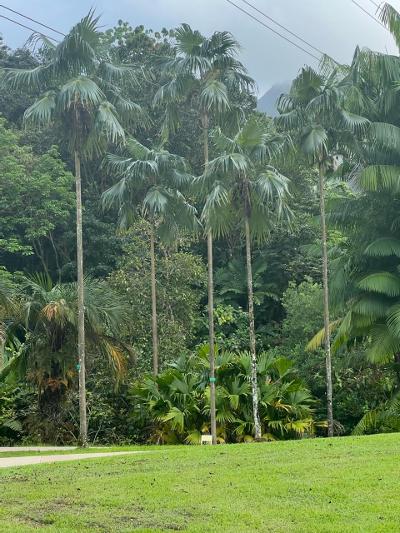
1. Accommodations were quite comfortable. Brent enjoyed the forests around this guest house, which was only a few miles from the Penthouse in Waikiki that he also stayed at.2. Palms of all sort are common in Hawaii. I have no idea what the palms to the left are. Nor can I know if this is a picture of those palms, a rainbow, or a utility pole with cables.3. What is this? It must be in the Araceae Family. It looks like some sort of Philodendron that does not develop a vining stem. Some familiar species are not so familiar in Hawaii.4. Doum palm is a weird palm that branches. There are actually a few species within the same genus. No one seems to know why it was never popularized in Southern California.5. Is this Kentia palm? There are so many unfamiliar palms in Hawaii that identification is baffling. This group certainly is pretty. The palms to the left looks a bit more familiar.
6. Brent labeled these as windmill palms. If they are, why are their trunks bald? Perhaps they are one of those few shedding species of Trachycarpus that is not yet available here.
Even without the variety of color of hydrangea, these relatively delicate, crisp white flowers of snowball bush are quite elegant.
Like small, clear white hydrangea blooms, the round, three inch wide floral trusses of snowball bush,Viburnum opulus ‘Roseum’, are composed of many smaller flowers. Unlike hydrangeas that bloom after vegetative (stem and foliar) growth, snowball bush blooms early, so that as it finishes, deteriorating blooms will be obscured by soft green foliage before anyone notices. The distinctively lobed, three inch wide leaves get quite colorful in autumn. Snowball bush should not be shorn, but can instead be pruned aggressively while bare in winter. Older or obtrusively tall stems should be pruned to the ground where possible. Good sun exposure without too much reflected glare or heat promotes bloom and autumn foliar color. Mature plants can get ten feet tall and nearly as broad.
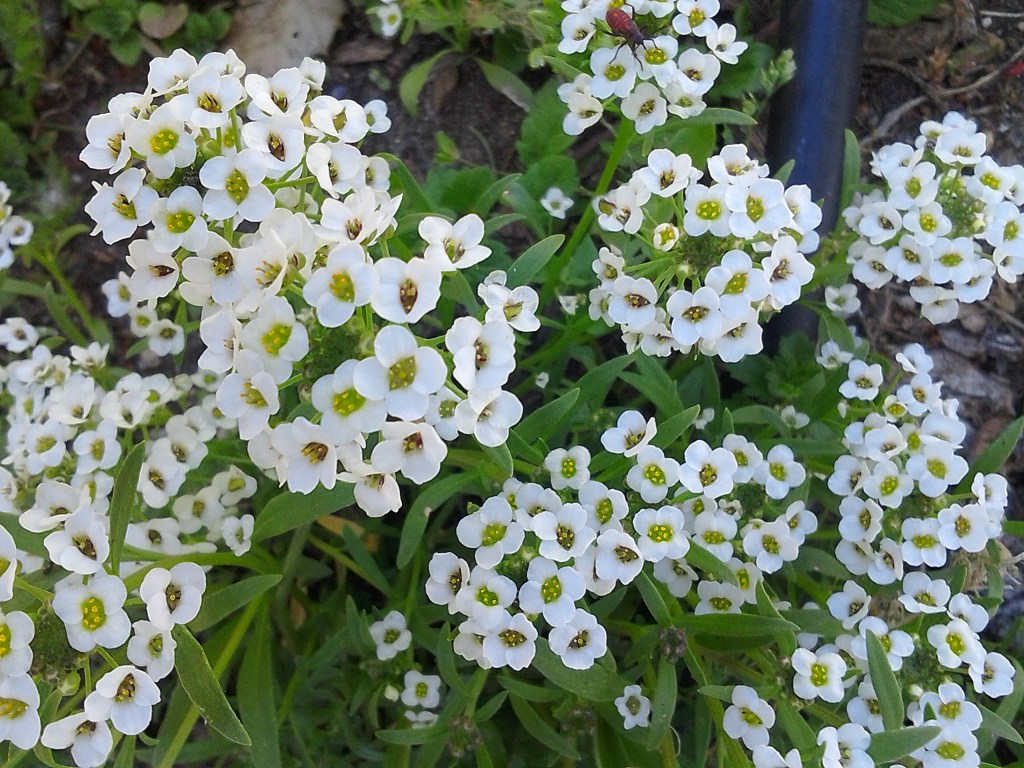
Sweet alyssum is one of those warm season annuals that is too easy to grow to be taken too seriously.
Nasturtium and sweet alyssum seem to be more than warm season annuals. Like many other warm season annuals, they get established best if added to the garden just after winter, and then grow and bloom mostly during warm spring and summer weather. Then, if allowed to stay in the garden as cooler weather inhibits bloom somewhat , they survive through autumn and winter. By the time the original plants die out, new seedling emerge to replace them.
A potential ‘slight’ problem with allowing these annuals to naturalize (perpetuate naturally by sowing their own seed) is that fancier varieties eventually revert to a more genetically stable state. Sweet alyssum that can be various shades of pink or purple as well as white eventually blooms almost exclusively white after a few generations. Nasturtium that might start out with all sorts of shades of yellow, orange, red or brownish red eventually blooms with only basic bright yellow, bright orange and perhaps rarely, cherry red.
The reason that this is only a potential problem is that most of us are totally pleased with white sweet alyssum, and yellow and orange nasturtium! Another slightly more realistic potential problem with naturalization of sweet alyssum or nasturtium is that it leaves us no excuse to try different varieties. Anyone who doubts this should take a quick look through the online catalog of Renee’s Garden!
Nasturtium is easier to grow from seed than from small plants in cell pack, since small plants take time to recover from transplant. Besides only two or perhaps three of the multitude of varieties available as seed can be found in cell packs. Sweet alyssum can either be grown from cell pack or from seed, but like nasturtium, more varieties are available as seed. Although they grow throughout the year, both are still considered to be warm season annuals.
Busy Lizzy (impatiens), petunia, marigold, lobelia, cosmos and zinnia are some of the other popular warm season bedding annuals this time of year. Statice, cockscomb, verbena, moss rose and pincushion flower are also in season. Statice, tall varieties of cosmos and some varieties of zinnias make good cut flowers. Verbena, moss rose and pincushion flower are more often grown in mixed planting rather than as homogenous bedding. Although many more varieties are available as seed, cell packs of any of these warm season annuals provide more immediate results, especially this late in the season.
Building and environmental codes are so ridiculous. So much of what I would want in my home is now illegal. So much modern technology that I do not want is now required. Fireplaces and wood stoves are not allowed. Overly elaborate electrical systems to serve every room are necessary. I would prefer a technologically simple home comparable to those built more than a century ago, but am prohibited by law from ever constructing one. The area outside of a home is no easier to work with. Dead trees inhabited by the wrong sorts of woodpeckers can not be cut down. Excavation can be prohibited if a particular beetle happens to be in the way. Even some of the increasingly combustible trees and overgrown vegetation have more rights on my land than I do. Now, I am a horticulturist; so I know more about vegetation management than the treehuggers formulating these…
Canary Island date palm is the largest local palm. Pygmy date palm, Phoenix roebelenii, although a species of the same genus, is one of the more diminutive palms. It might take many years to grow ten feet tall, and may never get twice as tall. Its pinnately compound leaves are only about two to four feet long. Thin leaflets are about five to ten inches long.
Such compact stature is a distinct advantage for some situations. With sufficient sunlight, pygmy date palm is a delightful houseplant. It is also appealing within atriums and cozily compact gardens. For those who appreciate the aesthetics but not the large size of most palms, pygmy date palm is a practical option. It actually resembles a common date palm.
Like all date palms, a pygmy date palm surrounds its single terminal bud with nasty long spines, which are specialized proximal leaflets. These spines are painful to interact with while grooming and pruning deteriorated old leaves and floral trusses back to their trunk. Unlike most other palms, mature pygmy date palms are not very conducive to relocation.

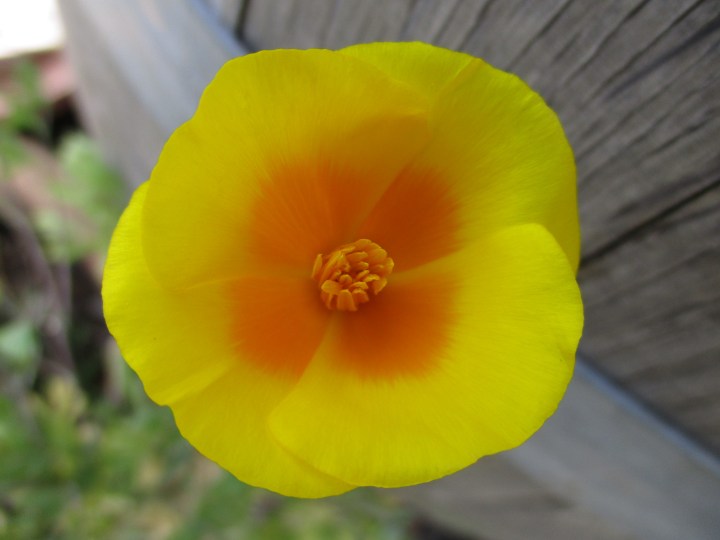 California poppies are like no other wildflower. They are so perfectly bright orange, and look almost synthetically uniform in profusion, as if painted onto coastal plains and hillsides. They may be a bit more yellowish in some regions, or a bit deeper orange in others, but they are always bright and strikingly uniform.

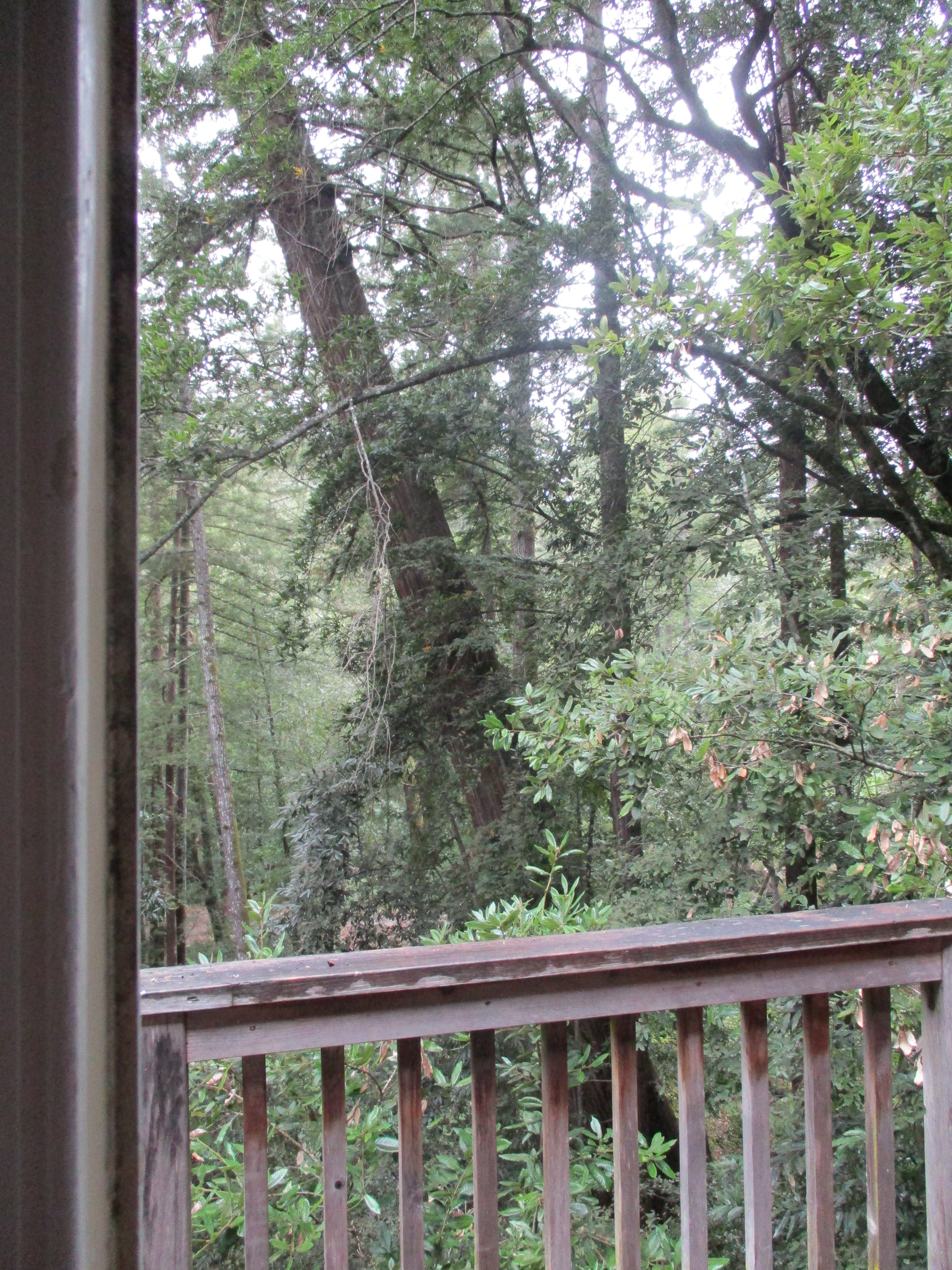 Redwoods are SO TALL!
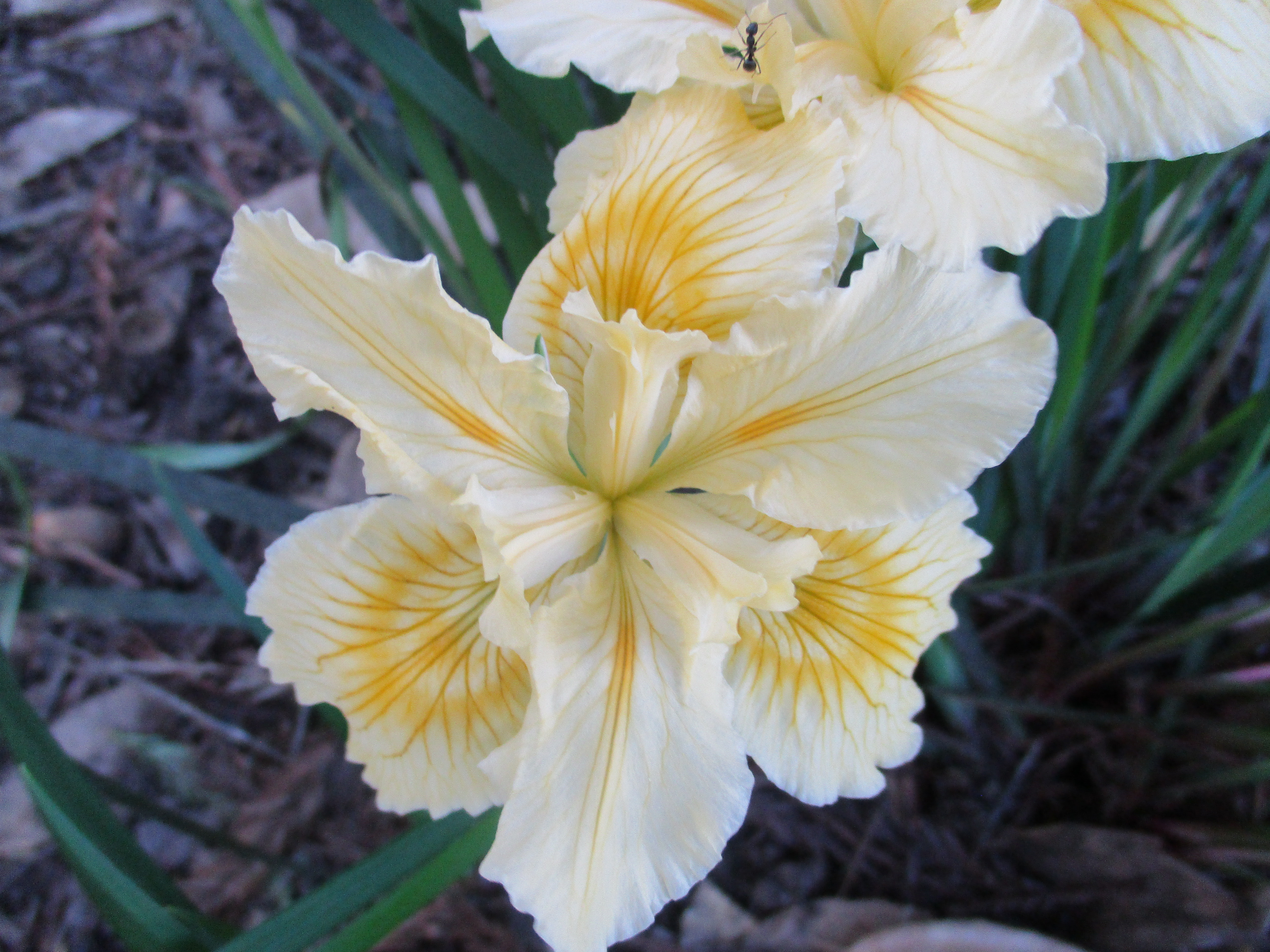 This picture of a yellow Pacific Coast iris probably should have been incorporated into the Six on Saturday post earlier today. I omitted it because I was not so impressed with how the color showed up. It is really more yellow than it looks. In this picture, it looks more like a discolored version of the white Pacific Coast iris. This sort of variation, that might have been normal for old fashioned photography, is not expected of digital imagery.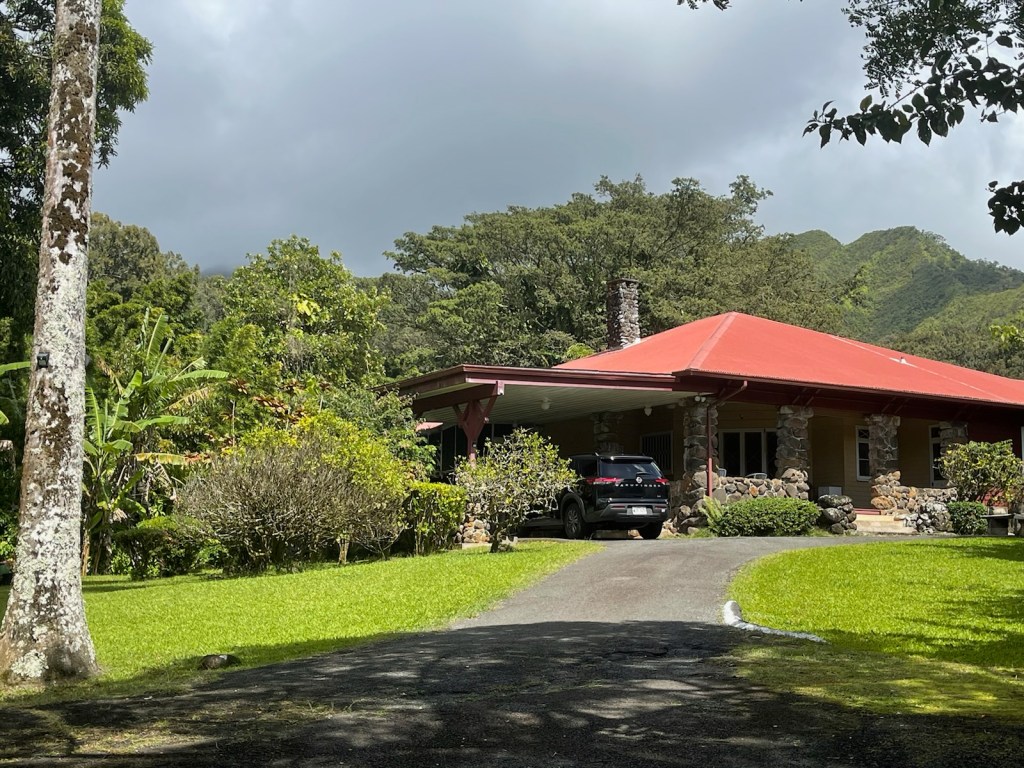



 Building and environmental codes are so ridiculous. So much of what I would want in my home is now illegal. So much modern technology that I do not want is now required. Fireplaces and wood stoves are not allowed. Overly elaborate electrical systems to serve every room are necessary. I would prefer a technologically simple home comparable to those built more than a century ago, but am prohibited by law from ever constructing one.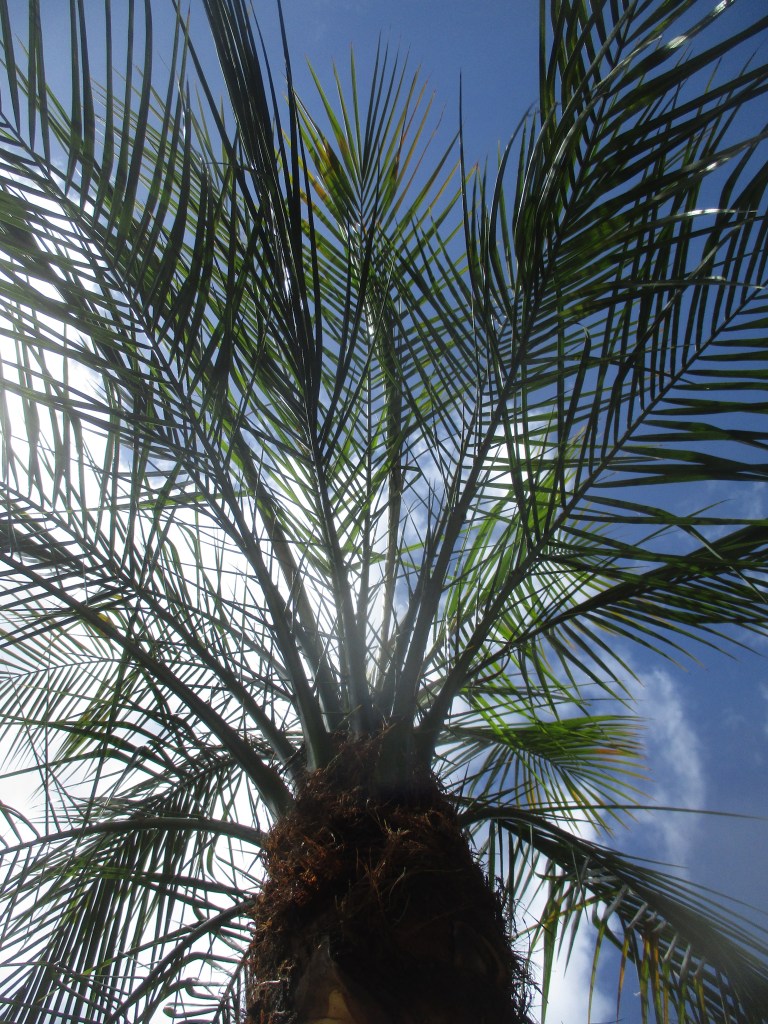
 Tony Tomeo