Sea Green Juniper

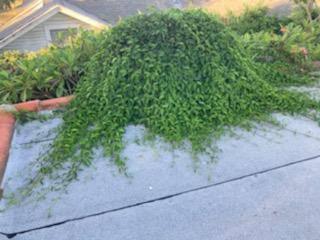
It may seem to grow slowly, but ‘Sea Green’ juniper outgrew the stigma that has followed junipers since the 1950’s.

No one can deny that junipers are useful, sustainable and resilient. They tolerate cold, heat and harsh exposure. Once established, they do not need much water.

Sea green juniper, Juniperus chinensis ‘Sea Green’, is a bit lighter green than more traditional dark green junipers. It can grow somewhat slowly, eventually getting to about five feet tall, and a foot or two wider. Like all junipers, it should never be indiscriminately shorn, but should instead be selectively pruned to exploit its distinctive ‘fountain’ shaped branch structure that points up and outward from the base.

Daddy’s Garden

Truly sustainable plants are less lucrative to the nursery industries.

My rhubarb really has been around a while! My father’s father’s father and mother grew it quite some time ago, and shared some shoots of it with my father. He then shared it with my maternal grandmother, who shared it with her mother, another of my great grandmothers, who thought it was something really exotic. Along the way, it was undoubtedly shared with friends and neighbors all over the place.

My great grandparents with the original rhubarb also grew old varieties of grapes, oranges, lemons, walnuts and all sorts of vegetables. Their two (‘Carpathian’ English from Persia) walnut trees were remnants from an orchard that was already old before their home was new in 1940. The few ‘ornamental’ features of their garden included such old fashioned but resilient plants as junipers, callas, pelargoniums (geraniums), dahlias and roses. Yes, the stereotypical Italian American garden. My great grandfather even gave me my first nasturtium seeds.

My maternal grandfather likewise grew all sorts of traditional vegetables, as well as cherries, peaches, avocados, blackberries and raspberries. My grandmother competed for limited garden space to tend to her many roses, as well as lilacs and bearded iris that she got from her mother. My mother still grows a large herd of the original iris, several lilacs and a copy of the peach tree.

My very first experiences with gardening were in the old fashioned but remarkably sustainable gardens of my parents, grandparents and great grandparents. Such gardening with so many old fashioned plants would seem primitive by modern standards, but really demonstrates how sustainable proper horticulture is.

Of course, as a horticulturist, I work with all sorts of exotic plants and modern varieties. Although some are fun to work with, the best and most sustainable plants are the old classics and simpler ‘unimproved’ plants, especially those that can be propagated from seed, division or cuttings from established plants.

Many modern varieties of plants are more beneficial to the retail nursery industry than to home gardens, since they do not last too long. They are generally either not well suited to local climates, or are genetically weak from extensive breeding or mutation. (Many of the mutant characteristics that some varieties are selected for, such as variegated foliage or compact growth, compromise vigor.) As they come and go, more new plants are needed from nurseries to replace them. This is actually contrary to the sustainability fad that so many nurseries claim to promote.

Perhaps our parents know more about gardening and sustainability than we give them credit for.

Horridculture – Three Is A Magic Number

I never would have made it as a landscape designer.

tonytomeo's avatarTony Tomeo

P81219We learned it young from Schoolhouse Rock. Those of us who studied Landscape Design were compelled to learn why, and assume that it is always true.
Well, I am not a landscape designer. I am just a horticulturist and arborist. I can see why three is the best number for groups of trees, and that five is probably the second best option for larger groups, followed by seven, and then nine, and so on. I sort of understand why two, four, six, eight and so on are not so desirable. However, these rules are not absolute.
When I was a kid, many suburban front yards were outfitted with three European white birch trees. Such groups were typically in a corner of the rectangular yards, just outside of the curvacious mowing strips that were designed to make the rectangular spaces seem to be more irregular than they really were. Individually, the…

View original post 248 more words

Stock

Stock happens to excel at purpleness.

This is one of those annuals that could be a short term perennial if it gets the opportunity to do so. In most climates, stock, Matthiola incana, is a popular warm season annual that relinquishes its space to cool season annuals before it gets too worn in autumn. Locally, because it does not mind mild frost, it is more popular as a cool season annual for winter.  

Floral color ranges through both pale and rich pastels of purple, red, pink, yellow, cream and also pure white. Flowers may be single or double. In close proximity, bloom is richly fragrant. Foliage is light grayish green. Individual leaves are somewhat narrow. Removal of deteriorating floral stalks before they develop seed pods prolongs subsequent bloom.

Many garden varieties of stock stay relatively low and compact. Some may get no higher than a foot. Florist varieties that produce long stems for cutting might get as high as three feet. Overgrown plants get shabby after a primary season, but may regenerate from hard pruning. However, secondary growth is generally irregular and likely marginally reliable.

Frost Is Different From Chill

Frost has already stricken some regions.

‘Chill’ could almost be a pleasant euphemism for ‘frost’. Both words describe cool or cold weather that occurs during winter. The obvious difference is that one is good, and one is bad. Chill is a minimum duration of cool weather that some plants require through winter to maintain their schedules. Frost is weather that is cool enough to damage some plants. 

This technical difference is that chill is at or below forty-five degrees Fahrenheit (≤45°F), and frost is at or below thirty-two degrees Fahrenheit (≤32°F). That is a difference of only thirteen degrees Fahrenheit (13°F), just above the freezing temperature of water. Climate and weather are simply not cooperative enough to comply to such precise technicalities.

Climates that provide sufficient chill for many plants that require it are also likely to inflict frost on occasion. Where chill is sufficient for most plants that need it, frost is likely much too severe for plants that are sensitive to it. Climates that lack frost are unlikely to provide enough chill for plants that need just a bit. High chill apples and oranges should not mix.

Of course, just as various chill dependent plants require various degrees of chill, various frost sensitive plants tolerate various degrees of frost. Some orange cultivars can survive frost as cold as twenty-five degrees Fahrenheit (25°F) within climates that low chill apple cultivars are happy with. Angel’s trumpet though, succumbs as soon as ice crystals form. 

It is helpful to know which plants are sensitive to frost, even in frostless climates. Tropical plants might get rather pallid when the weather is too cool for too long, even if frost is not a direct threat. Potted plants are more susceptible to frost damage than they would be in the ground, but can migrate to sheltered situations. Some can be temporary houseplants. 

Frost naturally limits the selection of plants. Various tropical plants that are appropriate to frostless climates are not appropriate for climates with harsh winter weather. That can be confusing with so many distinct climates within such minimal proximity. Coastal, inland, mountain, and all climates are so very different from each other.

Tannenbaum

Ah, I still like this one. After three years since this posted, or four years since the delivery of this Christmas tree, there are not many people who are homeless in Felton now. There were quite a few after the CZU Fire, but people seem to procure domestic situations rather efficiently nowadays. I write about it occasionally at feltonleague.com.

tonytomeo's avatarTony Tomeo

IMG_1983Many towns display a Town Christmas Tree in a prominent and centrally located public space.

The Town Christmas Tree in Los Gatos is a now mature but formerly feral deodar cedar that grew by chance next to the railroad tracks where they passed through downtown a very long time ago. As the railroad tracks were removed, and the rail yard was redeveloped into the Town Plaza, the maturing cedar tree survived the process to become the most prominent tree there. Because it just happened to be a symmetrically conical coniferous tree in the most prominent spot in town, it was a natural choice for the Town Christmas Tree. It gets lit up and decorated for Christmas, and is where children can meet up with Santa Claus.

The Town Christmas Tree in Felton is the Featherstone Tree, which is a mature coastal redwood tree that happened to be planted right on…

View original post 209 more words

Rhus diversiloba / Toxicodendron diversilobum

This probably qualifies for Horridculture on Wednesdays, but for whatever reason, I did not categorize it as such at the time.

tonytomeo's avatarTony Tomeo

P81209This would be a good topic for one of my rants on Wednesday, except that it is too silly for that.

Many years ago, before I started writing my gardening column for our local newspapers, my colleague Brent and I used to exchange funny newspaper gardening articles. Some were obviously not written for local climates. Some were just very inaccurate. Back then, it was done by mail, so the articles were added to anything that we happened to be sending to each other at the time. If I sent him some seeds, I would add an article or a few from the San Jose Mercury News. If he sent my cuttings, he would add an article or a few from the Los Angeles Times. They eventually became the inspiration for my gardening column, when Brent and others told me that rather than making fun of the inaccuracies of the articles…

View original post 475 more words

Six on Saturday: No Theme

There was a theme when I assembled these six pictures. I just can not remember what it was now. I am very happy with the three species from Del Norte County, #3, #4 and #5. #6 is my favorite though. It was so unfortunately necessary to remove the venerable old trees. It was necessary to remove their suckers too. I combined the two unpleasant tasks in a rather satisfying manner. There was absolutely no indications that the original trees were grafted. I looked for unions. I was informed that the suckers were visually identical to the original trees. I hope that the suckers that I transplanted within the centers of the decayed trunks will grow into trees that are new copies of the original trees!

1. Brugmansia X candida ‘Double White’, angel’s trumpet is a copy of the specimen at el Catedral de Santa Clara de Los Gatos. It somehow got frosted! Frost happens even here.

2. Yucca recurvifolia or Yucca gloriosa var.(iety) tristis, pendulous yucca is blooming at an unoccupied residence where only a few neighbors see it. It tastes like iceberg lettuce.

3. Abies grandis, grand fir was brought by another horticulturist here, from the extreme northwest corner of California, literally on the coast, barely south of the Oregon border.

4. Picea sitchensis, Sitka spruce got collected with the grand fir above and the bear grass below. I am very pleased with these species, but do not know where to plant more trees.

5. Xerophyllum tenax, bear grass came with the two tree species above, but will be easily incorporated into landscapes here. I am unfamiliar with it, and intent to get acquainted.

6. Prunus serrulata ‘Beni Hoshi’, flowering cherry was so severely decayed that only the outer shell of its stumped trunk remains. The twig in the center is its own rooted sucker! 

This is the link for Six on Saturday, for anyone else who would like to participate:

Dragon Wing Begonia

White blooming dragon wing begonia are still quite rare.

The modern hybrid of wax begonia and angel wing begonia, known as dragonwing begonia, wants to be out in the garden like wax begonia, but like angel wing begonia, needs to be sheltered from direct sun exposure in summer. This time of year, it also needs shelter from frost. It gets two or three feet high and wide, and makes quite an impressive display with abundant red or pink flowers against glossy foliage. A white blooming cultivar became available only recently. Pruning scraps are easy to root as cuttings.

The Need For Seed

Seed for some pines is easy to collect as their cones open during warm summer weather. However, some pine cones must be dried or even heated to release their seed.

Lily of the Nile is so easy to propagate by division of congested old plants that not many of us bother to grow it from seed. No one wants to leave the prominent but less than appealing seed pods out in the garden long enough to turn brown and ripen after the blue or white flowers are gone anyway. Besides, only the most basic old fashioned varieties reliably produce genetically similar seed, and even these often revert between blue and white. Yet, collecting seed for propagation is still an option for those who do not mind the risk of genetic variation.

The natural variation of flower color among seedlings of some plants can actually make gardening a bit more interesting. No one really knows if naturalized four o’ clocks will bloom white, yellow, pink or red until they actually bloom. The few types of iris that produce viable seed almost always produce seedlings with identical flowers, but oddities sometimes appear. (Most bearded iris have serious potential for genetic variation, but do not often produce viable seed.)

Cannas are likewise likely to produce seedlings that are indistinguishable from the parents. However, seedlings of many of the fancier cultivars are often variable. Their seed are very hard so should be scarified before sowing. However, I find that I get so many canna seeds that even if less than half germinate without scarification, there are too many anyway! (Scarification involves scratching or chipping the hard seed coat to promote germination. It can be as simple as rubbing the seeds on a file or sand paper, but should not be so aggressive that it damages the seed within.) 

African iris are just as easy to divide as lily of the Nile are, and are as easy to grow from seed as naturalized four o’ clocks are. The difference is that they lack genetic variation, so are always indistinguishable from their parents. The only problem is that they are so easy to propagate that they can soon dominate the garden.

If seed capsules have not been groomed from the various perennials and annuals that can be grown from seed, or if they have been left out in the garden intentionally so that they can ripen, this would be a good time to collect them for their seed. (Four o’ clocks should have been collected earlier though.) Seeds from certain trees, such as silk tree, redbud and the many specie of pine, can likewise be collected. Most seeds prefer to be sown about now to chill through winter, since cold winter weather actually promotes germination when weather warms in spring. However, seeds for annuals and frost sensitive perennials, like cannas, that might germinate early and get damaged by frost, should probably wait until the end of winter to get sown.