There are many different types of horticulturists. We are all unique, both individually as well as collectively within our respective professional group classifications. For some of us, individuality interferes with conformity to the collective generalizations that are so commonly associated with our collective groups. For some of us, the stereotypes are a perfect fit.
‘Primarily’, I am a nurseryman. We are the intellectual ones. Well, at least we get most of the credit for being the intellectual ones. Most of us really are quite intellectual. Most of us are rather humble about it. My excuse for nonconformity to the latter is that I am ‘secondarily’ an arborist. Arboriculture is something that I have never been able to get away from. I did an internship with the most excellent arborists in the entire universe in the summer of 1988. After all these years of mostly growing horticultural commodities, I still sometimes…
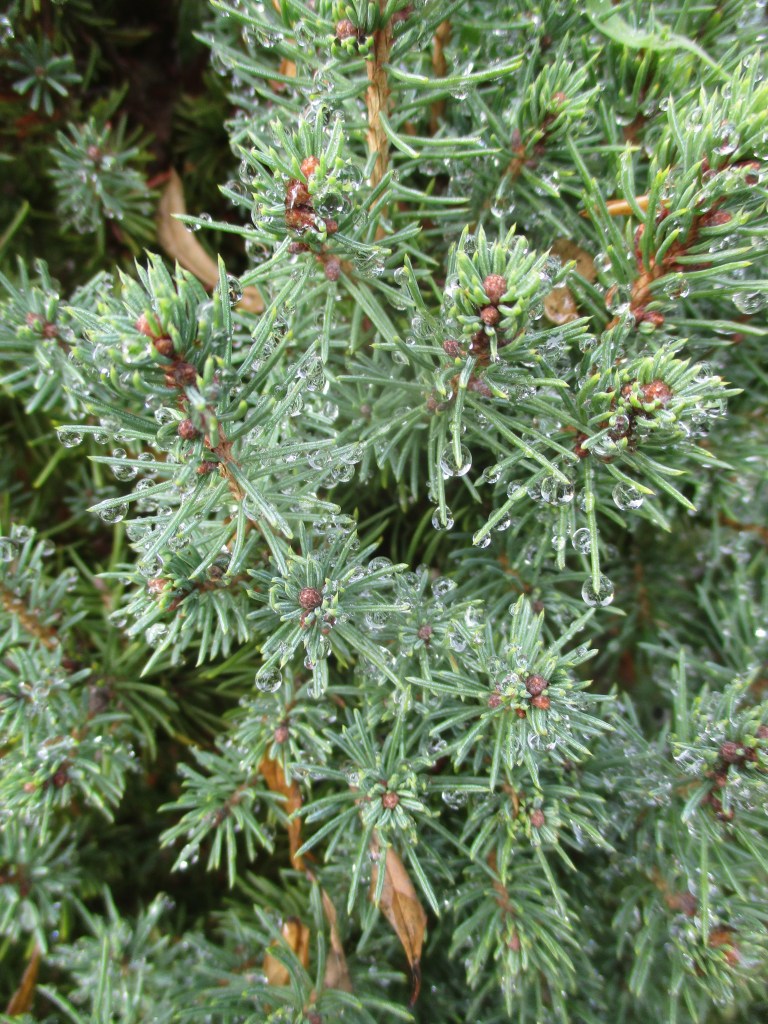
Sitka and Brewer spruce both live at low elevations and near the coast within their native ranges. Yet, neither perform as well here as blue spruce, Picea pungens, which is native to much higher inland regions of the Rocky Mountains. It grows neither as big nor as fast here as in the wild, so few old local trees are taller than thirty feet, or broader than twenty.
Although compact, blue spruce should get sufficient space to develop its densely conical form without pruning for confinement or clearance. Such pruning is disfiguring. Since the evergreen canopy is so dense, it should retain low branches to the ground for as long as possible. Blue spruce works more like big and formal shrubbery than like compact trees.
Some cultivars of blue spruce are very stout and rounded. Most have remarkably blue or silvery color. Seed grown trees (which are not cultivars) are sometimes available online. They have potential to exhibit notable variation. Some might develop slightly more open canopies, with elegantly upwardly curved limbs. Spruce needles are about an inch long with quite a prickly texture.
Evergreen plants retain foliage throughout the year. Deciduous plants defoliate for part of the year. That is the simplest explanation. The various reasons for shedding or retaining foliage are not so simple. Annual plants die after their single growing seasons. They can not live long enough to be either evergreen or deciduous. Some plants just may be both.
Foliar color, to some extent, conforms to preferable environments. Monterey cypress and Monterey pine have richly deep green foliage. It maximizes absorption of sunlight within the foggy coastal regions that the trees inhabit. Blue spruce has glaucous bluish foliage. It reflects a bit of sunlight to protect from sun scald within severe high mountain climates.
Similarly, deciduous plants generally defoliate for environmental situations. Most go bare for winter, in order to be less susceptible to damage from wind and snow. Bare stems do not collect as much heavy snow as foliated growth. They are also less resistant to wintry winds. If foliated, they are more likely to succumb to wind or overburdening snow weight.
Evergreen plants may retain their foliage because they are from climates in which winter weather is not so harsh. Wind may be no more extreme than it is in other seasons. Snow may never occur. Plants from tropical regions may be unfamiliar with colder weather and shorter daylength associated with winter. Their evergreen foliage might function all year.
Some tropical plants that are evergreen within their native environments may defoliate or die back as a result of even mild frost. Some recover as if deciduous. (Those that can not survive local climate conditions are not very popular here.) For example, canna die back to the ground after frost, but regenerate later. In tropical climates, they can be evergreen.
Evergreen species from mountainous regions or extreme northern latitudes are generally uncommon here. They prefer harsher weather. Although evergreen, they are remarkably resilient to wind and snow in the wild. They are likely evergreen to always stay receptive to limited sunlight whenever it is available, though wintry weather is possible at any time.
By ‘big trees’, I don’t mean the various ficus trees that can grow up to the ceiling, and be quite happy inside. I am referring to the shade trees that live out in the yard, or forest trees that live beyond that. They are outside for a reason . . . or actually, several reasons. They are too big to bring inside. They probably would not like the climate inside. No one wants to rake fallen autumn leaves inside. Well, you get the point. Unfortunately, on rare occasion, big trees that are outside end up partly inside by falling or dropping limbs onto the homes that they provide shade for. Just like trees seem to fall onto certain types of cars more than others ( tonytomeo.com/2018/11/04/trees-hate-cars ), trees seem to fall onto certain types of homes more than others. The difference between the homes that trees seem to dislike and…
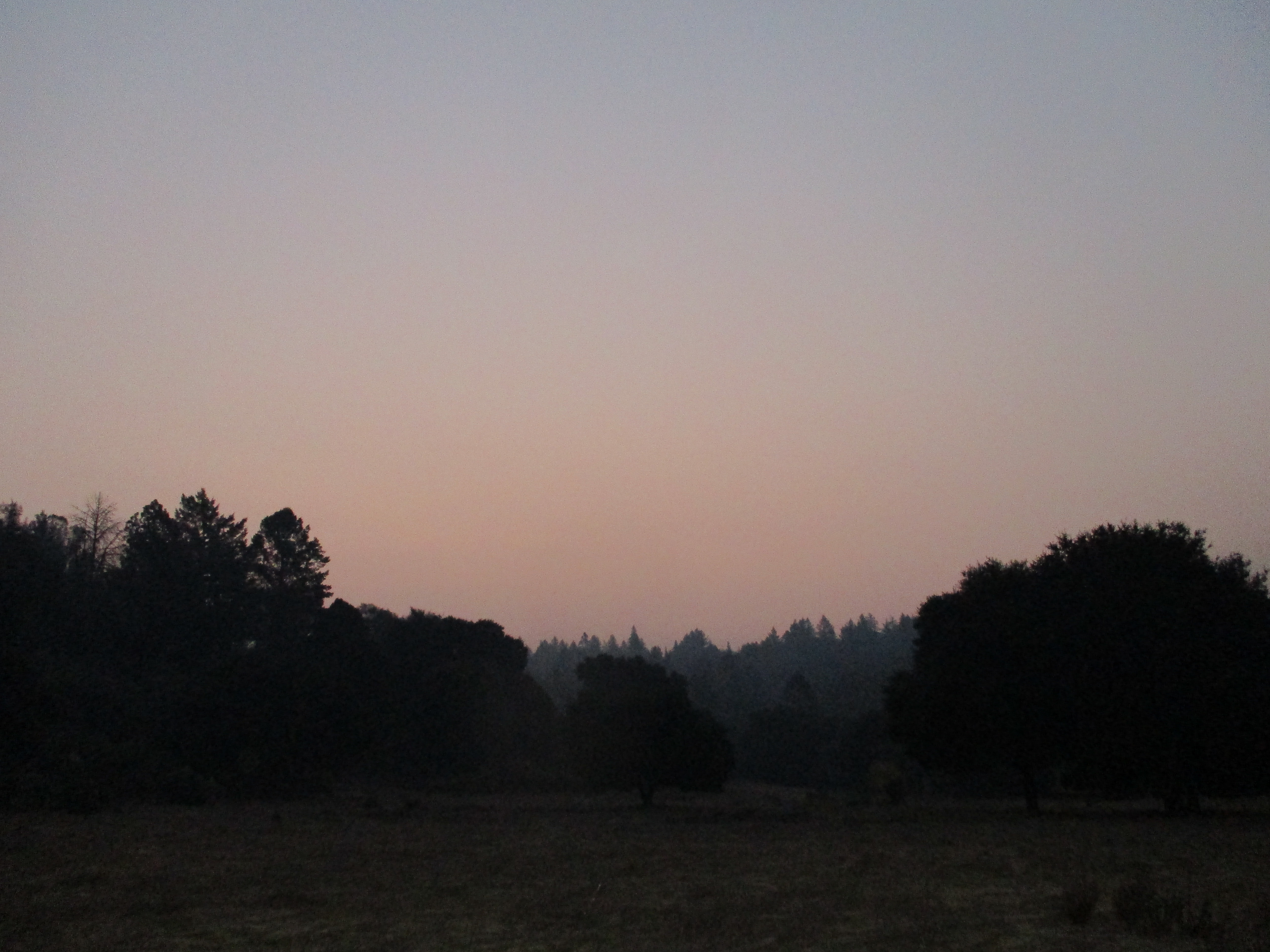
Fire has always been a part of life in most of California. That is why almost all native flora benefits from it, and has developed an efficient system and schedule for not only living with it, but exploiting it.
Within a few years after a fire, the pioneer species are the first to regenerate. They are aggressive, but short lived. Some are annuals. Others are trees that grow fast and then die out as the slower growing but longer lived trees dominate. Some of the longer lived trees might have been there all along, since they have developed ways of surviving fire. Big valley oaks and coast live oaks that live out in the open away from other forest trees can survive for centuries because the grasses around them burn off fast and relatively harmlessly. Giant redwoods and some pines survive by standing high above the more combustible fuel below…
With only one exception (#6), everything that I added to my downtown planter box was recycled from somewhere else. Almost all of that which I added came from the garden of the mother of a now deceased old friend, so has major history with me. The original cuttings rode around for more than a month on the dashboard of the old station wagon prior to getting plugged. Yet, I do not know many of their names. Only #5 inhabited the planter box before I got there. Nowadays, bits and pieces generated from occasional grooming of the planter box get recycled elsewhere. Many are shared with neighbors.
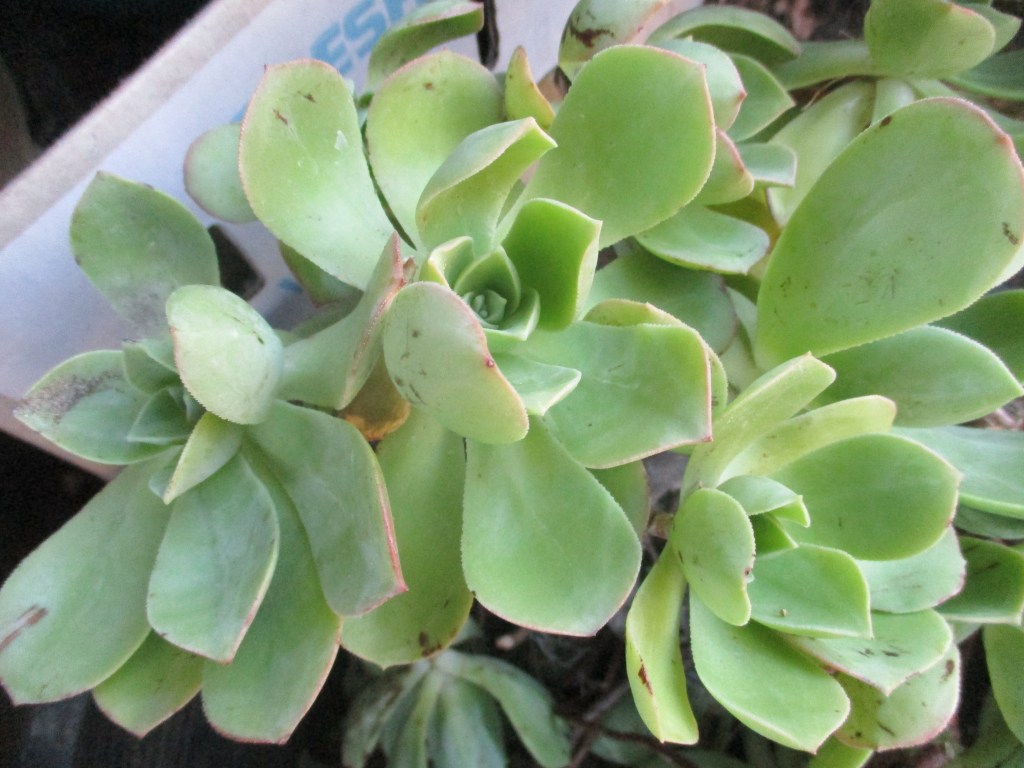
1. Tree houseleek grew almost as big as small tumbleweeds. Except for two Indian hawthorn trees that were installed when the planter boxes were built, they are the most prominent features.
2. Unknown succulent resembles tree houseleek, but stays much lower. A neighbor requested ‘Australia’ canna (#6) because this and tree houseleek produce so much pallid light green foliage.
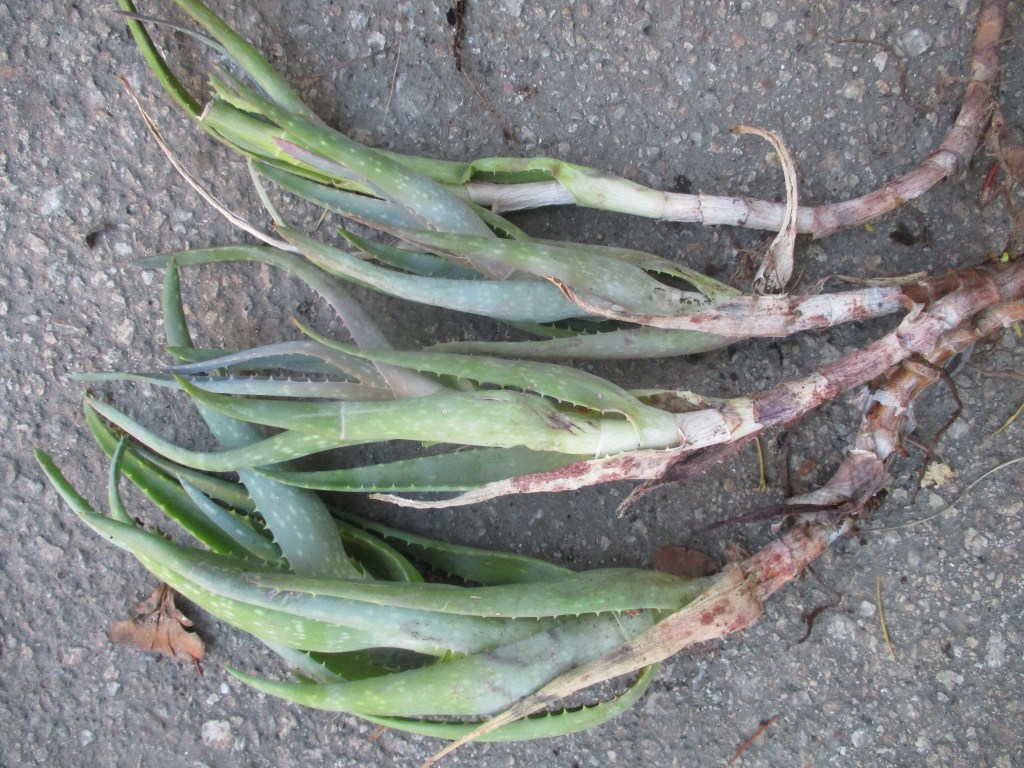
3. Unknown Aloe is more appealing in the planter box than these shriveled cuttings are. I think that it might be more appealing if it bloomed. After a few years, I have not seen a single flower.
4. Unknown bearded is not a good choice for a planter box downtown. It blooms only once annually, and the few flowers get picked. They are slightly grayish white, so are not even very pretty.
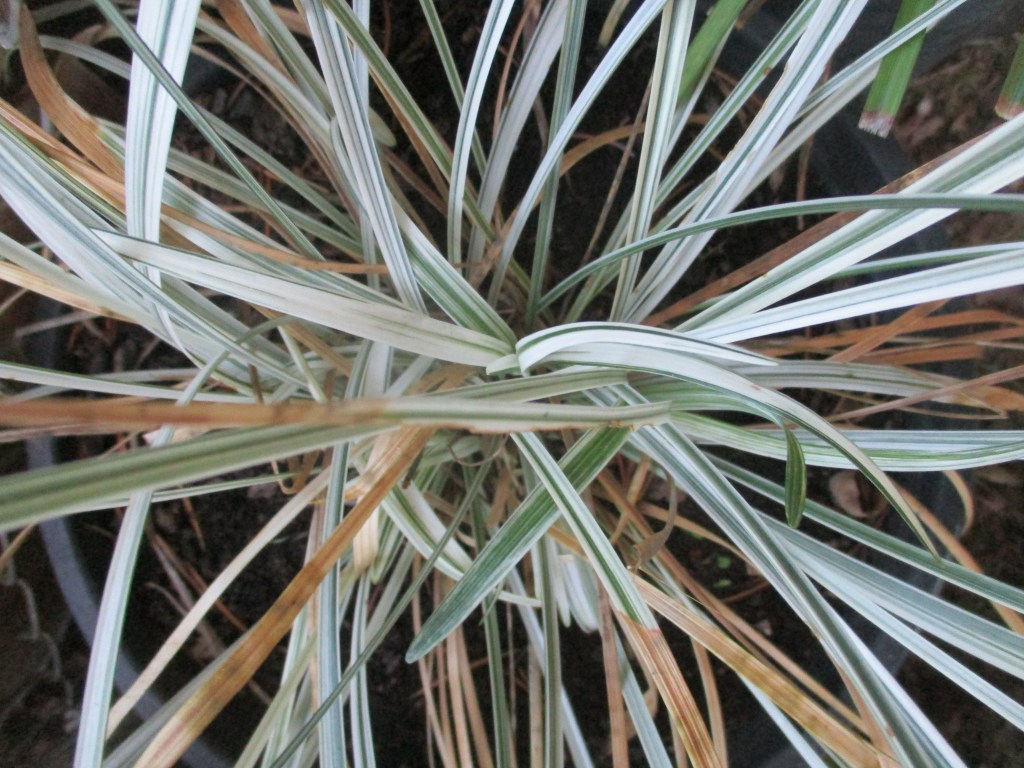
5. Variegated lily turf is one of the few plants that was already in the planter box when I go to it. Some of it reverted to unvariegated, and became even more invasive, and then more abundant.
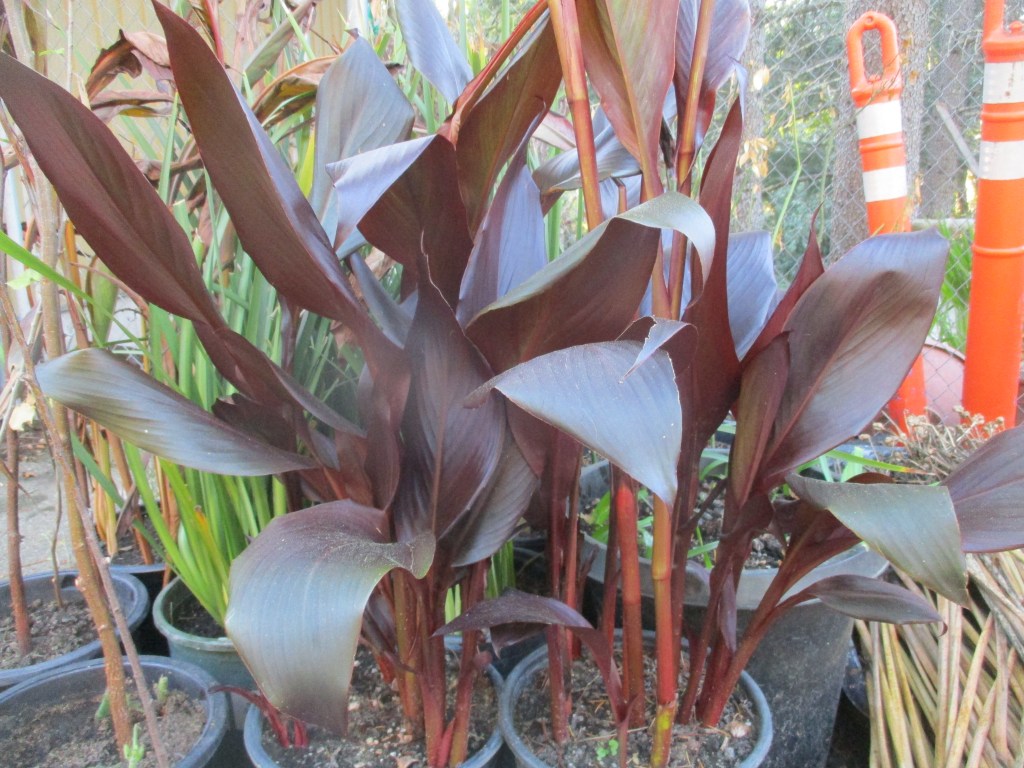
6. ‘Australia’ canna is the only item that I actually purchased for the planter box. I got it because a neighboring merchant expressed an appreciation for bronzed foliage. It does not disappoint!
This is the link for Six on Saturday, for anyone else who would like to participate:
Most coral bells are grown for their colorful foliage.
From Santa Barbara to Vancouver, and also in central Idaho, the humble native coral bells, Heuchera micrantha, is not much to look at, with compact rosettes of relatively small and bronzy rounded leaves with weird tomentum (hairs). In spring and early summer, and sometimes again in autumn, sparse trusses of minute brick red flowers hover about a foot above on wiry and slightly fuzzy stems. Old plants that get bare in the middle can be divided into several small plants in spring or autumn.
Modern cultivars are considerably more interesting, with more substantial foliage in various shades of green, gold, tan, brown, bronze and purplish bronze. The larger and variably lobed leaves can be two inches wide or slightly wider. The flowers stand as much as two feet high, but lack color. Most are pale greenish white. ‘Palace Purple’ has deep bronze or almost purplish foliage. ‘Ruffles’ has deeply lobed and ruffled green leaves. Unlike undemanding wild plants that can grow in cracks in exposed stone, modern cultivars like rich soil. Harsh exposure can scorch foliage, so a bit of partial shade is preferred.
Many coral bells have delightful bloom as an added bonus to their foliage.
Where frost is not a major concern, old canna foliage can be cut back as new growth develops.
Here on the west coast, autumn and winter weather is so mild that the native coral bells are already starting to develop new foliage on top of the old foliage from this last year. Technically, they are evergreen, so the old foliage does not need to be shed; but if it is not too much to ask, some types look better with a bit of grooming.
Other perennial plants that are from climates with stronger seasons and colder winters are not quite so evergreen. Many shed all of their foliage and are completely bare for at least part of the winter. Only a few, like cyclamen, are at their best through autumn and winter.
Dried watsonia foliage should be removed now if it has not been removed already. It is not so easy to pluck off like gladiola foliage is, so it should be cut off with shears. Because new foliage for next year develops before the old foliage of this past year is completely brown, it is often necessary to cut the old a few inches above the ground in order to avoid damaging the new.
The so called ‘evergreen’ daylilies can be even messier. New foliage is rather delicate, so it is easily tattered by the removal of old foliage. The ‘deciduous’ types may seem to be less appealing because they are bare for part of autumn and winter, but are so much easier to groom by simply removing all of the deteriorating old foliage as soon as it separates easily from the roots.
Deteriorating flowers can be removed from cannas; but their lush foliage can stay until it starts to deteriorate later in winter. Even if it survives winter, it should eventually be cut to the ground as it gets replaced by new growth in spring.
The many different iris have many different personalities. Most should be groomed sometime between summer and late autumn, although Dutch iris were groomed much earlier. Bearded iris that do not get divided can be groomed simply by plucking off big old leaves to expose smaller new shoots below.
Some dahlias bloom until they get frosted. Most though, are already finished. They do not need to be cut back all at once, but can be cut back in phases as leaves and stems dry and turn brown.
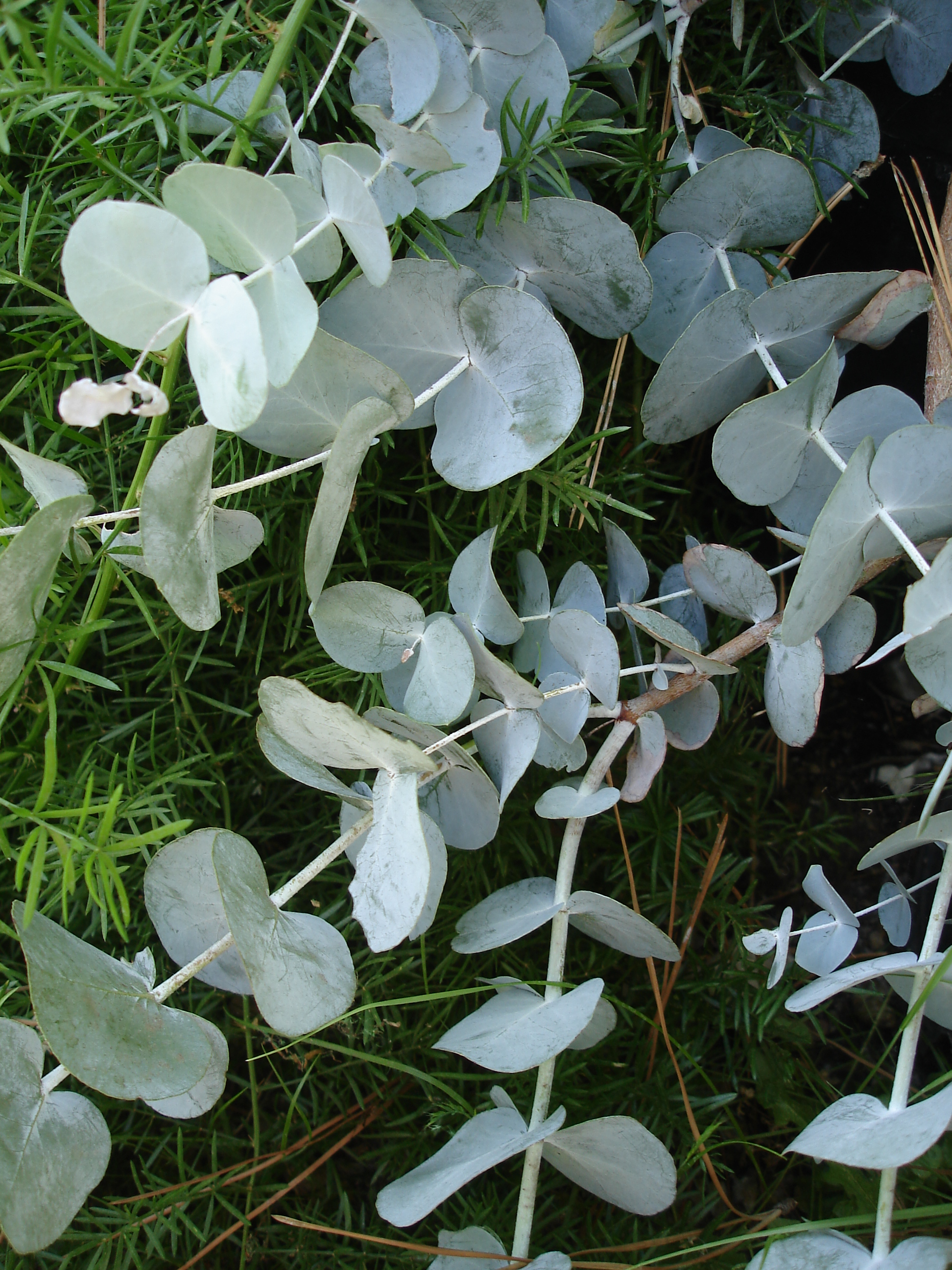
Yes, get over it! Regardless of the few junipers and eucalypti that have earned their bad reputation, there are many useful and practical junipers and eucalypti, as well as other plants with unjustified bad reputations.
Junipers have a bad name. So do eucalypti. Too many of the wrong types were planted back at a time when they were too trendy. Those that were planted into inappropriate situations grew up to cause problems. The names of all junipers and eucalypti are now synonymous with those problems, even though there are many types of both genera that are quite practical for landscape purposes.
Get over it.
There are many junipers and eucalypti that are very good options for some landscape purposes. They need only minimal watering once established, and many will survive with none at all when mature. Some types of juniper grow as very low and very dense ground cover. With proper pruning, others can develop as exquisitely sculptural shrubbery or even small trees. (Just do NOT shear them!) Because of their very complaisant roots, some of the smaller eucalypti work very well as street trees.
They start out simply enough, as weirdly twisted bare stems in fancy floral arrangements. By the time the last flowers fade, the submerged parts of these bare stems develop roots and perhaps leaves. These now rooted cuttings then graduate into pots or gardens. Most curly willow, Salix matsudana ‘Tortuosa’, is therefore unplanned. It is rare from nurseries.
Mature trees should not get much taller than fifteen feet, with awkwardly irregular branch structure. Regular pruning and grooming eliminates congested and structurally deficient growth. Alternatively, pollarding or coppicing during winter dormancy promotes vigorous growth. Healthy trees can drop overburdened limbs, and might live for only twenty years.
Curly willow, which is also corkscrew willow, is popular more for distinctively curly stems than as a small deciduous shade tree. Specimens that provide such stems for cutting do not need to be very big. If cut and dried while dormant during winter, stems can not grow roots in water. Nor will they require plucking to remove their leaves, which are also curly.

 There are many different types of horticulturists. We are all unique, both individually as well as collectively within our respective professional group classifications. For some of us, individuality interferes with conformity to the collective generalizations that are so commonly associated with our collective groups. For some of us, the stereotypes are a perfect fit.
 By ‘big trees’, I don’t mean the various ficus trees that can grow up to the ceiling, and be quite happy inside. I am referring to the shade trees that live out in the yard, or forest trees that live beyond that. They are outside for a reason . . . or actually, several reasons. They are too big to bring inside. They probably would not like the climate inside. No one wants to rake fallen autumn leaves inside. Well, you get the point.
 Fire has always been a part of life in most of California. That is why almost all native flora benefits from it, and has developed an efficient system and schedule for not only living with it, but exploiting it.



 Junipers have a bad name. So do eucalypti. Too many of the wrong types were planted back at a time when they were too trendy. Those that were planted into inappropriate situations grew up to cause problems. The names of all junipers and eucalypti are now synonymous with those problems, even though there are many types of both genera that are quite practical for landscape purposes.

