There are all sorts of philodendrons with all sorts of fancy names. Yet, the biggest and boldest lacks a common name (at least one that is actually ‘common’), and is most popularly known by a Latin name that is not even correct. The proper name for Philodendron selloum is really Philodendron bipinnatifidum. It is a big awkward plant with big and deeply lobed leaves on long petioles (leaf stalks), and weirdly thick aerial roots. Well exposed plants can stand on wobbly trunks. Partly shaded plants can creep along the ground, and prefer to grab onto and climb tree trunks, fences or anything that they can get a hold of. The aerial roots are harmless to trees, and generally too slow to catch a healthy cat, but will take paint off of walls. All parts of Philodendron selloum are toxic.
Cucumbers fill in between warm and season vegetables and cool season vegetables, so will finish prior to frost.
Tropical plants are clueless. They do not understand that autumn is just prior to winter, when the weather may get uncomfortably cool. Philodendron selloum continues to develop fresh new leaves that mature slowly in cool autumn weather, and may consequently lack resiliency to frost in winter. Vegetable plants and flowering annuals are not so ignorant, which is why so many that were productive through summer are nearly finished, and some are ready to relinquish their space to cool season counterparts.
Like the many warm season vegetables, most of the cool season vegetables should be grown from seed sown directly into the garden. Only those that produce efficiently from fewer but substantial plants, like broccoli, cauliflower, cabbage, Brussels sprout and some of the heading lettuces, can be grown practically from seedlings purchased in cell packs. Because individual plants produce only once, more can be added to the garden in phases every two to four weeks through the season to prolong production.
Chard, kale and collard greens can likewise be grown from cell pack seedlings if only a few plants to harvest as intact heads or large leaf greens are desired. However, a package of seed costs about as much as a single cell pack of only six seedlings, but contains enough seed for many more mature heads, as well as for abundant production of ‘baby’ greens plucked from many juvenile plants through the entire season. Those to be harvested as heads should be planted in phases with enough space to mature. Those that will get plucked through the season can be sown or planted once early in the season, and perhaps followed by a second phase if productions starts to diminish.
Root vegetables, such as beet, carrot, turnip and radish, really do not recover well from transplanting from cell packs. Individual cells are sometimes crowded with too many seedlings that must push away from each other as they mature. Otherwise, if not crowded, each cell contains only a few seedlings that are not nearly as practical as simply sown seed would be.
Although each individual root vegetable plant produces only once, they all mature at different rates, so most types can be sown in only one or two phases instead of several phases every two to four weeks. If the biggest get pulled first, the smaller ones continue to mature. They are less perishable than other vegetables, so any abundance is not likely to be wasted.
There are three practical ways to grow onions. They are most popularly grown from seed or from ‘baby’ onions known as onion sets. The third and sneakier way to grow them is from separated cell pack seedlings. Cell packs typically contain too many onion seedlings that would develop into crowded clumps anyway. There are often as many seedlings as could be grown from a package of seed!
Peas get sown as seed early in autumn to grow and produce before winter gets too cold. Another phase can be sown as winter ends for spring production.
Q: What do I spray on may medicinal marijuana plants to kill mealybug?
A: Roundup.
This solutions takes care of two problems at the same time; the mealybug infestation as well as the weed that it is growing on! Cutting the weed at the base and simply discarding it is just as effective and even more practical because it does not involve a toxic, environmentally controversial, and expensive chemical herbicide. The best option is to simply not grow weed in the first place.
I am a horticulturist. I love what I do. I love plants. However, I do not worship them. When I grew citrus trees back in the early 1990s, I happened to enjoy all sorts of rare and unusual citrus fruit that grew on the trees that we grew. However, there were no citrus themed clothing, jewelry, accessories, home furnishings or tattoos. There was no overly indulgent or…
Those who crave fall color in mild climates should appreciate Chinese pistache, Pistacia chinensis. It is happy to provide fiery yellow, orange and red color in response to a slight chill. Actually, it retains its colorful foliage later into the season with mild chill than it does with frosty weather. Rain eventually dislodges all of its deciduous foliage through winter.
Because it is so resilient to harsh situations, Chinese pistache is popular as a street tree. Pruning is necessary to establish adequate clearance of broad limbs over roadways and sidewalks. Since roots can be shallow with regular watering, root barriers should protect nearby pavement. However, established trees do not need regular watering, if any at all.
Old Chinese pistache trees, as well as those that grow wild from seed, are either male or female. Female trees produce tiny but annoyingly abundant fruit. Modern cultivars are all male, and therefore fruitless. They may get more than forty feet tall, with broad canopies. The pinnately compound leaves are just about eight inches long.
It seems appropriate to share this post from my other blog at Felton League. This little Memorial Tree has somehow become quite a celebrity. Those of us who are familiar with it are hoping for an efficient recover from recently incurred damage.
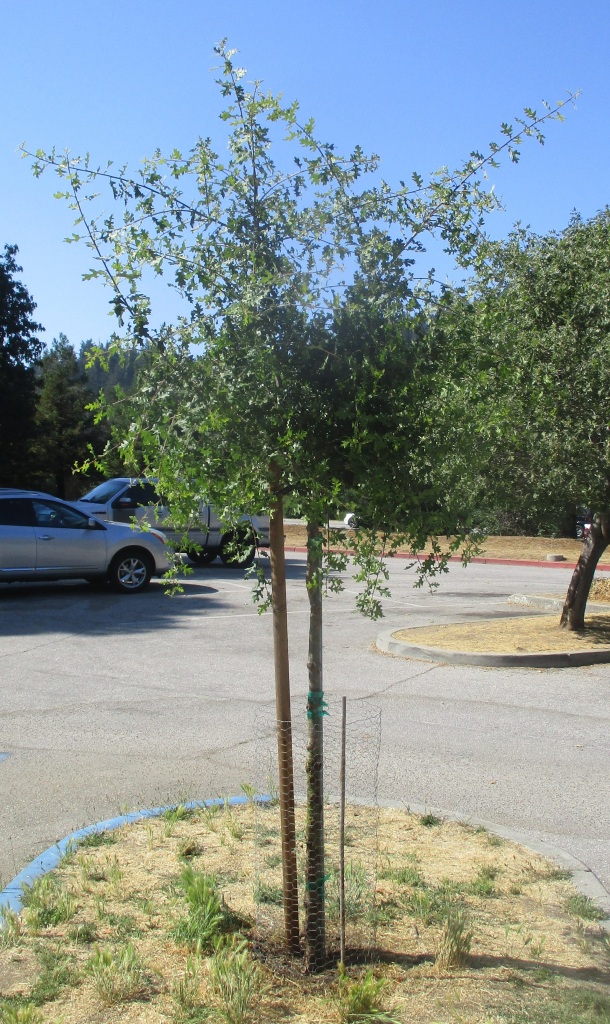
November 1, 2020, almost a year ago, was the last update for the resilient little Memorial Tree in Felton Covered Bridge Park. Since then, it began to develop a form that is more appropriate to the park parking lot that it inhabits, with a single straight trunk and a reasonably well structured canopy. (The illustration above is about three months old, from July 12, but the Tree has not grown much since then.)
Of course, the canopy will need to be pruned for continued structural development after it defoliates for winter. For now, lower growth remains somewhat obtrusive within the associated curbed parking lot island. This growth will be pruned up high enough so that no one must duck under it. As the tree matures, limbs that extend into the driveway beyond the curb must be higher than fourteen feet, so that they…
Autumn is also fall here. Actually, ‘fall’ is the more popular name. It had been the popular name in England during the Sixteenth Century. The (generally) French name of ‘autumn’ became more common there during the Seventeenth Century. Yet, both names remained in use in the American Colonies. That is why autumn foliar color is more simply fall color.
The natural fall color in New England, the Appalachian Mountains, the Rocky Mountains and the Great North Woods is famously exquisite. So many of the native deciduous trees develop remarkable fall color in response to local weather conditions. These same trees might not get sufficient chill to develop comparable fall color in milder climates of Florida.
In most regions of California, natural fall color is limited by the ability of native species to develop such color. Bigleaf maple and the various poplars turn bright yellow with a slight chill, but are not abundant. Even when chilled, the foliage of most other native deciduous trees simply shrivels and falls without much color. Most of the native trees are evergreen.
Therefore, most of the best local fall color is provided by exotic (nonnative) tree species. Such trees not only develop remarkable fall color, but do so in response to minimal chill. Sweetgum, flowering pear, Chinese pistache and ginkgo are four trees that most reliably develop brilliant fall color where winter weather is mild. None are native. All are popular.
Ginkgo turns brilliant yellow. The other three display various colors that range from bright yellow, to fiery orange, to rich red and burgundy. Their colorful foliage lingers longer than that of other deciduous trees. Sweetgum and flowering pear might retain fall color until it succumbs to rain in winter. Of course, these are not the only options for reliable fall color.
No tree is perfect. Although very colorful in autumn, sweetgum is notoriously structurally deficient, and produces obnoxiously spiked fruiting structures. Flowering pear is innately susceptible to fire blight. All deciduous trees drop leaves, which need raking. Trees must conform to their situational limitations, as well as their particular landscape applications.
The Third Day of Creation was when it all started. Plant life was created just two days after Heaven and Earth, and Night and Day. It must have been a pretty big deal. Humans were not created until three whole days later! After all this time since Creation, the flora of the World is still just as important as it has always been. Vegans can survive without the consumption of animal products, but no one can survive without the consumption of plants, or the consumption of animals who were sustained by plants. We breath oxygen generated by plants. We live in homes made of wood. We wear clothes made of cotton. Until relatively recent history, wood was the primary fuel for cooking and warmth through winter. Even modern fossil fuels that have replaced wood are derived partly from fossilized plants. There seems to be no end to the long list…
Goodness, I tend to forget about the trees that were there before. Three other Eastern redcedars of the original batch are still here and doing quite well. I still have no idea of what to do with them. I like junipers, but these junipers grow into trees!
The little Memorial Tree in Felton Covered Bridge park that I so frequently write about is not the first to be planted there in its parking lot island. It is actually the fourth! The first was a California black oak like the other four in the other islands. They were all planted with the original landscape. It did not live there long before getting run over by a car. The island was empty for many years.
The second tree (above) was an Eastern red cedar that I brought from Oklahoma. It arrived here very early in the morning on the last day of 2012, in a bag with a few others that I pulled out of the ground the day before we left. They may be nothing special within their native range, but they are very exotic to me. At the time, I had no plans for the small trees…
Of the fifty or so known species of Yucca, I formerly grew all but one. I still am not certain if the single species that I lacked, Yucca flexilis, is a real species or a synonym for another species. Of course, some species of Yucca might be considered to be subspecies of others. The genus is complicated. So is identification of its species. That is why I am not certain of the identity of the one Yucca that I got a picture of this week. Actually, only one of my Six, which live with the unidentified Yucca, are identified.
1. ‘Sedums, Dahlias and Hayfever’ might have something to say about this unappreciated mess. A neighbor left these for the gardens. I can identify only that ‘Angelina’ sedum. Oh, the shame!
2. Pups such as this could suggest that the associated primary rosette intends to bloom soon. If so, the pup will replace the original. I do not remember what species or cultivar of Agave this is.
3. This young pup appeared about six feet from its associated primary rosette, so is less likely to be an indication of impending bloom. I do not know the species or cultivar of this Agave either.
4. Agave attenuata is easier to identify. It has been here since December, but has not done much. I got a pup from it prior to planting. Later, another rosette was acquired from another source.
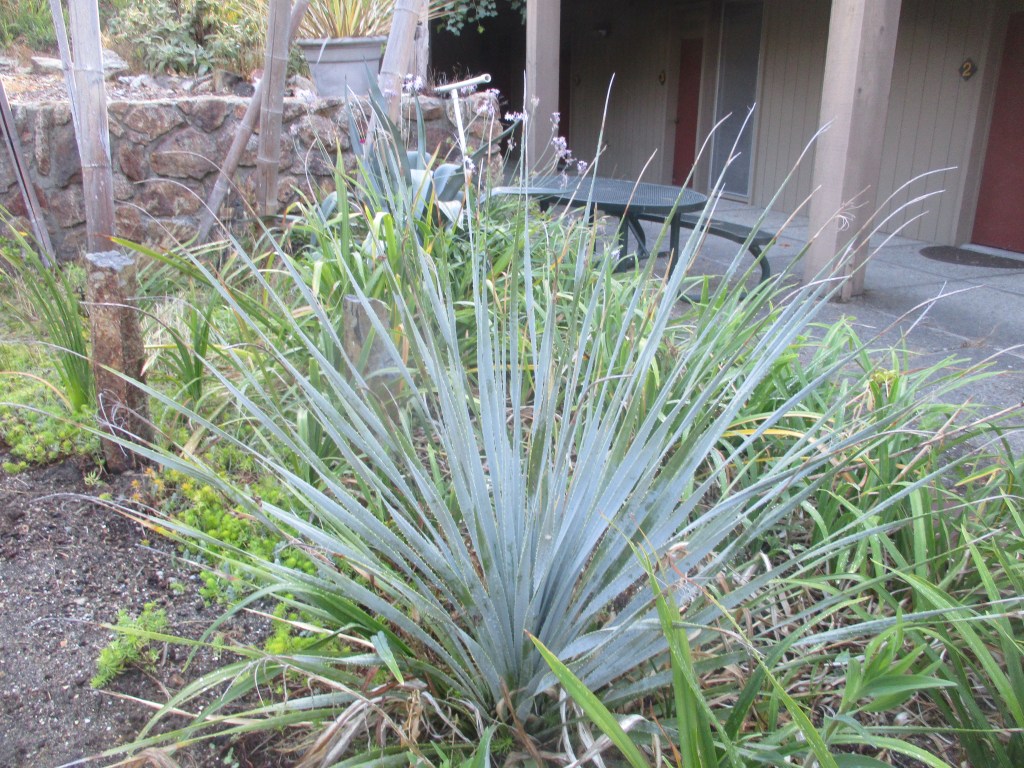
5. This might be Dasylirion wheeleri. I am rather certain of the genus, but not so certain of the species. Those little teeth on the foliar margins remind me that I do not want to weed around it.
6. Could this be Yucca whipplei? Its foliage certainly suggests that it is. However, the common sort should not develop such crowded rosettes. It could be a more densely clumping subspecies.
This is the link for Six on Saturday, for anyone else who would like to participate:
With such a weird name, beard tongue is probably less commonly known by its common name than by the Latin name of Penstemon. Of the thousands of cultivars (cultivated varieties) that have been developed over the decades, most of those that are popular for home gardens are known as cultivars of Penstemon gloxinioides, even though their actual lineage is generally unknown. In recent years, other species have become more available.
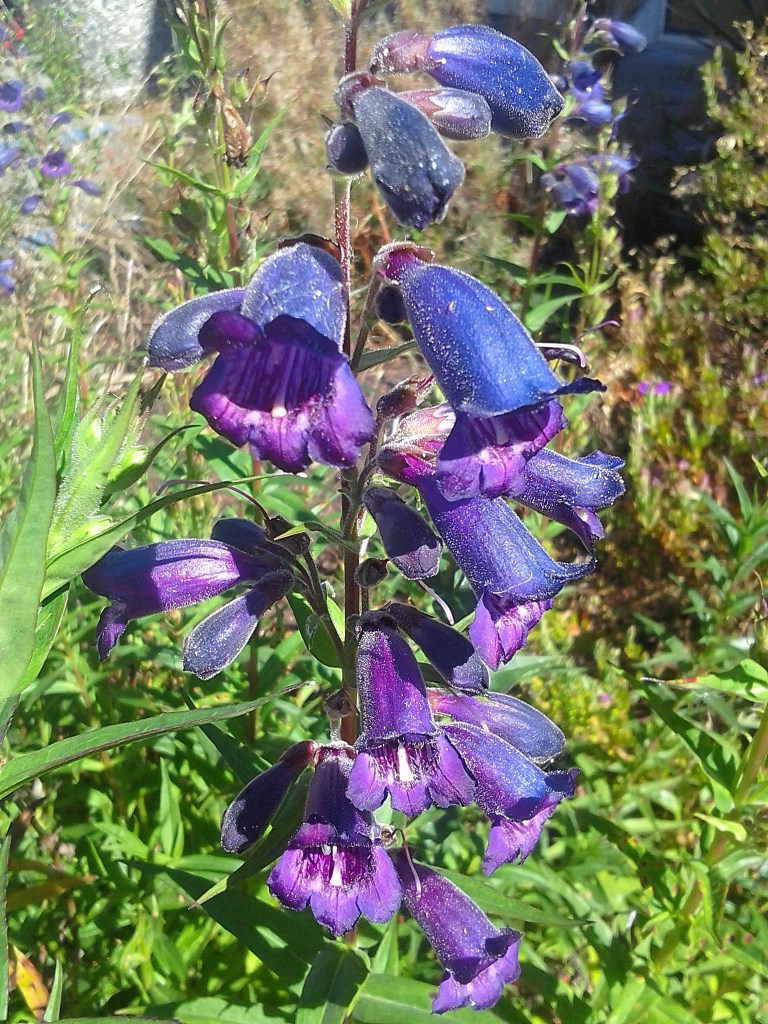
Spikes of red, pink, purple or white flowers stand vertically above the foliage. Yellow flowers are still rather rare. Individual flowers are bisymmetrically tubular, with two conspicuous lips and a fuzzy tongue. Some beard tongue have relatively wide leaves and plump flowers, like really big snapdragons. Others have narrow leaves and thin flowers. Mature plants get only 1 to 2½ feet high and a bit wider, although some of the rare specie can get significantly larger.


 Q: What do I spray on may medicinal marijuana plants to kill mealybug?

 The Third Day of Creation was when it all started. Plant life was created just two days after Heaven and Earth, and Night and Day. It must have been a pretty big deal. Humans were not created until three whole days later!
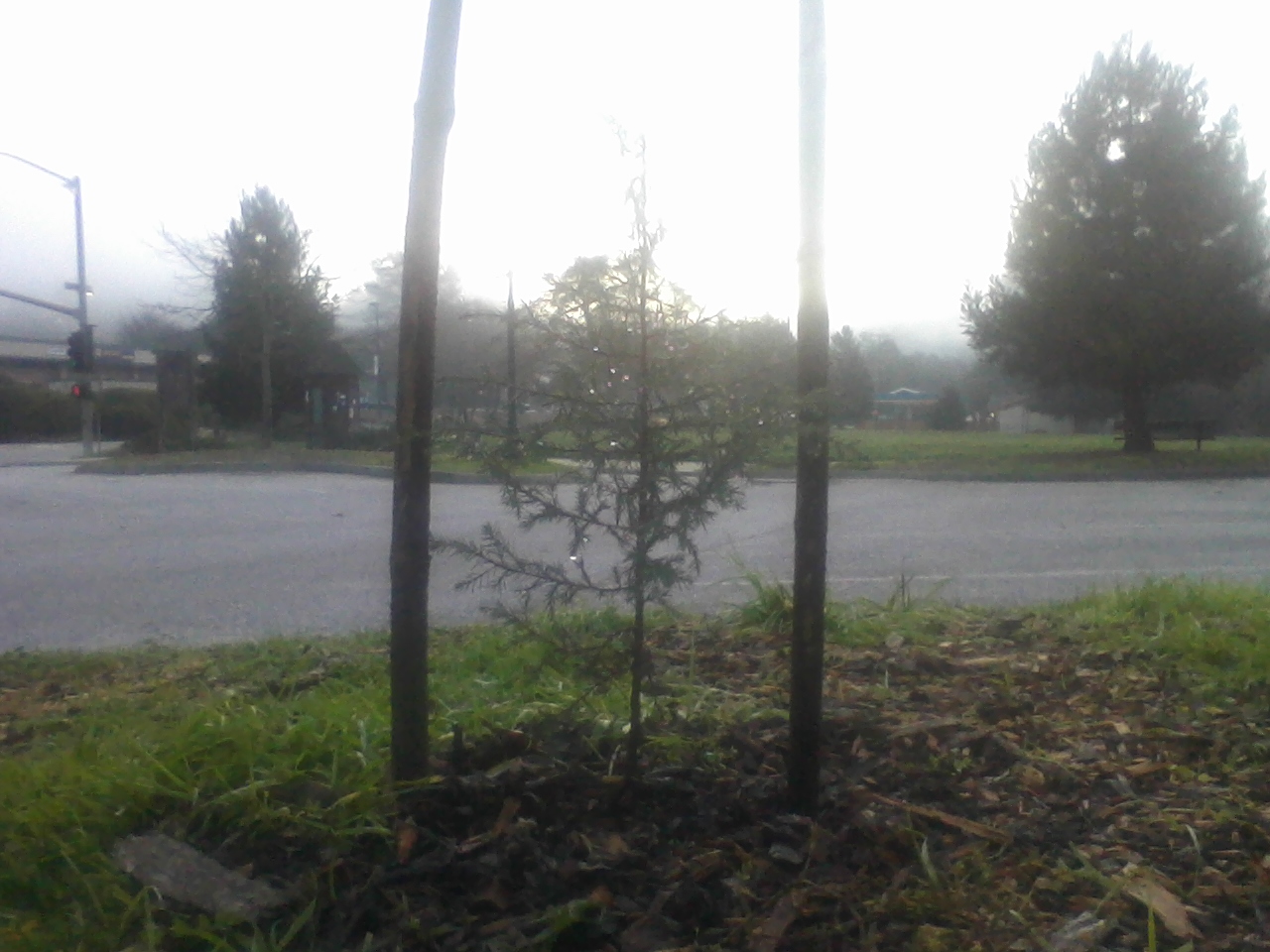 The little Memorial Tree in Felton Covered Bridge park that I so frequently write about is not the first to be planted there in its parking lot island. It is actually the fourth! The first was a California black oak like the other four in the other islands. They were all planted with the original landscape. It did not live there long before getting run over by a car. The island was empty for many years.