Finally! A White Cymbidium!

P00503-1
This is what a simple white Cymbidium orchid should look like.

Cymbidium orchids have been popular here for as long as I can remember. Back when horticultural commodities were still more commonly grown around the San Francisco Bay area, many genera of orchids, particularly Cymbidium, were grown in acres of greenhouses in the hills of South San Francisco. They are still grown near the coast of San Mateo and Santa Cruz Counties.

In home gardens, they are often pampered under the shelter of lath, where they are protected from frost and direct exposure to sunlight. Some Cymbidium orchids live and bloom for many years or decades, and sometimes get divided into more as they get overgrown, just like lily-of-the-Nile. Some live longer than those who originally grew them, and go live with someone else.

I never pampered my Cymbidium orchids. I grew all of them out in the garden, with only a bit of partial shade from larger trees. I never once potted any of them into the coarse fir bark that Cymbidium orchids supposedly need. I grew most in dirty and uncomposted oak leaves. I put some in rotting stumps to accelerate the rot. They were happy, and bloomed remarkably well.

None of mine were purchased. They were all acquired from neighbors, clients or colleagues. Of the many Cymbidium orchids that I have grown, none were white! Yes, I wanted a white one. I just do not admit to it.

After maintaining it for more than a decade, and bringing it from a former home hundreds of miles away, a colleague brought me this Cymbidium orchid. Although I did not want him to pass it along after so many years, I was pleased to take it, particularly since it blooms white. Then, it started to bloom, immediately after arrival! Ah, if only there were more people here to see it!

P00503-2
I do not know why the individual flowers are so huddled together.

Steven Michael Ralls Memorial Tree

P00502K
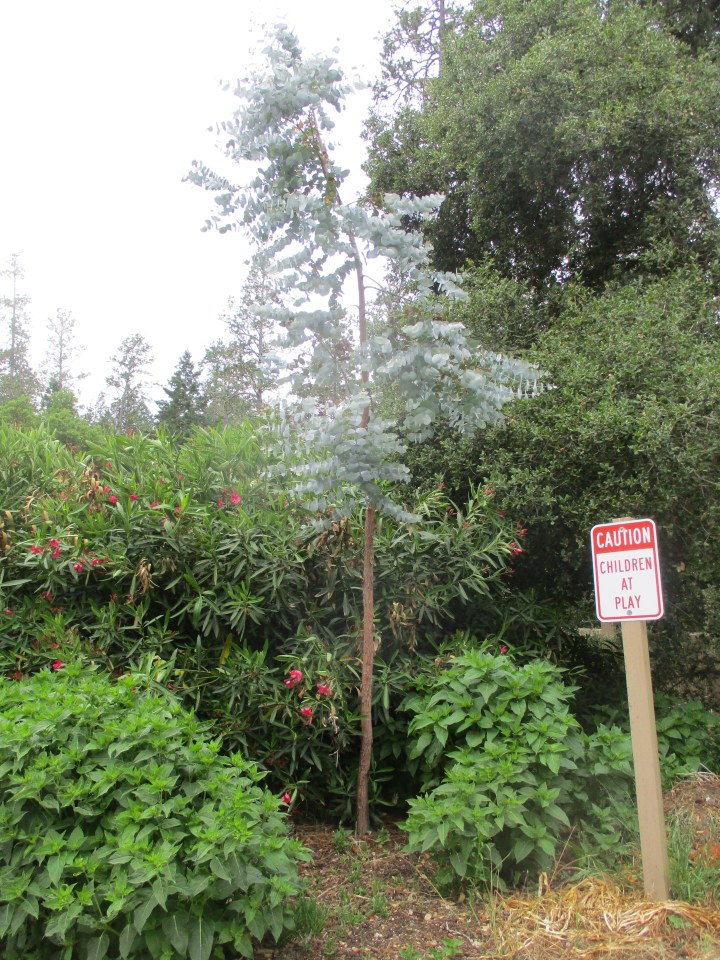
Steven Michael Ralls Memorial Tree is mostly camouflaged by the surrounding forest.

Steven Michael Ralls got his Memorial Tree this morning, three years after he passed away on May 2, 2017. The circumstances that coincided for this event were impossible to ignore. Just like the other Memorial Tree, which was installed to replace an oak that was missing from a parking lot island, the Steven Michael Ralls Memorial Tree also has a practical application.

The small tree is a young Monterey Cypress, Cupressus macrocarpa, that needed to be removed from one landscape, and was waiting in the recovery nursery to be installed into another. Of course, a Monterey cypress in no easy tree to accommodate. It is too big and too dark to be compatible with most of the landscapes into which we add smaller and mostly deciduous trees.

However, it happens to be ideal for obscuring undesirable scenery, just like a row of five Arizona cypress, Cupressus arizonica, will be expected to do when installed along a busy roadway. Furthermore, it just happens to grow bigger faster than Arizona cypress, so is even better for the low end of the row where a bigger tree is preferred. The row really needs six trees anyway.

The location of the tree just happens to be ideal as well. With all Arizona cypress spaced evenly along the roadway, and the Steven Michael Ralls Memorial Tree strategically situated around the lower corner of the fence, it is located precisely where Steven Michael Ralls camped while homeless late in 2012. I could not have selected a more appropriate location if I had planned it.

The new tree will need to be watered by bucket occasionally through summer, but will need no intervention after the rain starts next autumn. It knows what it needs to do to get established and become an evergreen asset to the forest.

FP00426
It was easier to see before it was planted.

Six on Saturday: Self Isolation


Self isolation was not exactly why I avoided the landscapes. Since there are very few people here, I can get all the pictures I want without getting too close to anyone. Nor did I intentionally avoid the landscapes because, as I mentioned earlier, it is too saddening to see them looking so good without anyone here to enjoy them. I was just too busy to get out. These six pictures are instead from the recovery nursery. These are items that should eventually be out in the landscapes. Some should have bee there a long time ago.

1. Jasminum humile, Italian jasmine was grown from pruning scraps from a big shrubby specimen in Monterey. It does not look like much so far, but is extremely fragrant, like pink jasmine.P00502-1

2. Solanum jasminoides, potato vine was left by someone who moved away, but has not yet been planted into a landscape. It is overgrown now, so will need to be pruned back when planted.P00502-2

3. Mimulus aurantiacus, sticky monkey flower got removed from where it was in the way of something else, got canned, and now waits to be recycled elsewhere. I should have composted it.P00502-3

4. Cistus x argenteus, rockrose was actually purchased rather than recycled or grown here. It was for a small new landscape that can not be completed right now. This might be ‘Silver Pink’.P00502-4

5. Pelargonium peltatum, ivy geranium provided cuttings when pruned a month ago. It might be ‘Royal Candy Cane’. They should have been planted intact, but there is not enough of them.P00502-5

6. Leucanthemum × superbum, Shasta daisy, like sticky monkey flower, was removed from an area that was outfitted with a new landscape, but not yet recycled. I really should just plant it.P00502-6

This is the link for Six on Saturday, for anyone else who would like to participate:

https://thepropagatorblog.wordpress.com/2017/09/18/six-on-saturday-a-participant-guide/

silver dollar gum

50429

There are actually a few different eucalypti known as silver dollar gum. The most familiar and largest is Eucalyptus polyanthemos. Mature trees that were popularly planted through the 1960s are about forty or fifty feet tall. Some stay smaller. A few that compete with taller trees are more than sixty feet tall. Trunks and limbs are somewhat sculptural, with fibrous bark.

Grayish foliage on limber stems forms a billowy and rounded canopy that blows softly in the breeze. Juvenile leaves are nearly circular, and more silvery gray than adult foliage is, like silver dollars. Ovate adult leaves are about three inches long and half as wide. Tiny flowers with prominent white stamens bloom amongst the adult foliage in spring and summer.

Smaller trees are often pruned aggressively or pollarded so that they continually produce the more desirable juvenile foliage without bloom. The problem with this technique is that it must be repeated every few years or even annually. Otherwise, vigorous secondary growth can get too heavy and break away.

Eucalypti Are Innately Drought Tolerant

50429thumb
Distinctive foliage provided by red ironbark.

Drought is nothing new here. There could be plenty of rain next winter and for years afterward; but eventually, there will be another series of dry winters, prompting rationing all over again. Landscapers and big box garden centers continue with business as usual. It is up to us to manage our gardens responsibly. Besides native plants, aloes, yuccas, junipers and eucalypti are four groups of formerly popular, drought tolerant plants that are worthy of more attention again.

Eucalypti had gotten a bad reputation even before they became popular the last time around. Tasmanian blue gum, Eucalyptus globulus, that was planted so extensively for wood pulp and timber throughout California, is a huge and extremely messy tree. Yet, it is still the most familiar of the eucalypti.

Garden varieties of eucalypti are much more docile. Even though they drop their evergreen foliage and hard seed capsules throughout the year, they do so on a smaller scale. The tall and elegant lemon gum constantly sheds strips of bark like the Tasmanian blue gum does, but does not get big enough to be too overwhelming.

Because they are so undemanding, and some are somewhat messy, eucalypti are best in unrefined parts of the landscape, and away from lawn. Their mess is no problem over ivy or iceplant. They are happiest where other trees might be unhappy. Generous watering actually inhibits root dispersion, and can cause vigorous but structurally deficient stem growth.

Eucalypti innately prefer to be planted while very young, even from four inch or one gallon (#1) pots. Larger (and more expensive) trees, such as boxed trees, take so long to get established that they get passed up by faster growing tiny (and less expensive) trees. Because they are sensitive to confinement, eucalypti are unfortunately rare in nurseries.

The online catalog of Annie’s Annuals and Perennials, which is famous for excellently weird and undemanding plants, features lemon flowered mallee, red capped gum, silver princess gum, bell fruited mallee and fuchsia gum, all in four inch pots. The bell fruited mallee and fuchsia gum are like large but airy shrubbery that do not get much taller than the eaves.

Horridculture – Fences

P00429
This is not exactly visually appealing.

Fences are necessary. They contain children, dogs and minor livestock. They exclude deer, cattle and others who are unwanted within an enclosed space. Some obscure unwanted scenery. However, even the more ornate sorts are more functional than aesthetically appealing.

That is why hedges are popularly grown to obscure fences that obscure outside scenery. Climbing vines take up less space than hedges, but are likely to damage the fences that they are intended to obscure.

Where I lived in town, the garden in back was surrounded by fences. I loathed them. I grew a grapevine on one. Another one was outfitted with a trellis of twine for pole beans to climb. Tall zonal geraniums obscured at least the lower half of the fence behind the laundry yard. I would have preferred no fences at all.

There were no children or dogs to contain. Nor were there cattle or deer to exclude. Except for the laundry and trash yards, there was no unwanted scenery to obscure. Nonetheless, the neighbors wanted fences, probably because they all believed that backyards should be fenced. It was just how it had always been.

Some urban fences are more like high and solidly constructed walls. Batons cover the seams between planks. Where local ordinance limits the height of fences, lattice is commonly added on top to (sort of) lawfully increase height. It is difficult to grow much on the shady north side of such tall fences.

I am fortunate that I do not work with many fences anymore. However, an area at work is surrounded by cyclone fences. It is necessary and practical, but would be very unappealing around landscape situations. I put pole beans on one, and two grape vines on another. If I must contend with them, I may as well take advantage of them.

Forget-Me-Not

00506
Blue like this is worth remembering.

Alaska, the biggest state in America, claims one of the most diminutive state flowers; their native alpine forget-me-not, Myosotis alpestris. Common woodland forget-me-not, Myosotis sylvatica, is the more familiar species here. It is not as common as the name implies though. Where naturalized, it stays within riparian or coastal situations, where the soil does not stay too dry for too long.

Forget-me-not is not notably popular in home gardens nowadays either. Of course, that only means that it is not often planted intentionally. Like violets and alyssum, it can proliferate where it gets a bit of water. Those who recognize it as more than a weed often leave it to provide delightful sky blue bloom until it succumbs to the warmth of summer. It is pleased to toss seed for the next year.

Common woodland forget-me-not is an annual, or at most, a biennial. Self sown seed starts to germinate through autumn, and grows into plants that can bloom before the end of winter. Manually sown seed wants to be in the garden early too, even if it grows slowly. New plants are too delicate to be commonly available in nurseries. Mature plants are less than a foot tall and two feet broad.

Blue Is The Loneliest Color

00506thumb
Colorado has a blue State Flower.

The majority of common pollinators are not impressed with blue. Otherwise, more flowers would be blue. After all, floral color appeals to pollinators. Each type of pollinator prefers specific colors. Plants customize their floral color to their preferred pollinators. If more flowers could attract more pollinators with blue, they would do so. Instead, they rely on colors that have worked well for them.

Green is actually the most common floral color. It is not obviously common because green flowers are generally ignored. They are the sort that rely on wind for pollination, so make little or no effort to draw attention. They are also the sort that produce the most and worst pollen, which gets carried farthest by the wind. Flowers that rely on pollinators produce coarser pollen that clings to things.

Of the many other colors that appeal to pollinators, most are significantly more complex than they appear. For example, what appears to be simple orange may appeal to pollinators that perceive it to be yellow, as well as those that are drawn to red, even if none are interested in orange. Different pollinators perceive different color ranges. Insects do not perceive red; but hummingbirds do.

That certainly could not explain why blue is such an uncommon color for flowers. It surely has more of a following than red, which is more common among flowers. Since most pollinators perceive blue, more flowers should utilize it. They could even add some ultraviolet or infrared to it, if that would make it more appealing. Nonetheless, true blue, without the influence of purple, is quite rare.

Lily-of-the-Nile and blue dawn flower are some of the more substantial species that provide exquisitely blue bloom. A few cultivars of butterfly bush bloom true blue too, but the color is not so clear and bright. Delphinium, bellflower, squill and grape hyacinth are smaller, but worthy perennials for the richest blues. Petunias, lobelia, nigella, cornflower and columbine are blue blooming annuals.

Many iris, sage and lupine provide exquisitely true blue bloom as well.

Lineup

P00426
The usual suspects.

There is significant traffic right outside. It is one of the three busiest roads around. No one here really minds, because we are mostly too busy with something else while we are here. We are accustomed to it as part of the ‘scenery’. The noise sometimes makes it necessary to shout to each other, or take a telephone call somewhere else, but is not too much of a bother otherwise.

However, the scenery that those in the traffic see from the road might be slightly less than appealing. Industrial buildings surrounded by pavement, building materials, work vehicles and all sorts of associated items are all that are in here. Next door, there is a herd of dumpsters! It is a view worth obscuring. Bay trees and box elders that used to screen the view are too tall now.

I should have planted these five Arizona cypress in a row along the road last autumn. If I were to plant them now, I will need to water them occasionally until next autumn, not that I would mind. After their first winter, they would be happy on their own. They would start to obscure the view within only a few years, and unlike box elders, would stay evergreen through winter.

They really should have been planted a long time ago. They have been in the same cans for so long that the medium within has decomposed and collapsed. Without staking, their lean trunks became disfigured in confinement. They really would not have needed to be staked if they had been planted sooner and been able to grow more vigorously. Fortunately, they should recover.

A Monterey cypress will be planted at the low end of the row next Saturday, even if these Arizona cypress are not planted until autumn. I will explain later.

Wheat

P00425K
It is not as bad as it looks.

No, this is not wheat. It is the larger of the two Mexican fan palms that I dug and canned more than a week ago. ‘Wheat’ refers to the unpleasant phase that it is now going through. It is a long and awkward story about how it became known as the ‘wheat’ phase. All that anyone should know is that it refers to the color of the fading foliage. It fades from green to golden brown, just like ‘wheat’.

I say that the explanation is awkward because it involves an old skit by an offensive comedian on HBO in 1986, when the renowned landscape designer, Brent Green, was my college roommate.

Yes, we will just leave it at that.

Anyway, this is not at all unexpected. It is a normal process. I just wish it could be avoided. Every time I dig and can a palm, I hope that it will not happen; and I actually engage the associated palm as if it will somehow be different from the rest, and maintain all of its healthy green foliage. Some get through it more efficiently. Some start to produce new foliage before their old foliage dies off.

I actually relocated a mature windmill palm that somehow maintained the upper half of its canopy until it started to produce new foliage. That was all the fronds that were above a right angle to the trunk! I was impressed by that one. It was very different though. Most of the roots had already been damaged prior to relocation. Also, it was relocated in autumn, so had all winter to start recovery.

This unfortunate palm was dug not very long ago, just as the cool and rainy weather of winter was ending. Now that the weather is suddenly warming to around 80 degrees, the foliage is resuming vascular activity that the severed roots can not sustain. To compensate, it will shed this foliage that is now browning, while diverting resources into new foliage and roots. It knows what it is doing.

The new fronds that are still folded up in the middle are just fine. They will unfold into healthy new fronds as the palm recovers through summer. The first few fronds might be a bit stunted, but that is just part of the process. Newly relocated palms tend to accelerate foliar growth during such recovery, so, in just a few months, this cute little palm may look as good as it did when I canned it here.