Six on Saturday: Greens


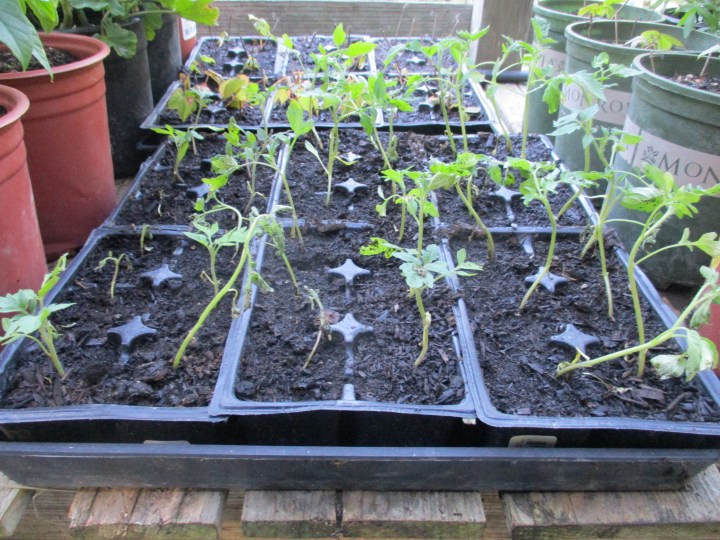
There are no vegetables in the garden yet. It is so shameful. Work had been so overwhelming that I am only now renovating a small vacant space into a new vegetable garden, and only because I am unable to go to work at my most time consuming job. I needed to remove our berry canes to do it!

Until the garden becomes productive, and perhaps to avoid the supermarket, I have been getting much of my produce from the surrounding forest and landscapes.

1. mustard greens – are the most abundant of the greens growing wild around the perimeter of the abandoned baseball field. Similar wild radish and turnip greens are even better, but not abundant.P00328-1

2. dandelion – grows in the outfield of the same abandoned baseball field, mostly past third base. They are not my favorite, but are an alternative to the other greens. These are dirty from heavy rain.P00328-2

3. dock – is more randomly sporadic. It grows amongst the other greens and elsewhere, although not in significant colonies. The tough midribs are supposed to be removed. I just chop them up fine.P00328-3

4. miners’ lettuce – is the only native of these greens. Most leaves are circular with tiny white flowers in the center. These vegetative leaves are supposedly better. Like lettuce, they do not get cooked.P00328-4

5. stinging nettle – must be cooked to stop stinging. This is my favorite of the greens. It is like spinach that I do not need to tend to. I get it from along the trails where it should be eradicated anyway.P00328-5

6. Rhody – is not even remotely relevant to greens; but everyone wants to see him. Someone suggested that I write exclusively about Rhody, as if my horticultural topics are insufficiently interesting.P00328-6

This is the link for Six on Saturday, for anyone else who would like to participate:

https://thepropagatorblog.wordpress.com/2017/09/18/six-on-saturday-a-participant-guide/

Sweet Box

50325
Foliage of sweet box outdoes flowers.

While bloom cycles of most plants are accelerated by the unusually warm winter, sweet box, Sarcococca ruscifolia, seems to be blooming a bit late. It should have bloomed sometime in winter, and finished a month ago. The tiny pale greenish white flowers are certainly nothing to look at, but they produce a remarkably rich fragrance that seems like it would be delicious with coffee.

The foliage is very glossy and dark green, like that of English holly, but the leaves are small and lack spines. Red berries sometimes develop, but are only abundant enough to be notably colorful on plants that are distressed. Sweet box may take a few years to get established and grow to only about three feet high and wide, although it can slowly get a bit larger.

Since it is naturally an understory plant, sweet box prefers at least a bit of shade. Harsh exposure fades foliage. Because of its tolerance of partial shade, as well as its low and dense growth, sweet box is ideal for obscuring foundations. After the first few years, it does not need too much water. It gets established more efficiently in rich soil.

Good Looks Are Not Everything

00311
Less color can mean more fragrance.

More flowers bloom as winter becomes early spring than at any other time of year. For many flowers, bloom is significantly accelerated this year because winter was so very warm. Flowering cherry, purple leaf plum and most of the stone fruit trees (such as almond, cherry, apricot, nectarine, peach, plum, prune and all their various hybrids) have already bloomed.

Color is what gets noticed first. After all, that is what all the flashy colors are intended for, to get the attention of pollinators. Yet, there is more to the indirect mating strategies of flowers than color. Because flowers lack the mobility to pollinate each other, they do what they must to attract others to disperse their pollen for them. Some use fragrance.

Generally, flowers prefer one tactic or the other. This is why the most colorful flowers lack fragrance, and the most fragrant lack color. Gardenia (which is not easy to grow locally), star jasmine, honeysuckle, Pittosporum tobira, Pittosporum undulatum and night blooming jasmine are not exactly colorful while blooming. The powerfully fragrant flowers of sweet osmanthus and sweet box barely get noticed.

Pink jasmine and mock orange (Philadelphus spp.) are flashier, only because their blooms are so profuse. Southern magnolia has spectacularly big flowers, but they are mostly obscured by dense foliage high above view. Cereus cactus and moon flower are likewise spectacular, but bloom at night to attract nocturnal moths for pollination.

Only a few flowers are both colorful and fragrant. Lilac and wisteria are among the more familiar. Both bloom early in spring, with a similar color range of lavender, blue, pink and white. Lilac is shrubby. Wisteria is an aggressive vine. ‘Charles Grimaldi’ angel’s trumpet is a big shrubby perennial that blooms rich yellow, but may only be fragrant at sundown.

Freesia, hyacinth, lily and bearded iris are flashy and fragrant flowers grown from bulbs, although hyacinth and most lilies rarely bloom a second year, and many lilies and bearded iris lack fragrance. Sweet alyssum is a mildly fragrant annual that blooms white, pink or lavender.

Unused Pictures

P00325K-1
I believe that this azalea is ‘Phoenicia’.

Okay, so I felt slightly guilty about not posting anything of any horticultural interest today. Okay, perhaps a bit more than slightly. Okay, perhaps guilty enough to post a few pretty flowery pictures . . . and the last one, which some might find objectionable.

P00325K-2
‘Coral Bells’ is not one of my favorite azaleas, but is reliable and profuse.

I will not put much effort into this. I did not even take these pictures for any particular article.  I am only sharing them here and now because I have no use for them, but did not want to just file them away unseen forever. Hey, these flowers work hard to bloom!

P00325K-3
I have no idea what this azalea is, but I am impressed.

Actually though, except for the last picture, all are about a month old. The last picture is half as old, and the bloom that is shows continues. Otherwise, the other blooms are already finished. Although colorful, none are particularly remarkable or interesting.

This odd camellia seemed to grow from the base of a bigger and older specimen, as if it is a sucker from understock. However, there is no indication that the original specimen is grafted. Nor is there any reason why a Camellia japonica should be grafted. The odd camellia could have grown from seed. It is rare but not impossible for Camellia japonica to produce seed here. It is not crowding anything, so remains.

P00325K-4
This odd camellia looks like it could be an extra on the Muppet Show.

I really should eradicate this pampas grass. However, it has been here for many years without becoming aggressively invasive. We have observed no seedlings nearby. Besides, even if we did eradicate it, there are herds of more just over the ridge. I can not explain why it is not migrating inward, but I am not complaining. I happen to like the bloom.

P00325K-5
This is not just any pampas grass. It is the dreaded Cortaderia jubata.

These pictures are, of course, not nearly as awesome as the pictures of Rhody that posted earlier. They just happen to be more relevant to what should be a horticultural blog.

Horridculture – Antihorridculture


Wednesday has been my day for ranting about aberrations of horticulture. I certainly have plenty to rant about. However, there is plenty of other ranting going on nowadays without my help. Therefore, for this Wednesday only, I will forego the ranting. Furthermore, I will forego the horticulture too. I can not remember ever doing that before. This could be something totally new for me.

After Rhody photo bombed one of my pictures that was featured on Saturday, others suggested that I feature more pictures of Rhody. Everyone loves Rhody.

Most of these pictures are devoid of vegetation. The minimal vegetation that is visible in the other pictures is mostly unrecognizable in the background. There are a few redwoods, a few firs, some English ivy and all that riparian mess around Zayante Creek behind the abandoned ball field. They are unimportant in this post.

This post is just pictures of Rhody, complete with captions that all begin with ‘Rhody’.

Rhody really has been a good sport. He has been coming to work without his crew for more than a week. Only a few of them stop by in the morning. One or two rarely come by through the day. We avoid each other.

Rhody misses them very much. He frolics on their sofa where he typically does ‘laps’ during morning staff meetings, and sometimes settles into the rocker chair that he typically avoids when no one else in it. He neglects his favorite thrasher toys, but instead drags around a dirty glove that belonged to someone of his crew. He takes it to bed, but I somehow wake up with it.

We will work in the still unvegetated vegetable garden in the morning. It is right outside, so he will be here if anyone of his crew happens to stop by.

P00325-01
Rhody found us a new car.
P00325-02
Rhody still prefers his friend’s work truck.
P00325-03
Rhody in camo.
P00325-04
Rhody found it, . . . but doesn’t know what it is.
P00325-05
Rhody likes the beach, . . . but can’t find the ocean. (It is a few miles away.)
P00325-06
Rhody gets to second base and beyond, past the outfield of the abandoned ball field.
P00325-07
Rhody is easily amused. I don’t get it.
P00325-08
Rhody is still intent on finding . . . it.
P00325-09
Rhody can be such a ham.
P00325-10
Rhody knows how cool he is.
P00325-11
Rhody misses his staff who can’t come to work yet.
P00325-12
Rhody misses them a lot!
P00325-13
Rhody still works hard at being cute, even though there is no one here to see it.
P00325-14
Rhody is done with pictures for now.
P00325-15
Rhody thinks the camera smells . . . interesting.

Breath Of Heaven

00401
Foliar aroma rather than floral fragrance.

Bloom may not wait until spring. Breath of Heaven, Coleonema pulchellum, can start to bloom late in winter if it chooses to. After another more prolific bloom phase sometime in spring, sporadic bloom can continue until autumn. The delightfully pale lavender pink flowers are tiny, but abundant during bloom phases. A few are likely to linger after the main phases, until another phase begins.

The straight species is not as popular as it formerly was. It gets to be approximately five feet tall and broad, or a bit bigger if crowded. Nowadays, most breath of Heaven are ‘Compactum’, which do not get much taller than three feet, with delightfully wispy light green foliage. ‘Sunset Gold’ has bright greenish gold foliage that stays lower than two feet. All have impressively aromatic foliage.

Breath of Heaven is best where it does not need much pruning for confinement. Frequent shearing compromises foliar texture and inhibits bloom. Partial shade likewise inhibits bloom, although it can also promote an appealingly sparser and wispier foliar texture. Unfortunately, breath of Heaven does not live for very long. Even the healthiest and oldest specimens may not last twenty years.

Rodents Will Never Give Up

00401thumb
Warming weather brings out the gophers.

None of the most problematic rodents here hibernate completely. Only ground squirrels hibernate, but they are rare, and tend to avoid home gardens and refined landscapes. Some other rodents are less active through the cooler parts of winter, but never completely stop eating, chewing and digging up what they want from our gardens. Many will become more active with warming weather.

Gophers are the most destructive rodents right now. They might still be excavating the mud of last winter from their tunnels. They will find plenty to eat as warming weather stimulates root growth of their favorite plants. Young gophers are growing up and leaving home, to excavate more tunnels and consume more vegetation elsewhere. They are more numerous now than they will be all year.

Squirrels are not so industrious. For now, they are destructive only if they dig out recently planted seedlings and bedding plants, or eat flowers and freshly emerging foliage. They should otherwise be temporarily satisfied with acorns that they hid late last year. They will become more of a problem as they eat ripening fruit, nuts and maybe vegetables later in summer. Some might chew bark.

Rats are sneakier than squirrels. They are not as destructive to ripening nuts and stone fruits, but do eat some of what falls to the ground. Although not a problem for the garden, well fed rats infest adjacent homes, where they cause serious damage. At this time of year, rats sometimes ruin citrus fruit. They eat the pulp out from the rinds of oranges and tangerines, and the rind off of lemons.

Rodents are nearly impossible to exclude completely and safely from gardens. Poisons are too dangerous to be practical around the home, particularly if there are dogs or cats anywhere nearby. Traps are safer and effective, but require diligence. Also, some traps are difficult to set. Each type of rodent exhibits distinct characteristics. That which controls one type is ineffective for another.

Sanitation and vegetation management deters some rodents by depriving them of sustenance and nesting sites.

March 22, 2020 – Memorial Tree Update

As I promised earlier, this is the update from Felton League.

tonytomeo's avatarFelton League

Before

If it continues with the healthy growth it exhibited after a seemingly slow start last year, the still small Memorial Tree of Felton Covered Bridge Park should be happy now, in its fifth season. It was pruned, groomed and relieved of weeds last Friday. Its first dose of fertilizer will be applied today, before fresh new foliage starts to develop. New binding should remain until autumn.

The last update for the Memorial Tree was on August 10. An update regarding its horticultural concerns posted earlier this morning on my other blog, where this post will be reblogged to. This little tree has certainly been through some difficult times. It is gratifying to see that it is recovering and doing well. As it grows, it becomes more resilient and less susceptible to damage.

The Memorial Tree is actually the fourth tree to be planted on its spot since Felton Covered…

View original post 152 more words

Memorial Tree Update – March 22, 2020

P00322-1
Memorial Tree – Before

Updates get complicated as they link back to previous updates to previous updates to previous updates and so on. Linking and reblogging from another blog adds more complication. The last update for the Memorial Tree was reblogged from Felton League on August 10. It and previous updates should link back to preceding updates chronologically. At least it sounds simple.

Another brief update that will reblog here from Felton League at noon will describe more of the social significance of the Memorial Tree rather than horticultural concerns. It really is special.

This little Memorial Tree has certainly been through some difficult times. Despite reassurances that it would not happen again, and that the tree would be outfitted with an ‘approved’ trunk guard, the trunk base has been gouged by weed whackers on more occasions than I can remember. That is an unfortunate consequence of efficient but unaware community service workers.

Such major damage severely inhibited growth. As it begins its fifth year, the Memorial Tree is barely six feet tall. By now, it should be developing branch structure above minimal clearance. Fortunately, it was quite healthy last year. If it continues to grow similarly this year, it will grow above six feet, where it can later develop scaffold limbs. I intend to apply fertilizer regularly.

Stubble had been left on the trunk to enhance caliper growth. That which was developing into significant branches was removed to concentrate resources into vertical trunk growth. Stubble that remains is minimal, but should be substantial enough by winter to get mostly pruned away again. It will more likely be unnecessary, and pruned away completely from the main trunk.

Binding is unfortunately still necessary. The species innately develops irregular form. Binding straightens the otherwise curved trunk. Once the trunk lignifies in the desired position, binding and the associated stake will not be necessary. The larger lodgepole stake holds the binding stake vertical, but is more important for protection from those who bump into the still small tree.

Weeds were removed from around the base of the Memorial Tree, so that there would be no need for a dreaded weed whacker to get close to it. Former damage is compartmentalizing well.

P00322-2
Memorial Tree – After

Poppy And Periwinkle

P00321-1
Even though I know they are slightly purplish, periwinkle look blue to me.

Clearing space for a new small vegetable garden is more work than it will be worth. It took more than a day to remove the thicket of bramble from a triangular area that is only about forty feet from front to back, and not much more than twenty feet wide. After so many years of getting trash dumped on top of them, the brambles were unusually prolific with gnarly root burls.

There is still significant work to do. I still need to condition the soil and groom the adjacent junipers before sowing seed for the warm season vegetables for this summer. Now that I can see that the junipers that were formerly concealed by brambles are worthy of salvage and grooming, I will need to clear a bit more garden space across the road, and cut back a few trees above.

When finished and producing, the garden will not produce enough. The four hundred or so square feet in the main part of the garden should supply enough for two people; but realistically, it would more likely produce enough for me alone, with a bit extra to can for when it is not producing much. There are about a dozen on our crew. They all have families. I need a quarter acre!

The math of it all is frustrating. So is all the work to get it started. It all seems so futile. I know we will appreciate the little bit that we get. I will still get plenty from the weeds that grow wild around the baseball field, so will not take much from the garden.

P00321-2
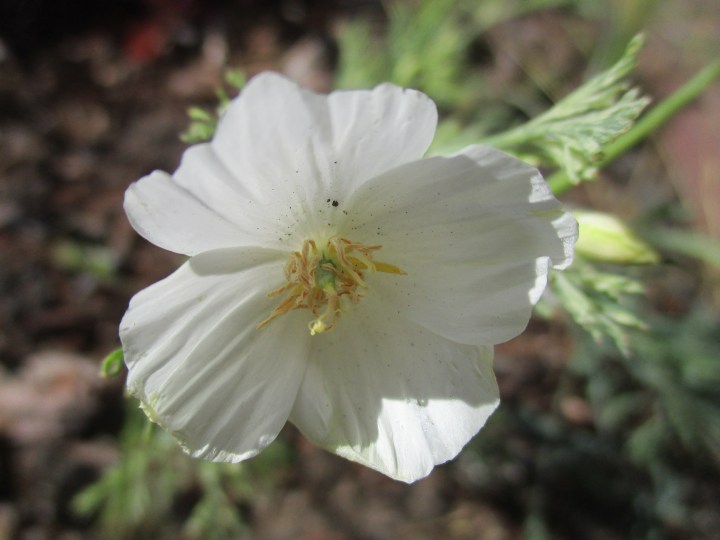
As simple as they are, poppies are still my favorite native wildflower.

For now, I try to visualize what the small vegetable garden will look like in production this summer, even if all that I see blooming are the poppies and periwinkle on the outskirts.

P00321-3
My illustrations are more technical than artistic. It looks like someone else took this one. Ignore the pickup in the background.