Ferns Are Made For Shade

50304thumb
Ferns are famous for distinctive foliage.

Without color or fragrance of flowers, ferns provide some of the most distinctive foliage in the garden. They do not turn color in autumn. Only a few tree ferns develop sculptural branch structure. Yet, they do their job well, and many are happy to do so in spots that are a bit too shady for other plants.

Almost all ferns are low perennials that produce foliage that arches outward from the center. Some can get quite broad. A few tree ferns grow upward on trunks (although the trunks are merely tough roots that grow through decomposing stems). Australian tree ferns can get quite tall and broad where sheltered from wind.

The staghorn fern is a weird epiphyte that naturally clings to tree trunks or rock outcroppings where it collects organic debris that falls from trees above. In home gardens, it is popularly grown on wooden plaques or as a hanging plant. Hanging plants do not necessarily need pots, or sometimes engulf their pots as they grow.

Leaves of ferns are known as ‘fronds’, and with few exceptions, are intricately lobed or divided into smaller leaflets known as ‘pinnae’, which are arranged on opposite sides of leafstalks known as ‘rachi’ (or singularly as ‘rachis’). The staghorn fern has unusually branched but otherwise unlobed fronds. The bird’s next fern has has distinctively simple fronds without any lobes or pinnae.

Most of the popular ferns are naturally understory plants that grow below larger plants. Even most tree ferns grow amongst larger trees. This is why so many ferns tolerate shade so well. In fact, many prefer partial shade, and will actually fade or scorch if too exposed. However, it is also why so many ferns prefer rich soil with an abundance of organic matter.

Maidenhair, rabbit’s foot, bird’s nest, holly, Boston and a few other ferns are popular as houseplants. Because home interiors are a somewhat arid for them (lacking humidity), some ferns like to be misted daily. Ferns respond well to regular but light application of fertilizer. Too much fertilizer can roast foliage.

Because ferns are not expected to bloom, nitrogen (which can inhibit bloom for some plants) is not a problem. Ferns that are out in the garden can therefore get fish emulsion or a bit of the same sort of nitrogen fertilizers that keep lawns green.

Horridculture – ?!

P00304-1
This is how appreciated camellias bloom.

I seriously can not think of a title for this one. All that comes to mind is too objectionable. Writing about it will not be much easier.

It began with a few mature camellias that were in need of grooming a few months ago. They were sufficiently shabby that I did not mind pruning them at the wrong time. Ultimately, almost all of what was groomed out was necrotic anyway, so did not compromise bloom significantly. I was pleased that the eventual bloom would be better presented against a neater background.

Then, I was informed that several of the same camellias would need to be removed to facilitate the installation of a new sidewalk. That would have been useful information before I put such meticulous effort into grooming them. It was briefly annoying; but I did not fret long. I planned to recycle the camellias, and realized that I would have groomed them in the process anyway.

At the time, there was no rush. I thought that the camellias would get to bloom prior to relocation. In the meantime, someone else removed a rotting madrone stump nearby. I thinned and groomed a sloppy filbert into an impressively tailored specimen. Immediate relocation of the camellias was not yet a priority. We had not even identified the precise location of the sidewalk.

Then, there was another disappointment. The project was unexpectedly scheduled immediately after another nearby project that would be completed in only a few days. It would have been more expensive for the crew to leave after finishing the primary project, and then return for the secondary project. I might salvage the camellias, but I knew I could not salvage their bloom.

That is not the worst of it. After planning to relocate the five or so offending camellias on Wednesday or Thursday, I was informed on Tuesday morning that three had already been removed by the backhoe operator who had removed old concrete pavement from the other nearby project. By removed, I mean they got torn mercilessly from the ground and completely destroyed.

P00304-2
One of two relocated camellias demonstrates how mature the three that were needlessly destroyed were, although they were not so broad. That is a shovel handle in front.

No other excavation was done. Asphalt pavement and a curb that need to be removed remain intact. The unwanted ivy is just as unwanted and intact as it was before this weird incident, as if nothing happened. The craters where the camellias got gouged out are barely visible. The only other damage was the mutilation of my well groomed filbert, which was not even in the way.

It was as if the camellias were targeted. Two survived only because someone arrived on site to stop the backhoe operator from destroying them also. There was no regard for any associated subterranean infrastructure, such as an irrigation system and electrical landscape lighting. I suspect that the filbert was mangled just because it was too close to one of the targeted camellias.

I tried to conceal my anger as I frantically relocated the two surviving camellias, while the backhoe operator who so needlessly and blatantly destroyed the other three worked with the crew at the other project just a few yards away. I tried to convince myself that the incident was merely an honest mistake. I doubt that the backhoe operator intentionally targeted the camellias.

As I finished, and was calmly leaving the site, something happened that made me realize that perhaps some of my anger was not completely unfounded. I still do not believe that the backhoe operator was intentionally malicious. I realized instead that the backhoe operator, regardless of his intentions, should most certainly not be operating such potentially dangerous machinery.

From where the crew was taking a break, and the backhoe operator seemed to be enjoying a cigarette, a voluminous and aromatic cloud of marijuana smoke drifted to where I could smell it.

What these guys do prior to or after work is none of my business, as long as it does not compromise their safety or rationality. If someone wants to go off and use their so-called medication in private during the day, he should do so discretely and moderately. Someone who can generate such a voluminous cloud of smoke with no regard to what others think about it has a problem.

P00304-3
Someone took the initiative to destroy my formerly well tailored filbert, but not to remove the carcass. I could have left it to regenerate, but I do not want to look at it anymore.

Winter Daphne

00311
Simple daphne flowers produce complex fragrance.

While winter weather is still cool and damp, winter daphne, Daphne odora, provides an alluringly fresh fragrance of spring. It is easy to dismiss the abundant but rather small domed trusses of tiny pastel pink flowers as the source of their formidable fragrance. Like so many fragrant blooms, daphne bloom is visually demure. Nevertheless, blooming stems are delightful with other cut flowers.

‘Aureomarginata’ is the most popular cultivar of daphne, and is the only cultivar available in many regions. The handsomely glossy evergreen foliage is variegated with yellowy white or light yellow margins. Mature plants get about two feet tall and about twice as wide, with a delightfully tame hemispherical form. They may get slightly taller with slightly less refined form where partially shaded.

Daphne prefers rich and loose soil, and with sufficient organic matter, will tolerate rather sandy soil. Partial shade might inhibit bloom somewhat, but is otherwise not a problem. Proper placement is important. Established daphne recover slowly from transplant. It is also important to be aware that even the healthiest of plants may live for only five years, and rarely live for more than ten years.

Foliage Is Meant For Weather

00311thumb
Lush foliar houseplants enjoy occasional rinsing.

Foliage needs sunlight for photosynthesis. Foliage needs air for respiration. Roots need moisture to sustain foliage. Houseplants can technically get all of what they need from the confinement of their pots within the interiors of homes and other buildings. They only require sufficient moisture to be delivered to them, and sufficient sunlight from windows. The air is the same that we all utilize.

However, there is no substitute for nature. While hydroponics and synthetic light facilitate yet more deprivation of what is natural, the plants involved would appreciate more consideration. Without exception, domesticated plants are descendants of plants that grew wild somewhere. Those that dislike local weather would be pleased with the weather of their respective ancestral homelands.

Most of the popular houseplants that are grown for their lush foliage originated from tropical forests. Many were understory plants that prefer the shade of larger trees. That is how they tolerate the relatively shaded interiors of buildings. Now that they are here as houseplants, they appreciate shelter from frost. They probably miss rain, humidity, sporadic breezes and tropical warmth though.

Rinsing tropical foliage plants in the shower eliminates some of the dust that they accumulate where air stagnates. Rinsing them out in the garden is even better because it does not make such a mess in the shower. What is even better than both of these options is allowing a gentle rain to rinse the foliage. Plants only need to be moved to a windless spot prior to an expected rain shower.

The weather was much too cool earlier in winter. There will be no rain later in summer. This time of year, and again next autumn, the weather is safely mild; and eventually, a few showers are likely. Timing is critical. Plants should be brought out just prior to rain, and brought in before the weather gets sunny. Foliage that has always been sheltered is very sensitive to scald from direct sunlight.

Saucers and pots can be cleaned while outside. Crowded plant can be repotted.

Feral Plum

P00301-1
Feral plum naturalized from understock cultivars.

Springtime in the Santa Clara Valley was famously spectacular decades ago, when vast orchards occupied what is now only urban sprawl. Tourists came to see it like some still go to see foliar color of autumn in New England. Most of the orchards were for stone fruits. Only a few in cooler spots were for apples and pears. Only orchards of English walnuts did not bloom colorfully.

Cherry and almond trees typically bloomed first. Prune trees bloomed immediately afterward. Apricot trees were only a few days later. Of course, the schedule of bloom was variable. Prune trees often bloomed just after apricot trees. Various cultivars of cherry started to bloom at slightly different times, even though those that needed to pollinate each other managed to do so.

After the main bloom of all the stone fruits, and after the tourists were gone, the few apple and pear orchards in cooler spots and surrounding hillsides continued the process. Mulberry trees that grew sporadically on roadsides around the orchards bloomed no more colorfully than English walnuts, but somehow produced enough fruit to distract birds from developing stone fruits.

Feral plum trees are a group that was not easy to categorize even before the demise of the orchards. They were not intentionally grown in orchards, or even in home gardens. They just sort of grew wild along creeks or from the roots of grafted stone fruit trees that had been cut down. They were originally grown as understock cultivars, but had naturalized to become truly feral.

Because their fruit was not used for much, they did not get much consideration. We tend to forget that some types bloomed before any of the other stone fruits. To those who do not expect fruit, feral plum trees are as spectacular as productive stone fruit trees.

P00301-2
Feral plum bloom is now finishing. Foliage will replace blossoms.

Not So Annual

P00229K-1
These primrose look as good as they did last year.

Among cattle, a cow is a female who has calved. Prior to that, she was a heifer. A bull is an adult male. A bullock is a juvenile male or castrated bull. Most cattle are males who were castrated while young, and are known as steers. Yet, cattle are commonly known collectively as ‘cows’.

Similarly, bedding plants are commonly known collectively as ‘annuals’. Many really are annuals. However, some are biennials; an even more are, to some degree, perennials.

Replacing annuals annually make sense. They grow, bloom and die within one year. Some sow seed to regenerate if and when they get the chance. In the prominent spots of our gardens, not many are likely to get such a chance before they are replaced by other annuals for more immediate gratification within the next season.

The same applies to bedding plants that have potential to perform as perennials. They too get replaced during their off season. Since most are inexpensive, their untimely collective demise is not considered to be too terribly wasteful.

There are a few that are not so easy to part with. Cyclamen will be a topic for next week because it is a cool season perennial that is too expensive to be deprived of its potential to regenerate and bloom next autumn and winter.

These English primrose from last winter were afforded an opportunity to stay in their landscape while they were somewhat dormant through the warmth of last summer, so that they could regenerate last autumn and bloom through this winter. A few from around the edges were moved inward to replace a few that did not survive. Impatiens were planted in front for summer.

The results are not exemplary only because of the shade, but are worth the effort of not putting effort into replacement.

P00229K-2
Two seasons for the price of one.

Six on Saturday: More Gopher Problems


Even underground, gophers must know what time of day or night it is. Otherwise, they would not know when to “lie awake at night, thinking up evil plans” (Micah 2:1). Why do they bother being so sneaky with their exploits? They know that there is not much I can do to stop them. Why are they so creative with their damage? Is it just to flaunt their ability to get away with it? Gophers enjoy this too much.

1. Only the Heavenly bamboo to the right in the background is standing upright to show off its red new foliage. The other four (with two in the background) are suspiciously flopped forward.P00229-1

2. It was as if they were just set on the surface, with no roots to hold them down. Removing their carcasses was like picking up litter. They flopped forward because of wind a few hours prior.P00229-2

3. This is all that remained of the roots. It is amazing that the foliage was as fresh as it was. This much damage did not happen just recently. Foliage should have started to desiccate already.P00229-3

4. The worst of the four demonstrates how thorough the damage was. It was like a mean prank. It seemed as if someone pulled them up, whittled the roots away, and plugged them back in.P00229-4

5. Yarrow gets partially eaten by gophers too, but somehow survives. Supposedly, only the thick tap roots get eaten, while lateral roots are ignored. Gophers do not seem to be so discerning.P00229-5

6. Daffodil is how I should end this mostly unpleasant six. No one eats them. Many are still blooming. I probably should have posted pictures of flowers, instead of what gophers are killing.P00229-6

This is the link for Six on Saturday, for anyone else who would like to participate:

https://thepropagatorblog.wordpress.com/2017/09/18/six-on-saturday-a-participant-guide/

Barrel Cactus

50225
Barrel cactus spines are serious business!

‘Echino’ translates to ‘spiny’; so the genus name of barrel cactus, Echinocactus grusonii, means ‘spiny cactus’. Duh! The nearly spherical and furrowed (ribbed) plants are completely covered with stout and dangerously sharp spines. The most popular variety, known as golden barrel cactus, has pale amber yellow spines. Another variety has white spines. Tan or ruddy spines are rare.

Growth is quite slow. It takes many years for plants to get to three feet tall. Only plants that are quite mature bloom in spring or early summer with bright yellow or orange flowers that develop in a circle, like a halo around the top of the plant. Pink or red flowers are rare. Old plants typically develop a few pups (side-shoots), which may likewise take many years to bloom.

Like most cacti, barrel cactus wants a warm and very sunny location, and very well drained soil. If they do not get watered too much, they can stay potted for many years. However, because they are so nasty, they are not too welcome on porches or patios where most potted plants live. Because they are so heavy and difficult to handle, they are not as portable as they should be.

Cacti Have Bite Without Bark

50225thumb
Cacti exhibit unique and striking form.

The most inhospitable spots in the garden that no one wants to put any work into seem to be the domain of cacti, whether or not any cacti actually live there. “Oh, I will just put some cactus there!” is cliché in regard to shadeless and dry spots that get too hot with glare from a south-facing wall. Yet, such spots typically continue to be neglected, and the cactus never get planted.

Why are such distinctive and interesting plants considered to be so lowly that they should be banished to the badlands? Why should they be expected to endure what not other plants are expected to endure? After all, there are so many other distinctive xeric plants, like yuccas, agaves and some aloes, that are just as resilient, and according to some, just as lowly.

Cacti really are not as independent as commonly believed. New plants should actually get watered occasionally until they disperse their roots. If they get watered regularly, they need coarse soil that drains very well. Cactus plants that were grown in sheltered spots really can get scaled if planted where they are too harshly exposed during hot weather.

The main problem with cactus is their nasty spines. Simply planting small plants without getting poked is a challenge. Moving big potted specimens or removing overgrown cactus plants without getting seriously perforated can be daunting. So, even though they might do well in the harsh exposure at the curb, they do not belong in such a high traffic area.

Without foliage or conventional stems, cactus are either awkward to prune, or can not be pruned at all. Barrel cactus have only one or very few round stems. If one of these stems gets to wide, it can not be pruned back. Prickly pear cactus is easier to accommodate only because it has enough stems to spare those that grow out of bounds.

What makes cacti so excellent is their distinctive form. Some have strictly upright stems that resemble those of the organ pipe cactus. Some grow as clumps of short and fat stems. Others grow upward and outward with rounded and flat stems like those of the beaver tail cactus.

Horridculture – High & Mighty

P00226-1
Camellias are pretty this time of year, but . . .

Camellias have been blooming for a while now. I typically get rather good pictures of them. The pictures are nothing too artistic, of course, and are intended to merely exhibit the floral color and form. A bit of the glossy foliage in the background is nice.

The picture above is not so useful for exhibiting much of the floral characteristics. Even the pink color is muted by the sloppy background and gray sky above. Zooming in would not have corrected the positioning of the flowers. I simply could not get close enough to do any better.

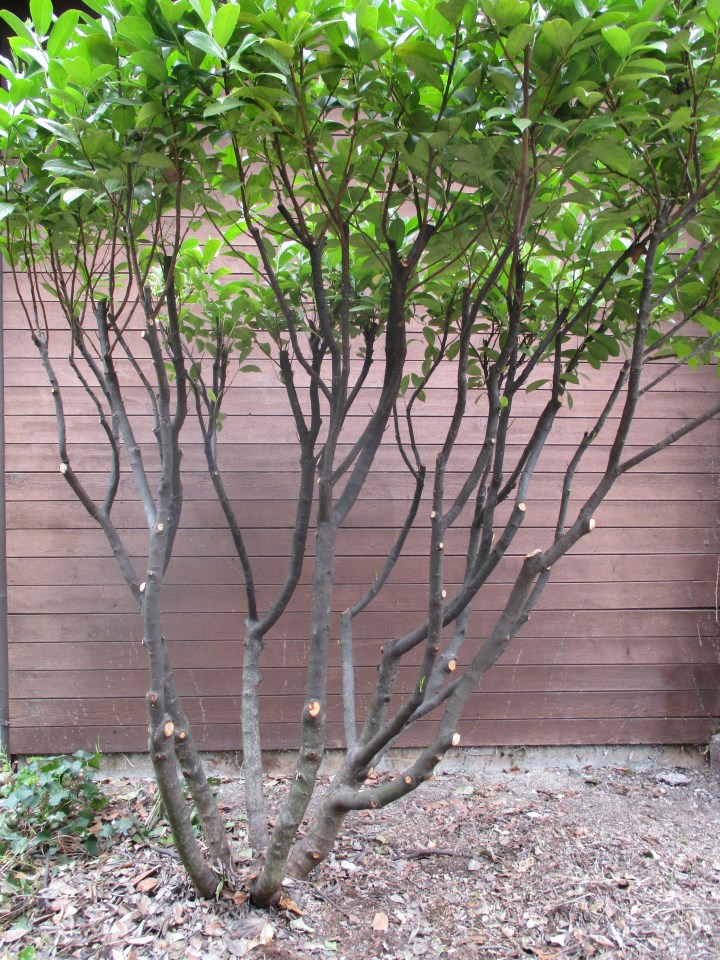
That eave in the lower right corner of the picture is above a two story building. That is where all the blooms of this particular camellia shrub are located. With so much of the lower growth shaded out and gone, this shrub is more like a small tree. The bloom is too high up to be appreciated. The picture below demonstrates what it all looks like without zooming in.

If there were windows facing this big camellia shrub or tree, I would likely prune it only a bit lower, just to keep it below the eave and within view of the windows. Without windows, I know that I really should prune the tall trunks back to what little lower growth remains, in order to promote more growth and bloom closer to ground level where it can be appreciated.

The difficulty I have with pruning it back is that this big camellia shrub or tree is so impressively big and sculptural, and all the glossy foliage looks so good in the foreground of the rich dark brown wall. I do not know what is more important here, the sculptural limbs and rich green foliage that lasts throughout the year, or the colorful but seasonal bloom.

P00226-2
There is not much to see from this distance.