Where does this delightful columbine think it is?!
Columbine does not do well here. I do no know why. It does well enough in Colorado to be the Official State Flower there. Yet, the mildest of climates is Colorado are harsher than the climate here. It does not get too terribly warm in summer here. Humidity is minimal, but not as minimal as in much of Colorado. Nor does it exceed that of other regions where columbine does well.
We have certainly tried to grow columbine. It just does not work. Some of it succumbs to powdery mildew. Some succumbs to rust. The last batch just succumbed. Because it was expected, I did not bother to investigate. I got the impression that it was taken out by both powdery mildew and rust. Flowers that bloomed so delightfully when planted went to seed on their way out.
That should have been the end of it. I would not mind if someone tries again to grow columbine for next spring, even if it last for only a short while. I just do not expect to see it ever perform well here. None was planted this year. Even if someone had considered it, there was no need to add any prior to furlough, while cool season annuals for winter continued to bloom so happily.
What I certainly did not consider was the few seed that the last batch of columbine tossed almost a year ago. Apparently, at least one of those seed fell from the ledge where its parent plants lived briefly in now absent planter boxes, and into the edge of a small landscape below. It grew into an exemplary specimen of columbine, which is happily blooming as if it were in Colorado!
It is surrounded by a concrete retaining wall, a perpendicular granite wall and a big granite boulder!
The landscapes are in surprisingly good condition after more than a month of neglect. Weeds are horrendous, but no more so than expected. They and the lawns are the priorities. Significant progress was made just in the last three days that we have been able to work. As busy as we are, I managed to get some nice floral pictures. Rhododendrons are still blooming, but will be the topic for next week.
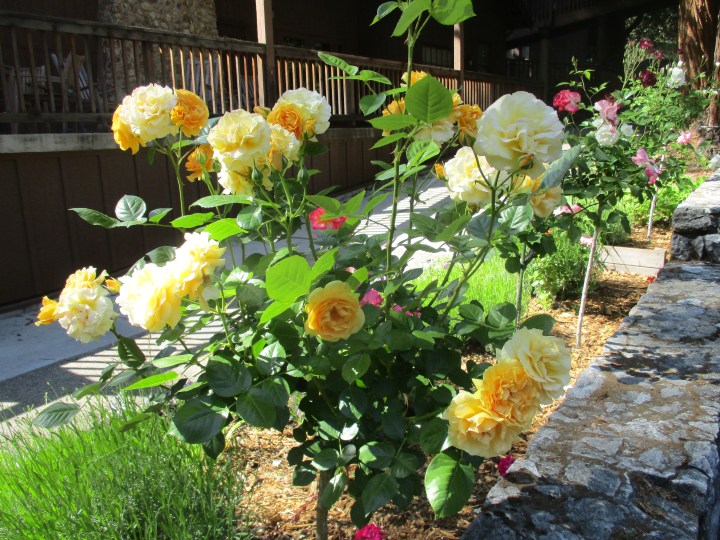
1. Of the mere four cultivars here, this is my least favorite. The color and profusion of bloom are excellent. I just dislike how the floral form resembles those of the trendy David Austin roses.
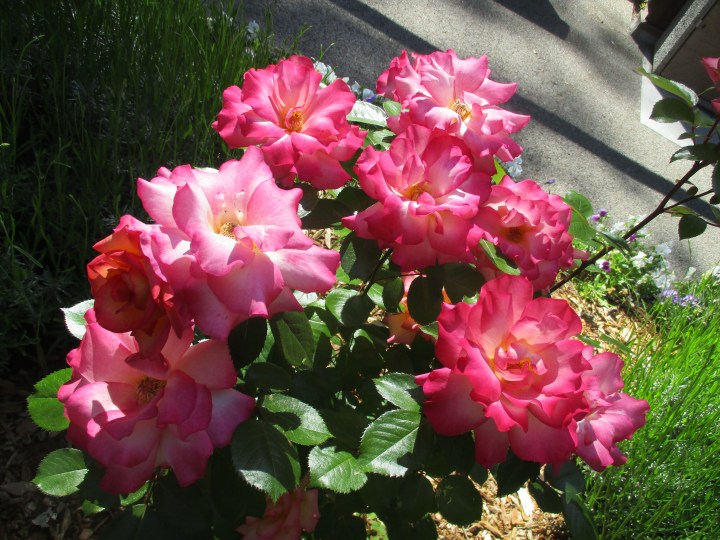
2. This cultivar is the only one that is in shrub form. All the others are tree roses (or standards). The profuse bloom resembled ‘Double Delight’ last year, but is completely different this year.
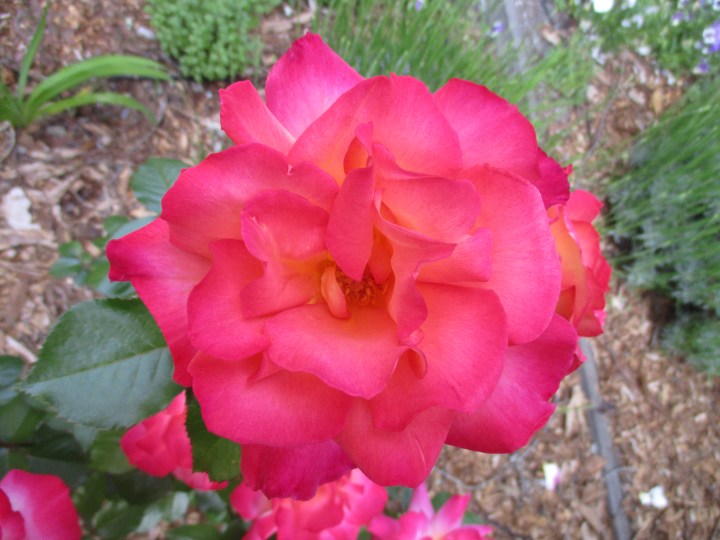
3. Close up, it is more rich bright pink than distinctly reddish pink with white. It is fragrant like ‘Double Delight’ should be, although it does not seem to be as fragrant now as it was last year.
4. The first (#1 above) is also different from how it bloomed last year. Its petals are not so densely packed. There are plenty of buds behind the maturing flowers. Performance is exemplary.
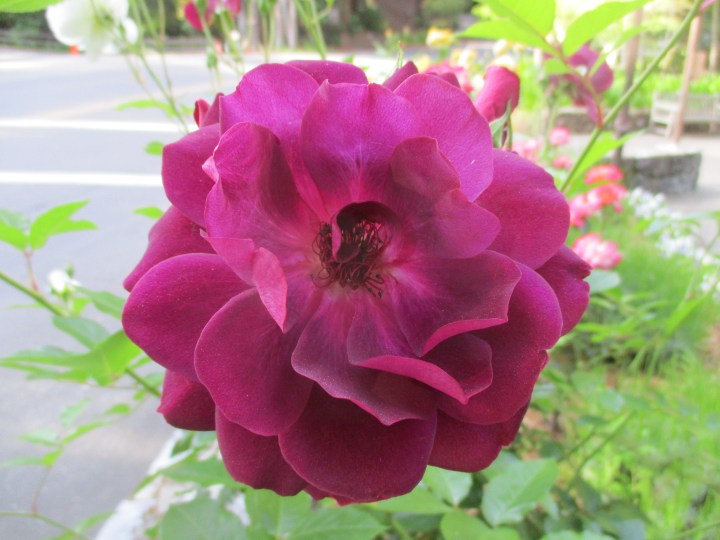
5. Is this purple? Not only is its color odd, but it is grafted onto the same rose trees as the white roses (#6 below). It is too weird for my taste. Everyone else likes it. That is more important.
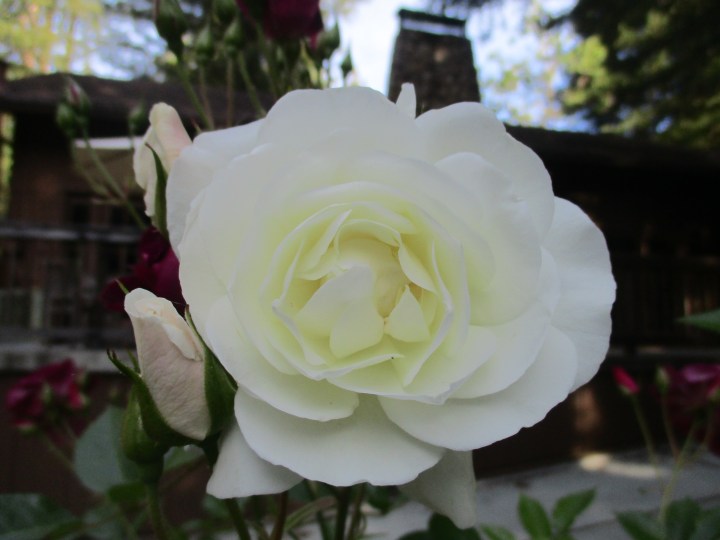
6. As mentioned above, this cultivar is grafted onto the same rose trees as the purple roses (#5 above). To me, it seems to be the common ‘Iceberg’. I do like white, even if it is just ‘Iceberg’.
This is the link for Six on Saturday, for anyone else who would like to participate:
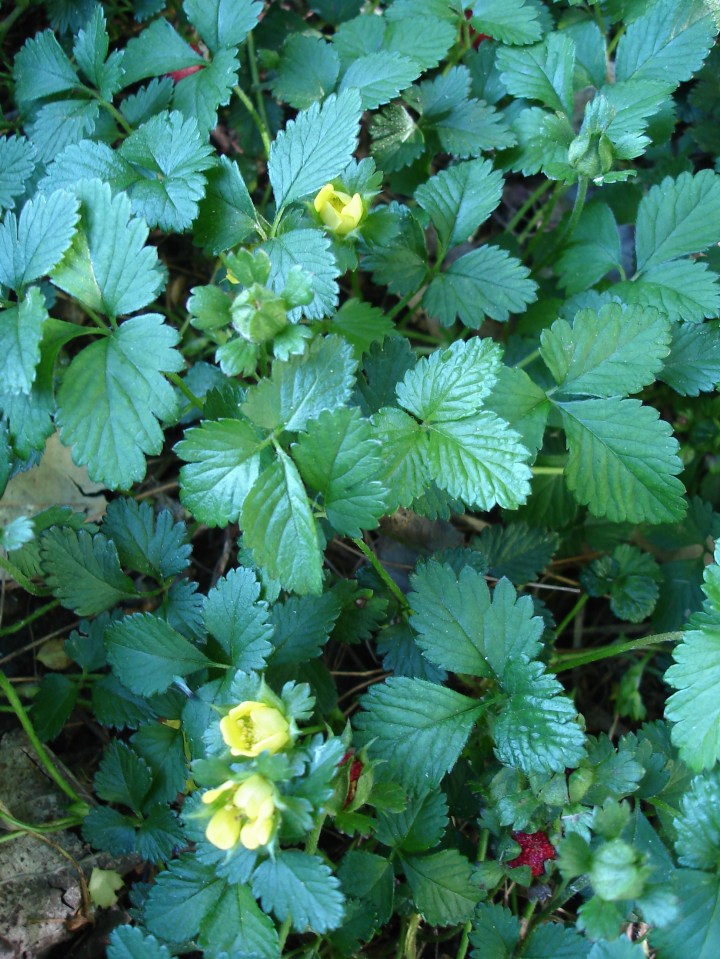
The small yellow flowers are the giveaway. Real strawberries have white or maybe pink flowers. Otherwise, mock strawberry, Potentilla indica, looks very much like wild strawberry, with similar small red fruits and neatly serrate trifoliate leaves (that are palmately divided into three leaflets). The berries are edible, but do not taste like much.
Like real strawberries, mock strawberry spreads efficiently by stolons. If watered occasionally and sometimes fertilized, it is probably a better groundcover than the common ornamental varieties of wild strawberry. It is invasive in some areas.
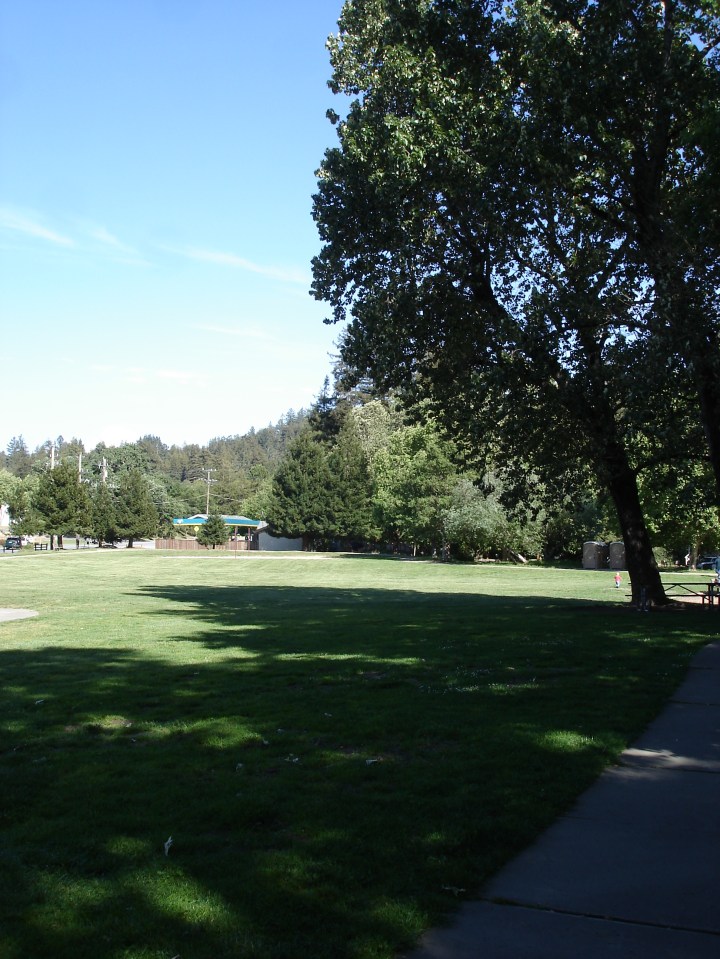
As a landscape feature, lawn and turf are in a distinct category. Just as arborists specialize in arboriculture (horticulture of trees), there used to be horticulturists who specialized in turf. Even though it is just as interesting, and in most regards, much more demanding than other plant material, many horticulturists who are not specialists with turf do not want to bother with it.
Turf is undeniably the most useful of all plant material, which is why there is so much of it. Unfortunately, it is also the most demanding. It requires more water than any other plant material, except only for aquatic plants and some bedding plants. (Small ponds with aquatic plants are actually less consumptive than larger lawns.) Mowing and edging needs to be done almost weekly.
All this work and water is probably worth the effort where turf gets the most use, such as athletic fields and parks. Yet, it is good incentive for alternatives where applicable. Larger patios and decks mean smaller lawns, and are usable ‘hardscape’ areas. Less demanding ground cover plants, and even old fashioned gravel and bark, work nicely over unused areas.
Since it was invented for the athletic field of the Astro Dome, artificial turf has had a bad reputation. It did not feel or look like real turf, and eventually succumbed to wear and tear. Realistically though, it worked. The main problem was that it was constantly compared to real turf, instead of recognized as an alternative to turf, like carpeting for garden space.
Modern artificial turf is much more convincing. It actually looks and feels something like turf, and is more resilient to weathering and wear. It is convincing enough to be used for athletic fields and playgrounds. It would be just as appropriate for landscapes inhabited by dogs if the dogs do not dig. Artificial turf can be expensive, but saves so much in water and labor.
Removing a real lawn and leveling the area for new artificial turf can be stressful to the root systems of mature shrubbery and trees around it, and even in neighboring gardens if the lawn is near a fence. Because artificial turf needs no soil amendment, excavation should be minimal. Because it needs no water, artificial turf can be placed right up against tree trunks.
After artificial turf is installed, some adjacent shrubbery and trees may want to be occasionally watered through the first few summers until they adapt to the lack of watering where the former lawn was. Such plants will not need as much water as the original lawn got, and will only need it temporarily if they get enough water in other areas of their roots zones.
Rhody, . . . because everyone loves Rhody, . . . and this is not about horticulture anyway.
This is not a misspelling of a misspelling. There is no misspelling of “Horticulture” in the title this week. “Horridculture” is typical of my rants on Wednesday. It is not the only deviation from the norm here. I included the contraction of “It’s” in the title. I have been trying to relax my otherwise objectionably uptight writing style; but a contraction in the title still makes me cringe.
“Horridculture – It Is What I Do Not Do.” would be consistent with my style, but silly, and not so relevant to the subject matter. I am a horticulturist, arborist and garden columnist. I enjoy what I do very much, which is why I made a career of it. It is demanding work though, and does not afford much time for blogging. The quality of my blogging is consequently compromised.
I still work as many as three days weekly at a job that was supposed to be temporary two years ago! It is so excellent that I can not bear to leave, although I must eventually do so. It entails the maintenance of many acres of landscapes and forest at a Christian Conference Center. We have been unable to work for the past month, so will be busier than typical as we resume work.
Mondays and Tuesdays are my days for writing my weekly gardening column. I should probably retire from this work, but enjoy it so much, and would prefer to instead expand it into other publications to fill in the gaps between San Francisco and Los Angeles. I do intend to simplify this writing, even if expanding it; so that I can do it all on Mondays like I used to not so long ago.
For more than the past two years, I have not inspected trees or landscapes for other arborists or landscape professions. There just is not sufficient time! I do miss that work, and composing reports for those who dislike writing. (Arborists and landscape professionals who enjoy their trees and landscapes innately dislike writing.) If I ever resume such work, it will be only rarely.
I intend to eventually return to the farm where I belong, and resume production of horticultural commodities. As much as I enjoy the rest of what I do, growing things is what I do naturally. It is why my ‘temporary’ job was supposed to be ‘temporary’ two years ago. It will involve even more demanding work than what I already can not keep up with, but it is what I need to do.
Therefore, I will have even less time to devote to blogging. I intend to continue to post my brief weekly gardening column in two parts on Mondays and Tuesdays, as well as old articles from the same gardening column in two parts on Thursdays and Fridays. I would also like to continue with Six on Saturday and other brief posts for Saturdays at noon, Sundays and Wednesdays.
I write for my gardening column weekly regardless of the blog. Old articles from the column are already written. Only new posts for Saturdays, Sundays and Wednesdays need to be written separately; so some or all will be omitted if necessary. What I must discontinue now is my involvement with the many compelling blogs that I have been following for the past many months.
I will not stop following any of the blogs that I presently follow. I will just not be able to read all of the posts, or interact with them like I had been. For me, it will be quite a weird adjustment. I feel obligated to read much of what others post into blogs that I follow. If someone puts effort into positing it, then it must be important. I certainly enjoy how others interact with my blog.
I certainly do not want anyone to think that I lost interest in their respective blog. Many of them provide ideas for what I should write about within the context of my own weekly gardening column. Insight into horticulture in other climates, regions and even cultures has been fascinating. This is merely something that I must sacrifice in order to continue on with my own writing.
Seed for this species is all or nothing. The straight species of Mediterranean spurge, Euphorbia characias, seeds abundantly. It can actually be a bit too prolific. However, fancier and extensively bred cultivars either produce no viable seed, or produce only a few seed that are not true to type. Such seed grows into plants that resemble their ancestral species more than their direct parents.
Foliage of common Mediterranean spurge is slightly grayish green. Cultivars exhibit more distinctly grayish, bluish, yellowish or variegated foliage. Appealingly weird and generally greenish floral trusses bloom on top of upwardly arching stems about now. Mature plants are less than four feet tall and broad, with neatly rounded form. They slowly lean toward sunlight as they grow and bloom.
After old stems get cut to the ground in autumn, new stems develop through winter, to repeat the process. Established plants are surprisingly resilient to harsh exposure, warmth, wind and lapses of irrigation. They just dislike shade and constant dampness. However, even the healthiest live for only five to eight years. Those that toss seed can provide their own replacements before they go.
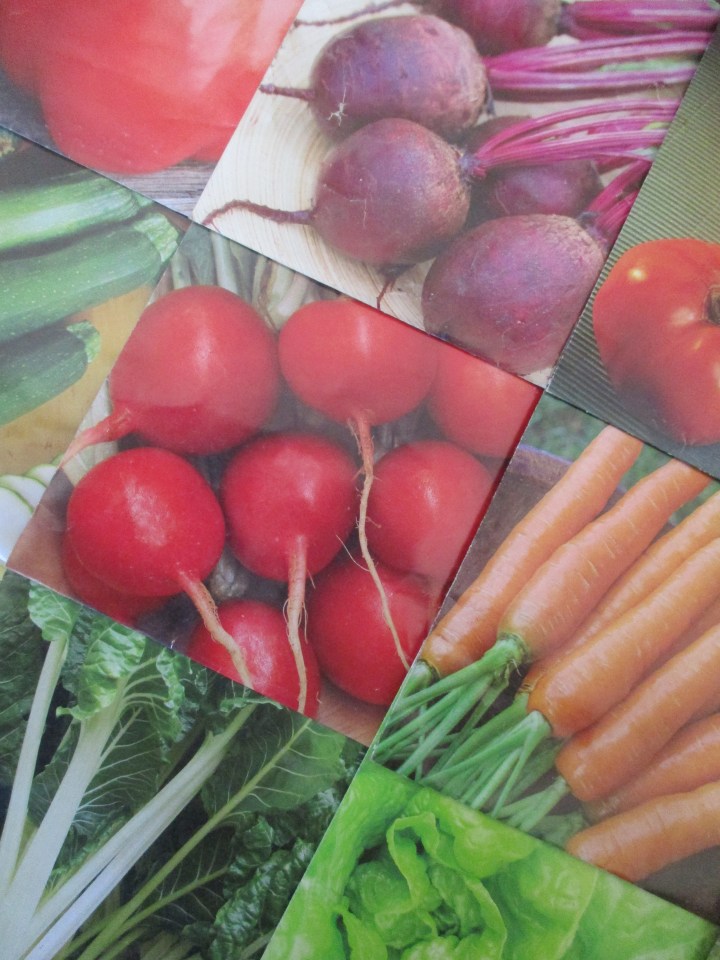
Many of us who are still sowing spring seed know the doubt. Seed for warm season vegetables and bedding plants is presently scarce. Consequently, we doubt that all the varieties that we want are still available. Many unusual varieties that we purchase by mail order or online are sold out. Some more popular and reliably obtainable varieties in supermarket seed racks are going fast too.
Home gardening is very suddenly more popular than it had been for a very long time. Those who can not work at their respective professions have much more time to work in their gardens. Many want to grow a bit more produce at home, in order to shop amongst others in supermarkets less frequently. Many who have never enjoyed gardening before are now taking a serious interest in it.
This adds a few more complications to planning the garden. Choices really are limited. Some of us must be satisfied with what we get. Instead of trying new and unusual varieties, we might need to try old and common varieties. It might be a new and unusual experience, and an interesting way to learn why they have been so popular for so long. This applies to young plants as well as seed.
Although more varieties are available online and by mail order, it is now more important to purchase them early. Delivery is not as prompt as it was prior to this increase in popularity of gardening. Seed providers are overwhelmed by the demand. Since it is already late in the season, it is probably too late to order seed that start in spring. It is not too early to start procuring seed for autumn.
It is also a good time to share surplus with friends and neighbors who may be experiencing the same scarcity of seed and seedlings. Although it is too late to wait for delayed delivery of seed that gets sown in spring, it is not too late to sow some types if they are already available. If left outside to avoid personal interaction with recipients, seed might need protection from rodents and birds.
Anyone who is experienced with gardening knows that it involves challenges. This is certainly a new one.
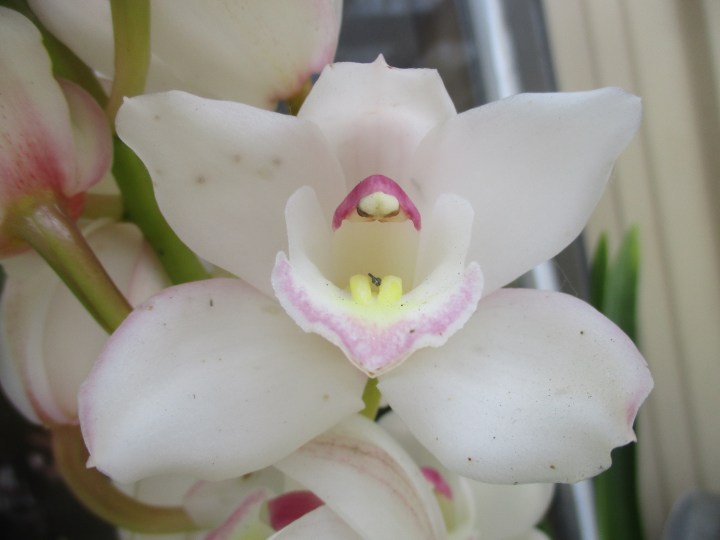
This is what a simple white Cymbidium orchid should look like.
Cymbidium orchids have been popular here for as long as I can remember. Back when horticultural commodities were still more commonly grown around the San Francisco Bay area, many genera of orchids, particularly Cymbidium, were grown in acres of greenhouses in the hills of South San Francisco. They are still grown near the coast of San Mateo and Santa Cruz Counties.
In home gardens, they are often pampered under the shelter of lath, where they are protected from frost and direct exposure to sunlight. Some Cymbidium orchids live and bloom for many years or decades, and sometimes get divided into more as they get overgrown, just like lily-of-the-Nile. Some live longer than those who originally grew them, and go live with someone else.
I never pampered my Cymbidium orchids. I grew all of them out in the garden, with only a bit of partial shade from larger trees. I never once potted any of them into the coarse fir bark that Cymbidium orchids supposedly need. I grew most in dirty and uncomposted oak leaves. I put some in rotting stumps to accelerate the rot. They were happy, and bloomed remarkably well.
None of mine were purchased. They were all acquired from neighbors, clients or colleagues. Of the many Cymbidium orchids that I have grown, none were white! Yes, I wanted a white one. I just do not admit to it.
After maintaining it for more than a decade, and bringing it from a former home hundreds of miles away, a colleague brought me this Cymbidium orchid. Although I did not want him to pass it along after so many years, I was pleased to take it, particularly since it blooms white. Then, it started to bloom, immediately after arrival! Ah, if only there were more people here to see it!
I do not know why the individual flowers are so huddled together.
Steven Michael Ralls Memorial Tree is mostly camouflaged by the surrounding forest.
Steven Michael Ralls got his Memorial Tree this morning, three years after he passed away on May 2, 2017. The circumstances that coincided for this event were impossible to ignore. Just like the other Memorial Tree, which was installed to replace an oak that was missing from a parking lot island, the Steven Michael Ralls Memorial Tree also has a practical application.
The small tree is a young Monterey Cypress, Cupressus macrocarpa, that needed to be removed from one landscape, and was waiting in the recovery nursery to be installed into another. Of course, a Monterey cypress in no easy tree to accommodate. It is too big and too dark to be compatible with most of the landscapes into which we add smaller and mostly deciduous trees.
However, it happens to be ideal for obscuring undesirable scenery, just like a row of five Arizona cypress, Cupressus arizonica, will be expected to do when installed along a busy roadway. Furthermore, it just happens to grow bigger faster than Arizona cypress, so is even better for the low end of the row where a bigger tree is preferred. The row really needs six trees anyway.
The location of the tree just happens to be ideal as well. With all Arizona cypress spaced evenly along the roadway, and the Steven Michael Ralls Memorial Tree strategically situated around the lower corner of the fence, it is located precisely where Steven Michael Ralls camped while homeless late in 2012. I could not have selected a more appropriate location if I had planned it.
The new tree will need to be watered by bucket occasionally through summer, but will need no intervention after the rain starts next autumn. It knows what it needs to do to get established and become an evergreen asset to the forest.
Self isolation was not exactly why I avoided the landscapes. Since there are very few people here, I can get all the pictures I want without getting too close to anyone. Nor did I intentionally avoid the landscapes because, as I mentioned earlier, it is too saddening to see them looking so good without anyone here to enjoy them. I was just too busy to get out. These six pictures are instead from the recovery nursery. These are items that should eventually be out in the landscapes. Some should have bee there a long time ago.
1. Jasminum humile, Italian jasmine was grown from pruning scraps from a big shrubby specimen in Monterey. It does not look like much so far, but is extremely fragrant, like pink jasmine.
2. Solanum jasminoides, potato vine was left by someone who moved away, but has not yet been planted into a landscape. It is overgrown now, so will need to be pruned back when planted.
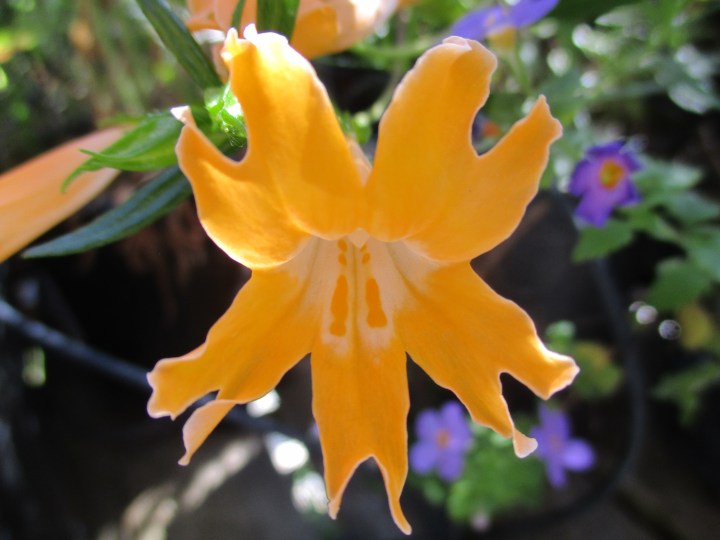
3. Mimulus aurantiacus, sticky monkey flower got removed from where it was in the way of something else, got canned, and now waits to be recycled elsewhere. I should have composted it.
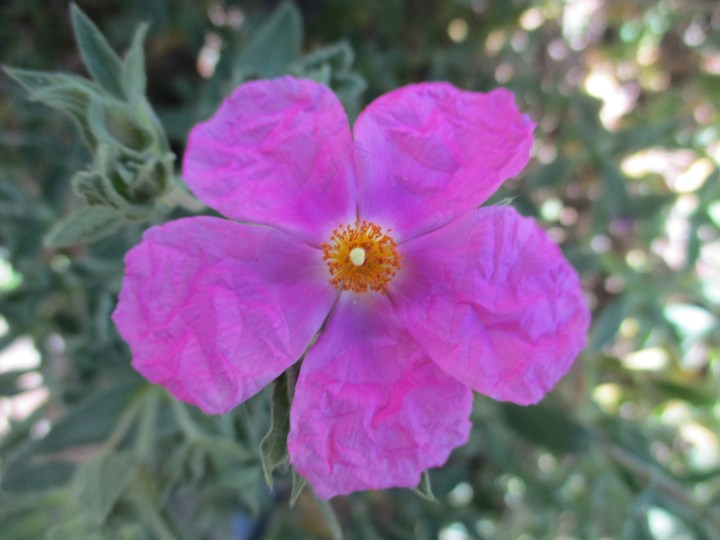
4. Cistus x argenteus, rockrose was actually purchased rather than recycled or grown here. It was for a small new landscape that can not be completed right now. This might be ‘Silver Pink’.
5. Pelargonium peltatum, ivy geranium provided cuttings when pruned a month ago. It might be ‘Royal Candy Cane’. They should have been planted intact, but there is not enough of them.
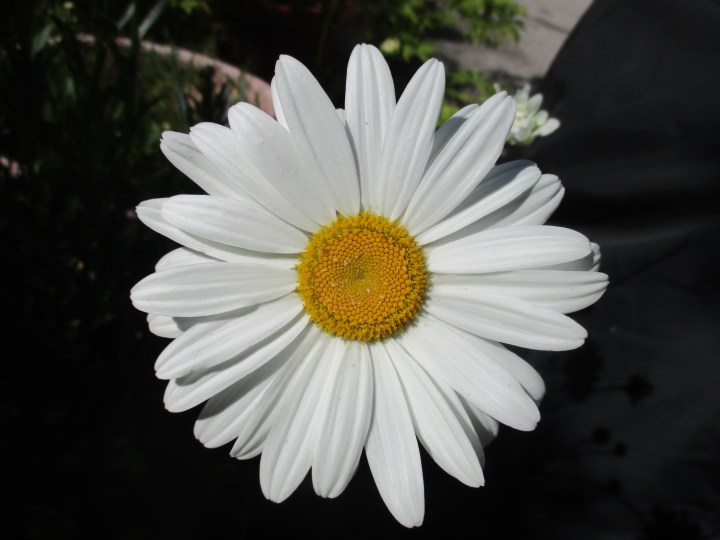
6. Leucanthemum × superbum, Shasta daisy, like sticky monkey flower, was removed from an area that was outfitted with a new landscape, but not yet recycled. I really should just plant it.
This is the link for Six on Saturday, for anyone else who would like to participate: