Midnight Oil

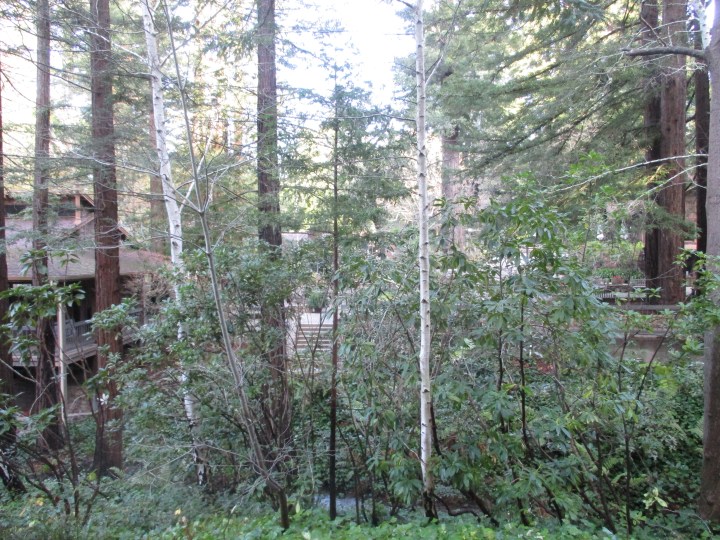
P91027The electricity is still on here at 8:20 p.m.. I just turned the lights off to get the cool picture above. The outages in this region were scheduled to begin twenty minutes ago, so the electricity could be disconnected here at any moment. I may not finish writing and scheduling this to post later at midnight before that happens. So, if you are not reading this presently, you know why.

Before you waste another second thinking about that, I will tell you now that it makes no sense.

Scheduled electrical outages are now one of the consequences of living in this excellent place. We live with trees. Some of these trees are the biggest in the World. Some are very combustible. Regardless of the diligence of those who prune trees to maintain clearance from utility cables, big trees are likely to drop limbs onto cables, causing sparks that can ignite combustible trees.

The electricity just went out at 8:40 p.m..

As I was saying, we also live with weather. It happens to be excellent weather. It is pleasantly warm through summer, with minimal humidity and an almost constant cooling breeze. When the weather gets a bit too warm, it compensates with lower humidity and increased breeze. Unfortunately, this combination of weather is precisely what accelerates the worst of forest fires.

Scheduled electrical outages are intended to coincide with forecasts of weather conditions that are dangerously conducive to the initiation and perpetuation of forest fires. As inconvenient as they are, such outages are a sensible precaution.

The smoke that made such a colorful sunset earlier is from a fire in nearby forests, on the southern coast of San Mateo County.

Now, I will go to town to see if I can find someplace to get online to schedule this for midnight.

Arborists’ View

P91026KArborists see trees very differently from how most of us see them. They know their trees very intimately, and by botanical name. Arborists know how big particular trees get, both tall and wide, and if they are likely to develop structural deficiency or aggressive roots. They can tell us which are deciduous, which are evergreen, and which are messy with foliage, bloom or fruit.

Some arborists are happy to divulge a bit of history of some trees, whether exotic or native. They might tell us where the exotic trees came from, and why they were imported. Some trees were brought for timber. Some were brought for fuel. Some were imported just because they were pretty. Some naturalized, and now impose on the natural ecosystem. Natives try to adapt.

Since they know the innate characteristics of trees, arborists know what their cultural preferences are. They know that some are understory trees that prefer the company of other bigger trees. Many others are those bigger trees, that want to dominate their respective landscapes. Some want plenty of water. Many of the natives do not want much more than annual rainfall.

An arborist might provide you with way more information than you ever thought you wanted about your seemingly innocuous trees.

Besides all that, arborists are a weird breed that really enjoy their work. Arborists like me simply enjoy diagnosing problems with trees, and prescribing corrective arboricultural procedures. Those who climb trees to execute such procedures are much more involved! Their work is as demanding as extreme sports, and they take it very seriously. They must. It is their profession.

This view of a big box elder, Acer negundo, from above, which I got from the edge of a bridge, might be that of just another day at the office for other arborists.

Six on Saturday: More Outages


Electricity is expected to be turned off again tomorrow. The weather is predicted to be too warm, windy and arid (with minimal humidity) to leave it on. Otherwise, sparks from electrical cables out in forested areas could potentially start catastrophic fires. Although unlikely, it is more likely during such weather.

Hopefully, fires will not be started by candles, oil lamps, barbecues, or any of what will compensate for the lack of electricity. One of the worst fires in history here was incidentally started by sparks from a generator.

Trees are regularly and efficiently pruned for clearance from electrical cables. That does not fix everything though. Utility cables can spark even without trees blowing into them. Many trees in many areas are much higher than the utility cables, so can drop limbs onto them.

1. These are the regions of Northern California where electricity will be turned off.

P91026

2. This is a close up of our region, between San Jose and Santa Cruz. At the moment, I am near the first ‘t’ in Scott’s Valley.

P91026+

3. I am not as concerned about the garden in this weather as I am about this freezer without electricity. I would not use a freezer, but this one if for Felton League. I would not normally freeze bread either, but there happened to be space at the time, and it was better than discarding it.P91026++

4. Although this thermometer supposedly got to a hundred today after I got this picture, it was really not much more than ninety degrees. This thermometer is just in a hot spot. According to the weather forecast, it should be only in the mid seventies tomorrow. Obviously, the predicted fire risk is determined by a combination of heat, humidity and wind.P91026+++

5. There was a bit of horticulture to mention too. These are seeds of naked lady amaryllis. They certainly are weird, like mutant salmon eggs, or pink pomegranate seeds. They are supposed to be sown while still pink and fleshy like this, rather than dried. It just seems wrong.P91026++++

6. There were a few amaryllis bulbs in a group that made these unusually big seed capsules. I should have put something else in the picture to show scale. The largest is about as big as a ping pong ball. I suspect that they are the same as the others, but I will sow them separately anyway. Although unlikely, neighborhood crinum could have gotten in the mix.P91026+++++

This is the link for Six on Saturday, for anyone else who would like to participate:

https://thepropagatorblog.wordpress.com/2017/09/18/six-on-saturday-a-participant-guide/
Chrysanthemum

41022Mild autumns and arid summers keep chrysanthemums on a different schedule here than in most other regions. They can get planted in spring to grow through summer and bloom through autumn; but because they can take a bit of work, they are more often planted while blooming in autumn. Although commonly grown as autumn annuals, they are perennials that can regenerate next spring, grow through summer, and bloom even better the following autumn.

Centuries of development in Japan have produced more varieties of chrysanthemums than can be documented. There are really some weird types grown for cut flowers or by hobbyists. Garden varieties are mostly limited to simpler flowers that do not need much thinning or staking. Color ranges through all sorts of hues and shades of yellow, orange, red, pink and bronze, as well as a few purplish colors, cream and white. Many have yellow centers. The aromatic foliage is alluring to some, but objectionable to others.41022thumb

Snails, Weeds And Falling Leaves

P90713KThe coloring of foliage is a bit slow this autumn. The cooling nights after such warm weather is bringing some of the deciduous foliage down while it is barely yellowing. Honeylocust and black oak have already gotten notably sparse without much notable color. Hopefully, the more colorful sweetgum, flowering pear, pistache and gingko trees will retain their foliage later into cooler weather, so that they can put on a worthy show before filling compost piles.

It is probably slightly too early to clean gutters and downspouts. Unless the rainy season somehow starts first, this should probably wait until most of the foliage that is expected to fall has already fallen. Lawns, certain ground covers, decks and pavement should be raked as needed though. Decks and pavement can get stained from the tannins that leach from decomposing foliage. Lawn and ground cover do not like the shade under the debris.

However, slugs and snails really dig the mess. Fallen foliage keeps the ground cool, damp and shaded. Raking leaves does not eliminate slugs and snails, but inhibits their proliferation. There are always plenty of other hiding places. As the weather eventually gets cooler and damp, snails that stay out in the early morning should be collected and disposed of. Of course this technique is not convenient for everyone, since most snails hide before the sun comes up. Small slugs hide earlier in the morning and are even more unpleasant to handle.

Once found, neither slugs nor snails are too elusive . . . or fast. Yet, plucking and collecting them is not a fun job. Once collected, no one knows what to do with them. They can be put into plastic bags and disposed of; and will eventually succumb. Some people prefer to simply toss them onto a dry and sunny driveway or roof where they succumb more quickly and get taken by birds. Snails may need to be squashed to limit mobility.

Even though it is too late to prevent most types of weeds from dispersing their seed, a few types continue to disperse seed as they deteriorate through autumn and winter. Weeds in areas that get watered last longer and disperse their seed later than those without watering. Perennial weeds that are still green in dry areas areas will be easier to pull after the first rain.

Horridculture – Home Greenhouses

P91023Why do we all think we need a greenhouse? Some of us may rely on them for sheltering plants through cold winters. Some of us grow seedling late in winter, for an early start in spring. For some of us, greenhouses are where we grow plants that would not be as happy out in the natural climate. There is a multitude of uses for a greenhouse; but really, how many of us need one?

When I grew citrus trees, I needed a greenhouse. It was where the freshly grafted cuttings were rooted. (Citrus are grafted and rooted simultaneously, literally by grafting the scions to the unrooted understock, and ‘sticking’ the combination as a cutting into rooting media.) The greenhouse contained humidity to prevent desiccation, and warmth to stimulate root development.

From there, freshly rooted citrus trees were canned and moved out of the greenhouse and into a partly sheltered location to harden off. Once well rooted, they graduated from #1 cans to #5 cans, and were moved out to the field where they were completely exposed to the weather. All those acres of citrus tree production used only a few hundred square feet of greenhouse space.

Most of us are not rooting freshly grafted citrus cuttings, or many other cuttings that can not be rooted out in the real weather. Really, in this particularly mild climate, not many of us have any practical use for a greenhouse. It is just something that we believe a well outfitted garden should include, even if we need to procure a few rare and needfully tropical plants to prove it.

Contrary to what anyone says, plants in greenhouses need more work than those of comparable substance outside. They need to be watered even during rainy weather. They need the vents opened during warm weather. Most pathogens proliferate much more aggressively inside a greenhouse than outside. Greenhouses can create almost as much extra work as they eliminate.

The saran house in the picture above works nicely for a few plants that want a bit of shelter. Some plants are recovering from removal from landscapes, and will eventually get planted back into other landscapes. We grew a few of these plants from cuttings. They all get a bit of shelter from hot direct sunlight in summer, and frost in winter. We grow many more plants outside.

Shade trees, even the nearby deciduous box elders, could provide as much shelter as the saran house provides. Nothing fancy is necessary. Plants that need any more shelter than what they could get here or under a shade tree are useless in our landscapes. After all, our landscapes, by nature, are all outside. The plants that go into them must therefore be able to survive outside.

Pumpkin

91030It really would be nice to be able to transform a pumpkin into a chauffeured coach to ride to the ball, just by waving a magic wand over it. A Buick would be even more excellent! Over the years, as the variety of new Buicks has diminished to not much more than a few SUVs that are scarcely more stylish than pumpkins, the variety of pumpkins has grown crazily. Form is not following function.

You see, for longer than anyone can document, pumpkins were grown merely for food. They still make much better pie than other winter squash would. Many varieties produce nicely edible seeds and bloom. In fact, some types are grown specially for their hullless seeds, which are known as pepitas, or for pumpkin seed oil. Nowadays though, pumpkins are more ornamental than culinary.

Decades ago, bright orange pumpkins with relatively thin shells became more popular than the more brownish orange and thicker shelled culinary types. They are more colorful, and more easily carved into Jack-O’-lanterns, but not quite as richly flavored. Since then, white, yellow, pink, red, green and bluish gray pumpkins have become available, in all sorts of shapes, sizes and textures.

Squash For Autumn And Winter

91030thumbWinter squash are not exactly the sort of cool season vegetables that their designation implies. They grow through the summer just like summer squash do. Both winter and summer squash are warm season vegetables that get planted early in spring. The difference is that summer squash get harvested regularly through summer, and winter squash get harvested only once after summer.

Zucchini, crookneck, pattypan and other summer squash are very productive as long as the weather is warm, and their fruit gets harvested. Fruit that stays too long and continues to mature gets big and tough, and consumes resources that would otherwise be diverted to newly developing fruit. Therefore, regular harvesting of the more desirable juvenile fruit actually promotes production.

Pumpkin, acorn, butternut and other winter squash grow all summer, but each plant should be allowed to produce only a few fruits each. Some pumpkin vines produce only one fruit each. Once the desired number of fruits are developing, fruits that start to develop later should be culled to concentrate resources into the primary fruits. These fruits mature all summer to get harvested after frost.

So, by the time that summer squash stops producing, winter squash is about ready for harvest. Where autumn weather is cooler, the tender foliage shrivels after frost, exposing the richly colored but formerly obscured ripe fruit. Winter squash is supposedly best if slightly frosted prior to harvest, which might take a bit longer here. After harvest, they should be left to cure for two weeks or so.

Winter squash vines are more rampant and somewhat shabbier than those of summer squash. Those that produce smaller fruit might be able to climb trellises or onto firewood piles that are not in use through summer anyway. Female flowers tend to shrivel sooner than male flowers, but all flowers that are big and turgid enough to bother with are edible. Bloom continues through summer.

If properly stored, even without canning or freezing, intact winter squash can last for months, until summer squash start producing the following season.

Work Day Renovation Of A Flowering Crabapple

P91020P91020+It is amazing what just a few parishioners and friends can accomplish in just a few hours from about nine to noon on Saturday morning. It is only happens a few times through the year, so we make the most of it to catch up on all sorts of maintenance and projects at Felton Presbyterian Church. (My parish should do this sort of thing.) I was there to work in the minimal landscape.

I started working with this ‘Prairie Fire’ flowering crabapple several years ago. As I pruned for clearance above the adjacent parking spaces and patio, I retained lower growth in the space in between. The tree bloomed too nicely to unnecessarily remove all that was right where it was most visible. Besides, from the patio, it was more visually appealing than a view of parked cars.

Then, I missed a work day. There were plenty of volunteers. There were plenty of power tools. There was plenty of enthusiasm. There was no horticultural expertise. Someone decided that my once exemplary flowering crabapple was in need of pruning, so executed the task with power hedge shears. The damage is irreparable. Lower growth is gone. Upper growth is mutilated.

It was very discouraging. It was done out of season, so I could do nothing to start to repair the damage at the time. There was not much left to repair anyway. I could only let the tree grow through a season so that there would be something to work with later.

Well, this was later. I would have preferred to wait for complete defoliation, but the tree is starting to go dormant now, which is technically good enough. I also would have preferred to prune less away; but really wanted to remove as much of the disfigured growth as possible.

I am less than pleased with the results. With all the disfigured lower growth removed, only the new upper canopy remains. The tree got what my colleagues might refer to as an ‘Ethiopia cut’, which is what much taller trees in Ethiopia get when their lower growth gets eaten by giraffes. It will be a long recovery.

The upper picture is the ‘before’ picture. The bright sunlight at noon does not look so good in the lower ‘after’ picture. I mentioned the Work Day and an update in my other blog, Felton League.


Self Grafted Redwoods

P91019K

Redwoods are some of the most stable trees in the World. That is partly why they can survive for thousands of years. In my entire career, I have seen very few fall, and only inspected two.

Of those two, one fell because it had co-dominant leaders (double trunks) that fell away from each other, which is more of a structural deficiency than instability. The other, which I suspect was demonically possessed, was a small tree less than thirty feet tall, that literally jumped up out of the ground and onto an Astro van more than ten feet away. A rare ‘updraft’ was blamed.

Almost all of the redwoods here regenerated from the stumps and roots of much older trees that were clear cut harvested a century or so ago. Most of those that grew back with structurally deficient co-dominant leaders are very effectively sheltered from wind by their collective groves. Roots systems are very extensive, very resilient, and too intermeshed to be compromised.

The trunks in the picture above are part of a group of several trunks that grew from roots of the same tree that has been gone for a very long time. All are genetically identical and very close together. They happen to be a focal point of a big patio at a conference center. Although the structural integrity of the limbs within their canopy is a concern, the stability of the trunks is not.

Regardless, I am impressed by their attempt to improve stability. The limb that extends horizontally across the middle of this picture from the trunk to the left grafted to the trunk to the right! It is not uncommon for crossing limbs and trunks to rub through their bark to expose the cambium, but how do they stay still long enough to graft together?!