Fan Flower

60727Only a few flowers are true blue. A few more are nearly blue, but slightly blushed with lavender. Of the latter group, fan flower, Scaevola albida, which is usually more lavender than blue, can be quite convincingly blue if conditions are just so. The semi-circular flowers (which are actually wide bilateral flowers) are most abundant in spring and summer, but can bloom sporadically all year.

The finely textured evergreen foliage is dense enough to function as light duty groundcover. Mature plants eventually get about four feet wide without getting deeper than a foot, and more typically stay less than half a foot deep. Outer stems pressed into the soil with their tips up should root and grow into new plants. Fan flower prefers regular but moderate watering. Shade inhibits bloom.

Fan flower only became available in the middle of the 1980’s. How appropriate for flowers of such distinctive style and color! The original common type is still the most reliable. Newer cultivars are not quite as resilient, and might not be as vigorous either. However, they are worth growing for their bigger and bolder flowers, and because they cascade better from pots or raised planters.

To Mulch Is Not Enough

60727thumbMost plants would prefer the real thing; how they do it in the wild. They drop their leaves, flowers and twigs. Deciduous plants do it mostly in autumn. Evergreens might spread it out through the year. The debris accumulates on the ground below, and decomposes at about the same rate as it accumulates. There is no one there to clean it up. Yet, the natural ecosystems know what to do.

The plants that produce the debris use the nutrients produced by its decomposition. So, with the help of the many microorganisms in the soil, they recycle their own trash. To exploit this resource most efficiently, feeder roots tend to congregate near the surface of the soil where the nutrients are. Because the debris also insulates and shades the soil surface, roots are comfortable there.

Densely forested ecosystems produce the most debris. Many smaller plants in such ecosystems may disperse their roots exclusively into decomposing debris without reaching into soil below. In desert ecosystems, where such debris is minimal, roots are mostly dispersed much deeper to avoid the hot and dry soil surface. They wait for recycled nutrients to leach to them through the soil.

Redwoods, cypresses, many pines and most eucalyptus produce unusually thick layers of debris that decompose slowly. This technique inhibits or prevents the germination of seeds of potentially competitive plants. So, in other words, these trees and other plants had this, as well as moisture retention, soil insulation and nutrient recycling, all figured out long before we knew about mulching.

After we put so much work into raking and disposing of foliar debris that would otherwise accumulate in our gardens, it is ironic that we sometimes need to apply seasoned mulch to compensate for the lack of organic material on the surface of the soil. (Unseasoned mulch draws nitrogen from the soil to sustain its own decomposition.) It does more than merely improve the appearance of otherwise exposed soil. Mulch helps unnatural landscape environments function a bit more naturally.

Horridculture – Fruit Theft

70726thumbGrowing fruit trees is quite a bit of work. While producing, some of the fruit trees need nearly as much attention as annual vegetable plants in the vegetable garden. Then, while dormant, they need meticulous and specialized pruning. Some fruit trees get damaged by insect or disease infestation, or severe weather. Some fruit can get taken by wildlife. Yet, for most of us, the reward of fresh fruit is worth all the hard work that goes into growing it.
Unfortunately, most types of fruit, especially the stone fruits, ripen simultaneously within their respective seasons, and are suddenly and briefly too abundant to be consumed while still fresh. Unless shared very efficiently with plenty of friends and neighbors, some of the fruit must be canned, frozen or dried for later consumption. Then, as suddenly as it started, the season for the particular type of fruit is done. There will be no more until next year.
That had never been a problem us, even though some of the fruit trees produce quite a bit. There was one particular summer, about 2004, when we were expecting an unusually abundant crop of unusually big peaches. We got all the jars out and cleaned on Friday afternoon. All the big pots and utensils that we would need for canning were out on the counters. We must have purchased ten pounds of sugar, and even got some pectin for jam.
Early on Saturday morning, we went out to collect the peaches while it was still cool, and found them GONE! It was as if they had never been there. All the work of pruning and pampering the tree was for NOTHING!
Now, I know that when I was a kid, we shared abundance with neighbors. We children were expected to take brown paper grocery bags of produce to neighbors who lacked the trees for particular fruit. For example, I delivered cherries to those who lacked cherry trees. I delivered apricots to the few who lacked apricot trees. Neighbors sometimes stopped me on the road to give bags of fresh produce for my parents or other neighbors.
Also, I know that there was nothing wrong with taking a few fruits from a neighbor’s tree. We often went behind the Charles Residence to get a few oranges when we got out of school. We sometimes got apples from the back yard of the Richmond Residence. Of course, we first asked if we wanted more than a few for a recipe or something. No one really minded because the system was respected, and none of the trees were exploited.
That was a long time ago. By the time I was in high school, we started hearing about fruit trees getting stripped of every last bit of fruit while no one was around. Over the years, it became progressively common. Some neighbors had me cut down fruit trees from their front yards because there was no point in all the maintenance if they could not get fruit from them. It was saddening, wasteful, and so contrary to our formerly idyllic lifestyle.
When it happened to the peach tree that I had taken such good care of in the garden next door, I was furious! What made it even worse is that we knew who did it! The so-called ‘gardener’, who was supposed to ‘maintain’ ONLY the front lawn stopped by the prior evening, just after I checked on the fruit. I sort of wondered why he was there so late, and why he was in back, but gave it no more thought than that.
He later told me that no one wanted the fruit, and that it was just going to fall on the ground and go to waste. Really, I would not have minded if he had taken a few peaches. I would not have minded if he had taken several or even most if he had asked before we got ready to can them. It would have been better for someone or several someones to enjoy them fresh than to can them as surplus.
About a year and a few months or so later, the fig tree in my back yard was stripped by the so-called ‘gardener’ who supposedly ‘maintained’ the landscape next door on the opposite side of where the peach tree lived. There had been no preparation to dry the figs yet, since I had planned to leave them on the tree a bit longer. Also, there was not as much fruit as there was on the peach tree.
The theft of the fruit was not the worst of the problems in this situation. The main problem was that the tree was so severely damaged in the process. I had pruned the tree so meticulously for several years, both for good (late crop) production, and also for clearance above a parking space. I did not mind the slightly elevated canopy; but the guy who stole the fruit without a ladder broke the limbs so that he could get the higher fruit!

Iochroma

90731It is gratifying to see renewed interest in this old fashioned flower. Naturally occurring varieties of some of the nearly three dozen species of Iochroma were popular decades ago. Some might actually be naturally occurring hybrids that have yet to be identified. Many modern cultivars (cultivated varieties) were intentionally bred or hybridized for more compact growth and profuse bloom.

Old fashioned varieties of Iochroma are occasionally seen as large rampant shrubbery or even small trees in old established landscapes. Modern cultivars are more compact and manageable. For the fullest and most vigorous growth in summer, they can be pruned aggressively as winter ends, but should otherwise be pruned only for shape and confinement. They should never be shorn.

If Iochroma resembles angel’s trumpet, it is because they are related. The foliage is very similar, although the leaves are smaller. The narrowly tubular flowers are much smaller and clustered. The hummingbirds who like them so much do not even need to reach their beaks all the way in. Bloom is purple, blue, red, pink or maybe white or yellow. Iochroma happens to do well in partial shade.

Summer Perennials Are Now Blooming

90731thumbAre warm season annuals really the most colorful flowers for summer? Perhaps. They have their limits though. They are also very demanding. They need to be watered very regularly, and should probably be fertilized too. Many need to be deadheaded frequently. After all that, they are only temporary, and will get replaced with cool season annuals in autumn. Perennials are more practical.

Lily-of-the-Nile is likely the most common and most familiar of blooming summer perennials. It is a shame that it blooms only once. Bloom is usually in time for the Fourth of July, and lasts a good long time, but is already fading. Deadheading as the blue or white color is eventually exhausted will not promote subsequent bloom, but will keep the evergreen foliage looking tidy until next year.

Daylily might be the second most popular of summer perennials. Some of the older types bloom only once like lily-of-the-Nile, but various cultivars bloom at various times to prolong the season if a few are grown together in the same garden. The most popular modern cultivars probably bloomed earlier, and will bloom again, perhaps with little time in between. The color range is extensive.

Penstemon are not committed to their natural schedule of blooming in late spring and again in autumn. A good pruning at the end of winter eliminates tired old foliage, and enhances and delays bloom until summer, without compromising the later autumn bloom. Like daylily, a few different varieties of penstemon in the same garden prolong bloom, which can be white, pink, red or purple.

Salvias are a big group of summer perennials that really should be more popular than they are. Some are native. Others are from other chaparral climates. Naturally, they are right at home here. Many bloom about now, and some will bloom again in autumn if deadheaded or pruned back. What they lack in flashy color, they compensate for in resiliency and reliability. They really are tough.

This is by no means a complete list of summer perennials. It does not even include the perennial daisies such as coneflower, black-eyed Susan and gaillardia.

Trendsetters

Now that blue elderberries are ripening. I need to gather mine while I can. This is reblogged from Felton League, because it describes why gathering blue elderberries is not as easy as it was only a few years ago.

tonytomeo's avatarFelton League

Fashion trendsetters we are not. Some of us wear clothing that was donated by others partly because it was no longer in style. We take what we can get.

Nor do we start trends of electronics technology. Most of us are
satisfied with the basics, or none at all.

Most of us are not at all interested in keeping up with the trends
that others indulge in.

Yet, somehow, we inadvertently started a culinary trend that we
probably should have kept as our secret.

Black elderberry had already become a culinary and medicinal fad.
It started with medicinal black elderberry products, such as herbal
extracts and tinctures, to stimulate the immune system. From there,
black elderberry tea, syrup, candy and (cooked) juice were
popularized as more culinarily appealing options for exploiting the
health benefits of this rediscovered fruit. Even old fashioned
products made from the flowers became trendy.

All the…

View original post 248 more words

Candy Corn Dog

P90721Just a short distance from the corn dog orchard, I found this candy corn dog growing wild. I really had no idea that candy corn grew in a corn dog form like this. These particular candy corn seem to have turned from green to yellow to orange as they ripened. It will be interesting to see if the outer ends eventually ripen to yellow like conventional candy corn, or if they are a fancier cultivar. They sort of look like tiny persimmons.

Perhaps it is ‘Cupid Corn’, which is red at the outer end and pink in the middle, for Saint Valentine’s Day. If so, it will be quite stale long before next February.

Even if it is ‘Reindeer Corn’, which is red at the outer end and green in the middle, for Christmas, it will not likely be fresh by late December.

Heck, just expecting it to last until Halloween is a stretch. There are actually a few different cultivars for a variety of holidays, so this one could be for any of the obscure holidays before Halloween that few know about; or it could be very out of season.

I do not know how this candy corn dog got here. I did not plant it. I am pleased that snails, slugs, squirrels or insects have not eaten it so far.

Something came into this part of the landscape earlier, and ate all the foliage off of the Arum italicum. Even though it is a naturalized exotic weed, the Arum italicum was rather appealing, with its intricately lacy foliar variegation. It is completely gone now, but should regenerate once rain resumes in autumn or winter.

For now, the candy corn dog is more colorful than the Arum italicum was. How odd that it has no foliage. hmmmm . . .

Exfoliating Bark

P90720KBecause redwoods live for centuries, their bark gets very thick. They do not shed their bark as they grow. Old giant redwoods in the Sierra Nevada have bark that is a few feet thick and thousands of years old. Their bark is thicker than the trunks of what most of us consider to be large trees! Even much younger coastal redwoods that have regenerated here since clear cut harvesting about a century ago have bark that is a few inches thick.
They like their bark thick. It is the insulation that protects them from forest fires that incinerate other vegetation. Unlike most species here that are designed to burn and then regenerate more vigorously after fire, redwoods prefer to survive fire by being less combustible. As they mature, and their bark gets thicker, they become more resilient to fire. There are only a few species here that survive fire mostly intact, rather than regenerate after it.
Of course, survival is more complicated than mere thick bark. Redwoods, particularly coastal redwoods, also try to exclude other more combustible species from their forests. Also, they tend to shed lower limbs that would be more combustible during a fire, and prioritize higher and therefore less combustible canopies. Redwoods have developed a rather ingenious (but unfortunately ecologically delicate) systems of survival techniques.
Other trees are not so easy to figure out. Many species of Eucalyptus shed lower growth as if they want to be less combustible. They shed copious amounts of foliage and bark to inhibit undergrowth and other combustible vegetation. However, not only are they innately very combustible, but because they shed so much of their bark, they lack insulation from fire. It is as if they expect to burn back to the ground, and then regenerate after a fire.
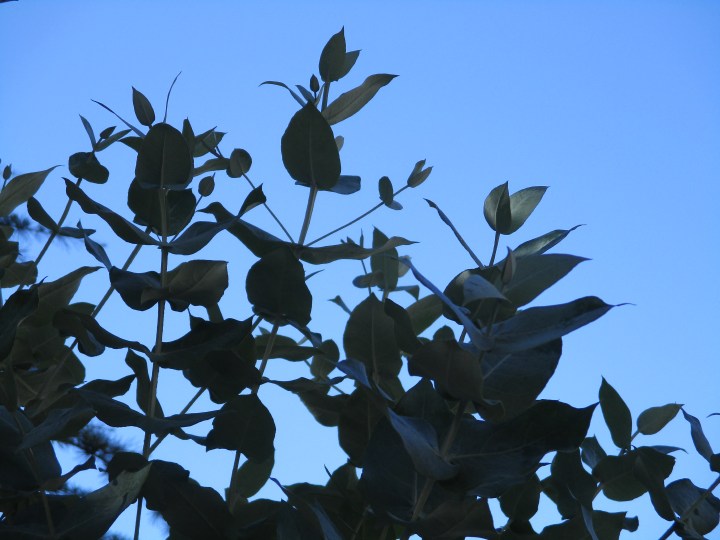
Regardless of their logic, exfoliating bark of the larger eucalypti can be annoyingly messy. Exfoliating bark of some of the smaller eucalypti can be rather appealing in home gardens. This tree happens to be the same featured last week in ‘Silver‘.P90720K+

Six on Saturday: No Category


I do try. I prefer to submit pictures that conform at least somewhat to a particular theme. It just did not work out that way for this week. The only thing in common with these pictures is that they are from the same garden. It is garden at work, but one that I do not do much in.

1. Grape, which I still think of as dago wisteria, was planted here years ago, by someone who is no longer here to take care of it. The established vine grows like big voracious weed. I pruned it back last winter, and pulled up several stems that rooted where they flopped onto the ground. There are still six copies left at the storage nursery. I would like to plant some of them this winter, but the one original is already too much work. The grapes are somewhat tart when ripe, which makes me suspect that it is not quite warm enough here for them. It gets warm during the day, but cools off at night.P90720

2. Succulent of an unknown species grows so close to the grapevine that it was overwhelmed before I pruned the vine back. This is a common exotic succulent that has been around in the region for a long time. I remember that it grew on the sides of some of the roads in Montara, along with other vegetation that naturalized from the gardens of homes that had been there during the Victorian period. I suppose that it is naturalized also in some spots, but does not seem to be aggressive or invasive about it. This particular specimen was likely put here intentionally. The foliage is always yellowish.P90720+

3. Tillandsia, along with a few other epiphytic bromeliads, were added to this garden just this year. They are wired onto this branch from the Eucalyptus cinerea that I mentioned in ‘Silver‘ last week. The branch is a scrap from pruning that was just propped up in the landscape for the ephiphytes. The big gray limbs in the background are of an old ‘Kwanzan’ flowering cherry tree. The epiphyllums that I mentioned two weeks ago on Sunday in ‘Epiphyllum Surprise‘ get hung from the cherry tree while they are in bloom, and then sent back to the storage nursery for recovery when they finish.P90720++

4. Spanish moss hangs with the tillandsias on the same branch of the Eucalyptus cinerea. It does not grow here naturally of course. It would probably prefer a significantly more humid situation. It gets watered and misted automatically from above. So far all the epiphytes seem to be happy here, and do not see to mind that the stem that they are clinging to is from a eucalyptus. Mosses that cling to native oaks do not cling to eucalyptus trees until the trees are old. While viable, young eucalyptus bark is toxic to mosses and other epiphytes, and exfoliates too regularly for much to cling to it anyway.P90720+++

5. Alyssum happens to be one of my favorite wildflowers in this garden. When I was little kid, I found a small envelope of mixed wildflowers seed in a Sunset Magazine in a waiting room in a hospital. It is a long story, but to be brief, I ‘borrowed’ the seed, and put it out in my mother’s garden. The alyssum from that mix naturalized and self sowed quite nicely for decades. The original plants might have bloomed more colorfully, but eventually reverted to basic white, just like these that grow wild here. I still believe that white is the best, but would not mind other colors if I ever grew it intentionally.P90720++++

6. Morning Glory is another favorite, but for a different reason. I like it here because it is so much prettier than it ever was in any of my gardens. I sowed the seed, and cared for it, but morning glory was never very happy for me. In this garden, it sows its own seed, and does reasonably well. The vines are not as voracious as they are supposed to be, but the flowers are pretty. That is probably a good thing. These vines happen to be next to the grapevine, so could make quite a mess on top of the mess of the grapevine if they grew as well as they are supposed to. This is a good compromise.P90720+++++

This is the link for Six on Saturday, for anyone else who would like to participate:

https://thepropagatorblog.wordpress.com/2017/09/18/six-on-saturday-a-participant-guide/

Giant Bird Of Paradise

60720Unlike the common bird of Paradise that is grown for striking bright orange flowers, the giant bird of Paradise, Strelitzia nicolai, is grown for strikingly lush foliage. The big rich green leaves get nearly six feet long, and flare outward from leaning trunks that can eventually reach upstairs eaves. Foliage is healthiest if sheltered from harsh sunlight (such as hot reflected glare), wind and frost.

Bold white blooms with contrastingly delicate blue streaks are a rare surprise on older trunks. The navy blue floral husks with nectar dripping from them look like the beaks of drooling seagulls; but the flared flowers above look like the crests of parrots.