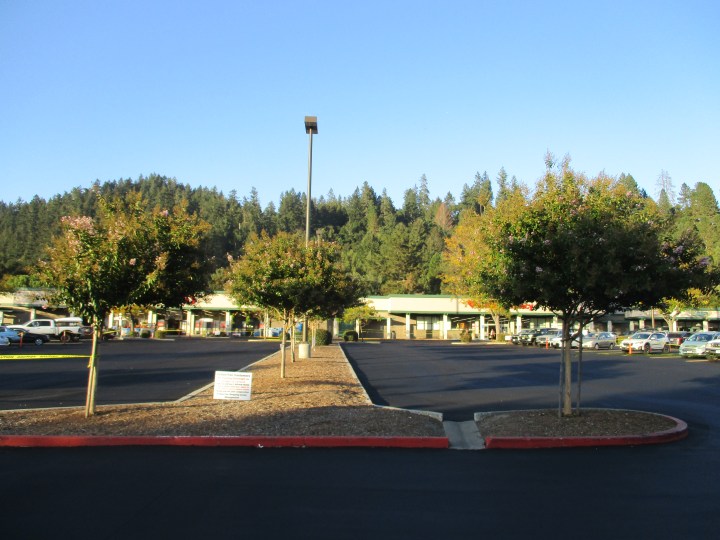
 Perhaps the signs should be down instead. They are obscured by the crape myrtles where they are now. They would be more visible if they were either higher or lower, but not in line with all these trees. The trees were planted only a few years ago, but have done very well. Lodgepoles need to be removed. The specimen to the left is recovering well from earlier disfigurement.
Selection of trees for parking lots is not easy. Such trees must disperse complaisant roots that are not likely to displace pavement or curbs. They should should be reasonably high branched and conducive to pruning for clearance above parked cars, and where necessary, for delivery trucks. Excessive floral or foliar mess would be a problem. So would fruit that attracts wildlife.
Unfortunately, not many trees conform to all limitations. Those with the most complaisant roots do not get big enough to be pruned up high enough for adequate clearance, or even provide significant shade over the often hot black pavement below. Since shade is the primary function of such trees, an abundance of diminutive trees often compensate for fewer substantial trees.
This presents another range of problems. The smaller trees can be pruned for minimal clearance above pedestrians and parked cars, but not delivery trucks. What is worse is that they can not be pruned above lighting and shop signs either. Pruning them lower than the signs instead would only work if the signs were to be viewed horizontally, from the same height as the signs.
Nonetheless, that is what is most commonly done. This is the result. All those flashy and expensive signs on the buildings in the distance are mostly obscured from this vantage. Fortunately, the honey locusts closer to the signs can be pruned up higher for adequate clearance.
 It is easy to mistake various cultivars of Dyckia for diminutive relatives of Agave or Yucca. They form stout rosettes of rigid leaves with wickedly sharp terminal spines. Their comparably nasty but incurved marginal teeth resemble those of most species of Agave, but are generally more abundant. Surprisingly though, Dyckia are instead related to bromeliads. They just happen to be xeric.
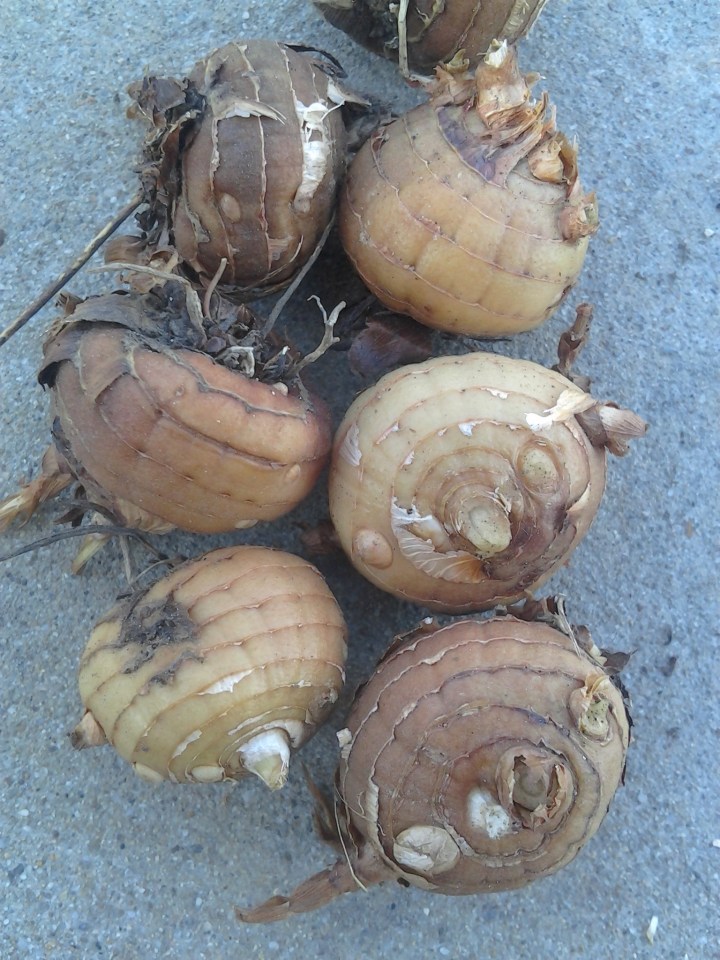 To those who do not enjoy gardening, the process of planting dormant bulbs must seem to be blatantly unproductive. Those of us who know what we are doing are so dutiful to select the bulbs we want, only to bury them in shallow graves in the garden, with nothing to show for all the effort. Knowing that the bulbs are buried at specific depths and orientations makes them no more exciting.
 Okay; so this is neither the first, nor real autumn foliar color. It just happened to be convenient for me to get a picture of. Someone left this unfortunate Japanese maple right outside on the driveway a few years ago. It colors early from uncomfortable exposure to late summer warmth. The picture below is even more colorful, and was from even earlier in the year, last August.
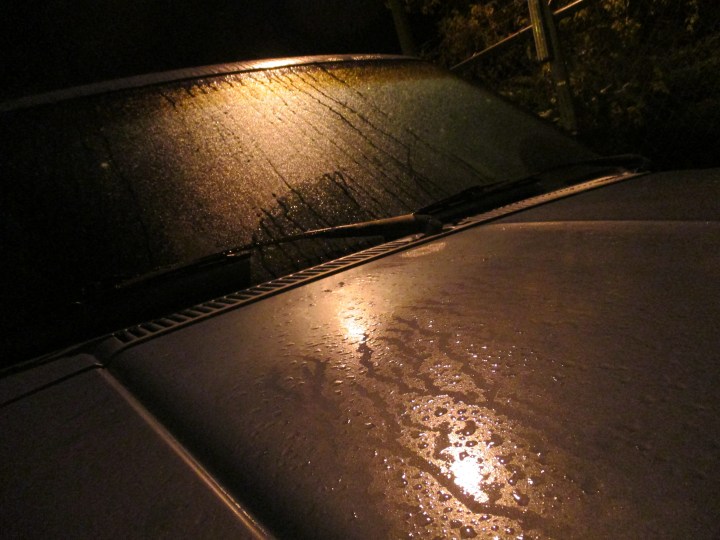 Warnings were broadcast in local news for a few days prior. Because of the extreme potential for catastrophic forest fires, electrical service was to be disabled to our region, and large areas of California. Weather was predicted to be warm, windy and dry (with minimal humidity). Such conditions are exactly what cause fires to spread so explosively through the overgrown forests.


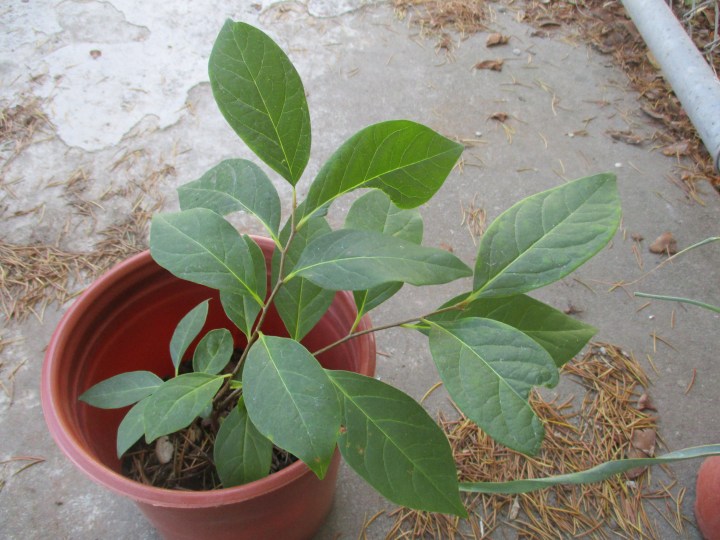

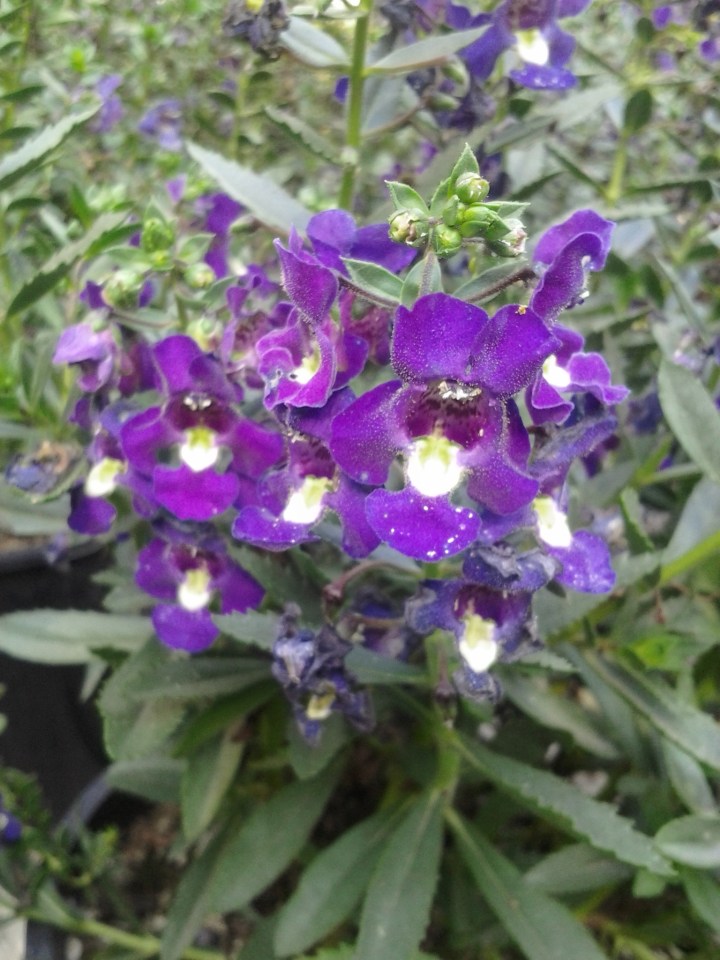 Angelonia is one of those warm season annuals that can actually survive through winter as a pernnial to bloom again next spring. It may even want to continue to bloom untill frost. The flowers can be blue, purple, red, pink or white, and look something like small snapdragon flowers. Most have spots or stripes of an alternate color or two in their throats. Some modern varieties have fragrant flowers. Plants can get a foot or two tall, and almost as wide. In sheltered spots, angelonia can be cut back as soon as it starts to look tired in autumn. Exposed plants might be happier if cut back significantly later, as winter ends. Old growth may be unsightly for a while, but can protect interior stems and roots from frost. Besides, pruning stimulates new growth that will be more susceptible to subsequent frost.
 As the name implies, ‘annuals’ need to be replaced ‘annually’. What is worse is that they do not even function for an entire year, but only for a specific season. Cool season annuals mostly work from autumn to spring. Warm season annuals mostly work from spring to autumn. Calendula is a popular cool season annual that may not last even that long, since it can mildew half way through winter.
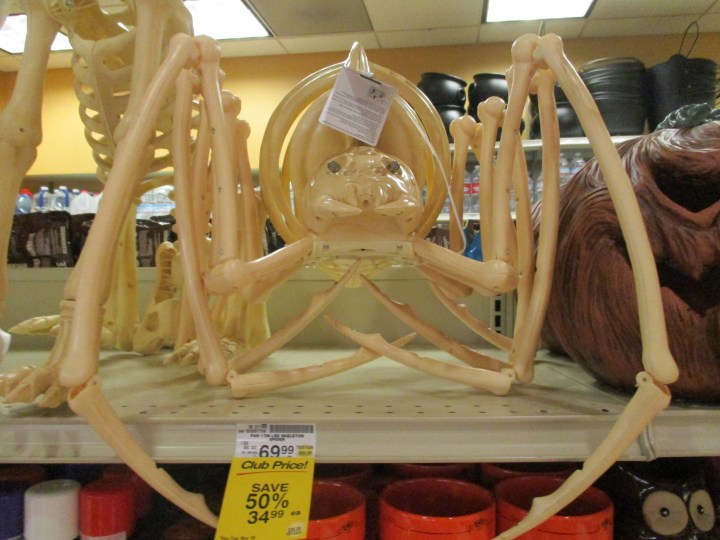 Halloween is a topic that I could rant about for days. Seriously. I loathe it. I dislike any formerly respectable holiday that has been ruined by excessive commercialization. We all know what happened to Christmas. For me, Halloween, in some regards, is even worse. Christmas is at least pretty. Halloween is intended to be morbid and grotesque and creepy and . . . just plain bad.

 This is not an easily defined flower. There are hundreds of species within the genus of Viola. Many are known as pansies. Many are known as violas or Johnny-jump-ups. Many are in between. The main difference between these two major groups is that, although very closely related, pansies bloom with bigger flowers, and violas bloom with smaller, simpler and more abundant flowers.
