Periwinkle

70503Like so many of the easiest to grow plants, periwinkle, Vinca major, is too easy to grow. It has become an invasive exotic (nonnative) weed in many moist riparian environments. It can get rather weedy in home gardens as well. This can be an advantage if it happens to fill in for bald spots in areas of other ground cover. It is a disadvantage if it overwhelms or competes with other plants.

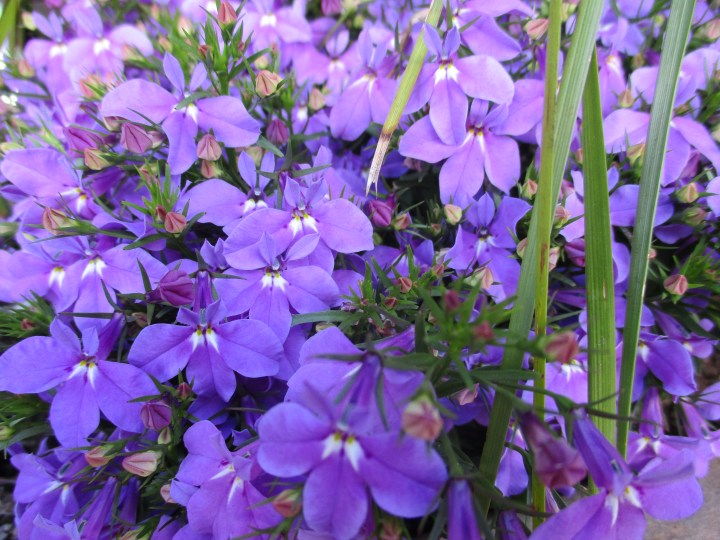
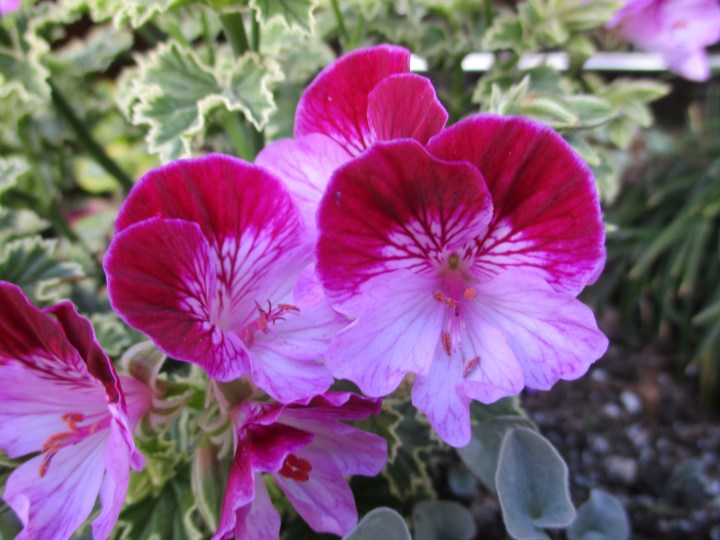
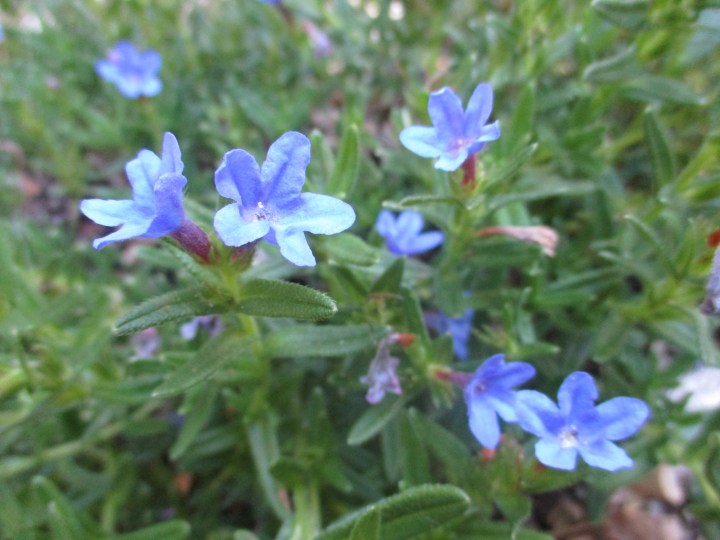
It is hard to believe that such a seemingly innocent plant with sporadic but delightful light blue flowers amongst rich green foliage has such unpleasant potential. The radial flowers are about an inch or maybe two wide, and bloom almost all year except for winter. The simple evergreen leaves are likewise an inch or two long. The wiry stems stand a foot or two high before flopping over.

Once stems lay down, they develop roots where they touch the ground, and form new plants that repeat the process of producing upright stems that flop over. Without confinement, there is no limit to the trouble they can get into. Fortunately, it is not a fast process. Cultivars with white or purple flowers, or variegated foliage are more complaisant. Periwinkle is neater if mown as winter ends.

Get The Lowdown On Groundcover

1Lawns composed of turf grasses are the most functional, but also the most demanding forms of groundcover. That is old news. There are so many other less demanding low growing plants that that can cover the ground in areas that are not used like lawns are. Sometimes they work nicely just to control weeds. Sometimes they help to control erosion on otherwise unlandscaped hillsides.

Like all other plants in the garden, groundcover plants must be appealing. There is no point in growing plants that look no better than the bare soil they are intended to obscure, or the weeds they are intended to control. Some provide good foliage. Some bloom nicely. Many do both. Although not as resilient to wear as turf grasses, some groundcover plants tolerate some degree of traffic.

There are of course all sorts of groundcover. Only a few want as much water as lawns need. Some need no watering at all once established. Some are low growing shrubbery like sprawling forms of ceanothus, coyote brush, cotoneaster, coprosma and juniper. Others are vines like honeysuckle and ivy. Some of the best are creeping low perennials like iceplant, gazania and African daisy.

Low growing shrubberies may not be practical for confined spaces. When they run out of room to grow laterally, they tend to pile up on themselves, and some types can eventually get quite deep. Some types look silly if pruned around the edges for containment. Vines however need to be pruned around the edges, as well as out of trees and shrubbery. Some vines eventually get deep too.

Sprawling perennial groundcovers are the lowest and tidiest of groundcovers. They might not be as practical as shrubbery or vines for large areas, but are more often the better options for tight spaces. They do not mind getting pruned around the edges, and generally do not need any other pruning, although some look better if mown annually. Periwinkle and Saint John’s wort can get deep enough to get sloppy. Many other perennial groundcovers stay low enough to barely get disheveled by light trampling.2

May 2

P80502When I started writing this blog eight months ago, I reserved the right to occasionally write about topics that were irrelevant to horticulture and gardening. I designated the category of ‘elaborations’ for posts that were not from my weekly gardening column; but so far, I have tried to post articles within this category that were at least remotely relevant to horticulture, even if only to discuss a single tree, or merely a single ginkgo leaf that somehow appeared in Felton Covered Bridge Park.

Today is May 2. My post for today is only relevant to horticulture in that it explains the importance of the ‘Memorial Tree’ in Felton Covered Bridge Park.

Steven Michael Ralls passed away a year ago, on May 2, 2017

Jeffrey Dale Scofield passed away two years prior to that, on May 2, 2015

They were two of my most intimate friends. I wrote both obituaries. The obituaries are posted below, and are irrelevant to horticulture.

The small valley oak ‘Memorial Tree’ that was planted in Felton Covered Bridge Park was originally designated as the ‘Scofield Tree’. However, a few more prominent friends of our Community passed away afterward; and the Park could not accommodate more memorial trees. Finally, when we could not find an appropriate situation for a memorial tree for Steven, the ‘Scofield Tree’ was designated simply as the ‘Memorial Tree’. These are a few brief articles about it.

https://tonytomeo.wordpress.com/2017/10/06/small-tree-in-a-big-park/

https://tonytomeo.wordpress.com/2017/12/24/scofield-tree-update/

https://tonytomeo.wordpress.com/2018/03/31/scofield-tree-update-spring-2018/

https://tonytomeo.wordpress.com/2018/04/15/memorial-tree-update-to-the-updated-update-etc-the-sequel-to-all-those-other-sequels/

These are two articles about some of our adventures with Steven, and a third about the ginkgo leaf that appeared in Felton Covered Bridge Park on Steven’s birthday last December 13:

https://tonytomeo.wordpress.com/2017/11/19/oklahoma/

https://tonytomeo.wordpress.com/2017/12/13/birthday/

https://tonytomeo.wordpress.com/2018/01/21/okie-mowers/

P80502+
Jeffrey Dale Scofield of Felton passed away peacefully from complications associated with cancer on May 2, 2015, in Santa Cruz, only a short distance from where he was born on June 9, 1959. Except for when he traveled for work in other regions, he lived his entire life in the San Lorenzo Valley.

After harvesting timber earlier in his career, Jeffrey Scofield became well known professionally for setting “miles of tiles” and stone. More recently, he harvested firewood. He was a champion of both baseball and arm wrestling.

Mr. Scofield is survived by his sister Valerie of Las Vegas, nephew Rodney of Bethel Island, niece Christa, nephew Charles of Reno, and many lifelong friends of the San Lorenzo Valley. Ashes will be scattered privately.

P80502++Steven Michael Ralls of Felton succumbed to complications associated with a variety of chronic medical conditions, and passed away in Aptos on May 2, 2017, at the age of 46. Steven was born on December 13, 1970 in Fort Leonard Wood, Missouri, and then spent most of his childhood in Norman, Oklahoma. He came with his family to Berkeley, California in 1987, and then lived in Hayward, before settling in Felton in 1999. His recent relocation to Aptos was considered to be only temporary, as he would have preferred to return home to Felton.
Prior to the onset of debilitating medical conditions, Steven had a distinguished career in specialized woodworking and finish carpentry. His work can be found in some of the more luxuriously outfitted homes and offices of the San Francisco and Monterey Bay Areas. Steven was also remarkably proficient with the restoration of old homes, cabinetry and furniture.
Later in life, Steven devoted more attention to art, particularly drawing and guitar music. His talent with the guitar was exceeded only by his exquisite voice that accompanied it.
Steven Ralls is survived by his son Michael Forrest Ralls of Oakland, California, wife Gayle Schermerhorn of Murphys, California, brother Jonathan Ralls of Hayward, California, sister Tammy Roberts of Wichita, Kansas, sister Brandi Ralls Sullivan of Lakewood, Washington, brother Brent Patty of Saginaw, Texas, mother Virginia Bates of Newalla, Oklahoma, father Michael Ralls of Olathe, Kansas, and many old friends of the San Lorenzo Valley.

Avens

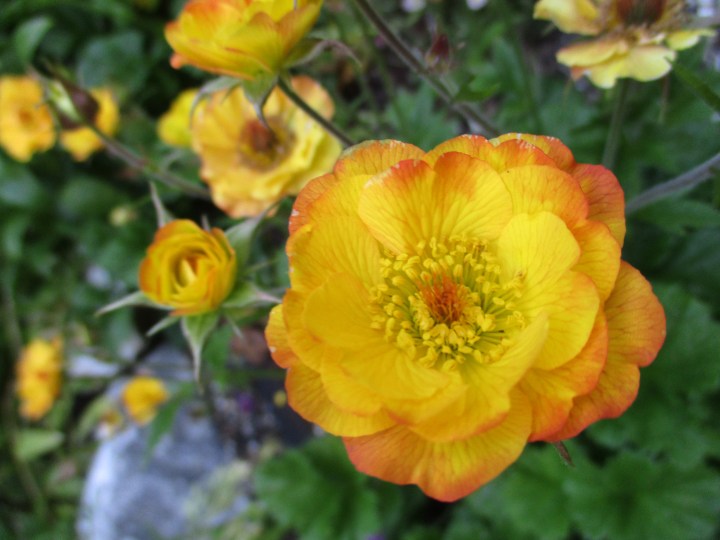
80509Wow, this is quite old school. Is it making a comeback? That would be nice. Avens, which is also known as Chilean avens, Geum quellyon, is an old fashioned perennial relative of the strawberry. Instead of producing fruit, it provides handsome yellow, red or coppery orange flowers that look something like small single, semi-double or double anemones, but can bloom through most of May.

Although perennial, avens do not last forever without some degree of help. After the first season, most of the slightly ruffled and hairy foliage dies down during the colder part of winter. New foliage and bloom develop in spring. After the second or third year, and every few years afterward, mature plants should be divided before or after bloom. Pups are more vigorous than the parent plants.

Happy avens gets as high and wide as a foot and a half. Much of the height is in the branched floral stems, which might need to be staked if they get too heavy with bloom, or are in a breezy spot. Most of the mounding foliage is basal. A bit of shade is tolerable and actually preferred to hot situations. Soil should be rich and well drained. Avens plays well with others in mixed perennial beds.

Gophers Go For Roots And Lawns

80509thumbWho do they think they are?! This ain’t ‘Caddy Shack’! They have such attitude! Gophers move into our gardens and lawns, take what they want, and build their messy volcanoes of loose soil. They do not care how much work we put into our gardens, or how much we spend on nice plants, or how much we crave our first zucchini of the year. They are safe in their subterranean tunnels.

Or so they think. There is more than one way to . . . well, you know. There are also several methods that either do not work, or are not practical. For example, gasoline poured into a tunnel may volatilize, and then explode if ignited, killing gophers below, but can very easily start a fire anywhere the fumes happen to seep from the tunnel, and there is no way of knowing where that might be!

Poisons are dangerous either because gophers do not eat them, leaving them to be dug up by someone else later, or because gophers do eat them, and then stagger from their tunnels in search of water, and then get eaten by someone else who gets poisoned as well. Putting razor blades in the tunnels is just plain wrong. Even if it actually kills gophers, who wants to dig up razors later?

Traps are still the most efficient way to eliminate gophers. This is of course more easily said than done. It must be done properly and VERY carefully. Gopher traps are dangerous! It is safest to learn how to set traps from someone who is experienced with them. Safer modern types that fit into holes that gophers are expelling soil from only work if gophers happen to be active at the time.

Conventional gopher traps are set and placed in a pair, with one trap in each direction of an excavated and cleared main run. A main run is found by following a surface tunnel below the freshest volcano of expelled soil, to where it splits into two direction. The paired traps should be attached by wire to a stake that stays visible at the surface. A bit of crushed vegetation can be placed behind the traps before the run gets buried firmly. If set properly, a gopher springs a trap as it returns to clear the run.

Pine

P80429Redwood Glen was the ‘camp’ that we all went to in the sixth grade. It was probably our equivalent of what is now known as ‘nature camp’. For most of us, our experience at Redwood Glen was the longest time we had ever been away from our homes and families. We arrived on Monday morning, and returned home on Friday afternoon. It was something that we looked forward to with great anticipation for the few years prior.

While there, we studied nature in a variety of ways. We found animal tracks and made plaster casts of them. We went hiking through a variety of ecosystems, and went on a night hike. We searched for fossils; and I found and still have the most complete fossil of half of a fish. We studied ecology and native flora and fauna. We identified redwoods, Douglas firs, ponderosa pines, bays, live oaks, bigleaf maples and box elders. We collected a few edible herbaceous plants and made our own salads with them. The three leaves that I collected to distinguish leaves with pinnate, palmate and parallel veins was a project in one of our botanical workshops. I described it yesterday at: https://tonytomeo.wordpress.com/2018/04/28/pinnate-leaves/

For my class, that was back in November of 1978. In 1995, when I went to grow rhododendrons nearby, I became a neighbor to Redwood Glen. I always knew where it was, but never had any excuse to stop by; until now. Some of my colleagues who manage the facilities and landscapes at a nearby conference center toured the site. I was right there with them.

Some of the buildings were new since 1978. Some had been renovated. The big dining room had not changed. What was most excellent about touring the facility was finding the same old cabin I stayed in back in 1978. I think that it was simply designated as Cabin 4 back then, but is now known as ‘PINE’.

Except for a modern roof and windows, Pine looks just like it did when I was there three decades ago. The middle front door was for the counselors who stayed in their own tiny room between the two wings to the left and right. I stayed in the wing on the right. My bunk was the lower of the two just inside the front door to the right. I so wanted to see the interior of Pine, but the door was locked.

I rarely want to see places that I remember so fondly. I prefer to remember them as they were rather than find that they had been renovated disgracefully, or demolished and replaced with something new. I sort of expected to find something new here. What an excellent surprise!P80429+

Pinnate Leaves

P80428K.JPGThat refers to the pattern of the veins in the leaves. Long before studying horticulture and botany at Cal Poly, my classmates and I learned a bit about horticulture within the contexts of studying ‘nature’. While in the sixth grade, we all went to camp for a week. One of the many projects we did during that time was collecting a few leaves to represent three different vein patterns, and mounting them under clear plastic on a cardboard plaque. The three different patters were, ‘pinnate’, ‘palmate’, and ‘parallel’. I do not remember if we all used the same leaves, but for my plaque, I got a blue gum eucalyptus leaf to represent pinnate veins. Palmate veins were represented by English ivy. Parallel veins were represented by English plantain.

These two blue gum trees are the same trees that provided the leaf with pinnate veins for my plaque. This is not a good picture. There really are two trees here. The picture below is even worse, but shows that there really are two separate trees. They probably flanked a driveway to the old house outside of the picture to the right. They are not very healthy right now, and do not seem to be much bigger than they were back in November of 1978, when my sixth grade class was here at camp with them.

This camp happens to be right down the road from the farm. We are neighbors. It is gratifying to see that so much of the camp is just as it was four decades ago. The English ivy that was so common back than is completely gone now, probably because it is so invasive. The lawn around the blue gum eucalyptus used to be much weedier, and provided the English plantain leaves for my plaque.P80428K+

Six on Saturday: Camellias on Parade II – Another Sequel


The camellias are getting meager, but a few are STILL blooming, even a week after the camellias that were blooming so late last week! These pictures were taken at the same time as those for last Saturday. There were just too many to fit into six pictures. Last week, we had two light pink and four white camellias. These are the dark pink or red camellias. There are no pictures of sasanqua camellias, and we have no reticulata camellias.

1. This is probably the biggest of our camellias. I do not know the name of it or any of the camellias here, but I believe that this is one of the old classics that had been around for centuries, and was popular in the 1960s.P80428
2. If this big ruffled dark pink camellia looks like the last one, it just might be. It does not seem to be as deep red, but that might be a result of the exposure.P80428+
3. You know, I do not typically like this simple pink; and I do not typically like this floral form; but for some reason, I really like this simple pink camellia. It just looks so much like a camellia should look.P80428++
4. This floral form is more refined, but looks almost too perfect, as if the flower were assembled by robots on an assembly line.P80428+++
5. This one also seems to have been assembled, but is a bit friendlier. I happen to like such formality.P80428++++
6. Like #3, this one has an unavoidable appeal. It really looks like a camellia should look, although it also looks like it could use some Grecian Formula.P80428+++++
This is the link for Six on Saturday, for anyone else who would like to participate:

https://thepropagatorblog.wordpress.com/2017/09/18/six-on-saturday-a-participant-guide/

Wisteria

70426The popular wisterias that bloom so profusely before their new foliage appears in spring are Chinese wisteria, Wisteria sinensis. Others specie are rare. The impressively longer floral trusses of Japanese wisteria are not as abundant, and bloom late amongst developing foliage. American and Kentucky wisteria are more docile small vines, but their floral trusses are both short and late.

Chinese wisteria is also the most fragrant and the most colorful of the wisterias. Lavender is still the most popular and traditional color. White, pink, sky blue and darker almost purplish lavender are also available. The floral trusses, known as racemes, get from half a foot to two feet long. Double flowered cultivars never became too popular because the fluffier blooms are not as elegant. The aggressive vines can reach the tops of tall trees. They rarely strangle limbs or young tree trunks, but have the potential to do so. They are more likely to crush fences and lattice. Wisteria really needs sturdy trellises and specialized pruning for confinement. Vines that grow from seed may take many years to bloom. The pinnately compound leaves turn pale yellow before falling in autumn.

Shade Is Not For Everyone

70426thumbThere is no way around it. Just about every garden has some degree of shade. Even low profile single story houses without eaves or fences are shaded on the north side. Eastern exposures get the cooler morning sun. Western exposures get only the warmer afternoon sun. There are vacant and treeless parcels out in the desert that lack shade, but not many of us are gardening out there.

Shade is very often an asset, which is why shade trees are so popular for shading both gardens and homes. Eaves and awnings are architectural features that shade windows and doorways. Arbors, lath roofs and patio umbrellas provide shade for patios where trees are lacking or insufficient. Without shade, garden spaces can get too uncomfortably warm to be useful during summer.

The problem with too much shade is that, although it makes the garden more comfortable and useful for some things, it also makes the garden less useful for gardening. Roses, vegetable plants and most flowering annuals need good exposure. Lawn, the carpeting for some of the more useful of garden spaces, can be sparse where it is too shaded. Sunlight is as important as shade is.

This is one of the many reasons it is so important to select the proper trees for each application. Big trees are nice, but might shade too much area. Evergreen trees that are good for obscuring unwanted views at a distance, will prevent warming sunlight from reaching parts of the home through winter if they are too close. Neighboring gardens and homes need to be considered as well.

Planning functional gardens is of course not always simple. Most of us contend with trees, shrubbery and vines that are too big and shady, either in our own gardens or in neighboring gardens. Climbing vines like wisteria, honeysuckle and trumpet vine, are notorious for growing far beyond their intended applications. It sometimes becomes necessary to remove overgrown or crowded plants, or prune them for confinement. Big plants that can not be contained will limit the choices for other plants that share their space.