Spontaneous Limb Failure

P80701It is as scary as it sounds. Well foliated limbs or entire trees really do fall spontaneously during the calmest of warm weather. It never fails to frighten anyone who witnesses it. Those who witness it always express the same difficulty with trying to explain it to those who did not witness it, as if they know that no one will believe them.

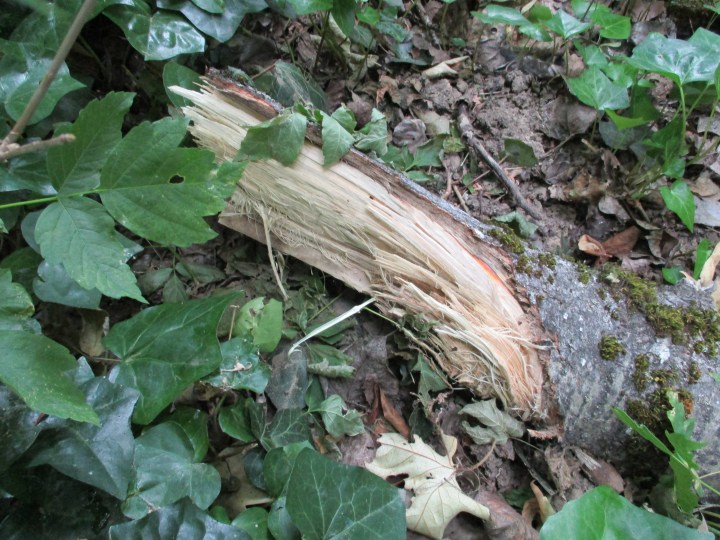
Several people heard this cottonwood limb fall onto a bridle path in Felton Covered Bridge Park. It is not a particularly large limb. The diameter about a foot above the flared union is only about seven inches.P80701+

Yet, even this relatively small limb is seriously dangerous when it falls from above, and from such a height.P80701++

A much larger sycamore limb that was almost two feet in diameter fell nearby a few years ago. It was like a full sized tree falling from the sky!

What makes it so frightening is the spontaneity. We expect limbs to break when the wind is blowing. Trees are more likely to fall when the soil is saturated from an abundance of rain. Dynamic weather like wind, rain and snow are expected to be the cause of limb or tree failure. Passive weather like warmth and humidity seem like they should be innocent of causing such damage. Not so.

Warmth accelerates vascular activity, which increases the weight of healthy foliage.

Humidity inhibits evapotranspiration (evaporation from foliar surfaces) that would otherwise decrease the increasing foliar weight.

Breezes that are normally thought of as a cause of limb failure would actually enhance evapotranspiration. Therefore, a lack of any breeze actually increases the potential for spontaneous limb failure.

So, while the weather is warm, humid and still, just when you least expect it, spontaneous limb failure is most likely to happen.

Horridculture – Stub

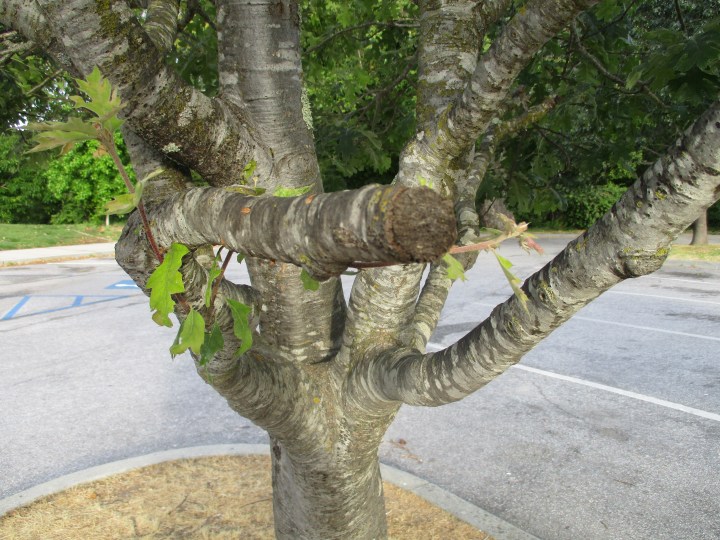
P80620.JPGHow can a professional ‘gardener’ leave such a stub on the little California black oak in Felton Covered Bridge Park. It is not as if it is high in the canopy of a large tree, and out of reach to an arborist. This one is right at eye level, exactly where someone getting out of a car parked in the adjacent parking space would run into it. The entire tree needs some major corrective pruning, which would include the removal of significant limbs and portions of the canopy, but that is only because of years of neglect, and is another story. Right now, we are focusing on the eye-level stub.

It is not easy to see in these pictures because the lower branches are so congested. The stub extends from the lower left to the upper right in the first picture. It is right in the center of the second picture, protruding upward and to the left of the trunk, and then kinking back to the right. The last picture shows how easy it would be to reach from the ground. This particular tree is located right across from the Memorial Tree. https://tonytomeo.wordpress.com/2018/04/15/memorial-tree-update-to-the-updated-update-etc-the-sequel-to-all-those-other-sequels/

We are always taught to not leave stubs. They interfere with compartmentalization of the pruning wound, or in this case, grow back into a disfigured wad of useless growth that will just need to be removed later. This poor tree already has plenty structural problems. Even if it were not unhealthy for the tree, it is just plain unsightly. Seriously, this looks ridiculous.

‘Gardeners’ do it all the time, as if they all take the same class on ‘how to leave stubs’. What was the advantage to cutting the limb right there instead of two feet closer to the trunk to eliminate the entire stub?P80620+P80620++

FLUX

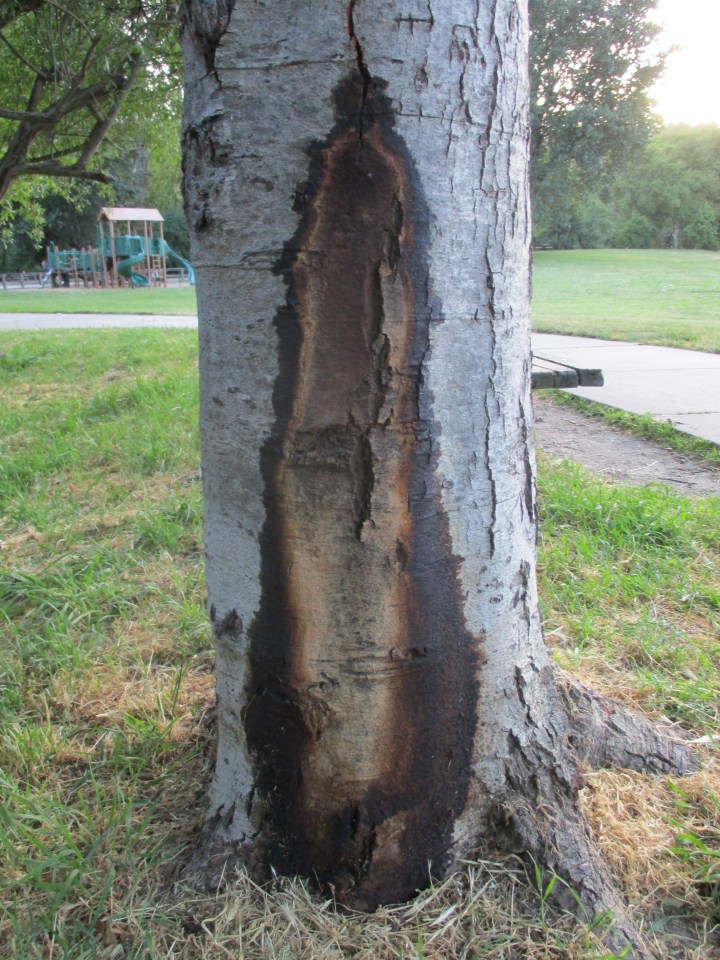
P80523This unhappy native white alder, Alnus rhombifolia, had been deteriorating for quite a while. White alders do not last long even in the wild. A few nearby have already been removed. This one is next. They were nice and shady when the landscape was new. Nicely maturing sycamores and a bigleaf maple can take over for this one now.

As bad as it looks, this nasty stain had nothing to do with the imminent doom of this tree. It developed only recently, and very quickly. It is not nearly as bad as it looks. If the tree were not to be removed, it could survive with this problem for quite a while. Other healthier trees can live with it for many years or indefinitely, and some actually recover.

It is ‘flux’. More specifically, it is slime flux, which is also known as bacterial wetwood. The obvious symptoms are this unsightly bleeding and staining. A less obvious symptom is the swelling that caused the fissure in the bark from which the unsightly fluid is draining. The fluid can smell nasty!

Furrows in the bark develop naturally as the trunk expands over many years. They do not penetrate through the bark into the cambium below.

Fissures are fractures that penetrate through the bark and into the cambium. The fissure in these pictures developed so recently that the orange interior of the bark has not oxidized to tan or gray yet. The fissure is about six inches long, and slightly lower than a doorknob.

Even for healthy trees, there is no remedy for slime flux infection. It can only be left to do whatever is going to do. It can accelerate internal decay, but is otherwise not as detrimental to the health of an infected tree as it would seem to be.P80523+P80523++

(The article from my weekly gardening column that is typically posted on Thursday was posted yesterday, which is why this article, which is more appropriate for Wednesday is posted today.)

Not So Fruitless Cherry Trees

P80520The ‘politically correct’ designation for them now is ‘flowering cherry’. We all know what it means, but it is not quite as accurate. After all, they all flower. Fruiting cherries can not make fruit without flowering first. The old fashioned designation as ‘fruitless cherry’ is more accurate, but not so appealing. Besides, after half a century, the work of these two deteriorating old fruitless cherry trees has not been in vain.

We are not certain what cultivar they are. I think of them as ‘Akebono’ because that is what I am familiar with. However, those who have been acquainted with them longer know them as ‘Yoshino’. The tree structure seems to be more similar to that of ‘Akebono’. The bloom seems to be more similar to that of ‘Yoshino’. My Mother happens to like ‘Akebono’, so if she ever asks, I know what to say. However, I would tell my Pa that they are ‘Yoshino’ because that happens to be the middle name of his newest son in law, who he gave my baby sister #5 away to. It does not really matter what their name is. They are some of the most important trees in the neighborhood.

You would think that with all the very old and very big redwoods here, that these puny and decrepit flowering cherry trees would not be all that important. Some of the redwoods are hundreds of feet tall and hundreds of years old. They will still be here for a very long time after the flowering cherries are gone. Flowering cherries can last for centuries where they are happiest and pampered in old gardens in Japan, but rarely last half a century here, even in the best of conditions.

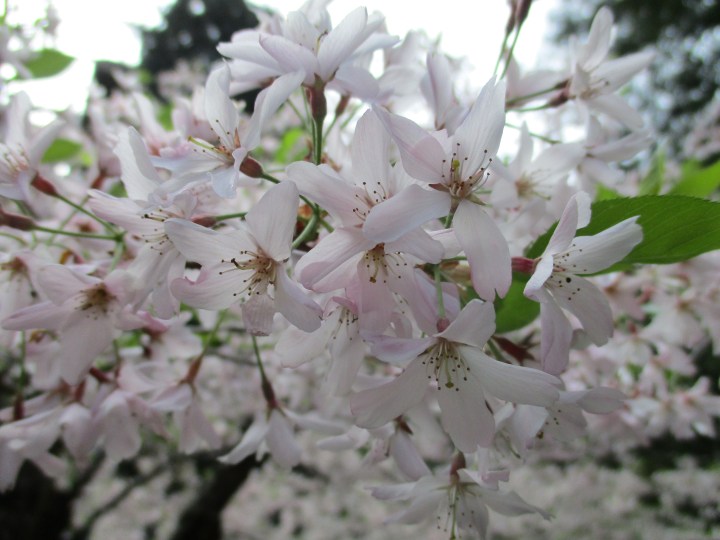
However, everyone in the neighborhood knows these cherry trees. There are only a few people who can remember before the trees were planted in the late 1960s. They are spectacular in bloom, particularly with the dark green backdrop of the rest of the landscape and redwoods. The picture below shows a close up of the bloom about a month and a half ago. One can imagine the entire canopy of the trees covered with this bloom before new foliage appears. It was even more spectacular years ago, before the canopies started to deteriorate and die back. There is not much left of them now.

They really are as bad as they look in the picture above. The closer of the two trees is just a stump with that silly little stub on top to make it look even more disfigured. I could not cut off the stump because some of the minimal remaining viable stems originate there. It does not matter much. There is no way to repair these trees, or make them any prettier. Either of the trees could die at any moment. We are ready to plant at least one replacement, although we will likely only plant one. The objective is to restore the bloom that was there before, but we know that there is no replacement for the trees that those who are familiar with are so fond of.

I have worked with MANY trees through my career, including a few that are (or were) very cultural significant. I was very disgusted by the lack of respect for a group of historic redwoods that used to be outside the old City Hall in Sunnyvale before the mall was build around them, over the area that used to be downtown. I inspected the big old coast live oak at the Scott Residence in Scott’s Valley, where the founder of the town resided. Again, I was saddened by the lack of concern from people who live there now but know nothing of local history, and care even less. At the Winchester House, I witnessed idiotic mislabeling of the historic California fan palms flanking the driveway, as well as blatant lies about their history. Well, I could write another article about this rant. These not so fruitless flowering cherries do not fit into this category anyway.

It seems that everyone is aware that the flowering cherries will be gone soon, and they understand why. No one questions the need for removal. It is saddening anyway. Yet, it is also gratifying to know that these trees are appreciated and respected as much as they are. Those who know them appreciate all the work they put into making their lives a bit more colorful and happier. For half a century, these flowering cherries have been doing what they were planted to do. They had a very good and fruitful career.P80414
A Tree Falls In The Forest

70412thumbThe Great Basin bristlecone pine of the eastern Sierra Nevada can live more than five thousand years. The giant sequoia of the western Sierra Nevada can live more than three thousand years. The familiar coastal redwood from the Coastal Ranges can live more than two thousand years. Besides impressive longevity, one thing that they all have in common is that they all eventually die.
Most trees in home gardens do not live much more than a century. Some oaks can last a long time. Willows, poplars and acacias do not. Trees typically do not live as long in landscape situations as they do naturally in the wild because their life cycles are accelerated by watering and fertilizing, and also because watering promotes rot. Some trees get removed because they grow too big.

While trees are young and growing, they sometimes need help with structural problems. They might need pruning to eliminate limbs that are likely to break away and fall. On rare occasion, trees might need pruning to reduce weight and resistance to wind if stability becomes a concern. Falling limbs or falling trees are very natural in the wild, but can be serious problems around the home.

As trees age, they develop more structural deficiencies, which are increasingly difficult to repair or accommodate. Most big old hardwood trees have some degree of decay within their main trunks, even if no such damage is visible from the outside. Although perfectly natural, this decay eventually compromises structural integrity. Stability is slowly compromised as aging roots decay.

It is true that most trees that fall or drop limbs are more likely to do so while getting thrashed by winter storms. However, there are other factors that can bring down limbs or entire trees. Warming spring weather promotes growth of new foliage, which significantly increases the weight and wind resistance of structurally deficient limbs and destabilized trees. Warmth also accelerates decay. Even after winter storms, there are many other reasons to be aware of the health of trees.

High Fashion

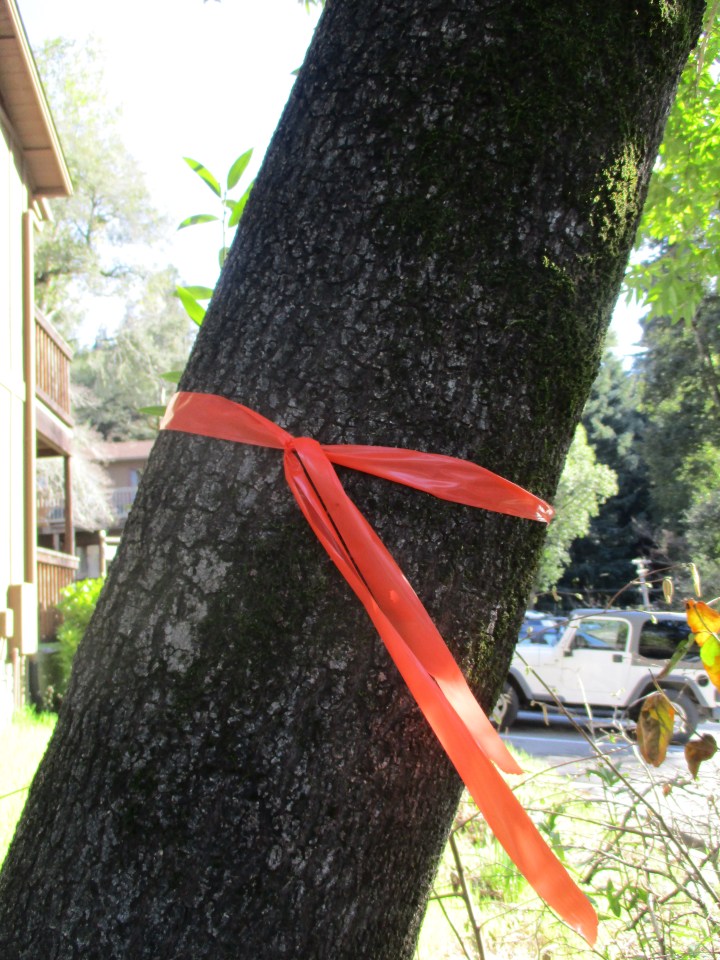
P80404This exquisite yet elegantly simple persimmon orange cravat is to die for! See how distinguishing it is for the Umbellularia californica sporting it! The brilliant color is so appropriate for a tree that needs to stand out in a crowd! How else would the arborists coming to cut it down find it? Yes, it is to die for!

This sort of high fashion is not normally so high. Trees that are tagged by surveyors are typically more discretely tagged with spray paint down near the ground. We just used this orange tape because we were only hastily marking a few or our own trees for removal, and nothing else.

The problem with tape in other situations is that it can be removed and applied to another tree. One of my colleagues sent his crew to cut down a street tree downtown that had been marked with orange tape, only to find later that the wrong tree had been cut down. The client had procured a permit for the tree that the arborist had tied the tape onto, but not another tree next to it that he wanted removed also. After the arborist marked the tree to be removed with tape and left, the client removed the tape, and tied it onto the tree that was to be preserved. Of course, the crew cut down the tree with the orange tape. The sleazy client did not want to pay for the removal because the wrong tree had been cut down, and then hired another tree service to legally remove the tree for which the removal permit had been issued, while leaving the first arborist liable for cutting down a protected tree without a permit. Fortunately, a neighboring merchant knew what the client was up to, saw him move the tape, and reported the incident to the responding code enforcement agents. The arborist got paid. The client got two huge fines; one for removing the tree without a permit, and one for the value of the rather valuable tree.

Tape works fine in the nursery because there is no one there to do anything sleazy. Besides, paint would be messy. Many years ago, we used red tape for stock that needed to be disposed of, orange tape for stock that needed to be shifted into the next larger size, and blue tape for stock that was sold and needed to be moved to a holding corral or loaded onto a delivery truck. Of course, different nurseries might use different colors and a different code.

For the sort of tree work that I was involved with, orange or red paint was used only on trees that were to be removed. It would not have been appropriate to tag good trees with paint! We usually marked trees for removal with a circled ‘X’ or just an ‘X’, in a very visible manner.

Surveyors use paint in a more discrete fashion, with single dots or other small markings of paint down near the ground. They use a variety of colors and a standardized code system. The paint is not permanent, and weathers away after a year or so. Some trees get tagged for pruning for clearance from utility cables. Some get tagged for clearance above roadways and sidewalks. A few that are hazardous or in need of such severe pruning that they will be ruined in the process get tagged for removal. Each color of paint means something different. Each specific tag is a message to whomever is responsible for the prescribed procedure. Some who are responsive to the coded messages work for the respective municipality. Others work for a utility company of some sort. They may not know what all the tagging means, but they recognize the meaning of the tags that are addressed to them.

That is why, when a client asks me what a particular tag on a tree means, I can only say that I do not know. I know what tags my associates use, and I can guess what a prominent circled ‘X’ or an ‘X’ means because I know of so many arborists who use that tag. I do happen to know what the bright orange tape around the bay tree above means because my associate put it there. However, I do not know what a blue dot, green dot, yellow dot, orange vertical line or red horizontal line mean.

Hanging Gardens of Babylon

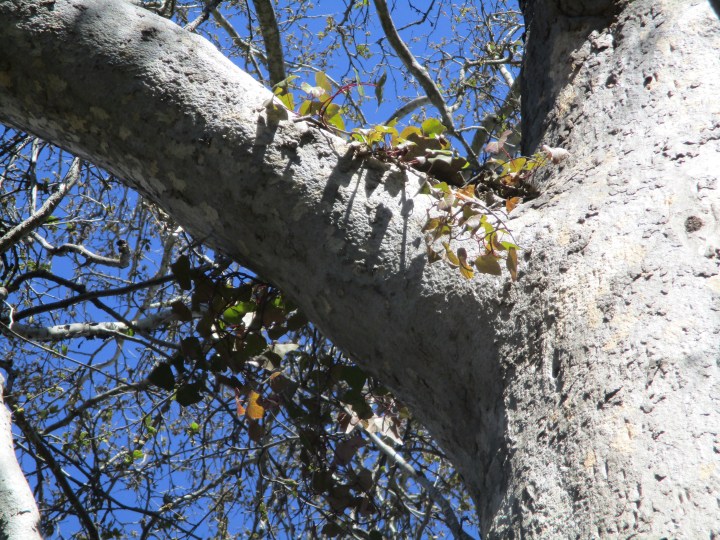
P80328The ivy in this sycamore did not just climb up from the ground to hang over this big limb. If you look closely, you will see no vine coming up from the ground. This small patch of ivy as well as a small pyracantha, are growing in a decayed cavity on top of the big limb. The ivy may have climbed up a long time ago, and then rooted into the cavity before the original vine was somehow removed. Alternatively, the ivy might have grown from a seed that was dropped by a bird or ivy vines that are higher up in nearby box elder trees. It is impossible to say now.P80328+It is also difficult to say why there is such a large cavity on top of the limb. It could have originated as a large scar incurred from the impact of another large limb that fell from above. There are a few cavities higher up that were caused by large limbs breaking away. Although unlikely, the cavity could have developed from sun scald damage, after the upper surface of the big limb suddenly became exposed by the loss of limbs higher up.P80328++This other aerial patch of ivy hangs from a smaller cavity higher in the same tree. Oddly, among sycamores, such cavities on upper surfaces of large limbs are not uncommon. Sycamores often drop large limbs from high in their canopies, exposing or damaging lower limbs below. Their lightly colored bark is very susceptible to sun scald if suddenly exposed after always being shaded. It is also not very resilient to heavy impact. Of course, more typical cavities develop on trunks where significant limbs broke or were pruned away. Other plants can grow in these as well, as demonstrated by the ‘epiphyte’. https://tonytomeo.wordpress.com/2017/11/15/epiphyte/

the Good, the Bad, and they’re both UGLY!

P80307Pollarding and coppicing are bad words to most American arborists. These extreme pruning techniques are considered to be synonymous with topping. Yet, both have been around for centuries, and have actually kept some trees alive and productive significantly longer than they would naturally live.
Rather than redundantly explaining what pollarding and coppicing are, and why they are useful arboricultural techniques, I will provide this link to an article I wrote about them earlier: https://tonytomeo.wordpress.com/2018/02/12/pollarding-and-coppicing-pruning-techniques/

I am one of the rare American arborists who not only condone pollarding and coppicing, but I also use these techniques when necessary. I will be coppicing red twig dogwood soon so that it produces more vigorous red twigs next year, and also because we can not allow it to grow wild as a thicket. Some of my fig trees will get pollarded to make vigorous shoots for cuttings, and also to keep them contained in their minimal space. Both techniques are very effective if done properly.

I must stress the word ‘properly’.

Improperly executed pollarding or coppicing really is disfiguring, and can be disastrous. Yet, it is done quite often by those who get payed to maintain landscapes!

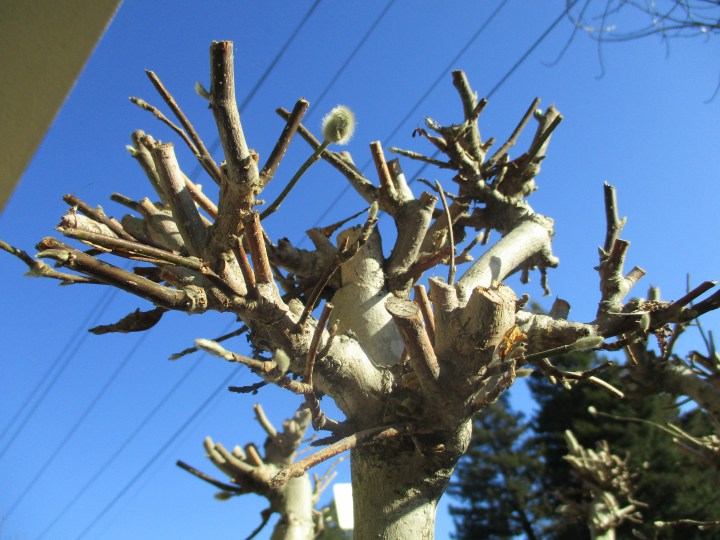
The picture above illustrates a remarkably well pollarded flowering pear tree. It was obviously done by an arborist who knows how to pollard in the English style. Although it is difficult to see in the picture, the knuckles were pruned back cleanly last year, leaving no stubble. The vigorous secondary shoots developed mostly from the knuckles, with only a few stems emerging from lower on the main limbs. When this tree gets pollarded again (and it may have already been pollarded since this picture was taken last week), it should get pruned back to the same knuckles.

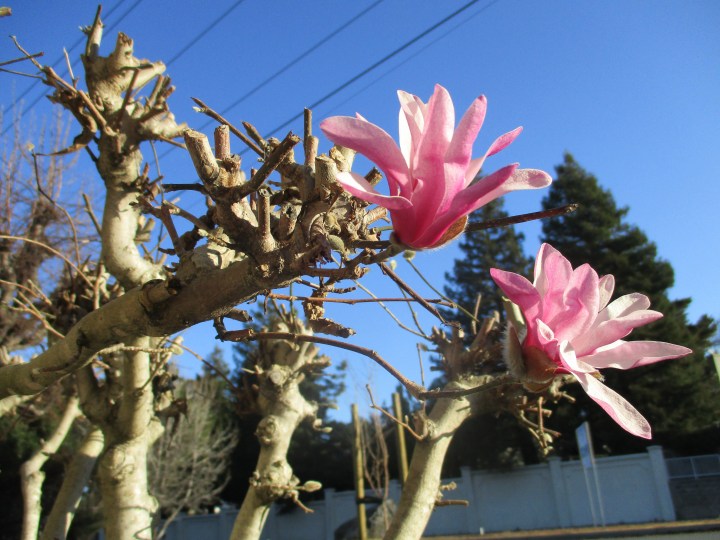
The pictures below show some sort of magnolia that was severely disfigured by maintenance ‘gardeners’, probably for no other reason than it was within their reach. A magnolia can not bloom if all of the stems from the previous year get pruned off by pollarding. This magnolia happened to bloom with a few distorted flowers only because the pollarding was so poorly done, that long stubs remain. These flowers are really nothing to look at within the context of all this unsightly disfigured stems. The long stubs can not be compartmentalized as the new growth develops in spring, so will remain as open and decaying wounds as the tree matures.

So, what is the point of this magnolias even being in the landscape? It contribute nothing. It can not bloom. It can not grow into a tree, but is unappealing as shrubbery. It will always be disfigured. The disfigurement will eventually compromise its health. It would be best if it were merely removed, or at least coppiced and allowed to regenerate. Even if it is a grafted tree, and gets coppiced below the graft, the resulting growth would be an improvement, and might actually bloom if the ‘gardeners’ do not ruing it again.P80307+P80307++

Two Heads Are Better Than One

P80221Three or four might be better than two. Perhaps that is what this queen palm was thinking when it decided to get extras.

This is not a good picture, and the tree is a bit too shaggy with old foliage to see what is going on inside clearly. To the left, a secondary limb is curving downward and away from the main trunk, before curving back upward as a secondary canopy. Another limb is developing immediately above this secondary canopy, and another is visible to the right of the main trunk. It is hard to say how many individual canopies are within the collective canopy of this single specimen.

What is weird about this development is that the popularly available palms do not form branches. Think of it. When was the last time you saw a palm tree with a limb or branches? Before you answer that, yuccas (such as Joshua trees) and dracaenas are not palms. Also, clumping palms like Mediterranean fan palm do not form limbs from their main trunks. They merely develop multiple trunks from basal pups.

The very few specie of palm that develop branches regularly are very rare and live very far away. Date palms, either grown for dates or recycled into landscapes from displaced date orchards, have the potential to develop pups higher on their trunks, but rarely do so.

Palms are only trees because they have trunks. Otherwise, they are merely really big perennials, with single terminal buds from which all their foliage, flowers and fruit develop. If deprived of the terminal bud, a palm can not generate a new one, which is why a palm will die if topped.

So why does this queen palm have more than one terminal bud? It is impossible to say.

Pollarding And Coppicing Pruning Techniques

80221thumbJust about any other arborist will say that pollarding and coppicing are wrong. These techniques ruin trees so that they can never develop into their natural form. Although restorative pruning after pollarding or coppicing is possible, it is usually more trouble than it is worth. However, no one can deny that properly pollarded and coppiced trees can live much longer than they would naturally.

Pollarding and coppicing are extreme pruning. Coppicing is literally cutting a tree down to a stump just above the ground. Pollarding is almost as severe, but allows the main trunk and main limbs to remain. It does not end there of course. It must be repeated annually to maintain the coppiced stump or pollarded trunk and limbs. Secondary growth gets pruned off, back to the previous cuts.

After this process is repeated for a few years, coppiced stumps and pollarded limbs develop distended ‘knuckles’. Cutting back to but not below these knuckles facilitates compartmentalization (healing) of pruning wounds. Because the secondary growth is only a year old when cut annually, the wounds are relatively small, so they get grown over by new growth during the following season.

English style pollarding leaves one or two stubs of any desired length on each knuckle annually. These stubs are generally but not necessarily selected from stems that are aimed upward and outward. This technique elongates knuckles so that the trees are more gnarly and sculptural. Otherwise, all other stems must be pruned away cleanly. Stubs interfere with compartmentalization.

Pollarding and coppicing are done while trees are dormant in winter, and only to the few specie of trees that are conducive to it. These techniques were historically used to generate firewood, wiry willow stems for weaving baskets, straight fence stakes, or lush foliage for livestock and silkworms. Nowadays, they are done to keep big trees small, enhance the size and color of leaves, enhance the color of bark (on twiggy secondary growth), maintain juvenile foliage, or to prevent the bloom of allergenic flowers.