Berries Get Colorful For Winter

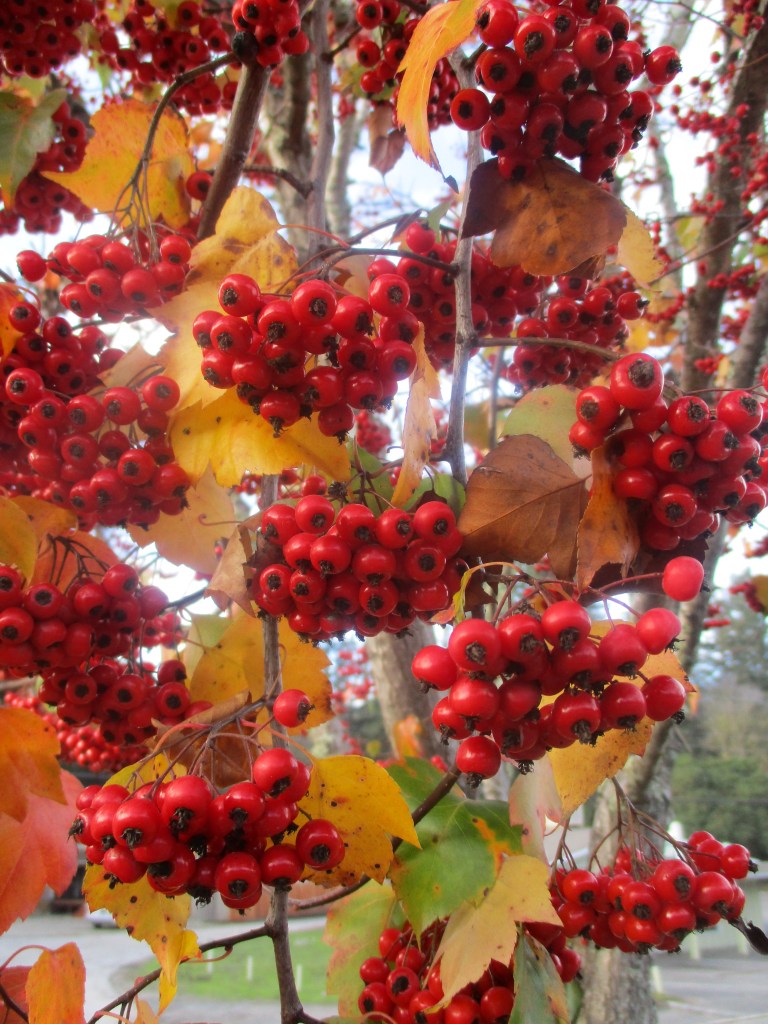
Firethorn berries are very reliably abundant.

Some vegetation excels at exploitation of wildlife. All sorts of flowers use color and floral form to attract pollinators. Many flowers rely on fragrance or flavorful nectar for this same purpose. Many flowers employ a combination of such techniques. After pollination, many species produce fruit to draw wildlife to disperse their seed. This includes winter berries.

Just as flowers appeal to particular pollinators, fruits appeal to particular consumers. Big fruits appeal to animals who eat them, perhaps sloppily, but drop the seed within. Acorns and nuts appeal to squirrels who bury more than they can retrieve. Winter berries appeal to birds who do not digest the seed within. The birds deposit the seed wherever they go.

It is a mutually beneficial arrangement. Birds, whether migratory or overwintering, eat as many berries as they want. Vegetation that provides winter berries benefits from efficient dispersal of its seed. Naturally, such fruits ripen as birds are fattening up for winter. They are brightly colorful to attract hungry birds. They are small enough for birds to eat whole.

This is convenient for home gardening. It provides some color after defoliation of autumn foliar color, and prior to spring bloom. It is actually more appealing where cooler weather accelerates defoliation. Also, such color contrasts more prominently against snow within a stark landscape. Within any climate though, such berries last only until birds find them.

For some, birds and squirrels who come for winter berries are welcome. Some prefer the color of winter berries. Ultimately though, the wildlife determines how long winter berries linger. Anyone can cultivate vegetation that produces winter berries. Very few can protect such fruit from wildlife that craves it. Berries rarely last long enough to rot through winter.

Firethorn produces the most colorful winter berries. Various cotoneasters are similar, but with somewhat subdued rusty red color. Toyon develops larger but looser clusters of fruit. English hawthorn fruit resembles that of cotoneaster, but on bare stems. Hollies produce only a few berries. They are dioecious, so need male pollinators which are rarely nearby.

Six on Saturday: No Hunting

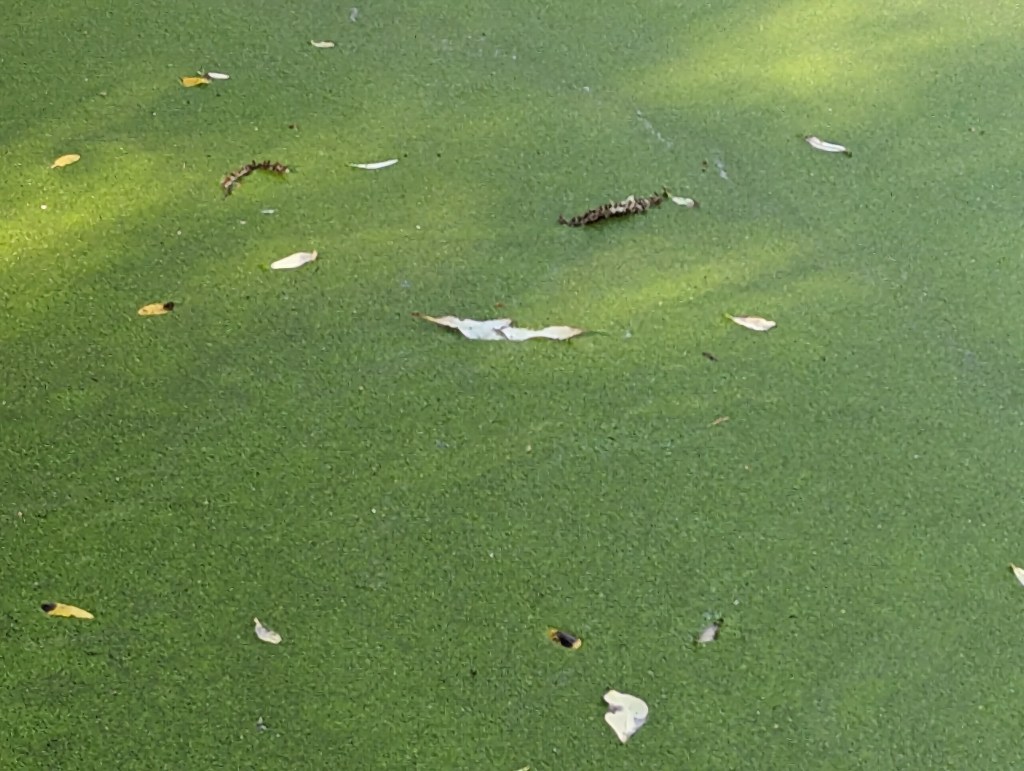
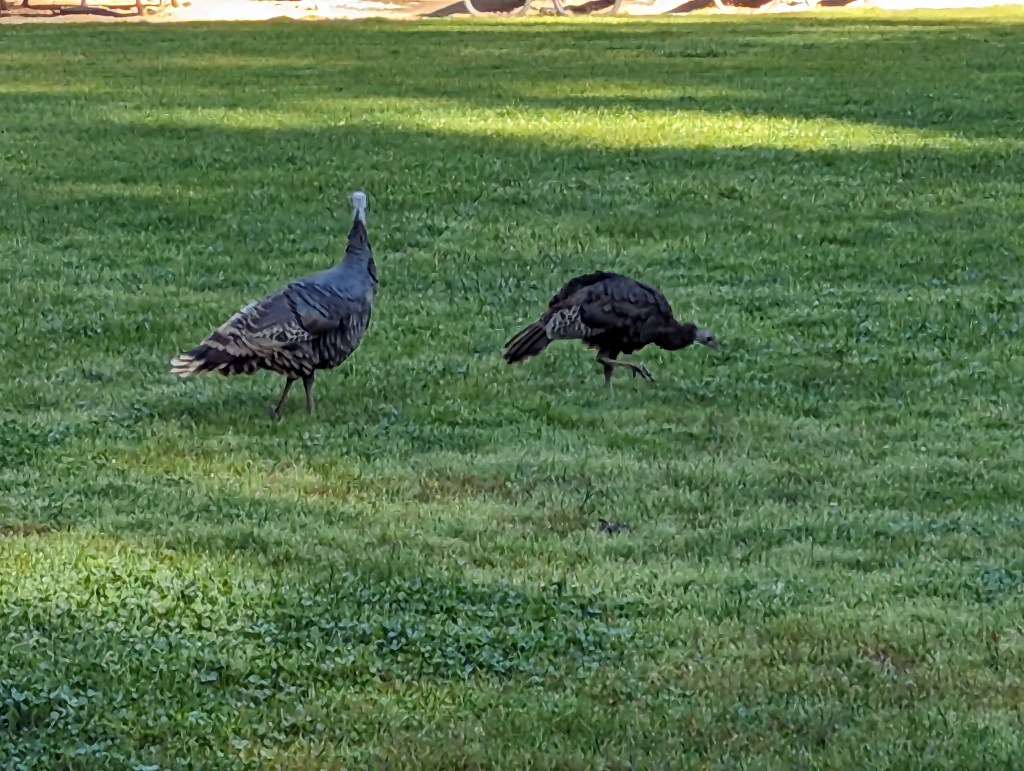
Wildlife is fortunately not too much of a problem within the landscapes here. Deer have complete access but strangely avoid refined landscapes, which includes roses. We would be unable to defend the landscapes otherwise. With so many people in the area, hunting is not possible. Even if it were, I do not like the local options much. Turkeys must know, which is why they are so blatant with their minor but annoying transgressions. Ducks at least try to be helpful by eating snails and the overwhelmingly prolific duckweed in their pond. Actually, I would not mind if they invited some of their friends over to help, since the pond looks more like a lush green lawn than water. Increasingly cooler weather may change that somewhat soon.

1. Single white angel’s trumpet is irrelevant to wildlife, but is blooming too splendidly to ignore. It was #6 last week, while beginning to bloom. It grew from a cutting last spring.

2. Ducks enjoy the pond without becoming too annoyingly numerous. Only this nice pair seems to be permanent residents. Another pair occasionally stops by but lives elsewhere.

3. Duckweed might otherwise be less bothersome if only they invited their friends over a bit more often. Even in this small pond, a single pair of ducks can not control duckweed.

4. Turkeys are the opposite. They are annoyingly numerous, but do not help much. They glean insects, but also thrash colorful flowers and berries, whether they eat them or not.

5. Pyracantha berries should remain colorful while small birds eat them through winter. Instead, turkeys shake most of them from their branches, and leave them on the ground.

6. Rhody is a terrier of some sort. His ancestors pursued burrowing animals who lived in the ground, or ‘terra’. Fortunately, he is uninterested, and is even less interested in fowl.

This is the link for Six on Saturday, for anyone else who would like to participate: https://thepropagatorblog.wordpress.com/2017/09/18/six-on-saturday-a-participant-guide/

Winter Berries Attract Migrating Birds

English hawthorn is like deciduous firethorn.

Bloom and colorful foliage provide most of the color besides green within home gardens during spring and summer. Deciduous foliage becomes more colorful for autumn. Winter berries and a few other lingering fruits become more colorful as deciduous foliage sheds through winter. All this color adheres to precise schedules within a collective ecosystem.

Many plants exploit wildlife. It is how they compensate for their immobility. Many provide incentive for the services that they desire from the wildlife that they exploit. For example, after enticing pollinators with fragrance or color, flowers happily exchange extra pollen or nectar for pollination. Many plants provide edible fruits in exchange for seed distribution.

It is no coincidence that so many different winter berries ripen through autumn for winter. They provide sustenance to many migratory birds who rely on them. Overwintering birds who compete with migratory birds appreciate their efforts as well. Such winter berries are small but abundant, for ‘grab and go’ convenience. Bright color is the best advertisement.

Some people appreciate how winter berries attract birds and squirrels into their gardens. Some appreciate the seasonal color of such berries more than the wildlife. Unfortunately, wildlife decides the outcome, and such outcomes are variable. It is impossible to predict if berries will disappear as they ripen, or linger as they deteriorate through most of winter.

Firethorn is likely the most familiar of the winter berries here. It seems to be more prolific with its brilliant red berries than any other species. Some old fashioned cultivars produce bright orange or perhaps even bright yellow berries. Some sorts of cotoneaster resemble firethorn, but with subdued rusty or orangish red display for less refined woodsy gardens.

Toyon, or California holly, is most prolific with winter berries where it grows wildly without pruning. It gets big though. Real hollies, which are more popular in other regions, do not produce many berries locally, particularly since male pollinators are uncommon. English Hawthorn is a small deciduous tree that displays berries that resemble those of firethorn, but on bare stems.

Squirrels Fear The Unknown Too

Pierre Francois dutifully protects ripening fruit.

It is embarrassing when my mother teaches me a practical gardening technique that I should have known about, especially if the particular technique is as simple and downright silly as what my mother does to protect ripening fruit from squirrels. A friend of hers suggested it; and it seems to be significantly more effective than the few fancier ideas that I recommended.

I should first mention that there is nothing new about repelling animal pests with effigies of other animals that they are afraid of. Scarecrows and stuffed snakes and owls have been around for centuries. As the name implies, scarecrows scare crows who perceive them to be potentially troublesome people. Rats and terrestrial rodents avoid snakes. Squirrels and some birds are afraid of owls.

When I was in about the fourth grade, I remember that National Geographic World magazine (which is now National Geographic Kids) featured a silhouette of a predatory bird that could be cut out and taped to windows to deter birds that might otherwise break their necks as they tried to fly through the clear glass. The associated article explained that the cut-out silhouette was effective because birds instinctively knew what to fear. A silhouette of a harmless seagull would not have been as effective.

However, some deterrents are not so specific, but instead rely on the fear of the unknown. Beach balls outfitted with decals of huge eyes look weird in the garden, but work because so many birds have bird brains that think such contraptions are big, scary and possibly predatory animals. Flash tape and old compact discs work simply because birds do not know what the reflected flashes are.

Scarecrows and other inanimate effigies should be relocated occasionally so they seem to be alive. They should stay near what they are in the garden to protect, and not loiter when it is gone. For example, if protecting ripening fruit, they should leave after the last of the fruit is gone. Otherwise, the target pest animals realize that they are fake or dead. Beach balls, flash tape and compact discs are more animated, so need not be moved so much, if at all, but are too tacky to stay all year.

All this may seem complicated, but can be simple enough for my mother to master with . . . well, allow me to explain.

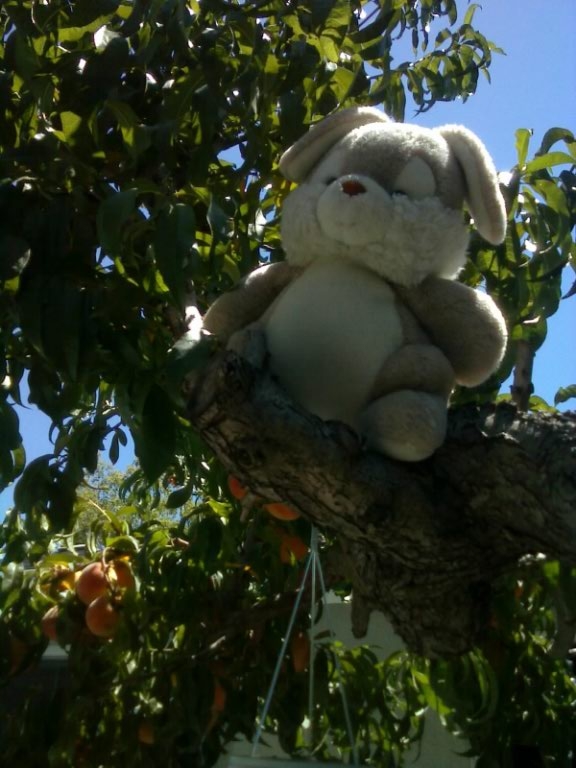
Pierre Francois is a cute, fuzzy and seemingly French plush toy bunny made in China, who knows all about protecting ripening fruit from squirrels. (‘Stuffed animal’ is no longer politically correct.) After seeing how expensive a fake owl would be, my mother put Mr. Francois in the peach tree. He and his sort are free if borrowed (stolen) from the grandchildren, or very cheap at garage sales or thrift stores. Although cute and soft to us, Mr. Francois is big, intimidating and unfamiliar to squirrels. Before the squirrels get acquainted with him, the peaches will have been harvested, and Pierre Francois will have been reassigned to an apple tree.

English Hawthorn

English hawthorn is small but distinguished.

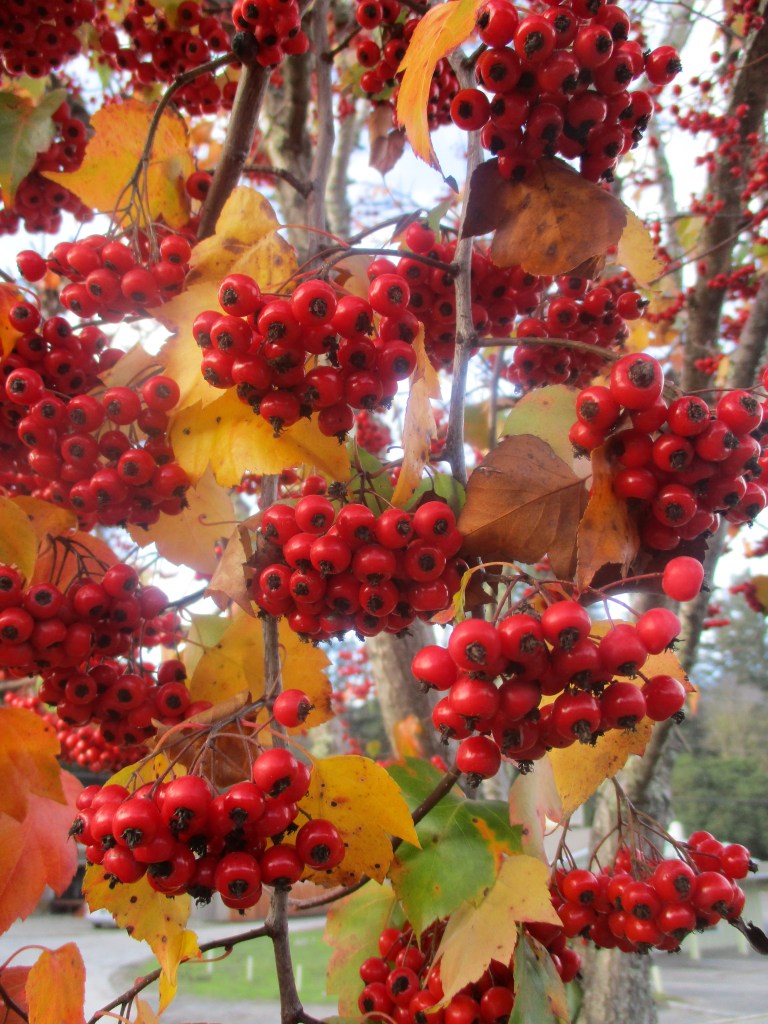
Most red berries that provide color and attract birds through late autumn and winter grow on shrubbery. Berries of English hawthorn, Crataegus laevigata, grow on trees. They are not big trees, but they are distinguished. Mature trees might get no taller than twenty feet, but their furrowed trunks with weathered bark resemble those of older and statelier trees. 

Trusses of small white flowers that bloom in spring are comparable to those of pear. Like pear bloom, they emit a potentially objectionable musky fragrance. Modern cultivars that bloom with pink, double pink or double red flowers are less fragrant. English hawthorn is uncommon locally. The few cultivars that produce yellow or orange berries might be rare. 

The deciduous leaves of English hawthorn are only about an inch or two long and wide. They are deeply lobed, with a handsomely coarse texture. Foliage can turn rusty orange or brownish yellow for autumn. Defoliation exposes any remaining berries, at least until the birds finish with them too. Thorns are unfortunately unavoidable.

Red Berries For Migrating Birds

Firethorn berries are the most colorful.

Red berries that ripen through autumn and into winter are becoming prominent. They are too brightly colorful and profuse to hide. Those that do not attract too much attention from wildlife may linger after floral color is finished. Some may last longer than the earliest fall color. Otherwise, if wildlife consumes all of the red berries, that is what they are there for.

Plants are naturally exploitative. Since they are inanimate, they exploit that which is not. Those that do not rely on wind for dispersion of their pollen and seed expect insects and animals to do it instead. Their flowers appeal to preferred pollinators, using color, texture, form, fragrance and flavor. Their fruit, which contains their seed, uses similar techniques. 

Red berries mature at this time of year for two primary reasons. Plants that produce them prefer their seed to disperse during autumn or early winter. Also, they know that they can rely on birds or other wildlife to eat the red berries, and subsequently ‘disperse’ the seed within. Overwintering wildlife and migratory birds are particularly hungry as berries ripen. 

Red berries are popular in home gardens for two primary reasons. Some people like the birds and squirrels who come to eat the fruit. Most people simply appreciate the red color while floral color is potentially scarce. Unfortunately, it is impossible to predict how birds will behave. They may prematurely consume berries that should provide color for winter.

Although various hollies provide delightfully glossy and densely evergreen foliage, their red berries are scarce or absent without male pollinators. (Hollies are dioecious, so their genders are distinct.) Male cultivars, which had been rare for several decades, have only recently become more available. Yet, even with pollinators, holly berries are not the best. 

Firethorn (Pyracantha), toyon and a few cultivars of cotoneaster are more prolific with red berries. Toyon, or California holly, is native, and is the namesake for Hollywood. It is best in wild landscapes where it needs no pruning. Firethorn produces the most berries but is also very thorny. Some cultivars of cotoneaster are both thornless and pleasantly prolific. 

Colorful Berries Brighten Wintry Gardens

Bright red attracts hungry overwintering birds.

It is no coincidence that so many colorful berries ripen in autumn as migratory birds migrate south for winter. Such colorful berries are intended for both migratory and overwintering birds. Rodents and other wildlife are welcome to take what they want as well. Most colorful berries are bright red, to get the attention of birds and wildlife. They are a convenient ‘grab and go’ size, and abundant.

Plants who produce colorful berries are pleased to provide in exchange for the dispersion of their seed. It is an ingenious system. Everyone involved does what they do best. Plants produce their colorful berries to exploit wildlife. Wildlife exploits the berries. Seed within the berries survives digestion, and gets ‘deposited’ elsewhere. Most types of berry seed germinate best after digestion.

Colorful berries are popular in home gardens either to attract birds, or because they are delightfully colorful for autumn and winter. Of course, many that should remain colorful attract birds instead. Fortunately, birds are good sports, and often leave colorful berries long enough to blet (age). Then, polite birds consume the berries before they get messy, and ideally take their mess elsewhere.

Various hollies are famous for their colorful berries. However, not many hollies reliably produce many berries here. Because they are dioecious (of separate genders), commonly available female plants are fruitless without rare male pollinators. Fortunately, modern hollies are becoming available in conjunction with pollinators. Otherwise, the best colorful berries are of the Rosaceae family.

Firethorn is the most profuse and most familiar of the colorful berries through autumn and winter. A few species and cultivars of Cotoneaster can be almost as prolific, but with more subdued color and stature. Toyon is a related native species that performs well in unrefined landscapes. English hawthorn produces similar colorful berries, but develops into a small and gnarled deciduous tree.

Unfortunately, none of these colorful berries are notably edible. In fact, some are mildly toxic.

Colorful Autumn And Winter Berries

41126thumbBefore the colorful foliage of autumn falls and gets raked away, a few types of berries and fruit start to provide a bit of color to last into winter, or at least until birds and other wildlife eat them. Technically, the most colorful berries are actually intended for the birds, both those that overwinter and those that migrate south for the winter. The berries are designed by the plants that produce them to both entice birds, and to reward them for dispersing the seeds within.

Pyracantha (or firethorn) is the most colorful of the berries. Cotoneaster is similar, but not quite so prolific. Toyon and English hawthorn, which can grow as small trees, produce open clusters of similar bright red berries. Of these, only English hawthorn is deciduous, and can defoliate before the berries disappear. Although such fruit is abundant, it is not often messy because it gets devoured before it reaches the ground. However, the birds can be messy.

English holly really should produce more berries than it does, but there are not enough pollinators out there. (Hollies are dioecious, which means that plants are either male or female. Female plants need male pollinators to produce fruit.) Decades ago, when horticulture was taken more seriously, male pollinator plants were marketed with female plants. Some other types of holly somehow make a few more berries, especially as they get older.

Loquat, mahonia, pomegranate and some flowering crabapples try to produce colorful fruit, but are not quite as colorful. Pomegranate fruit can be impressive in its own way, but are just rusty reddish brown on the outside. Strawberry tree produces a few red berries throughout most of the year. Many types of pittosporum develop fruit, but most are about as green as their foliage. The sticky amber seeds are ‘interesting’ when the fruit splits open, if anyone happens to look that closely.

Oranges, lemons, grapefruits, mandarins and other citrus will be colorful later in winter, even though they do not care if they attract any birds. For now, persimmons are the biggest and most colorful fruits out in the garden.

Gardening For The Birds

40924thumbSome of the most convenient bird feeders in the garden are some of the many plants we grow. Since so many plants exploit the birds as much as they get exploited by the birds, they naturally produce something that the birds want, when they want it. Right now, meaty seeds cater to migratory birds that need to plump up to travel, hoping that some of the seeds get dropped elsewhere or buried for later (hence ‘sown’ if forgotten, as they often are).

Since the climate is so mild, there is always something blooming to provide nectar for both migrating and overwintering hummingbirds, which inadvertently pollinate the flowers that feed them. Later in the winter, colorful berries feed hungry overwintering birds, in exchange for the dispersion of the small seeds within. (Digestion of the seeds does not harm them, and promotes germination.) Robins do not seem to do much for the garden, but certainly do enjoy digging for worms in unraked leaf litter.

Those who enjoy birds often intentionally plant pyracantha or cotoneaster to provide berries for birds in winter. Various salvias that bloom at various times likewise make nectar for hummingbirds. Fading sunflowers can be left out this time of year until birds that eat the seeds are finished with them. Alternatively, bird feeders can actually provide more food, and extend the seasons through which such food is available. Suet feeders provide something that plants can not provide.

The problem with plants or bird feeders that attract birds is that they can also attract less desirable guests. Squirrels and rats are the worst. Some bird feeders can be protected with exclusion devices. Cats have no interest in the plants or bird feeders, but can be a serious problem for the birds, and are not so easy to dissuade. Fortunately, hawks are rarely a threat in urban gardens, especially where there are trees to inhibit their hunting from above.

Contrary to popular belief, providing food to migratory birds does not interfere with natural migration. Cooling weather and shorter days are enough to convince birds to leave. The extra food actually helps them on their way once they get going. It also helps those that naturally stay here through winter. Some birds actually migrate to here from colder regions to the north. With winters so mild, there is no need to go any further.

Mr. McNugget

P90914KWildlife is a topic that is notably lacking from my articles. I mention only that which must be ‘escorted’ out of the landscapes, like Halston Junior. Gophers, racoons, squirrels, rats, skunks, mice, opossums, rabbits, deer, mountain lions, coyotes, rattlesnakes, turkeys, geese, woodpeckers, jays, crows, bees, wasps, mosquitoes, flies and feral boars can potentially be problematic.

There are probably at least a few more. This list does not even include bad neighbors or domestic animals. Nor does it include foxes, just because they eat mice, rats and snails, and do not seem to cause any problems. Butterflies and most birds, except those listed, are quite tolerable. Insects and mites that damage plants deserve their own list. I don’t know where ticks fit in.

Most unwelcome wildlife at least tries to stay out of my way. Others seem to make sport of antagonizing me. Skunks try to be friendly; but I must pass on that. Turkeys are . . . just turkeys.

This strangely calm black-chinned hummingbird who watches me from the same spot in a flowering cherry tree is either unaware of my disdain for wildlife, or is merely unconcerned about it. He just sits there . . . silently . . . observing . . . as if plotting or scheming or . . . something. He seems to be harmless; but I really don’t know. He could have sharp talons or another weapon!

I named him Mr. McNugget.

His species is apparently rare. I had nothing to do with that. Even if I believed that he tastes like chicken, I couldn’t catch him anyway. His kind fly at supersonic speed! He might use one of those ‘transporters’ like on Star Trek. Besides, I really don’t want to mess with that. A feral boar would be easier.