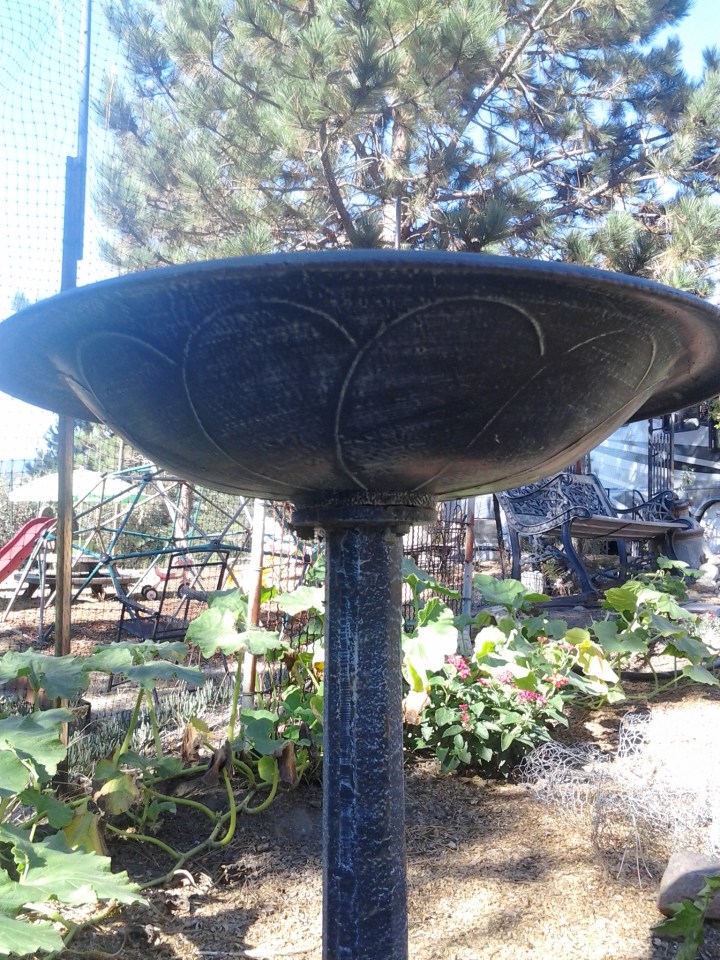
 Some of the most convenient bird feeders in the garden are some of the many plants we grow. Since so many plants exploit the birds as much as they get exploited by the birds, they naturally produce something that the birds want, when they want it. Right now, meaty seeds cater to migratory birds that need to plump up to travel, hoping that some of the seeds get dropped elsewhere or buried for later (hence ‘sown’ if forgotten, as they often are).
Since the climate is so mild, there is always something blooming to provide nectar for both migrating and overwintering hummingbirds, which inadvertently pollinate the flowers that feed them. Later in the winter, colorful berries feed hungry overwintering birds, in exchange for the dispersion of the small seeds within. (Digestion of the seeds does not harm them, and promotes germination.) Robins do not seem to do much for the garden, but certainly do enjoy digging for worms in unraked leaf litter.
Those who enjoy birds often intentionally plant pyracantha or cotoneaster to provide berries for birds in winter. Various salvias that bloom at various times likewise make nectar for hummingbirds. Fading sunflowers can be left out this time of year until birds that eat the seeds are finished with them. Alternatively, bird feeders can actually provide more food, and extend the seasons through which such food is available. Suet feeders provide something that plants can not provide.
The problem with plants or bird feeders that attract birds is that they can also attract less desirable guests. Squirrels and rats are the worst. Some bird feeders can be protected with exclusion devices. Cats have no interest in the plants or bird feeders, but can be a serious problem for the birds, and are not so easy to dissuade. Fortunately, hawks are rarely a threat in urban gardens, especially where there are trees to inhibit their hunting from above.
Contrary to popular belief, providing food to migratory birds does not interfere with natural migration. Cooling weather and shorter days are enough to convince birds to leave. The extra food actually helps them on their way once they get going. It also helps those that naturally stay here through winter. Some birds actually migrate to here from colder regions to the north. With winters so mild, there is no need to go any further.
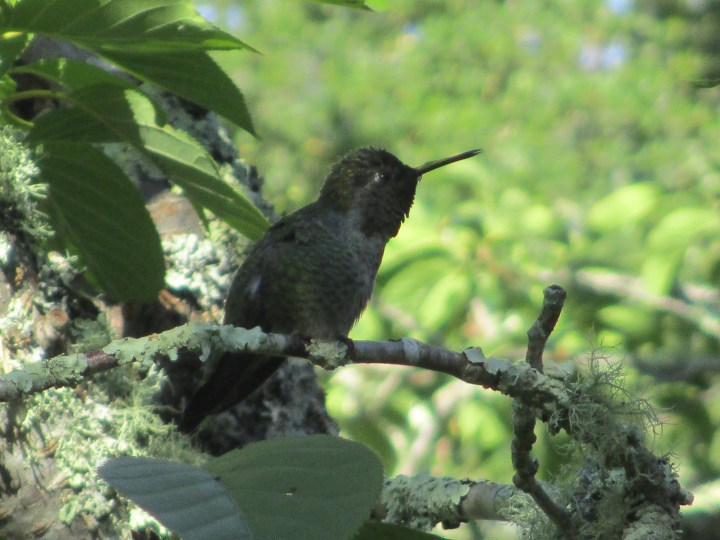 Wildlife is a topic that is notably lacking from my articles. I mention only that which must be ‘escorted’ out of the landscapes, like
  Birds do some odd things. They seem to know what they are doing. The odd things that they do make sense. Nonetheless, some of what they do out there is just plain odd.
 This is a relatively new development. The first few arrived here only two years ago. By last year, a few more arrived to make a significant herd that split into two smaller herds. Now these two smaller herds are quite significant. If they continue to proliferate as they have been, they will become more of a problem. They are already shredding flowers and colorful berries that are within their reach, and digging up flexible irrigation hoses.
 There is much more to the landscapes at work that I wrote about earlier this morning at
  This salvia would probably look badder without it. Yes, that’s badder and not better. I mean, if all these slightly unsightly seeded stems were cut back, then the even more unsightly deteriorating foliage below would be more prominent. When one looks at it that way, the bad seed suspended above does not seem all that bad.
 Wildlife and domestic animals seem to follow me everywhere I go. When Brent and I lived in the dorms at Cal Poly, our room was known as the Jungle Room, not only because of all the greenery, but also because every little bird that got knocked out while trying to fly through the big windows at the dining room was brought to our room to recuperate. A baby squirrel that weaseled into my jacket while I was out collecting insects for an entomology class lived with us for a while. There were two baby ducks that need a bit more explaining.
 The bright red berries of late cotoneaster, Cotoneaster lacteus, that ripen in autumn may not be as profuse or as bright red as those of firethorn, but they last longer, and even into winter. Birds strangely seem to avoid them. Although the clustered small berries can look just like firethorn berries, they are usually less shiny, and darker red. Clusters of tiny pale white flowers bloom in spring. The small evergreen leaves have a nice glossy and veined texture on top, with hazy gray or tan tomentum (fuzz) below. The grayish brown bark of old stems resembles that of apple or pear trees.
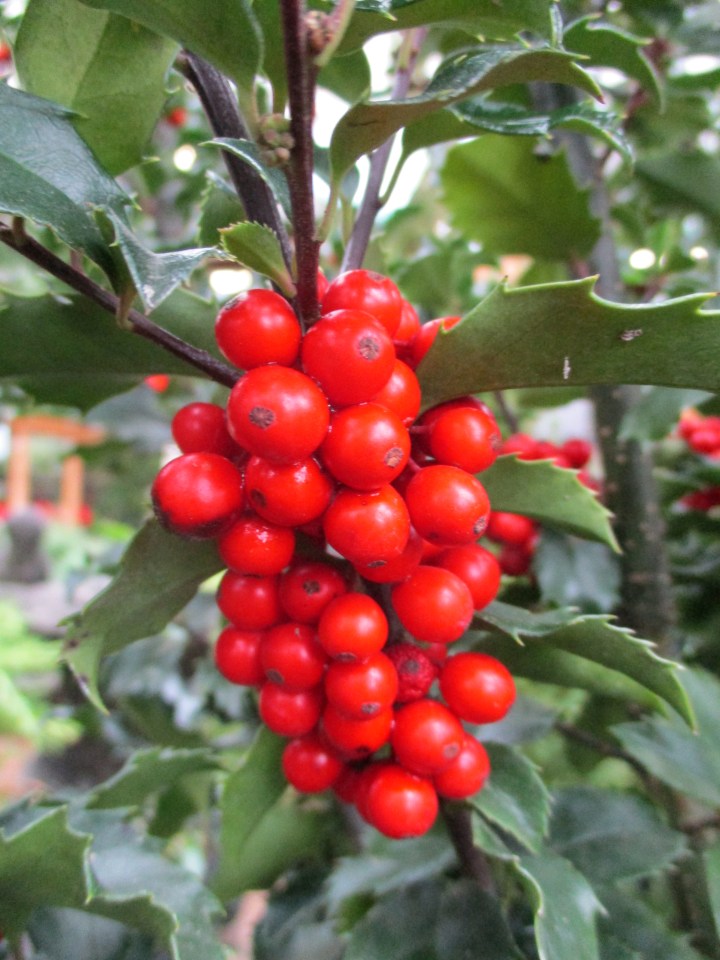 Plants compensate for their immobility by procuring the services of animals and insects. They bloom with flowers that attract pollinators with colors, fragrances and flavors. Their fruits use similar techniques to attract those who consume the fruits to disperse the seeds within. It is a pretty ingenious system. The animals and insects probably think that they are taking advantage of the plants.
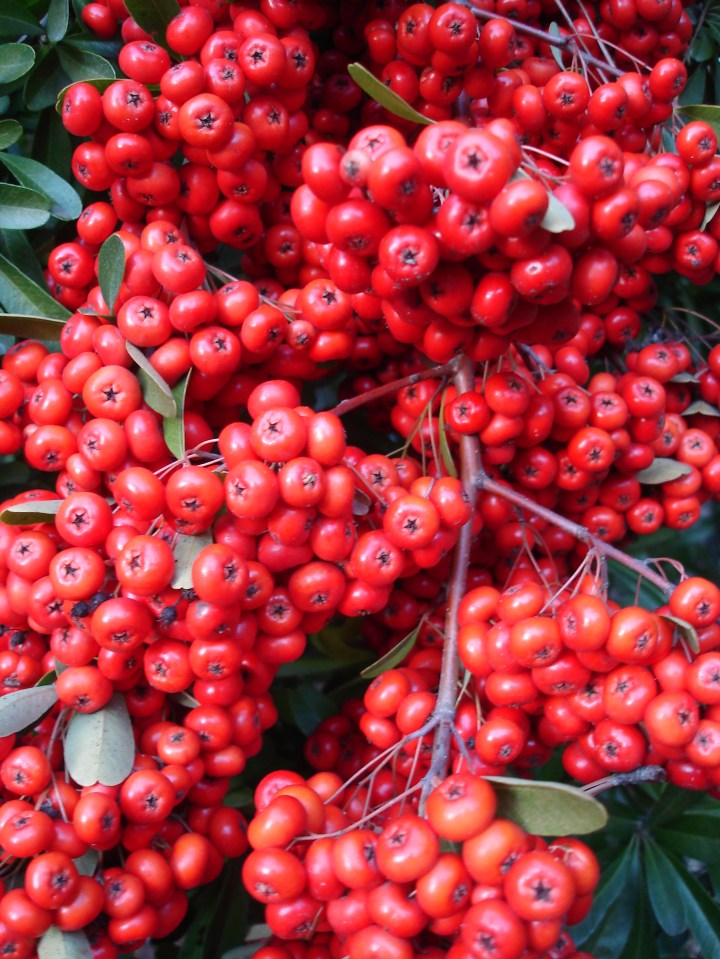 It is probably no coincidence that certain berries and small fruits are so colorful through winter while colorful flowers are relatively scarce. Like flowers, they want to get others to do something for them. Flowers use color, aroma, flavor and sometimes even texture to attract and reward pollinators. Colorful berries and fruits do the same to attract birds and animals who disperse their seeds.
