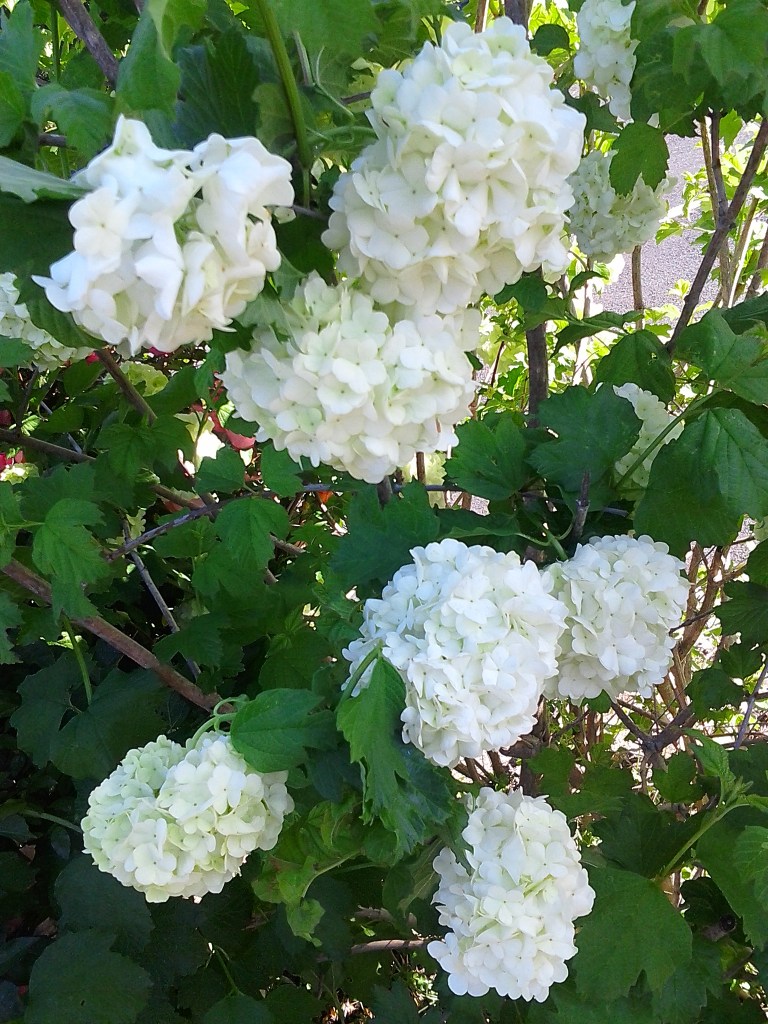
Deadhead Spring Bulbs After Bloom

Most spring bulbs are done blooming.

Fruiting warm season vegetables that are now in season, such as squash, tomatoes and beans, are more abundant with regular harvest. Plants that produce such fruit respond to their natural obligation to generate seed. Deprivation of the fruit that contains their seed stimulates production of more. Similarly, it is helpful to deadhead some flowering plants.

Deadhead grooming is a type of pruning, even if it does not involve pruning shears. It is, in simple terms, the removal of deteriorating flowers after bloom. For some plants, it only improves aesthetic appeal. For many others, it redirects resources from seed production into subsequent bloom, or vegetative growth that eventually sustains subsequent bloom. 

Now that early spring bulbs are finishing bloom, it is time to deadhead them. Most bloom just once annually, so without the distraction of seed production, will prioritize vegetative growth into new bulbs to bloom for next year. Many of the summer bulbs that bloom later bloom more than once annually, so divert conserved resources into subsequent blooms.

However, many cultivars of spring bulbs are too extensively hybridized to produce viable seed. For them, deadhead grooming merely eliminates unappealingly deteriorated floral carcasses, while their foliage continues to sustain the development of new bulbs for next year. The foliage of most deteriorates slowly through warming spring or summer weather. 

Some extensively hybridized modern cultivars are not sterile though. Some can produce feral progeny that are less appealing than the hybrid parents, but are vigorous enough to displace them. Deadhead grooming eliminates most or all of the unwanted feral seed. Of course, for wild grape hyacinth and snowdrop, seed can be left to develop and disperse.

Established colonies of feral freesias can be allowed to make seed for more of the same. However, hybrid freesia benefits from deadhead grooming to eliminate feral seed. Dutch iris, narcissus, daffodil, tulip, hyacinth and lily can also benefit from deadhead grooming, for a variety of reasons. Some are sterile. Some are not. Some get shabby. Some do not.

Six on Saturday: Rhody’s Roady II – Washington (the State)

Our vacation continued from Ilwaco, where I took both pictures #1 and #2, to Silverdale and Poulsbo, all within Washington. The Tomeo Residence, where I got pictures #5 and #6, is in Silverdale. The farm, where I got pictures #3 and #4, is near Poulsbo. For most of my vacation, I did exactly what I wanted to do. I pruned a few apple trees that were in need of major structure pruning. I wanted to do more, but got distracted. (That is a long story.) Apples were about to bloom.

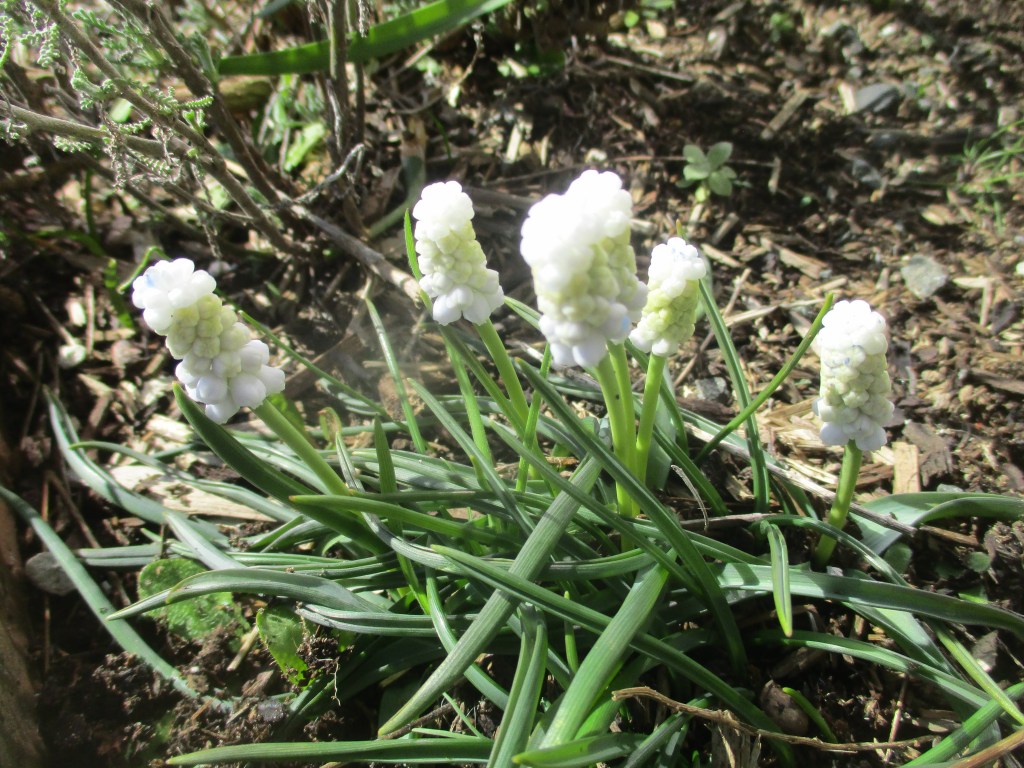
1. White grape hyacinth could be my favorite of the many goodies I received from Tangly Cottage Gardening. I try not to choose favorites, but I wanted this for a long time, and it came directly from the planter beds at the Port of Ilwaco! They are approved by Skooter!

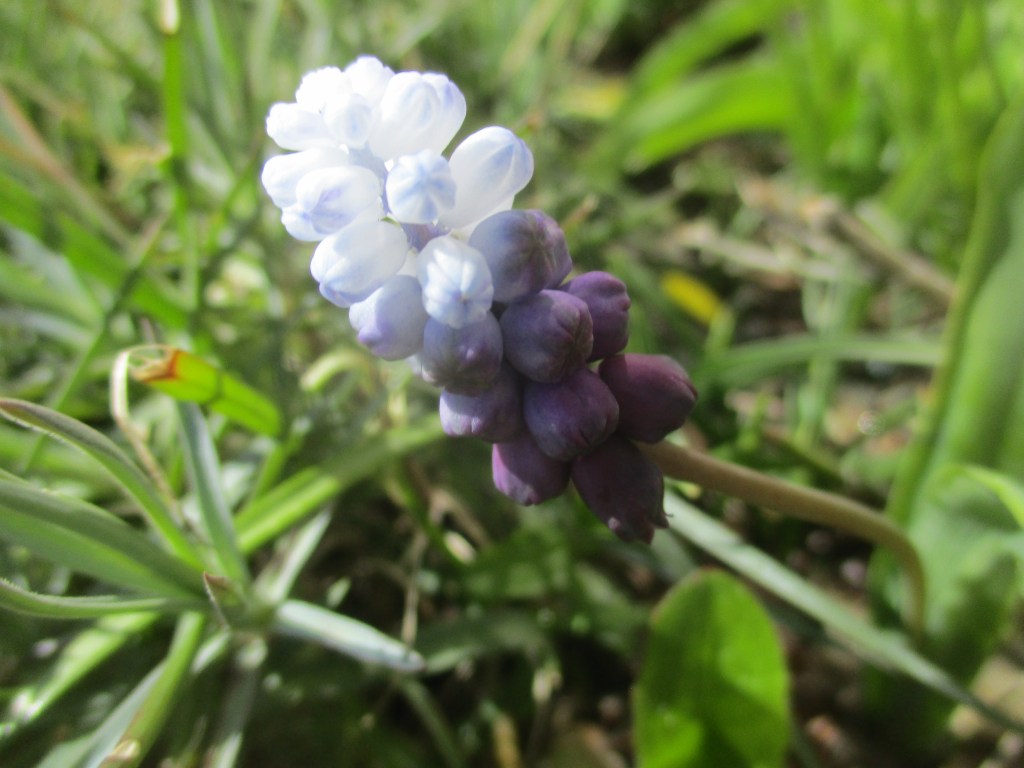
2. ‘Golden Fragrance’ grape hyacinth was blooming in the same bed with the white grape hyacinth. I thought I got a picture. This could be Muscari paradoxum, but I do not know. 

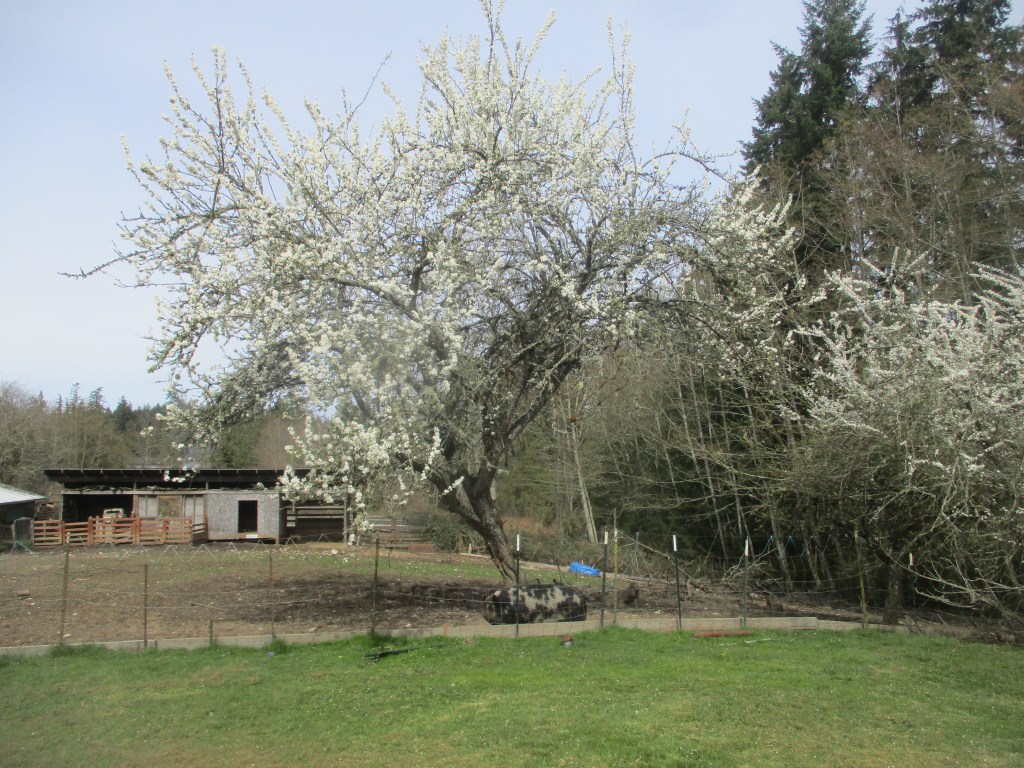
3. Pluot was still in early bloom when we arrived in Kitsap County. I dislike pluots, but it might substitute for apricot, which is unreliable in the local climate. Peach is absent too.

4. Apple trees were barely beginning to bloom. It was technically too late to prune them, but I did anyway. They have been neglected for too long. I finished less than half though.

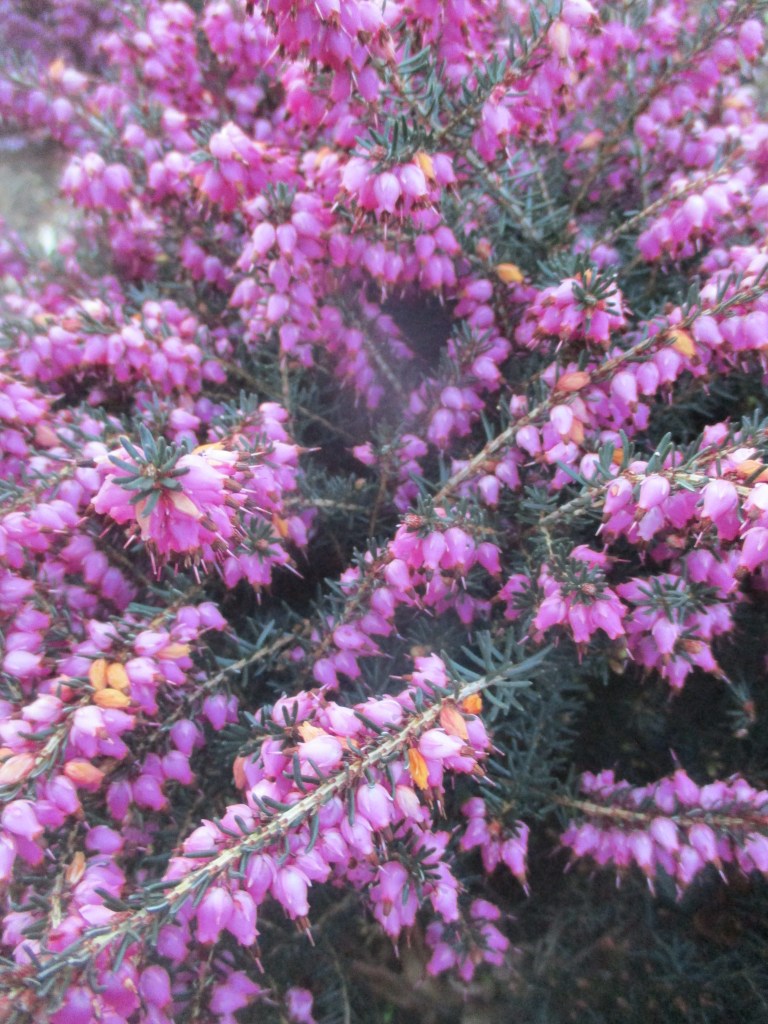
5. Heather was blooming quite colorfully. It seems to be about as popular there as lily of the Nile is here, likely because it performs so reliably. It was strange to see so much of it.

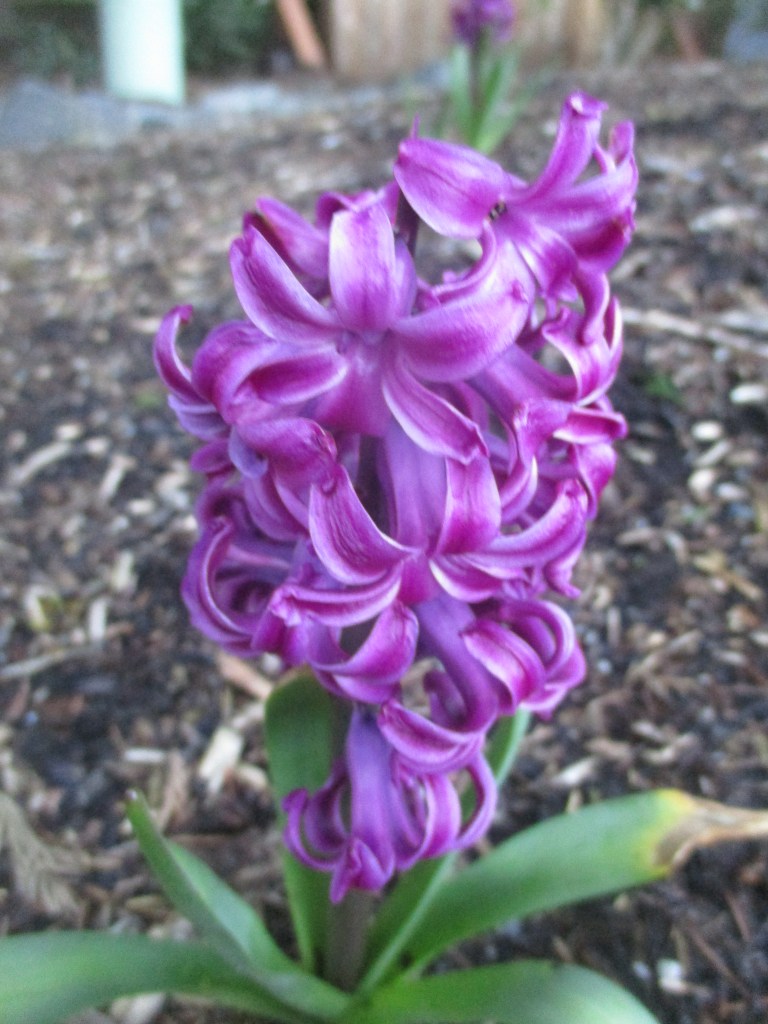
6. Hyacinth and many other early spring flowers were still blooming splendidly. I should have gotten a better picture of a colony of hyacinth, but wanted to get a close up picture.

This is the link for Six on Saturday, for anyone else who would like to participate: https://thepropagatorblog.wordpress.com/2017/09/18/six-on-saturday-a-participant-guide/

Six on Saturday: Totally Missed It

Goodness! For the first time in a very long time, I neglected to collect six pictures for Six on Saturday. Furthermore, after frantically assembling these random pictures that I had no use for otherwise, I posted them later than typical. I have a good excuse though. I am on vacation. Actually, I happen to be in Ilwaco in Washington. I will be meeting with the blogger of Tangly Cottage Garden later in the morning, so should have more interesting pictures for next week. I realize that I said that last week in regard to Rhody’s Roady, but as I mentioned, I presently have other very important priorities. By the way, I do intend to explain Rhody’s Roady!

1. After clearing away thickets of Himalayan blackberry and cattail, this drainage pond is allowed to fill for the first time in years. We might add lily pads and other aquatic plants.
2. Conical conifers that were available for live Christmas trees from nurseries go on sale after Christmas. This happy blue spruce, although expensive, was discounted by a third.
3. Flowering cherry continue to bloom. This picture was taken quite a while ago, but the particular tree and others like it were still in bloom on Wednesday. One was still in bud.
4. Camellia continue to bloom as well. Of course, many or perhaps most finished a while ago. Nonetheless, several often bloom rather late, or at different times from year to year.
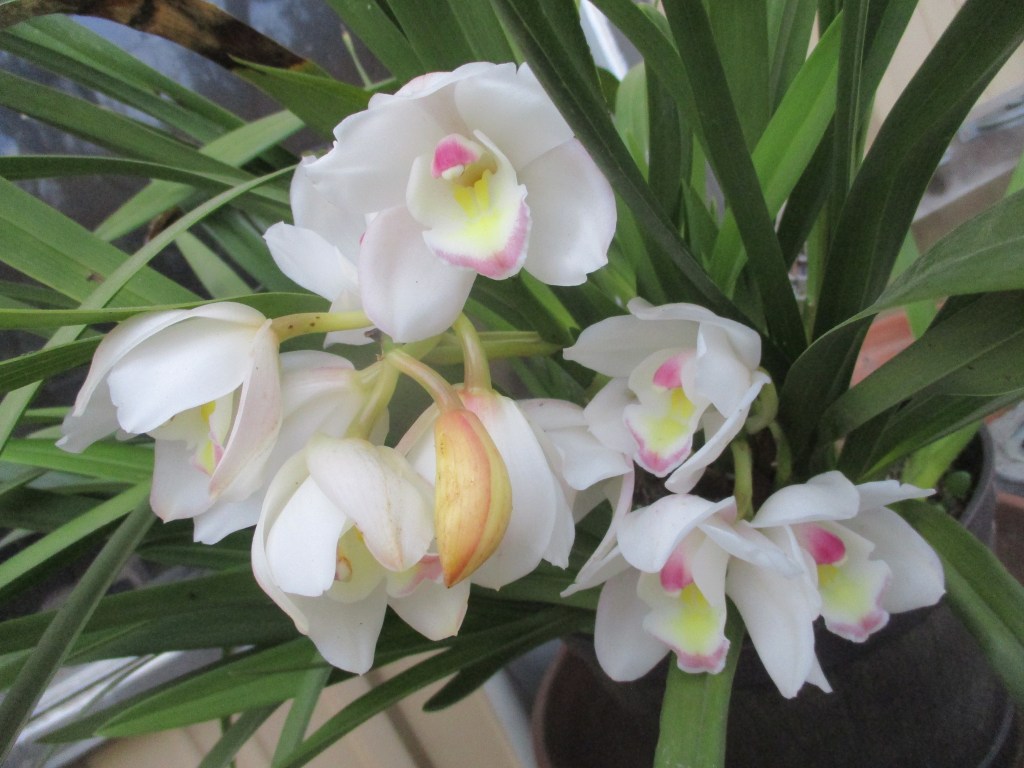
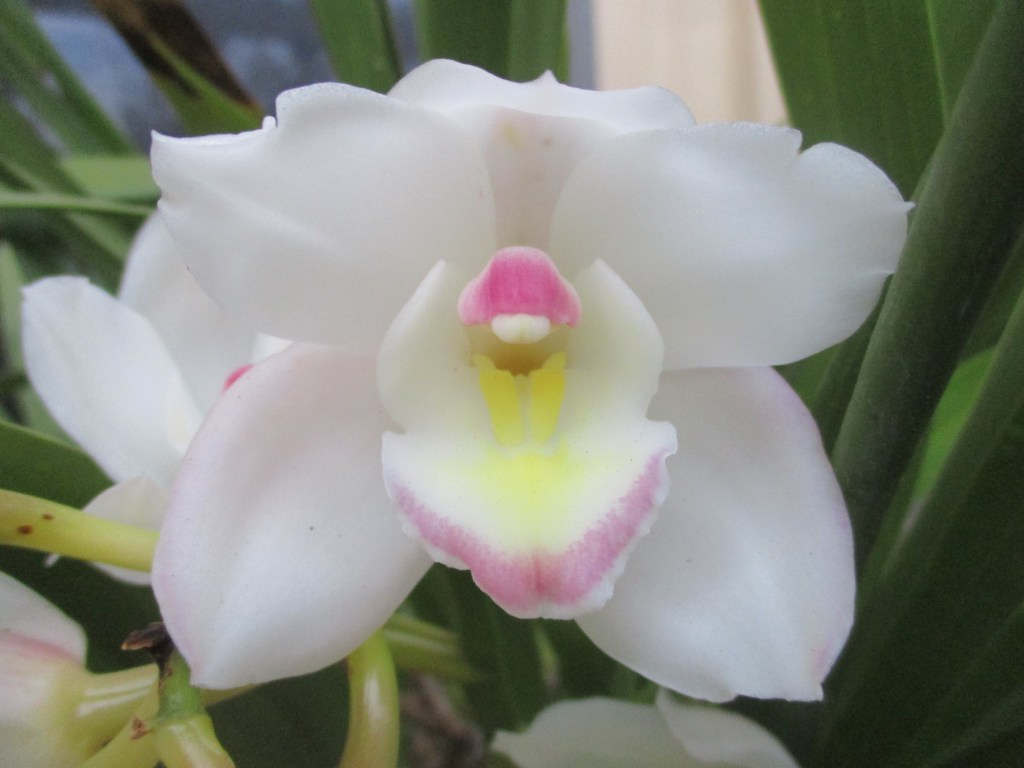
5. Cymbidium orchid bloomed right on schedule, but its flowers last for such a long time that it seems to be right in the middle of the process. There are four spikes on this plant.
6. Collective bloom is spectacular, and individual flowers are compelling. It is pleased to bloom like this for minimal attention. I merely water it, then display it proudly in bloom.

This is the link for Six on Saturday, for anyone else who would like to participate: https://thepropagatorblog.wordpress.com/2017/09/18/six-on-saturday-a-participant-guide/

FLORAL FRAGRANCE IN THE GARDEN

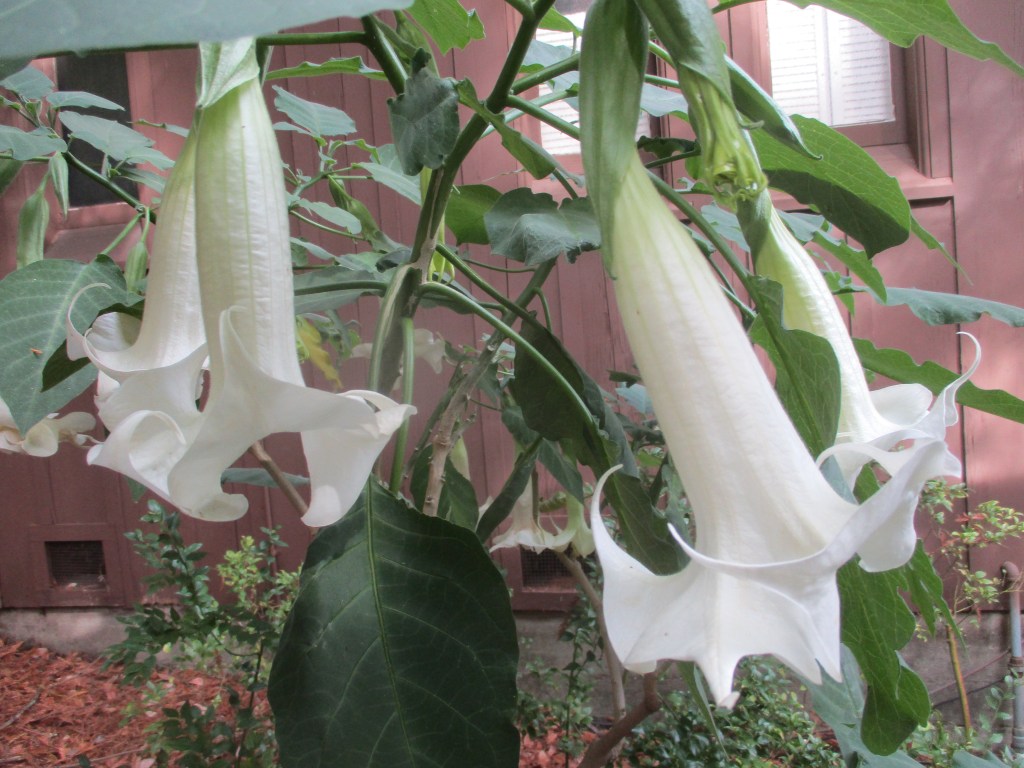
The most fragrant flowers are generally smaller and less colorful than less fragrant flowers. This angel’s trumpet is an exception.

Attracting pollinators is serious business for flowers that do not rely exclusively on wind for dispersion of their pollen. Many flowers attract pollinators with flashy color. Some reward their pollinators with sweet nectar. Many prefer to use fragrance. Most flowers use a combination of two or more of these tactics.

Fragrances are designed by the flowers that use them to appeal to the discriminating taste of specific pollinators. Most are sweet. Some are more perfumed. A few are even quite objectionable to people because they are tailored to flies. Fortunately, flowers with foul fragrances are rare in gardening.

The most fragrant flowers are often less abundant than flowers that rely on wind for dispersion of their pollen, or less colorful than flowers that rely on visual appeal to attract pollinators. Yet, the fragrant flowers of wisteria vines and lilacs are both profuse and colorful. The surprisingly big and fragrant flowers of ‘Charles Grimaldi’ angel’s trumpet are bright yellow.

Mock orange (Philadelphus spp.) conforms to the stereotype of fragrant flowers a little bit better, with somewhat small white flowers that are incredibly fragrant. The small pale pink flowers of daphne are even less impressive and nearly hidden among their foliage, even though their fragrance can not be ignored. The sweetly fragrant flowers of Japanese honeysuckle vines are abundant but not too colorful. Star jasmine vines likewise bloom fragrantly and abundantly, and their bright white flowers contrast better against their glossy green foliage.

Night blooming jasmine is not appealing enough for prominent placement, and is not even fragrant during the day, but will be unbelievably fragrant on warm summer nights. Just as fragrances appeal to specific pollinators, nocturnally fragrant flowers specifically appeal to insects or bats who are active at night.

Freesia, hyacinth, lily,narcissus and some types of iris are very fragrant as well as colorful now that they are blooming for early spring. It is unfortunate that their flowers do not last long, and that there are not any comparable flowers later in the year. The same annual sweet peas and stock that bloom about now can be planted again later for autumn bloom. Sweet peas are easiest to grow from seed. Stock is easiest to grow from cell packs, and since it is actually perennial, sheltered plants can survives through warm summer weather to bloom again in autumn. Annual sweet alyssum can bloom anytime while the weather is warm.

Lantana

Lantana just might bloom until frost.

Where winters are very mild, common lantana, Lantana camara, might bloom through all but the coolest of weather. It generally takes more of a break though. It could finish bloom at any time now, and resume at the end of winter. Where winter weather is cooler, foliage and perhaps stems may succumb to light frost. Growth should regenerate through spring. 

The tiny tubular flowers bloom inwardly from the margins of round umbels that are about and inch and a half wide. Flowers typically bloom yellow, and then fade to orange, red or pink. Therefore, the umbels have yellow centers with orange, red or pink margins during the middle of bloom. One cultivar blooms with one hue of yellow. Another fades to white.

Modern cultivars mostly stay rather low and compact. Some sprawl. Older cultivars might get as tall as six feet after a few years. However, after frost damage or coppicing, mature plants may regenerate from their roots, with vigorous stems that get six feet long through summer. The faintly raspy foliage appears to be smooth, and is aromatic when disturbed.

Dried Flowers Last All Year

With proper processing, hydrangea bloom can be dried.

Statice, strawflower and globe thistle continue to bloom later than most other summer annuals, and hold their flowers longer. Even after bloom, the flowers are so stiff and ‘crispy’ that they remain intact and colorful until they succumb to exposure to weather. If cut and brought in from the weather soon enough, they will last as dried flowers at least until fresh flowers start to bloom in the garden next spring.

Strawflower and larger globe thistle tend to wilt and droop from the weight of the bulky flowers, so should be tied in small bunches and hung upside down to dry. Perennial statice (which has larger blooms than annual statice) tends to flop to the ground, but the stems often bend only at the base so that the rest of the stem length stays somewhat straight. Smaller globe thistle and annual statice often dry standing up while still out in the garden.

Yarrow and English lavender can be dried as well, but lose most of their color. Lavender dries naturally in the garden. Yarrow can likewise be allowed to dry in the garden, but probably keeps a bit more color if cut while still fresh and hung upside down. Because yarrow blooms are so wide, they should be hung individually or in small bundles. Queen Anne’s lace has even wider blooms that curl inward as they dry, so they really should be hung individually.

Old hydrangea flowers that are only beginning to fade can dry surprisingly well if cut and hung individually before they deteriorate too much or start to rot. Some varieties retain color better than others. Some fade almost completely to an appealing brown paper bag.

There are not many roses this time of year, but when they do bloom, even they can be cut and dried while beginning to unfurl. Only a few small and tightly budded roses can be dried when completely open. Because they droop right below the blooms, roses should be hung upside down to dry. Dark colored roses get very dark as they dry. White roses turn tan. Pink and yellow are probably the better colors.

Cat-tails and pampas grass flowers are big, bold and dated cut flowers. Yet, for situations where big flowers fit, they are just as practical now as they were in the 1970s. Because pampas grass flowers shed, and cat-tails can explode (to disperse their seed), they should be sprayed with hair spray or another fixative to keep them contained. Pampas grass foliage has dangerously serrate edges that can give nasty paper cuts, so should be handled carefully, and displayed out of the way.

Color Wanes As Summer Ends

Summer blooms will be finishing soon.

Black-eyed Susan, sunflowers and a few of the late warm season annuals and perennials are still blooming, and a few will continue into autumn. By that time, cool season annuals can move in; and some of the deciduous trees, shrubs and vines that turn color for autumn will be doing so. Realistically though, this can be the leanest time of year for color in the garden. Even some of the foliage that is colorful through spring and summer has faded.

There are certainly plenty of flowers in season now. However, not many are colorful. Honeysuckle vine is pleasantly fragrant as it bloom in random phases until the weather gets cooler, but the flowers are only pale yellowish white. Some melaleuca trees bloom profusely enough to make a mess, but are just as pale, and do not even provide fragrance; although some have pretty light pink flowers. Abelia flowers are pink and abundant, but are really not all that flashy against their bronzy foliage.

Some of the more colorful flowers are not quite as reliable. Princess flower, hibiscus, blue hibiscus and mandevilla certainly can bloom in late summer or autumn, but sometimes bloom earlier than expected, so have nothing left for later. The bright red flowers of blood red trumpet vine are quite impressive, but only if they are not obscured by the accompanying foliage. Some roses bloom in phases as late as the weather will allow, but actually, most are done by now.

Fuchsia and angel’s trumpet likewise bloom in a few phases once they get started, but unlike the many cultivars of roses, they are much more reliable for a late bloom phase. Escallonia blooms late with small but colorful flowers, but only if they have not been shorn in the past few months. Shearing deprives them of the blooming stem tips that they had worked most of the year for.

Butterfly bush, tree mallow, cape plumbago, bee balm and several varieties of sage and salvia are among the most reliable plants for late summer or autumn bloom. Even without multiple bloom phases, they just naturally bloom at the end of their growing season, before winter dormancy.

Deadhead To Promote Continued Bloom

Alyssum is too profuse for deadheading.

Deadheading is simply the removal of deteriorating bloom prior to the maturation of seed or fruiting structures. Besides diverting resources, it removes unappealingly deteriorated bloom, as well as unwanted or potentially invasive seed. Deadheading can be delayed if seed from particular flowers is desirable, (although some types are genetically variable).

It was time to deadhead spring bulbs as they finished bloom earlier last spring. Now it is time to deadhead some of the summer bulbs. It eliminates unsightly faded floral stalks of gladiolus, and diverts resources into developing bulbs. It eradicates invasive montbretia seed. For canna, it conserves resources to enhance subsequent bloom through summer. 

It is helpful to deadhead some types of annual bedding plants too. Marigold, zinnia, floss flower, pincushion flower and petunia should bloom better with systematic deadheading. Of course, all will continue to bloom without deadheading, but might be slightly subdued, with fading flowers. Modern sterile varieties that produce no viable seed are less reliant.

Fortunately, there is no need to deadhead alyssum, lobelia, nasturtium, moss rose, busy Lizzie or verbena. Their bloom is so abundant that it constantly overwhelms older bloom. Grooming tiny alyssum and lobelia flowers would otherwise be incredibly tedious. Moss rose, alyssum and nasturtium are pleased to self sow, but revert to simpler feral varieties. 

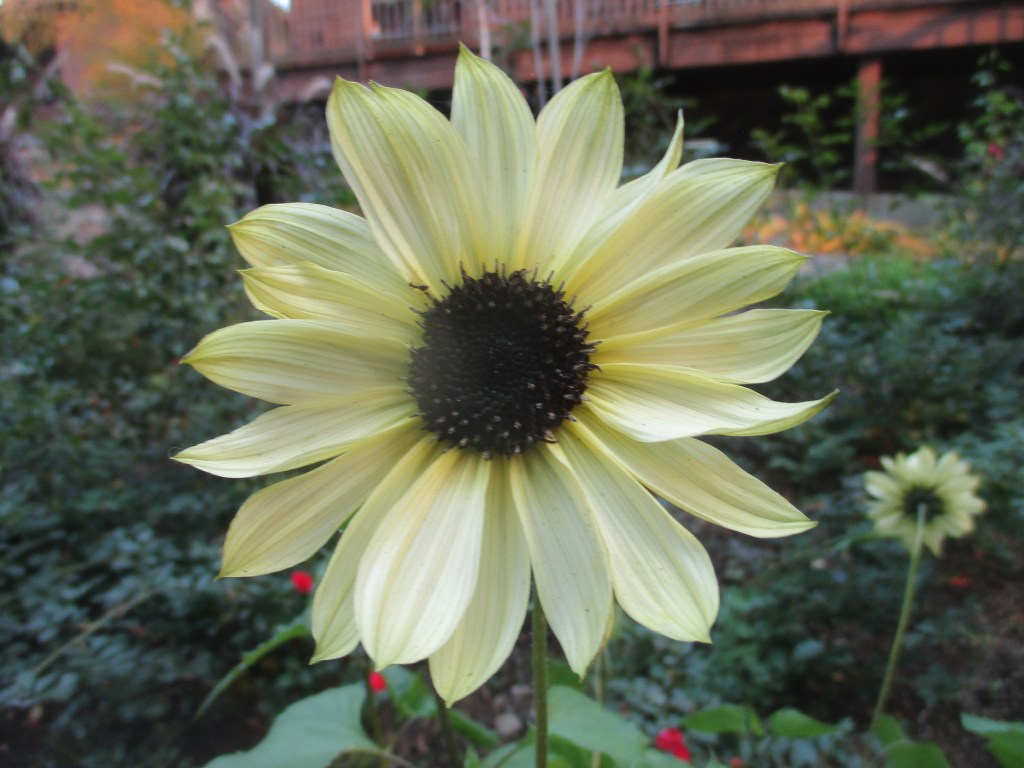
Some branched types of sunflowers produce several blooms on several separate stems. Others bloom with only a single flower on top of a tall single stem. If deadheaded prior to the maturation of their seed, the stalks of some single sunflowers generate a few smaller axillary flowers by autumn. This technique inhibits seed production, but prolongs bloom.

Six on Saturday: Integration


Brent, my colleague down south, scoffs at my predilection for white, as well as the exclusivity of the white garden from which I got pictures for Six on Saturday for last week. I suppose that he is entitled to that since he is a renowned landscape designer and I am not. White is my favorite color regardless; although I lack a white garden of my own, and have no intention of developing one. Exclusivity is no simple task. Some flowers that are not white are too appealing to easily dismiss. Some move in without invitation. Some are not what they should be.

1. Cestrum nocturnum – night blooming jasmine blooms pale white. After installing it, I learned that it might bloom pale yellow! Fortunately, it is next door, just barely beyond the landscape.

2. Bergenia crassifolia – pigsqueak has inhabited the space behind el Catedral de Santa Clara de Los Gatos longer than anyone can remember. It blooms pink, but is not visible from out front.

3. Bergenia crassifolia – pigsqueak should be groomed of old desiccated leaves. Incidentally, leaves blackened by frost are used as tea. I am unimpressed. These leaves are not frosted, just old.

4. Lychnis coronaria – rose campion is naturalized here, but is too pretty to pull while the landscape is still so sparse. It can bloom white, as well as red or pink, but I have not seen it do so yet.

5. Agapanthus orientalis – lily of the Nile was likely here about as long as the pigsqueak out back. Now that the first white lily of the Nile here was added at the road, the blue will be dismissed.

6. Hydrangea macrophylla – hydrangea got relocated to here from another landscape specifically because it was white. Now it is doing this. I do not know what color this is, but it is not white.

This is the link for Six on Saturday, for anyone else who would like to participate:

https://thepropagatorblog.wordpress.com/2017/09/18/six-on-saturday-a-participant-guide/

Six on Saturday: Plebian

Refined gardens are interesting. They are pretty also. Many are impressively colorful. It is easy to understand why refined gardens are as popular as they are. However, they innately lack quite a bit. Furthermore, they demand more attention that what would naturally grow wild. We are very fortunate here, that the refined components of our landscapes are rather minimal, and must conform to the unrefined components of the surrounding forests. We occasionally add a few new plants, including annuals. Much of what grows here now was once refined, but has gone wild. They are the plebian of horticulture.

1. Zinnia were just recently planted for summer. They are some of the most refined flowers now. There are not many annual bedding plants here, and none live in big beds. These are in a row.

2. Alyssum were planted as summer annuals sometime in the past. These were likely planted about a year ago, and survived through winter. They would likely be white if they grew from seed.

3. Alstroemeria are too aggressively perennial. They were planted intentionally, but overwhelmed the mixed perennial bed they were in. We tried to remove them, but a few continue to bloom.

4. Geranium, or zonal geranium, which is just a rather mundane Pelargonium, was plugged as cuttings and left to go wild. It happens to be one of my favorites because I have always grown it.

5. Calla must have been planted intentionally somewhere and sometime in the distant past, but was dug up and dumped with what became fill dirt here. It now blooms on the side of the road.

6. Poppy, or more specifically, California poppy, which is the Official State flower of California, grows wild, of course. They are some of the least refined flowers now, but also, among the best!

This is the link for Six on Saturday, for anyone else who would like to participate:

https://thepropagatorblog.wordpress.com/2017/09/18/six-on-saturday-a-participant-guide/