 This sort of weather pattern does not happen very often. Late spring is normally pleasantly warm, and the weather gets progressively warmer through summer, which typically includes a few unpleasantly warm days. It rarely gets too hot here, and when it does, it does not last for more than a few days, and tends to cool off at least somewhat at night. The air is normally arid. Humidity is uncommon in a chaparral climate.
While so many in the Northern Hemisphere were experiencing unseasonable warmth, the weather here was unusually mild. When the weather became warm, it did so suddenly. There was nothing unusual about the warmth. It was well withing the normal range for this time of year. The suddenness of the change was what made it unusual.
Humidity complicated matters. Again there is nothing too strange about humidity. Although rare, it does sometimes happen. The problem was that it happened at the same time that the weather suddenly changed from pleasantly mild to somewhat warm.
This combination of the weather changing so suddenly from mild and arid to warm and humid caused an outbreak of spontaneous limb failure. It was very evident in Felton Covered Bridge Park, where several trees that experienced it could be observed in the same place.
The most recent victim was the biggest old California sycamore in the area. Half of the top of the canopy broke away and got hung up on an adjacent trunk, but started a cascade of other limbs that broke off more major limbs all the way to the ground. A large cavity that contained a very established beehive was exposed. A car parked below was clobbered (but somehow sustained only minimal damage!). The remaining trunks and limbs of the old sycamore are now even more scarred and disfigured than they were before this happened. The biggest gash is about fifteen feet long! What a mess!
Spontaneous limb failure is technically very damaging to the trees who experience it, but not all of them see it that way. Many of the riparian trees that are so inordinately susceptible to it might use it to their advantage. Fractured limbs that remain attached to the original tree while they sag onto the ground can develop roots where they touch the soil, and develop into new trees. These new trees are more stable at first, but eventually develop structural inadequacies like their parents did, and repeat the process. Willows excel at this technique. Cottonwoods and box elders do it too. Sycamore do it only rarely, but sometimes destabilize and fall over so that some of their limbs can grow into new trees as the original trunks decay. It may not be the sort of behavior that we want in our home gardens or parks, but as far as the trees are concerned, it works.
Western Azalea
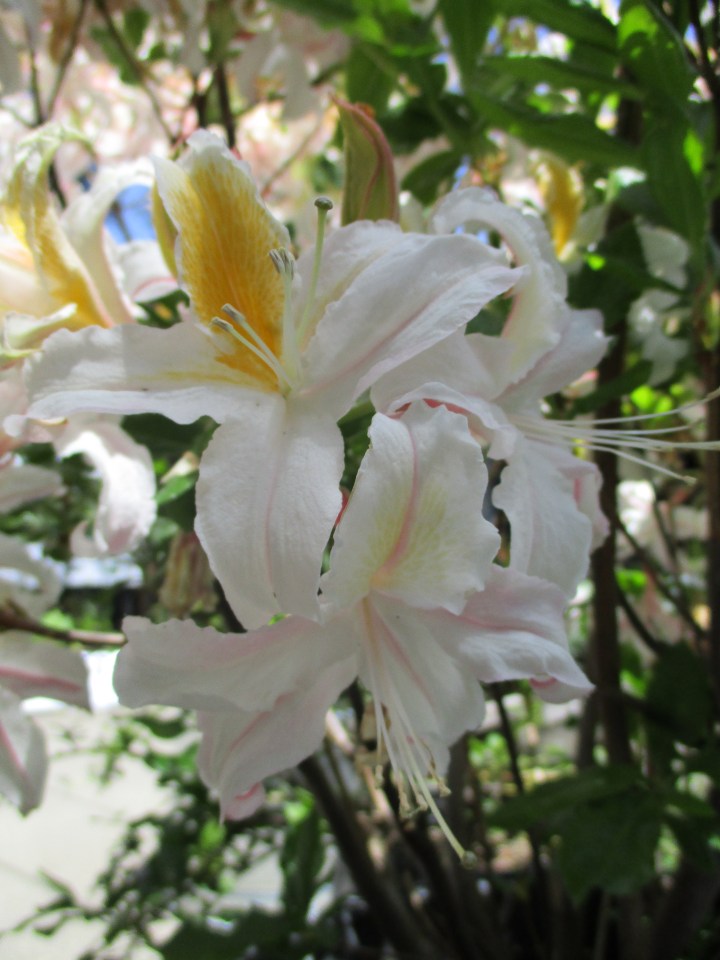 We think of rhododendrons and azaleas as being from cooler and moister climates. After all, that is where they do best. Yet, there does happen to be a native western azalea, Rhododendron occidentale, that lives in the Sierra Nevada and coastal ranges from San Diego County to just southwest of Portland, Oregon. (Azalea and Rhododendron are varied specie of the same genus.)
Bloom is mostly white, with pink, pale yellow or golden orange. Some of the fancier garden varieties bloom clear white, or with more vibrant color. The lightly fragrant, two inch wide flowers bloom in groups of two or three on open conical trusses. Each truss produces as many as a dozen flowers in sequence, so a new flower replaces a fading flower for a bit more than a week each spring.
Western azaleas plants are unfortunately not much to look at after bloom. They grow somewhat slowly and irregularly to about three to five feet tall. The two or three inch long deciduous leaves that can turn yellow and orange where autumn is cooler are more likely to turn an unimpressive grayish brown here. Foliage can fade prematurely if the weather gets too hot and arid through summer.
Fleabane
 Erigeron karvinskianus
Is it really supposed to be the bane of fleas? If so, why? I learned it as Santa Barbara daisy. Is it native there, or was a particular variety of it named for Santa Barbara? Is it a weed? Is it native? Is it a native of somewhere else in California that merely naturalized here? There are so many questions about this simple little flower that is growing wild under a cyclone fence at the backside of a motorcourt at work.
Whether it really is native or not, or whether it is a straight species or a selected variety of one, fleabane happens to do well in drought tolerant landscapes composed of native plants. It naturally spreads out to form shallow but wide mounds. If it gets cut back in its off season, it comes right back. Although it dies after only a few years, lower stems typically form roots and grow into new plants before the original one dies, essentially replacing itself before anyone notices.
If it is a weed, it is polite about it. Stray plants that appear where they are not wanted are easy to get rid of, and do not regenerate too aggressively to be managed. Those that happen to appear in out of the way situation can be left to bloom without much concern of profuse seed dispersion. Weed or not, it is preferred to other nastier weeds that it might prevent from growing simply by occupying the space.
It happens to grow in my planter box downtown. ( https://tonytomeo.wordpress.com/2017/11/04/my-tiny-downtown-garden/ https://tonytomeo.wordpress.com/2018/01/06/six-on-saturday-my-downtown-planter-box-again-and-up-close-this-time/ ) I certainly did not plant it. It was there long before my time, and remain, even if merely in a minor degree, just in case the person who planted it years ago ever stops by to check in on it.
San Francisco Iris II – the Expected Sequel
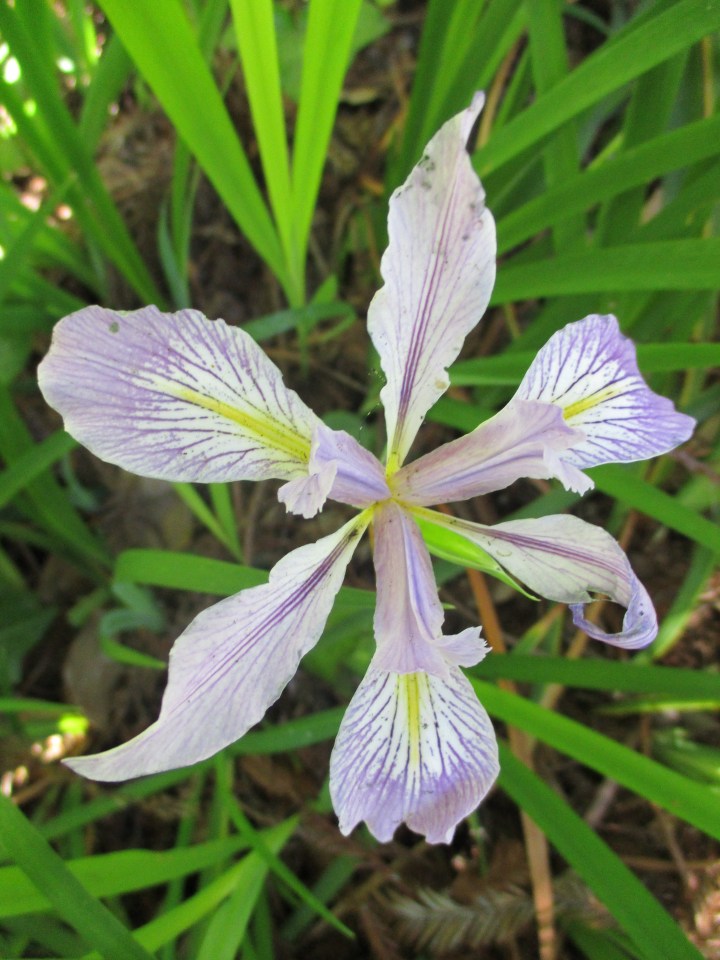 It is not as if the previous article about it was inadequate. https://tonytomeo.wordpress.com/2018/05/05/san-francisco-iris/ I really did not want to get into the habit of writing so many sequels. However, something happened to necessitate this update.
I found what seems to be a REAL San Francisco Iris, right here in the Santa Cruz Mountains. Except for being somewhat etiolated from the shade of the surrounding redwoods, it looks very similar to the San Francisco iris I picked on the Montara Peaks when I was in high school! This one happens to be a bit lighter blue than most, but is certainly well within the color range of the flowers that I remember. Most were probably a bit darker blue, but many were lighter, and some were very pale blue.
It is impossible to know if it was planted in this spot that had been landscaped in the distant past, or merely grew wild. It is right down the road from the more colorful cultivars that I got pictures of earlier. It only recently bloomed on rather grassy foliage that was easy to miss.
I know it does not look like much, but I prefer it to the fancier garden cultivars of the same specie, Iris douglasiana. (It is not the ‘San Francisco’ cultivar of bearded iris.) It is what I am familiar with, and exemplifies the species. Besides Montara, I remember it from San Bruno Mountain, Angel Island and Alcatraz. I might have seen it in the Oakland Hills and on Point Reyes too, but I am not certain if they really were the same.
The bearded iris from my great grandmother’s garden will always be my favorite. https://tonytomeo.wordpress.com/2017/09/10/roots/ However, these San Francisco iris and I have too much history together to ignore.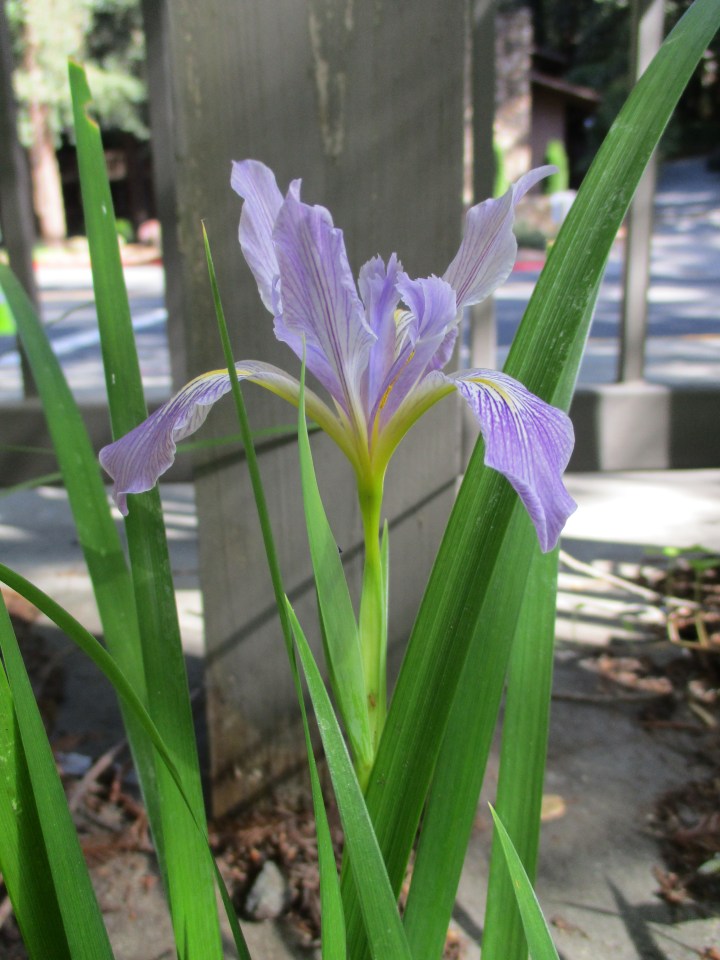
San Francisco iris
 There really is a bearded iris that happens to be named ‘San Francisco’. It is related to ‘Los Angeles’, but not ‘San Jose’. (I really want to find a copy of ‘San Jose’ for my own garden!) Both ‘San Francisco’ and ‘Los Angeles’ are white with a slight blue highlight, and an even slighter reddish edge that is easy to miss. I can not remember which one of the two is whiter than the other, but the whiter one may lack the reddish edge altogether.
The San Francisco iris I remember is something completely different. It is a native west coast iris, Iris douglasiana (or douglasii or any other variation of ‘douglas‘ that any particular botanist happen to prefer) that happens to be endemic to the coastal region of San Mateo County south of San Francisco, and was probably endemic to San Francisco County as well. It would be difficult to identify the entire range, because San Francisco iris is merely a variety, rather than a species. The species has a much larger range. Some might say that the same species in Sonoma or Monterey Counties is also San Francisco iris, just because it happens to bloom with a similar color range.
Well, then there is the issue of the color range. Most varieties of other specie are a particular color. Those that have a range of color at least exhibit a distinct color range that is somehow special and different from everything else. The San Francisco iris does not. It is always blue, but might be any shade or hue between very pale blue and rather dark new denim blue. Not only is that a broad range of color, but it is not very distinctive from the same species hundreds of miles away.
So why do we know it as ‘San Francisco iris’? I really do not know. Perhaps it is just something for us to brag about.
Over the years, west coast iris has been bred to bloom with larger flowers with more of a color range. I am sorry that I did not get more pictures while they were blooming. Besides the more common shades and hues of simple blue, they can bloom in various shades and hues of purple, violet, yellow, gold and white. They are still as undemanding as their ancestors are, and once established, do not need much attention at all.
Pink Flowering Currant
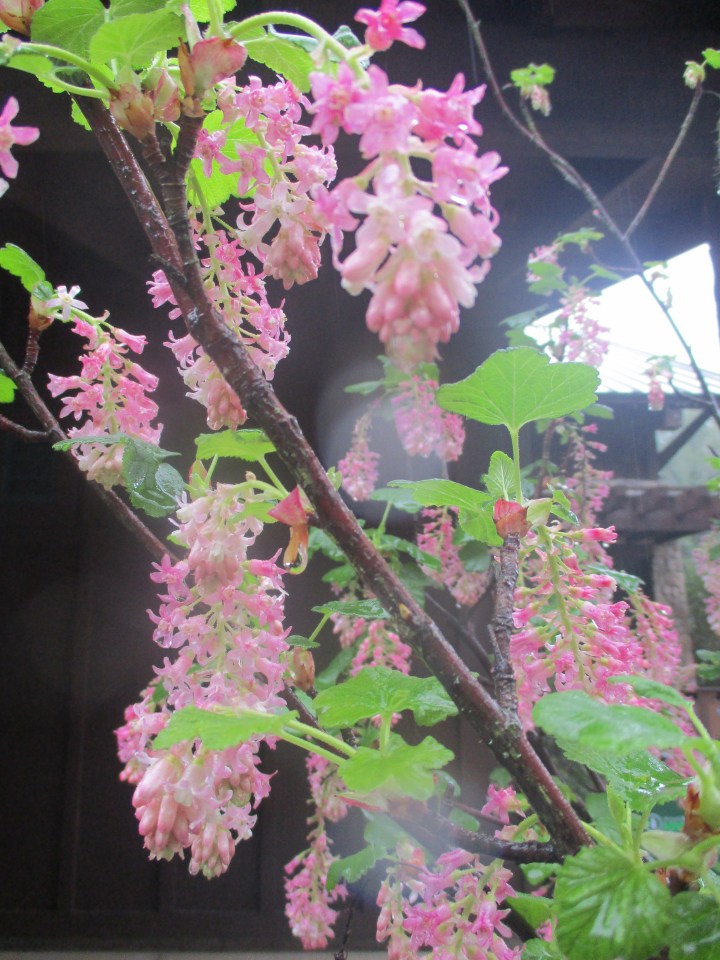 We tend to think of currants as being from Europe, Russia or Eastern North America. The pink flowering currant, Ribes sanguineum glutinosum, is actually endemic to canyons and riparian sites of the coastal ranges of California. Because it is an understory species that lives in the partial shade of large trees, it is quite tolerant of shade, and even prefers a bit of shade rather than full sun.
Mature specimens might reach first floor eaves, and get as wide as six feet. Aging stems of maturing plants should be pruned out to promote growth of new stems. New plants should probably be staked loosely until they disperse stabilizing roots. Although tolerant of drought, pink flowering currant is happier with occasional watering, and will actually tolerate poor drainage through winter.
Pendulous trusses of tiny pink flowers bloom like small wisteria flowers late in winter or early in spring. They are mostly done by now. Small and sparse currants get eaten by birds almost before they get seen. The deciduous foliage turns only soft yellow before falling in autumn. The handsome and slightly aromatic palmate leaves look and smell almost like those of a scented geranium.
Six on Saturday: Vegetation Management
It sounds so unglamorous; probably because it is. We had been working on this project for three weeks, and just finished on Thursday. Most of the work was cutting back thickets of native (but installed) redtwig dogwood. It was neither coppicing nor pollarding, but something in between. They could not be coppiced completely because they are in trafficked areas where they might be tripping hazards until they regenerate. They were not quite pollarded because there were no real trunks remaining, just short stubs of canes. We also needed to removed brambles that were mixed with the redtwig dogwood, as well as a few exotic (non-native) plants that had grown in amongst the whole nasty mess. There were a few nice pyracanthas and privets that needed to be removed. In a better situation, they would have been nice specimens. This was not the right situation for any of them. Besides, privets seed profusely and are quite invasive.
1. Now you see it. This is a privet that needed to be removed.
2. Now you don’t. This is the same privet noticeably absent.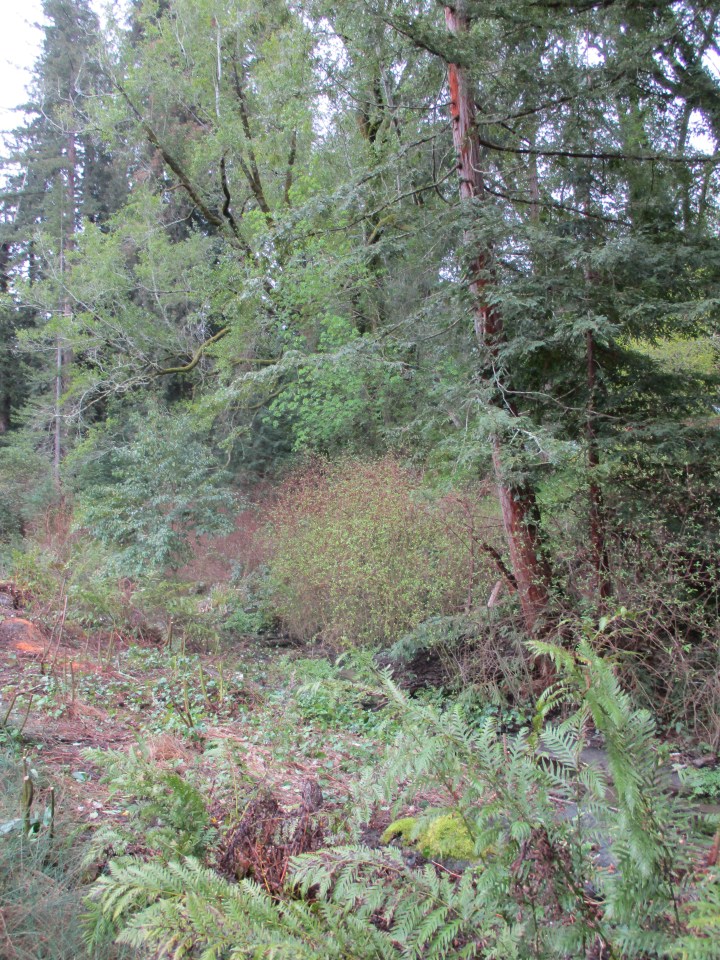
3. Evidence. There really was a privet here.
4. And there it goes!
5. Except for the foliage that just recently developed, this thicket of redtwig dogwood that will not be pruned is what the rest of it looked like.
6. This is what it looks like now.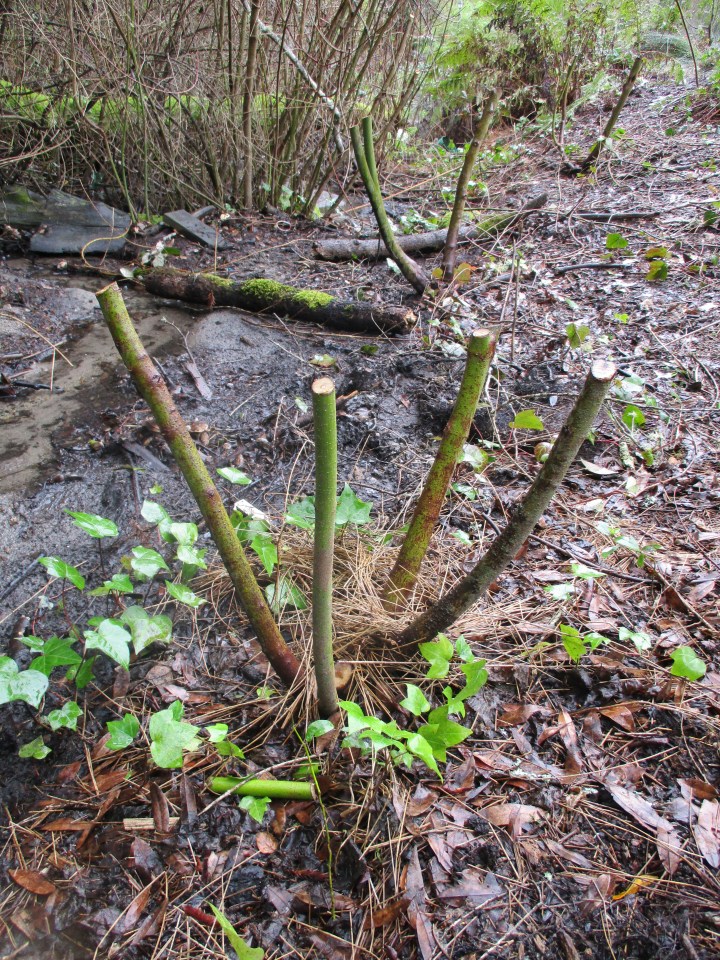
This is the link for Six on Saturday, for anyone else who would like to participate:
https://thepropagatorblog.wordpress.com/2017/09/18/six-on-saturday-a-participant-guide/
Maritime Ceanothus
 What ever happened to Point Reyes ceanothus? It is such a nice low growing shrub, with small holly-like leaves, and cheery blue flowers in very early spring. It was quite popular when it initially became available, but now seems to be rare. Maritime ceanothus, Ceanothus maritimus, from San Luis Obispo County, is a similar species that presently seems to be getting more attention.
‘Frosty Dawn’ is the standard cultivar of maritime ceanothus, although there may be at least three cultivars with the same name. The ‘correct’ cultivar gets about two feet tall and five feet wide, with rigid but arching stems, grayish half inch long leaves, and dense trusses of minute blue flowers as winter ends. Another cultivar gets taller with more open growth. Another has lighter blue flowers.
Once established, maritime ceanothus can probably survive without any watering, but it might be happier with occasional watering through summer. New plants will need to be watered until they disperse their roots. Compared to other ceanothus, maritime ceanothus grows relatively slowly, but lives longer. (Many ceanothus can be short-lived.) Also, it is a bit more tolerant of partial shade.
Little League
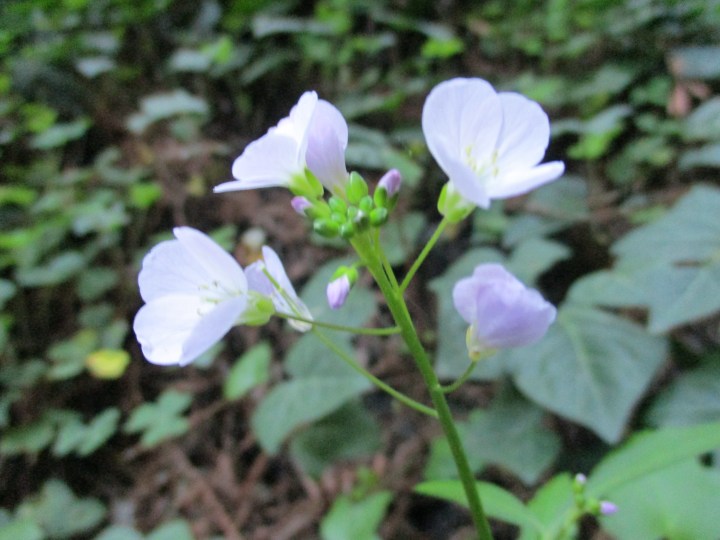 There are so many big trees in the Santa Cruz Mountains that keep most of us looking up. It is easy to miss much of the understory plants that grow on the forest floor.
While getting the pictures for the ‘Six on Saturday’ article posted earlier, I happened to notice these few small pale flowers that contrasted more with their own dark green foliage than they would have if they were more brightly colored. Perhaps that is a technique to get the attention of pollinators. It certainly got my attention.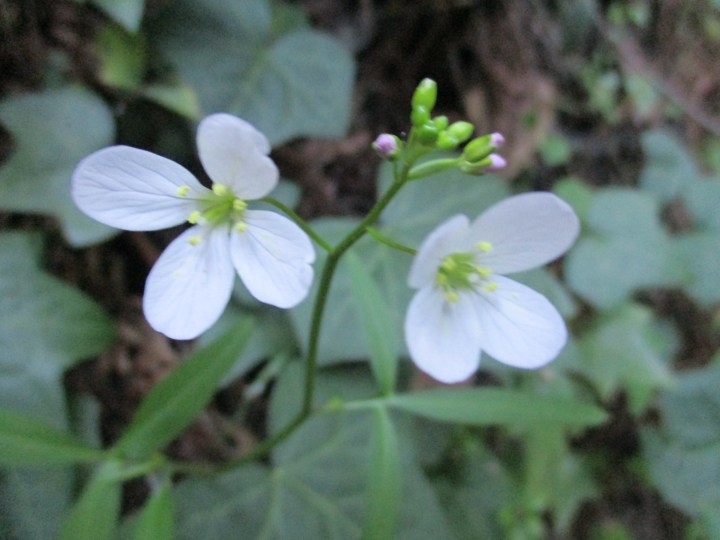 The flowers were not completely white. They were very pale hues of pink. The wood sorrel in the last picture was slightly more pinkish than the unidentified cruciferous (of the family Cruciferae) flowers of the first two pictures. Pale flowers, particularly those that seem to be adorned with barely perceptible patterns, are typically those that use infrared and ultraviolet color to attract pollinators that can see such color. If that was their intention, they would not look so bland to the pollinators whom they prefer to attract.
Much of the surrounding dark green foliage is exotic (non-native) English ivy. It climbs some of the redwood trees and makes quite a mess of the forest. Native specie are too docile to compete with it. The two species in these pictures might have been more common years ago, before the English ivy invaded.
Neither of these specie are the sort that I would plant in my own garden. I do not even know what the first species is. The wood sorrel looks too much like related oxalis. Although several specie of oxalis are popular in home gardens, I still think of them as invasive weeds. Yet, in their natural environment, they are too happy and pretty to not be appealing.
Poppies
 Not just any poppies; California poppies, the state flower of California.
So why the picture of an old cinder block wall on the edge of an unkempt and weathered parking lot behind the old County Bank Building? Well, right there in the middle of the picture, where the lowest course of block meets the edge of the pavement are a few weeds, and some of these weeds are poppies showing how resilient they can be.
California poppies are opportunistic. They grow fast and bloom when they can. For most, that means that they bloom as the weather starts to warm up at the end of winter. For others in irrigated gardens, they can bloom in phases through summer. Some do their thing quickly as soon as they get a bit of moisture from the first autumn rains or even dew. They know what time of year it is, and that the weather will not likely get hot enough to cook them; so they bloom and throw their seed for another generation in a few more months, or maybe many months from now. They adapt. That is how they live on the edges of forests of the Santa Cruz Mountain, to interior valley chaparral, to the Mojave Desert. They are a remarkable specie.
Remember the poppies in the Wizard of Oz? There are several theories about what those poppies represent, and why the put Dorothy, the Cowardly Lion and Toto to sleep without affecting Scarecrow and TinMan. Duh, Scarecrow and TinMan do not breath. They can not inhale the narcotic produced by the poppies. Even if they did, they lack the physiology to be susceptible to opiates.
There is a significance to poppies blooming today, the same day I wrote about the gingko, on December 13; but this ain’t Oz.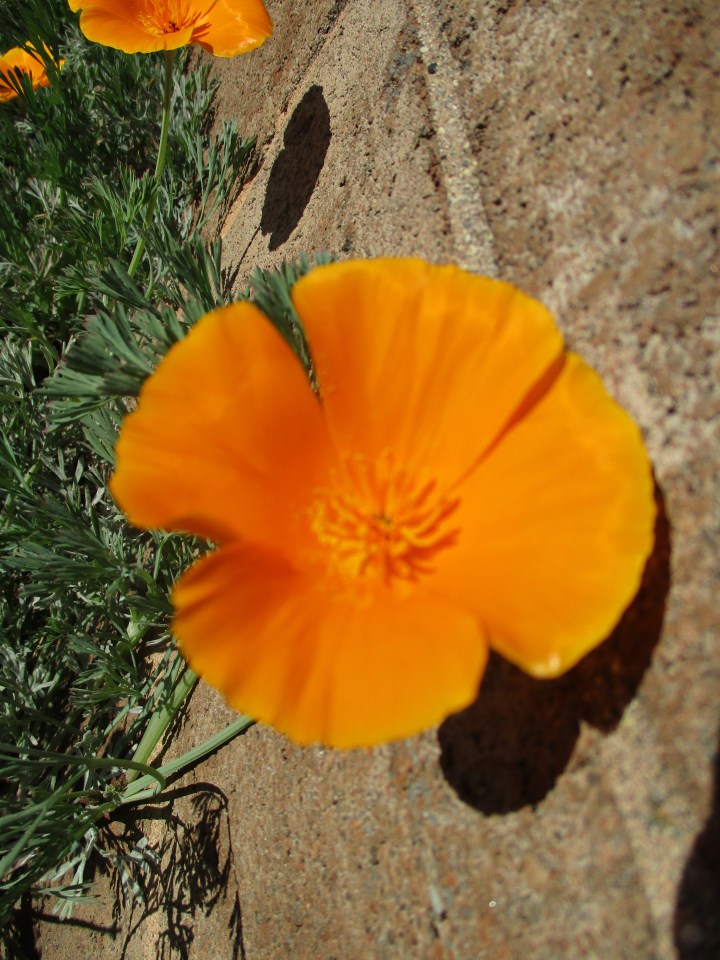
 Tony Tomeo