Pincushion Protea

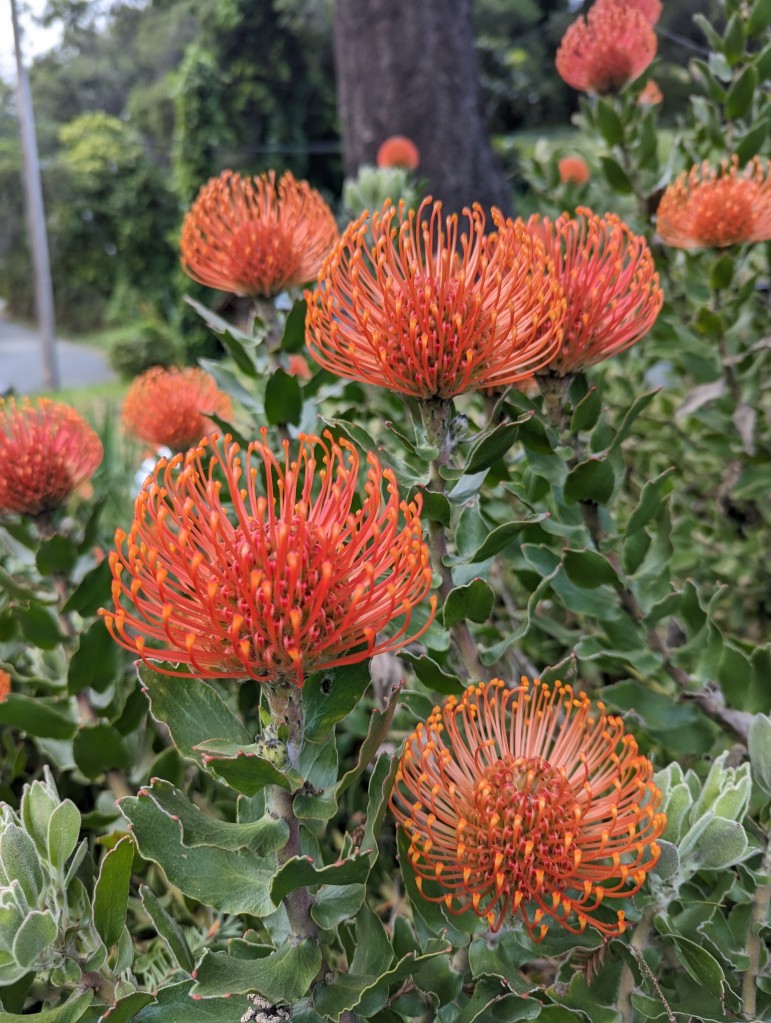
Pincushion protea is most certainly distinctive.

Proteas seem to be as happy locally as they are within their native range in South Africa. The Mediterranean climates there and here must be similar. Like most species from such climates, they are quite undemanding. They enjoy sunny and warm exposure with good drainage. They dislike fertilizer and frequent irrigation. Occasional irrigation is tolerable.

Pincushion protea, Leucospermum cordifolium, is the most popular protea here. Bloom can begin between late winter and early spring, and lasts for weeks. Many are presently blooming. Most are orange. Some are yellow or red. They are excellent cut flowers, both fresh and dried. Each rounded and four inch wide bloom contains many narrow flowers.

Pincushion protea develops stiff branches, but potentially wobbly roots. Sprawling stems that lean onto the ground improve stability. Pruning should remove undesirable stems at their origins, without leaving stubs. Shearing ruins form and texture, and inhibits bloom. Mature specimens can be about five feet tall and somewhat wider. Stiff evergreen leaves are about three inches long and half as wide.

Star Magnolia

Star magnolia insists it is springtime.

Unusually wintry weather did not seem to delay star magnolia, Magnolia stellata, bloom. Such bloom can begin immediately prior to March, or finish immediately afterward. Yet, it typically occurs at about the same time annually within any particular situation. Few here were notably later than they were last year. Bloom lasts only for about two weeks though.

Nonetheless, bright white bloom is spectacular prior to foliation of otherwise bare stems. Formerly rare cultivars with blushed or pastel pink bloom are becoming popular. Delicate floral fragrance is proportionate to profusion of bloom. Individual flowers are about three inches wide with many narrow tepals. Deciduous foliage appears as bloom deteriorates.

Star magnolia may be more comparable to large shrubbery than small trees. Most do not grow much taller than six feet. Some of the largest may be twice as tall and broad, with a few trunks. Old trunks and branches can be somewhat sculptural. Bark is pallid, like that of fig trees. As their plump floral buds begin to burst, bare stems are conducive to forcing.

Flowering Quince

Flowering quince blooms prior to foliation.

Flowering crabapples are the same genus as fruiting crabapples. Flowering cherries are the same genus as fruiting cherries. Flowering quince, Chaenomeles spp., though, is not the same genus as fruiting quince. Available cultivars are generally floriferous but sterile hybrids. Only four basic species produce small fruit that are good for little more than jelly.

They bloom magnificently though, on bare stems, prior to foliation. Profusion of bloom is comparable to that of flowering crabapple and flowering cherry. It begins early enough to finish before some flowering cherries begin. Flowering crabapples start even later. Floral color ranges from bright white to deep red. This includes orangish pink and orangish red.

Unlike flowering cherry trees and flowering crabapple trees, flowering quince is shrubby. The largest might grow no higher than ten feet, with irregular branch structure. Some old cultivars are thorny. Modern cultivars are more compact, shaplier and thornless. Younger trunks should methodically replace older trunks. Pruning can happen after spring bloom.

Mexican Heather

Mexican heather has finely textured foliage.

The minute bright pink flowers of Mexican heather, Cuphea hyssopifolia, are less than a quarter inch long, but are enough to get the attention of the hummingbirds who really dig them. Flowers can rarely be more purplish or even more rarely white. The limber stems are well foliated with finely textured and narrow leaves that are not much more than half an inch long. Mature plants are typically lower but a bit wider than two feet. Overgrown plants can be pruned severely at the end of winter to regenerate over summer.

Camellia

Many camellias have already finished bloom.

While other bloom might be lacking through late winter, camellia, Camellia japonica, can help compensate. Although generally not as profuse as spring and summer bloomers, its individual flowers display elegantly against luxuriantly glossy evergreen foliage. Lack of sturdy stems for cutting is no problem for a few flowers simply floating in a shallow bowl.

Centuries of breeding has produced more than two thousand cultivars of camellia. Floral form can be single, semi-double, double, formal double, paeony, anemone or rose, so is quite variable. Floral color ranges from pure white to deep red, with many hues of pink in between. Stripes, speckles, blotches or picotee margins are within the same color range. 

Camellia generally develops as nicely dense shrubbery that stays lower than the eaves. Some cultivars stay even lower. A few slowly mature as small and perhaps sparse trees. Individual flowers are about three inches wide. Some are smaller. A few are comparably bulky. Camellia sasanqua is a separate species with smaller but more abundant flowers.

Lantana

Lantana just might bloom until frost.

Where winters are very mild, common lantana, Lantana camara, might bloom through all but the coolest of weather. It generally takes more of a break though. It could finish bloom at any time now, and resume at the end of winter. Where winter weather is cooler, foliage and perhaps stems may succumb to light frost. Growth should regenerate through spring. 

The tiny tubular flowers bloom inwardly from the margins of round umbels that are about and inch and a half wide. Flowers typically bloom yellow, and then fade to orange, red or pink. Therefore, the umbels have yellow centers with orange, red or pink margins during the middle of bloom. One cultivar blooms with one hue of yellow. Another fades to white.

Modern cultivars mostly stay rather low and compact. Some sprawl. Older cultivars might get as tall as six feet after a few years. However, after frost damage or coppicing, mature plants may regenerate from their roots, with vigorous stems that get six feet long through summer. The faintly raspy foliage appears to be smooth, and is aromatic when disturbed.

Tropical Hibiscus

This tropical hibiscus was found in Oklahoma, where it needs shelter from frost.

This humongous six inch wide tropical hibiscus, Hibiscus rosa-sinensis, looks like it might be from Hawaii or Florida, but was actually found in K and K Nursery and Landscape of Norman, just south of Oklahoma City, where winter nights are already seriously cold by our coastal California standards. It is happy to bloom so impressively only because it is in a greenhouse. Even here in our pleasantly mild climates, tropical hibiscus are happiest where sheltered above from frost, by eaves or evergreen shade trees that are high enough to also allow warming sunlight through. In the cooler spots, even sheltered plants occasionally get damaged by frost, and need some time to regenerate after winter.

Some of the classic tropical hibiscus that typically have smaller flowers can grow above single story eaves if not pruned down. Most modern varieties with larger or ruffly double flowers rarely reach the eaves, and many stay less than six feet tall even without pruning. The evergreen foliage has an appealing glossy sheen, which is an ideal backdrop for the red, pink, white, yellow or orange flowers.

Oleander

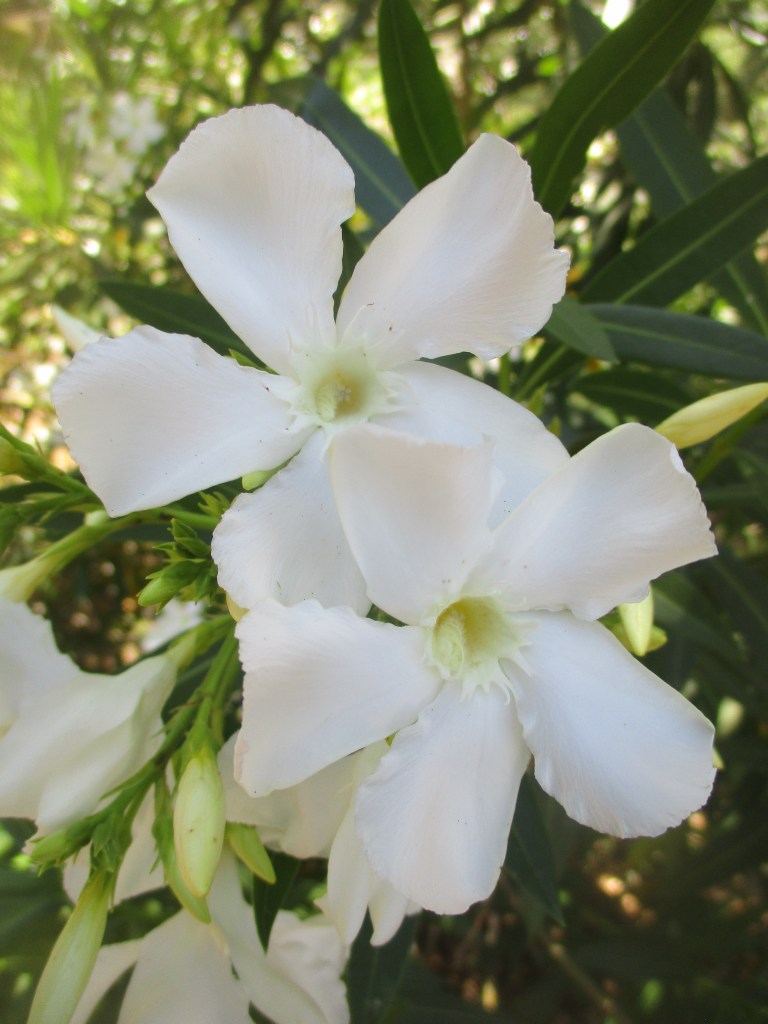
Oleander, although pretty, is famously toxic.

Prior to the appearance of oleander scorch disease in the early 1990s, oleander, Nerium oleander, was almost too popular, and for good reason. It is remarkably resilient to harsh conditions. It had been one of the more common plants within freeway landscapes since freeways were invented. Now, new plants are rarely available. Only older plants remain.

White, pink or red bloom is most abundant through warm summer weather, with sporadic bloom continuing through most of the year. Some dwarf cultivars bloom with peachy pink double flowers. Plants with enough room to grow wild without much pruning bloom best. Frequent shearing deprives the healthiest oleander of its blooming stems prior to bloom.

The biggest oleander get as tall as fifteen feet, so can be pruned up as small trees, either on single trunks or multiple trunks. However, because their limber trunks can not support much weight, occasional pruning is necessary while trunks develop. Such pruning limits bloom, so should happen mostly at the end of winter. Straight single trunks need staking. Oleander wants warm and sunny exposure, but is quite undemanding.

Weigela

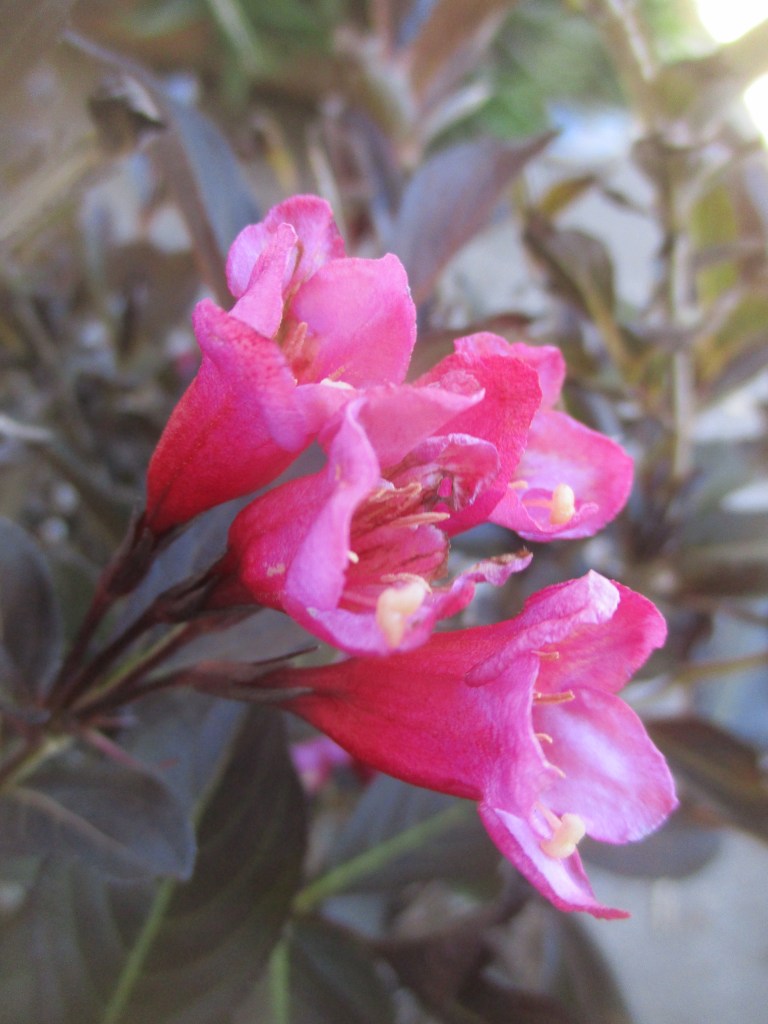
Weigela can be bronze or variegated.

Stylish modern cultivars have been restoring the popularity of formerly common weigela, Weigela florida. Traditional sorts can reach first floor eaves, with delightfully open branch structure and rosy pink spring bloom. The foliage of most is variegated with white. Newer cultivars are more compact, with more variety of form, as well as of foliar and floral color.

Bloom can be pink, red, rosy red, white, white with yellow centers, or the the familiar rosy pink. Foliage can be green, bronze, deep purply bronze, or variegated with white or pale yellow. As it develops in spring, variegated foliage might be blushed with pink. Shrubbier modern cultivars may get no taller than five feet. Some are lower and densely mounding. 

Although deciduous, weigela are popular as short informal hedges. Formal or excessive shearing compromises both bloom and form. After primary spring bloom, several modern cultivars bloom sporadically later in summer. Weigela enjoys a bit of winter chill, so may not appreciate the mildest coastal climates. Partial shade is tolerable, but inhibits bloom.

Oleander

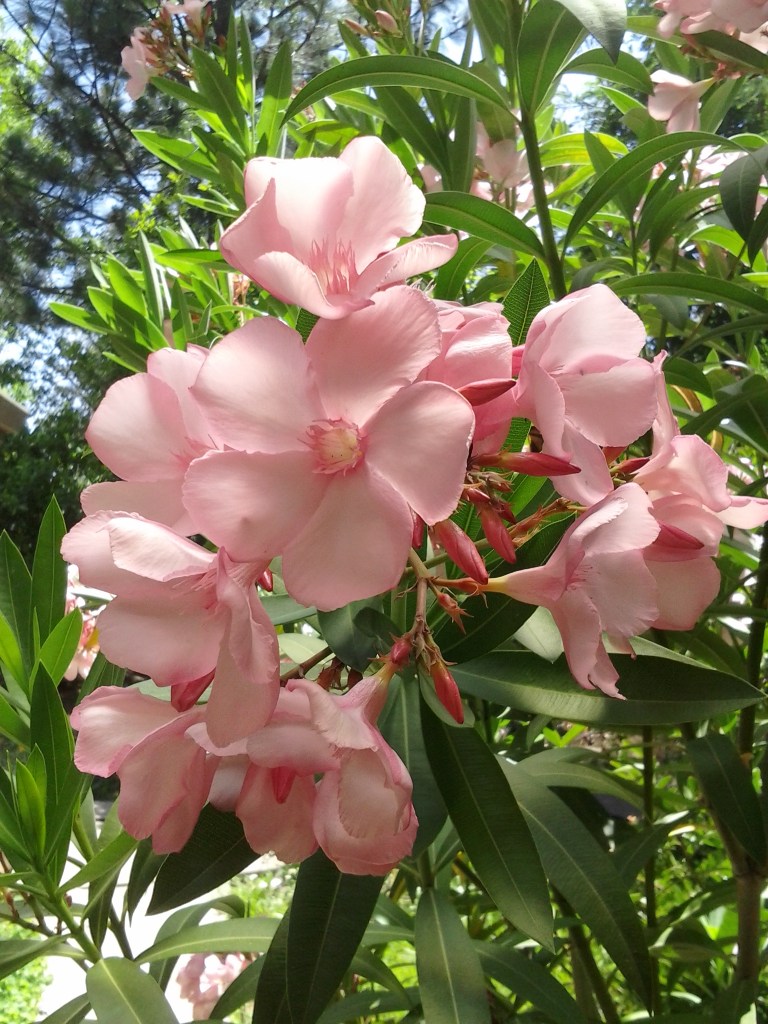
Oleanders add color to the commute.

As long as freeways have been getting landscaped, oleanders have been contributing their profuse white, pink and red bloom. Heat, exposure and lack of moisture do not seem to bother them. They have become less common recently only because of new diseases that had never before been problematic. The diseases do not necessarily kill all oleanders everywhere, but are serious problems where the nurseries that grow most oleander are located.

The largest oleanders can get more than fifteen feet tall, and can be pruned up as small trees with multiple trunks. Oleander trees with single trunks almost never stand up straight, and do not want to give up their stakes. Because flower clusters develop at the ends of new growth, frequent exterior pruning or shearing inhibits bloom. Dwarf cultivars that are naturally proportionate to their space will bloom better than larger types that need to be pruned for confinement.

Oleander flowers are about an inch or two wide, with five petals, although some have ruffly ‘double’ flowers. Unfortunately, double flowers tend to hang on as they deteriorate after bloom. Some oleanders are slightly fragrant. The name ‘oleander’ is derived from the similarity of their leaves to those of olive trees (‘Olea‘), although oleander leaves can get three times as long.