There is way too much blooming for me to keep up with. Because I know there will be less blooming through summer, I get pictures while I can, even if I can not use them right away. Consequently, these pictures are not exactly from this last week. Some were from the second phase of bloom, and the first picture is from the first and only phase of bloom of a rose that blooms only once annually. I suppose I could have gotten pictures of the other five this last week, but I wanted to get them earlier than later, just in case they were between phases when I wanted to get the pictures.
Roses do very well here, and are even happier in the warmer and more arid weather of the Santa Clara Valley, just a few miles away. The Santa Clara Valley is one of the best places in the world for roses, which is why the Heritage Rose Garden is located there. Sadly, that collection is presently not in very good condition.
1. ‘Doctor Huey’ is the only cultivar of these six that I can positively identify. It has been the common understock for grafted roses longer than I can remember. Because it is only used as understock, it is not often seen blooming out in the garden. These are only blooming because the original scion died, and was replaced with sucker growth from below the graft. ‘Doctor Huey’ blooms profusely but only once in spring. It grows as a bramble, and can form small thickets if neglected long enough.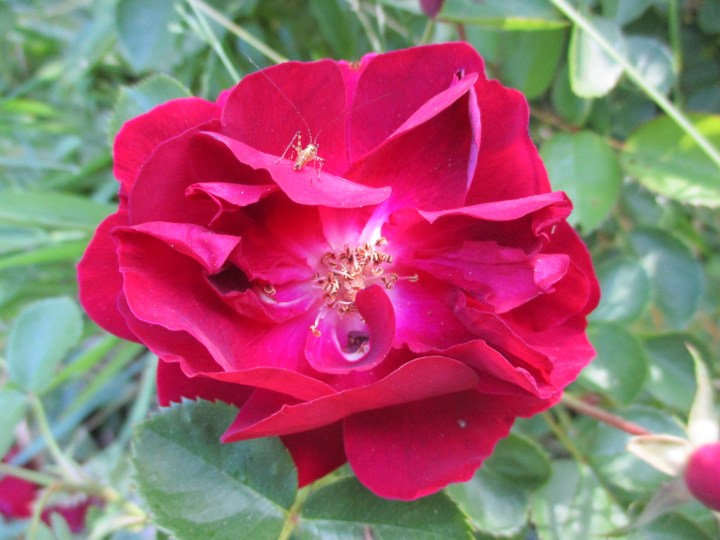
2. Although not white, this pretty hybrid tea rose is probably my favorite of the six just because it is so perfect. I do not know the cultivar. It is not in the landscape, but is in the nursery, waiting to be installed into the landscape. Hybrid teas are the roses that I grew up with, so are my favorites.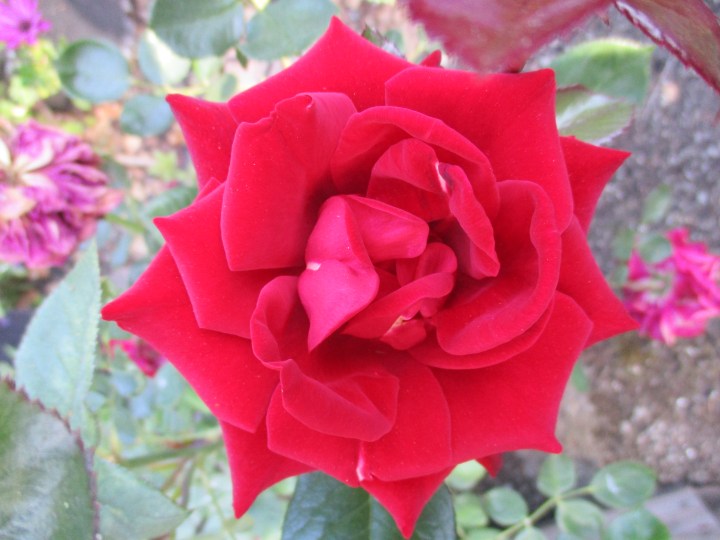
3. I am not sure if this bicolored rose is a hybrid tea or a floribunda. I am guessing that it is a floribunda because there are groups of flowers blooming where I earlier deadhead the first phase of single blooms. It is out in the landscape, in the same garden with 4, 5 and 6 below. It is grown as a shrub. The others are grown as standard or tree roses.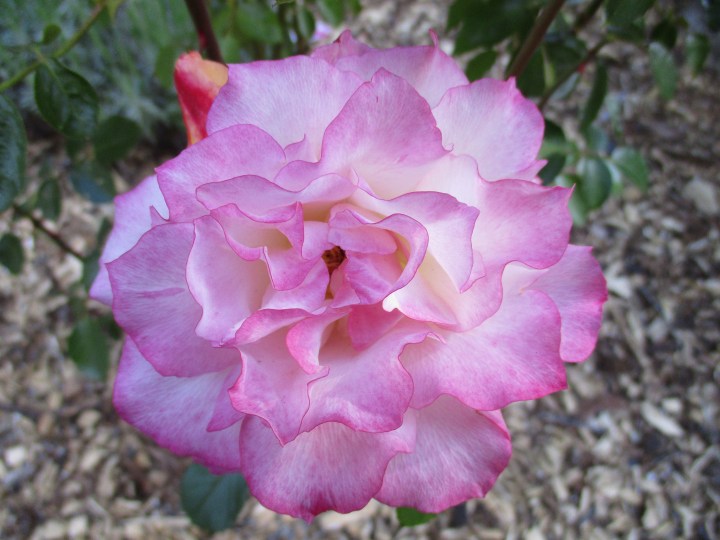
4. This is my least favorite of the six because it looks like one of those trendy David Austin roses. The color is nice, but the form is weird. I will never understand fads. I know that hybrid tea roses were a trend or maybe even a fad at one time, but it was the trend that I grew up with, which is why they are what I compare all other roses to. This rose does not compare to them too well. It is grown as a standard or tree rose.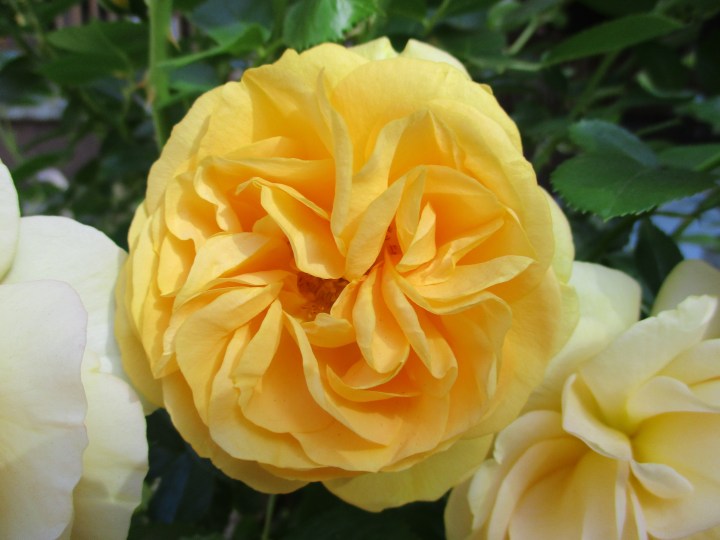
5. This is also grown as a standard or tree rose, but in conjunction with 6 below. I mean that they are grafted together on the same trees. Individually, they are nicely formed roses with excellent color, but they look silly stuck together with the white roses. I could probably identify this rose if I wanted to, but I do not want to misidentify it. Except for the color, the rest of it grows just like ‘Iceberg’.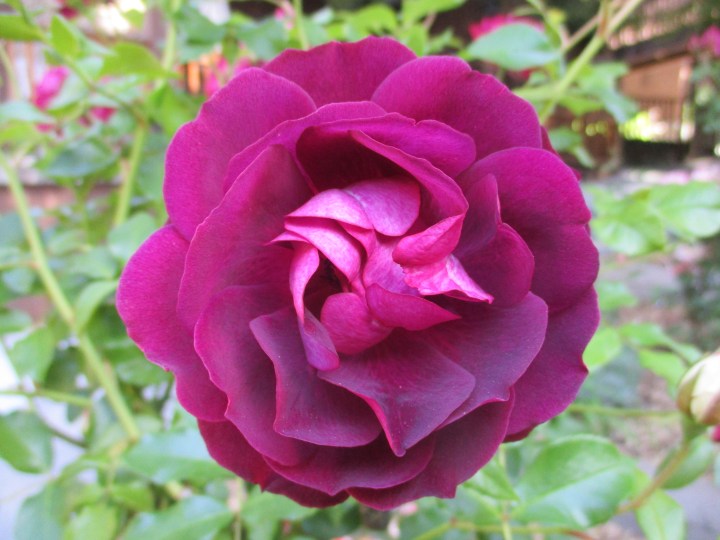
6. This one looks just like ‘Iceberg’, and except for the color, grows just like 5 above, which it is grafted onto the same trees with (as I mentioned above). The white is perfect. If it were a hybrid tea, it would be my favorite of these six. I just prefer 2 above because it is such a perfectly formed rose on good stems.
This is the link for Six on Saturday, for anyone else who would like to participate:
https://thepropagatorblog.wordpress.com/2017/09/18/six-on-saturday-a-participant-guide/



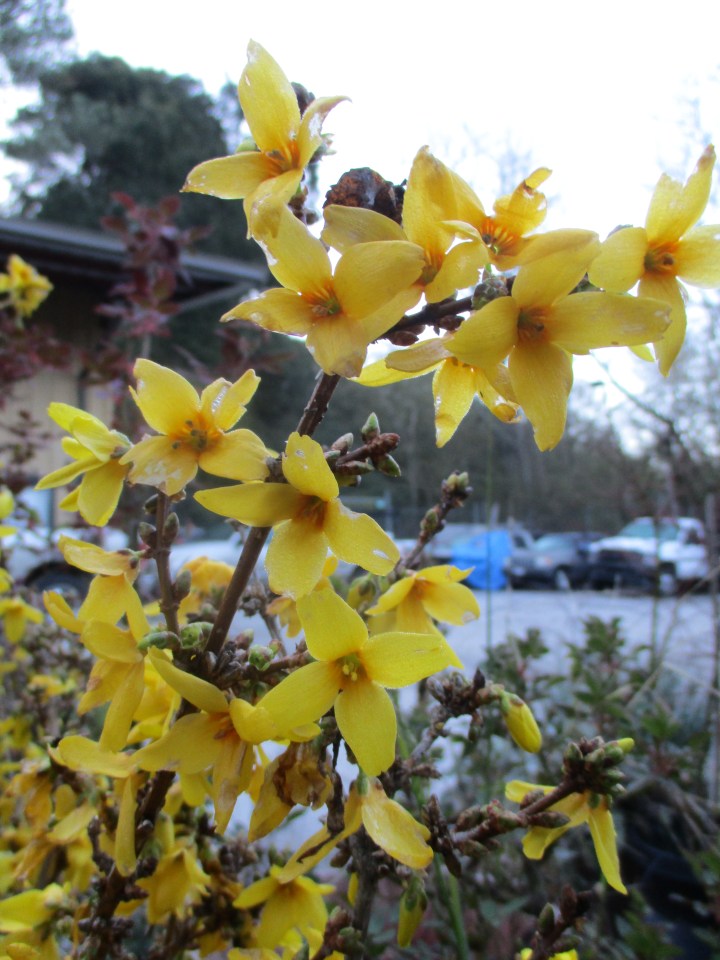 It is a shame that forsythia is not more popular here. Years ago, there was a commonly perpetuated myth that winters were not cool enough for it, as well as lilac. We now know that both lilac and forsythia are happy to bloom here. Now, some might insist that there are so many evergreen shrubs that bloom nicely right through winter, that there is no need for deciduous blooming shrubbery.
 What ever happened to Point Reyes ceanothus? It is such a nice low growing shrub, with small holly-like leaves, and cheery blue flowers in very early spring. It was quite popular when it initially became available, but now seems to be rare. Maritime ceanothus, Ceanothus maritimus, from San Luis Obispo County, is a similar species that presently seems to be getting more attention.
 Before its new lime green foliage emerges, the otherwise modest star magnolia, Magnolia stellata, dazzles with a surprising profusion of crisp white, blushed or pale pink bloom. The three inch wide flowers have between a dozen and two dozen floppy petals (which are actually tepals). If the weather is right, the flowers might be slightly fragrant. If only bloom could last longer than it does!
 Pictures are probably prettier than the real thing. Australian fuchsia, Correa pulchella, really does bloom with pendulous soft pink flowers through winter when not much else is blooming. However, the flowers are quite small, and the color is rather hazy. The real appeal of Australian fuchsia is that it is so undemanding, and once established, only needs watering a few times through summer.
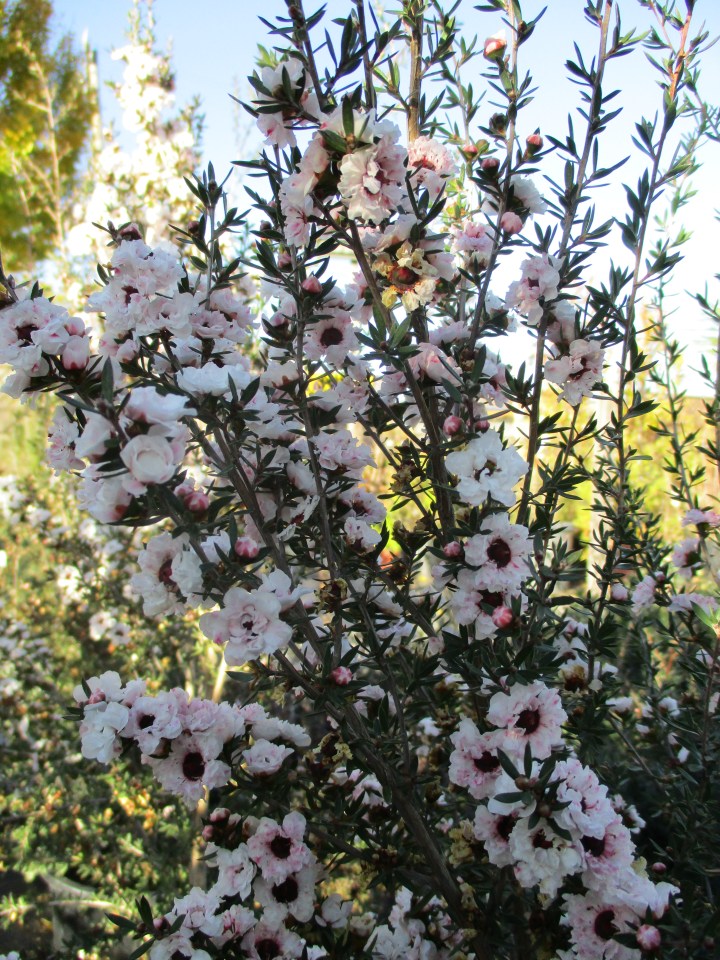 With such an odd variety of flowers blooming out of season, it should be no surprise that New Zealand tea tree, Leptospermum scoparium, decided to join the party. It starts blooming in phases in spring, and continues into autumn, so is not too terribly out of season. Besides, some varieties are known for spontaneous bloom phases at any time of year. Bloom can be pink, white or red.
 Tony Tomeo