Six on Saturday: Out Of Africa


Lily-of-the-Nile was the first perennial that I divided and propagated on a substantial scale. Back when I was in the seventh grade, I was instructed to remove an overgrown specimen that was nearly a quarter of a century old. It was too tough, big and heavy to dig up intact, but relatively easy to dismantle and remove in smaller pieces. These smaller pieces were all too easy to split into individual rhizomes with single terminal shoots. These individual rhizomes were easily groomed and planted where I thought copies of the same lily-of-the-Nile would be nice. A few years later, these copies were big enough to be dug and divided into even more copies. Nearly four decades later, I am still growing a few copies.

Because it is so resilient and undemanding, lily-of-the-Nile is one of the most common perennials here. They bloom through summer, with their firework shaped blooms at their best in time or the Fourth of July. Now that they are finishing their long bloom season, the deteriorating flowers must be removed, by ‘deadheading’.

1. Lily-of-the-Nile, although common, really is a delightful perennial. I thought I was getting a good representative picture here, but can now see that the two lower blooms in the foreground are fasciated, so are more billowy than typical blooms are. Also, the sunlight at about noon was a bit too harsh for a good picture of the foliage.P90817

2. This very late blooming floral truss is how all the other blooms started out.P90817+
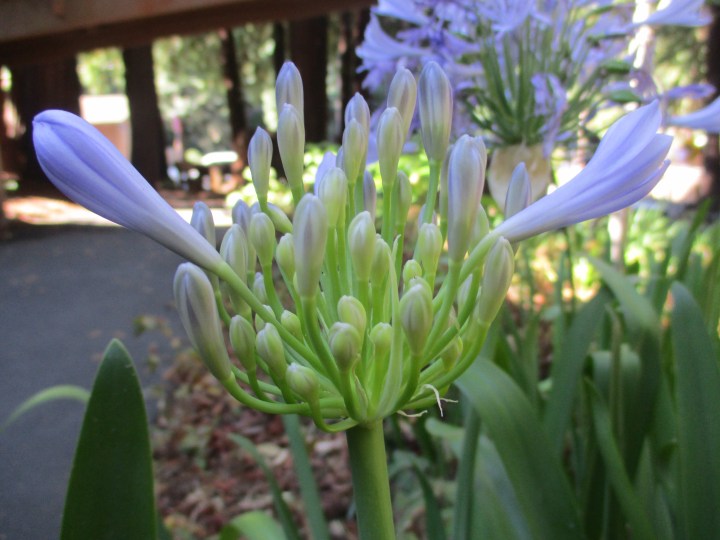
3. This one shows how they look at full bloom. It is only beginning to deteriorate.P90817++

4. As individual florets fall away, these maturing green seed capsuled remain. They slowly dry and turn tan before tossing their seed late in autumn or winter. Of course, they should get pruned out before they do so.P90817+++

5. Lily-of-the-Nile are very easy to work with, but snotty with this goo that flows from all cut floral stems and any damaged leaves. Ick!P90817++++
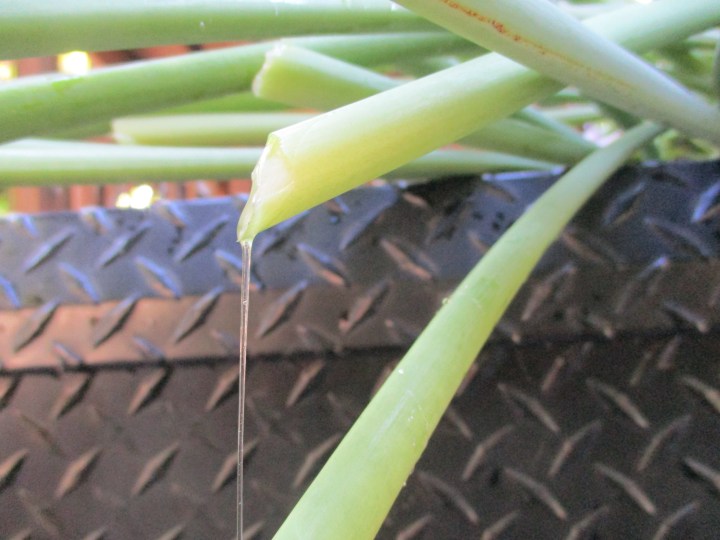
6. This is the pile of deadheaded bloom that got cut on Wednesday. More will be cut next Wednesday. Almost all typically finish within two weeks or so. However, they started a bit late this year, and are finishing more randomly than they normally do.P90817+++++

This is the link for Six on Saturday, for anyone else who would like to participate:

https://thepropagatorblog.wordpress.com/2017/09/18/six-on-saturday-a-participant-guide/
Six on Saturday: Cannas – Mostly


There are only four pictures of cannas here. I could have gotten two more for an even six, but would have needed to get them elsewhere. These six pictures were obtained within one of the landscapes at work. Except for pruning a grapevine and flowering cherry trees, I do not work in this garden, so can not take credit for these cannas. I will take credit for the pictures though.

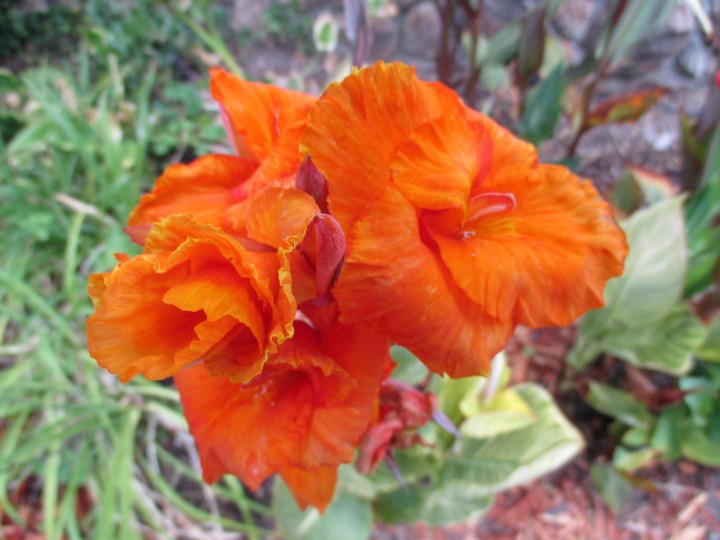
However, I probably should have taken pictures that show the foliage in conjunction with the bloom. Without the foliage there is not much to distinguish the big orange flowers of the last two pictures from each other.

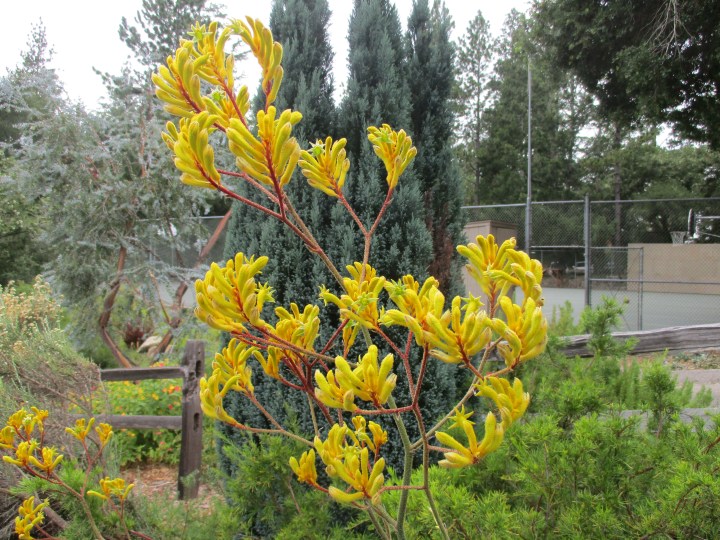
1. Kangaroo paw, Anigozanthus, is one of my lesser favorite perennials, but happens to be one of the more practical for the chaparral climate. Besides, this one happens to be rather pretty. I do not know what cultivar, or even what species this one is. The Eucalyptus cinerea to the upper left is the same that was featured in ‘Silver‘ and ‘Exfoliating Bark‘.P90803

2. Honeysuckle, which I believe might be Lonicera periclymenum ‘Peaches & Cream’ was featured as the second picture of ‘Six on Saturday – Not My Garden‘, and was likely also featured in other posts that I do not want to go looking for right now. When I first met this honeysuckle, it was rather grungy and mostly defoliated. I thought that it was Lonicera sempervirens ‘Major Wheeler’, which looks nothing like this.P90803+

3. Canna with wispy orange flowers and big green leaves is probably my favorite of the four. The big leaves, which are not shown here, are quite lush. I believe that this one can get quite tall.P90803++

4. Canna with bigger red flowers and simple green leaves is more what we expect a canna to look like. The bronze foliage to the right and in the background actually belongs to #6 below.P90803+++

5. Canna with big orange flowers and yellowish variegated leaves was the fourth picture of ‘Six on Saturday – No Silver‘. That picture shows only a close up of the foliage, without bloom.P90803++++

6. Canna with big orange flowers and bronze leaves was the third picture of ‘Six on Saturday – No Silver‘. That picture also shows only a close up of the foliage without bloom. I believe this to be the cultivar ‘Wyoming’.P90803+++++

This is the link for Six on Saturday, for anyone else who would like to participate:

https://thepropagatorblog.wordpress.com/2017/09/18/six-on-saturday-a-participant-guide/

Summer Perennials Are Now Blooming

90731thumbAre warm season annuals really the most colorful flowers for summer? Perhaps. They have their limits though. They are also very demanding. They need to be watered very regularly, and should probably be fertilized too. Many need to be deadheaded frequently. After all that, they are only temporary, and will get replaced with cool season annuals in autumn. Perennials are more practical.

Lily-of-the-Nile is likely the most common and most familiar of blooming summer perennials. It is a shame that it blooms only once. Bloom is usually in time for the Fourth of July, and lasts a good long time, but is already fading. Deadheading as the blue or white color is eventually exhausted will not promote subsequent bloom, but will keep the evergreen foliage looking tidy until next year.

Daylily might be the second most popular of summer perennials. Some of the older types bloom only once like lily-of-the-Nile, but various cultivars bloom at various times to prolong the season if a few are grown together in the same garden. The most popular modern cultivars probably bloomed earlier, and will bloom again, perhaps with little time in between. The color range is extensive.

Penstemon are not committed to their natural schedule of blooming in late spring and again in autumn. A good pruning at the end of winter eliminates tired old foliage, and enhances and delays bloom until summer, without compromising the later autumn bloom. Like daylily, a few different varieties of penstemon in the same garden prolong bloom, which can be white, pink, red or purple.

Salvias are a big group of summer perennials that really should be more popular than they are. Some are native. Others are from other chaparral climates. Naturally, they are right at home here. Many bloom about now, and some will bloom again in autumn if deadheaded or pruned back. What they lack in flashy color, they compensate for in resiliency and reliability. They really are tough.

This is by no means a complete list of summer perennials. It does not even include the perennial daisies such as coneflower, black-eyed Susan and gaillardia.

Giant Bird Of Paradise

60720Unlike the common bird of Paradise that is grown for striking bright orange flowers, the giant bird of Paradise, Strelitzia nicolai, is grown for strikingly lush foliage. The big rich green leaves get nearly six feet long, and flare outward from leaning trunks that can eventually reach upstairs eaves. Foliage is healthiest if sheltered from harsh sunlight (such as hot reflected glare), wind and frost.
Bold white blooms with contrastingly delicate blue streaks are a rare surprise on older trunks. The navy blue floral husks with nectar dripping from them look like the beaks of drooling seagulls; but the flared flowers above look like the crests of parrots.

Epiphyllum Surprise

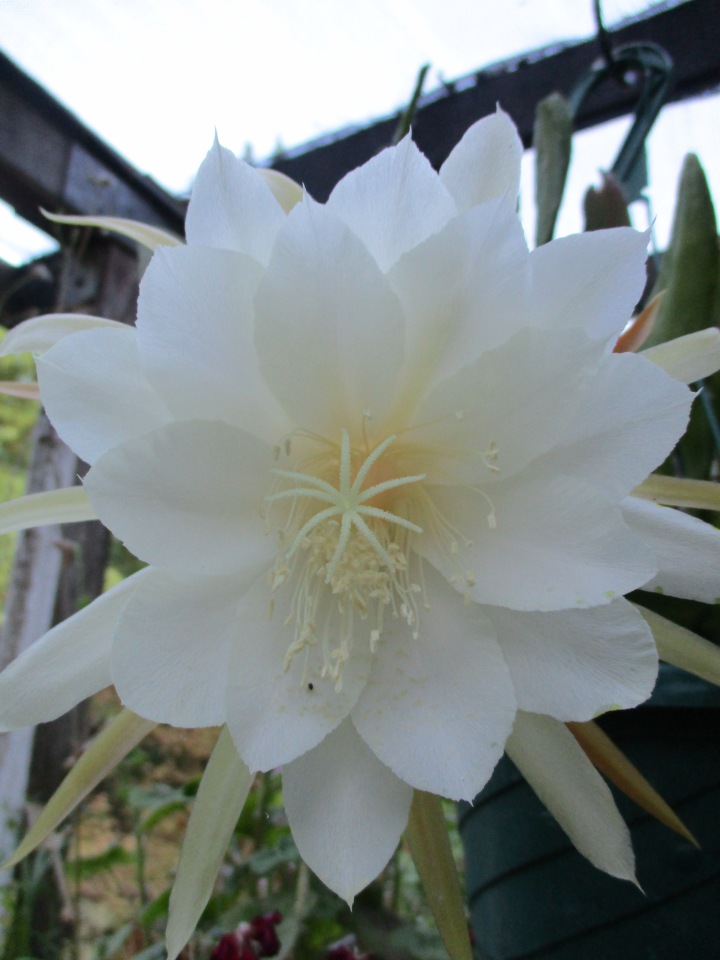
80808Epiphyllum oxypetalum was my very first epiphyllum. A friend’s mother gave me three long cuttings, which were cut in half to make six cuttings. They grew like weeds, and I was quite pleased with them. At the time, they were the only epiphyllum that I wanted. The wide nocturnal flowers are strikingly pure white and nicely fragrant, and stay open late into the morning if the weather is right. Since white is my favorite color, I craved no more.

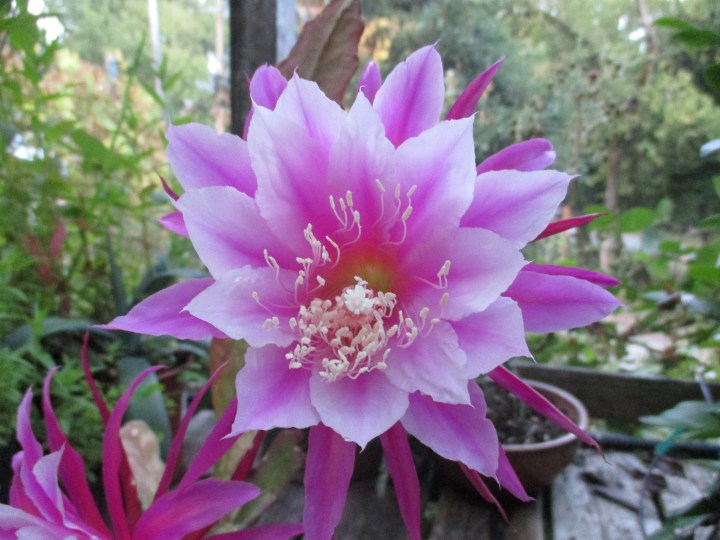
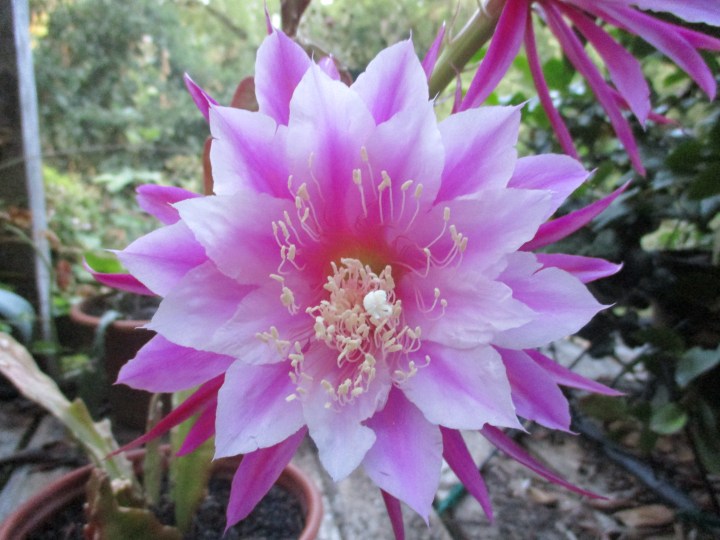
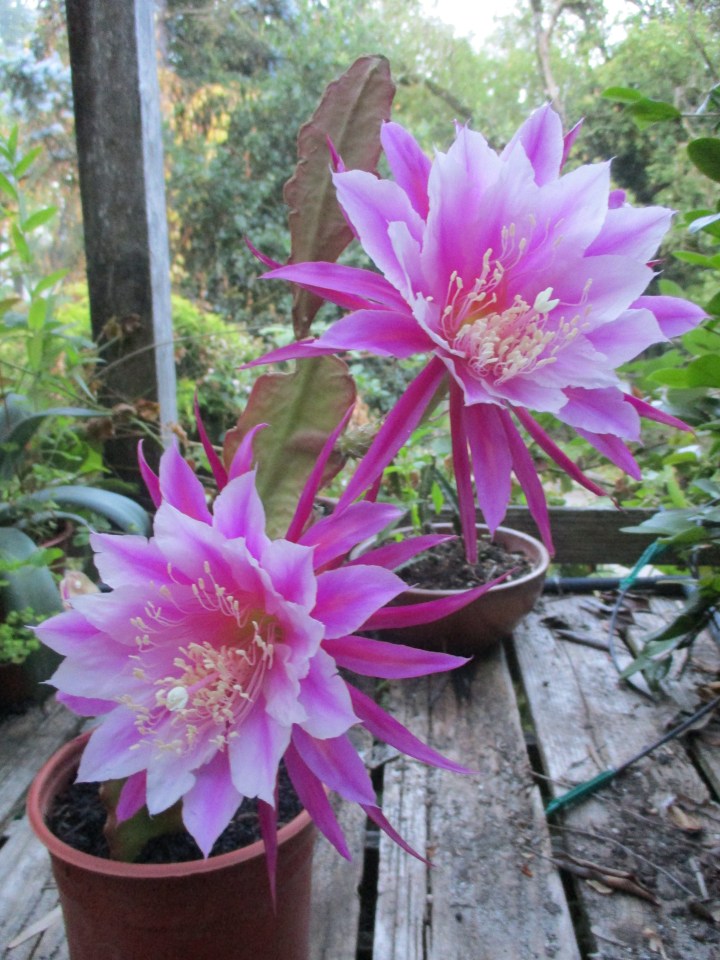
Then I got bits of another epiphyllum from one of my clients. I do not know if it really is a species of epiphyllum, but it grows just like one, with the exception of the bloom. Rather than only a few huge nocturnal flowers, it blooms with many smaller pink flowers that remain open all day. It lacks fragrance. It is not as impressive as Epiphyllum oxypetalum, but it is colorful for a longer time. Besides, now that I got it, I must continue to grow it.

Shortly afterward, I acquired a bit of another epiphyllum from another client. I expected it to bloom with a bright red flower, but it did nothing. In fact, it sat around for a few years without doing anything. Finally, it bloomed for the first time this year. That is the surprise.P80714+++++

This red epiphyllum that bloomed last year is not mine. It belongs to a colleague who hangs it in public garden at work while it is blooming. This is what I expected mine to look like. I sort of believe that it happens to be one of the more popular cultivars of epiphyllum.

What I got instead was these intriguing pink blooms! I don’t know what to think. The clear whit Epiphyllum oxypetalum is still my favorite, and I really like the rich red, but these pink flowers are totally rad too!P90707P90707+P90707++

Lily Of The Nile

60706The Nile River floods annually, inundating everything in its floodplain. Lily of the Nile, Agapanthus africanus, survives by hanging on firmly with a thick network of rubbery roots. It grows and blooms in warm weather as floodwater recedes, and then survives through a long, warm and dry season until the river floods again. It tolerates both drought and flooding, although it prefers more stability.

The blue or white blooms resemble fireworks, and happen to bloom in time for the Fourth of July. The small tubular flowers are neatly arranged in big and round trusses on top of slender and bare stems that stand about two to four feet tall. ‘Storm Cloud’ has darker blue or purplish flowers. Other purple varieties have larger and more pendant flowers (that hang downward from their trusses.)

The dense evergreen foliage is quite luxuriant, and is just as appealing as the bloom is. The rubbery leaves are up to two feet long, and arch outward from basal rosettes. Deteriorating lower leaves are typically obscured by fresh new foliage above. The thick rhizomes can be divided for propagation. Plants known as Agapanthus orientalis may have bigger blooms and wider leaves.

Paris Daisy

P90608KNo, this is not a Paris daisy. It is a common euryops daisy, Euryops pectinatus. It is obviously related, but the flowers are bright yellow rather than clear white with yellow centers, and the foliage is darker green. It is more resilient, so became more common in landscapes as quickly as mow, blow and go ‘gardeners’ replaced real gardeners who actually know something of horticulture. There is certainly nothing wrong with it. It is just cliché.
The few remaining Paris daisies are fancier cultivars of the old fashioned traditional sort anyway. Some bloom pale pink. Some bloom pale yellow. Flowers might have fluffy centers of the same color. Foliage might be pale grayish green. Plants are more compact. The cultivar that most closely resembles the old Paris daisy has more profuse, but smaller flowers. The cultivars are all quite nice, but are not quite the same as what we remember.

The original Paris daisy, Chrysanthemum frutescens, which is now known as Argyranthemum frutescens, was the sort of flower you wore in your hair if you were going to San Francisco in the late 1960s, or according to my memory, in the very early 1970s. It looked just like the three plastic daisies in the upper right (or lower left) corner of those cool AstroTurf door mats that were so popular. Perhaps they were cliché for their time too.

Cuttings rooted in half pint mason jars on kitchen windowsills to replace older plants. Our mothers grew them in the garden, supposedly to repel the bad insects, and attract the good insects to eat the bad ones who did not take the hint. In that regard, Paris daisies were how young horticulturists learned about vegetative propagation and ‘integrated pest management’ (IPM). They were so familiar back then; but then disappeared by the 1990s.

Only recently, Brent, my colleague in the Los Angeles region who I so frequently mention (typically in a disparaging manner) found just two specimens at a nursery in Southern California, and promptly procured both. One if for his garden, and one is for mine!

Deadheading Promotes And Prolongs Bloom

90612thumbApril showers bring May flowers. May flowers make a mess. Well, some of them do. Most simply disintegrate and fall from the trees, shrubs and vines that produced them, and decompose into the soil below. Some might have needed to be swept off of pavement and decks. Regardless, most of us do not notice the very minor consequences for the majority of spectacular spring bloom.
However, there are some flowers that demand a bit more attention after they finish blooming. They linger after the show is over, and can look shabby as they deteriorate. Small ones can simply be plucked. Larger blooms might need to be pruned out. The process of removing deteriorating blooms is known as ‘deadheading’, and it is done for more reasons than just to keep plants groomed.

Plants bloom to produce seed, and the production of seed takes resources. Removal of seed structures not only diverts resources to more useful functions, but for many plants, it also stimulates subsequent bloom in response to interrupted seed production. They literally keep trying until they are able to produce viable seed, even if they must continue all season until late autumn dormancy.

Most plants that benefit from deadheading are perennials. Shasta daisy, black-eyed Susan, blanket flower, cone flower, yarrow, lavender and beard tongue (penstemon) bloom more abundantly and for a longer time with regular deadheading. The various lavenders, as well as other perennials that are comparably shrubby, are easily deadheaded by shearing after profuse bloom phases.

For bulbs and bulb like perennials that bloom only once annually, deadheading will not promote subsequent bloom during the same year, but conserves resources for the following year. Daffodil, lily, clivia, various iris and, during summer, gladiolus and dahlia, all appreciate diligent deadheading.

Petunia and marigold are two annuals that happen to bloom better with regularly deadheading. They bloom so profusely that deadheading can be quite a chore. Plants that can be invasive, such as salsify, should be deadheaded before dispersing seed.

Rose Lily

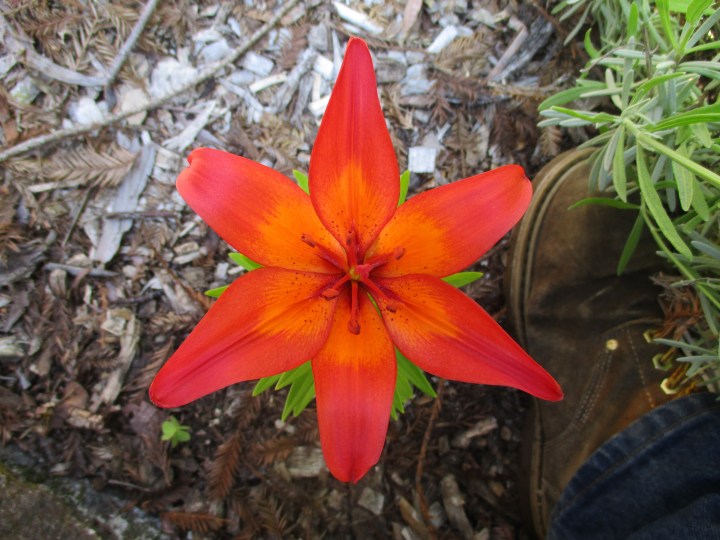
P90601KWhat a delightful surprise! It happens sometimes here in the rose garden. It may not look like much, as a short stemmed single lily floret that is mostly overwhelmed by the English lavender that I held back with my boot for this picture. It should be three feet tall or so, with several florets. The surprise is that no one planted it. Well, at least no one planted it recently. This rose garden has more history than is obvious from what blooms here now.
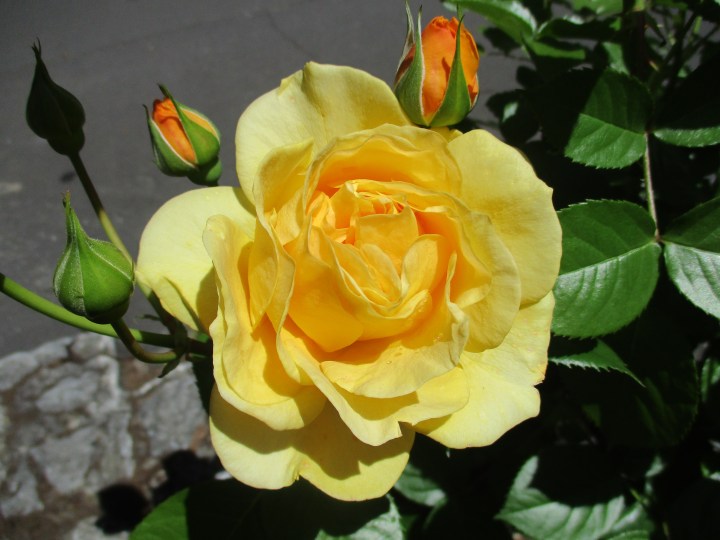
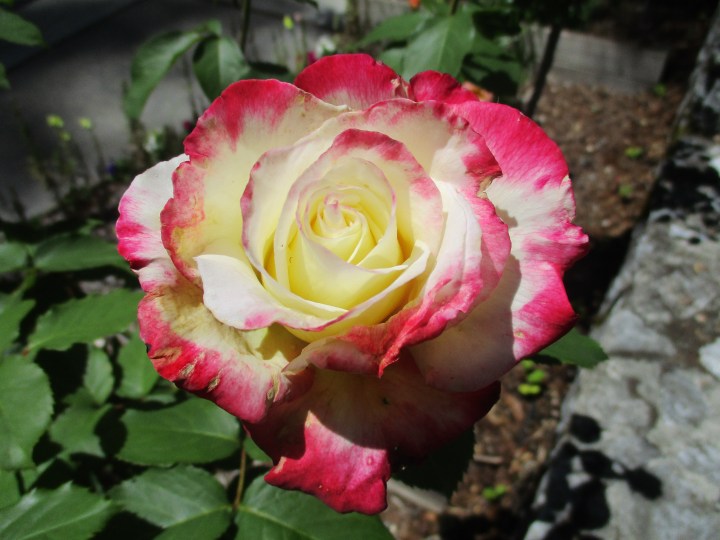
Old pictures show that it was formerly an extravagant perennial bed, with an abundance of canna, dahlia, penstemon, pelargonium, Shasta daisy, Japanese anemone, various iris, and of course, various lilies. Lower annuals were cycled through the seasons at the front edge. Only a few roses bloomed against the low wall at the rear. Soil was likely regularly amended with compost and fertilizer. Someone put significant effort into maintaining it.
Nearby redwoods appreciated all the effort, and extended their roots into the fertilized, richly amended and regularly irrigated soil. Their growing canopies extended over and shaded the upper portion of the perennial bed so that all but daylilies and Japanese anemone were replaced with ferns. Perennials that got dug and stored for their dormant seasons were later installed elsewhere as it became obvious that they would not be happy here.
Because the few roses did not seem to mind the redwood roots, a few more, as well as English lavender, were added in informal rows to replace deteriorating perennials. Annuals require more effort than they did originally, but are still cycled through the seasons in a narrow row at the front edge. The rose garden now seems to have always been here, as if intentionally planned. Every once in a while, we find reminders of extravagant history.

Six on Saturday: Abbreviated Rose Parade


There are a few other roses that I could have gotten pictures of in order to submit a complete set of six, but I wanted to show off just these four that bloom in what is known as the ‘rose bed’. A fifth purple cultivar was not blooming when I got these pictures. What seems to be a sixth cultivar that I did not get a picture of is really suckers of ‘Doctor Huey’ understock that appeared far enough away from the original plant to not be a problem.

There are several rose shrubs and standards (trees) in the rose bed, but they are limited to these five and a half distinct and mostly unidentified cultivars. They are the most prominently located roses that I work with. The other roses are in other landscapes, or at the yard of the maintenance shops. Two of the larger groups of roses are uniform beds of carpet roses, which I am really none too keen on.

1. The few rose standards (trees) seem to be floribundas. This one looks familiar, but not familiar enough for me to guess the name of it.P90525

2. I would guess that this hybrid tea rose that grows in a shrub form is ‘Double Delight’. It does happen to be quite pleasantly fragrant.P90525+

3. This one seems to be a floribunda like the standards (trees) but grows in shrub form like #2 above. I do not believe it is notably fragrant.P90525++

4. I would guess that this one is the common floribunda ‘Iceberg’, growing as a standard. One is a double graft with a purple floribunda.P90525+++

5. Well, that was it. The fifth purple cultivar is not blooming, and ‘Doctor Huey’ bloomed only once for the year. This nearby yellow calla is irrelevant.P90525++++

6. This piece of dead madrone is just as irrelevant, but I though it was amusingly sculptural. I probably should have been more careful while cutting it apart.P90525+++++

This is the link for Six on Saturday, for anyone else who would like to participate:

https://thepropagatorblog.wordpress.com/2017/09/18/six-on-saturday-a-participant-guide/