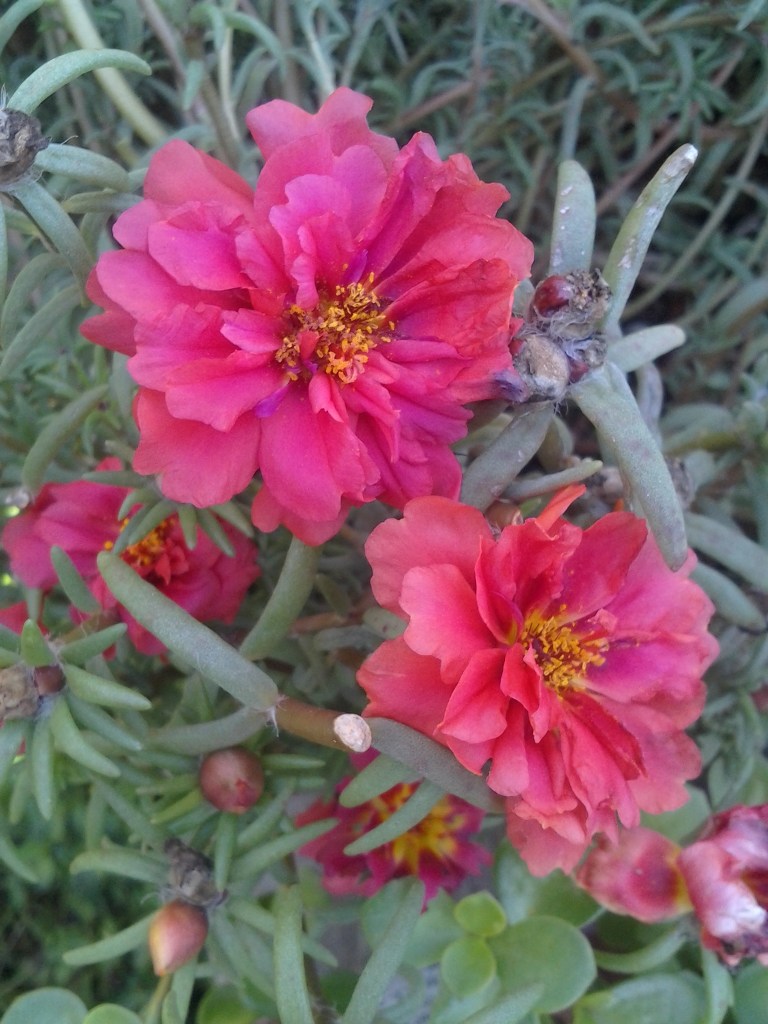
Moss rose has something in common with fern pine and cabbage palm. ‘It is neither this nor that’. Fern pine is neither a fern nor a pine. Cabbage palm is neither a cabbage nor a palm. Well, moss rose is neither a moss nor a rose. It is Portulaca grandiflora. It is a somewhat uncommon warm season annual that blooms until frost, with potential to toss a few seed for next year.
Ours were planted a bit late, after English daisies that were where they are now succumbed unexpectedly to rust. Because they are in three small planter boxes, where annuals get replaced regularly, they will not be able to naturalize. I suppose I could collect some of the seed to toss about nearby, or in a sunnier place where they would be happier. It really is that time of year.
These six picture show six of the colors of our moss rose. There might have been a seventh color that was very pale pink. It was omitted because it was so similar to the white that I am still not certain that it was not white. Peach #3 is more distinct from orange #4 than it seems to be in these pictures. Red, which is common among moss rose, is strangely lacking from our mix.
Flowers are somewhat variable. Pink #1 seems to be a bit fluffier than the others. Yellow #5 has a bit of red around the center. Rose #2 seems to have a very slight bit of white at the center. I only guessed on the names of the colors ‘rose’ for #2 and ‘peach’ for #3.
1. pink
2. rose
3. peach
4. orange
5. yellow
6. white
This is the link for Six on Saturday, for anyone else who would like to participate:
https://thepropagatorblog.wordpress.com/2017/09/18/six-on-saturday-a-participant-guide/
The recent unseasonably warm weather was no problem for any remaining moss rose, Portulaca grandiflora. They usually start to look rather tired as the weather gets cooler this time of year, and eventually succumb to the first frost. Where allowed to do so, they can regenerate next year from seed. I like to collect their seed during the summer or autumn so that I can sow them after the last frost of the following winter. Through spring and summer, I find that additional plants are easy to grow from cuttings.
Angelonia is one of those warm season annuals that can actually survive through winter as a pernnial to bloom again next spring. It may even want to continue to bloom untill frost. The flowers can be blue, purple, red, pink or white, and look something like small snapdragon flowers. Most have spots or stripes of an alternate color or two in their throats. Some modern varieties have fragrant flowers. Plants can get a foot or two tall, and almost as wide. In sheltered spots, angelonia can be cut back as soon as it starts to look tired in autumn. Exposed plants might be happier if cut back significantly later, as winter ends. Old growth may be unsightly for a while, but can protect interior stems and roots from frost. Besides, pruning stimulates new growth that will be more susceptible to subsequent frost.
This is not an easily defined flower. There are hundreds of species within the genus of Viola. Many are known as pansies. Many are known as violas or Johnny-jump-ups. Many are in between. The main difference between these two major groups is that, although very closely related, pansies bloom with bigger flowers, and violas bloom with smaller, simpler and more abundant flowers.
Dog days of summer are no time for a dogwood to bloom. It should be slowing down and getting ready for autumn. Plump floral buds start to develop, but then wait dormant as foliage turns color and falls away. Only after winter dormancy, just prior to the emergence of new foliage, floral buds bloom spectacularly. September is either half a year too early or half a year too late.
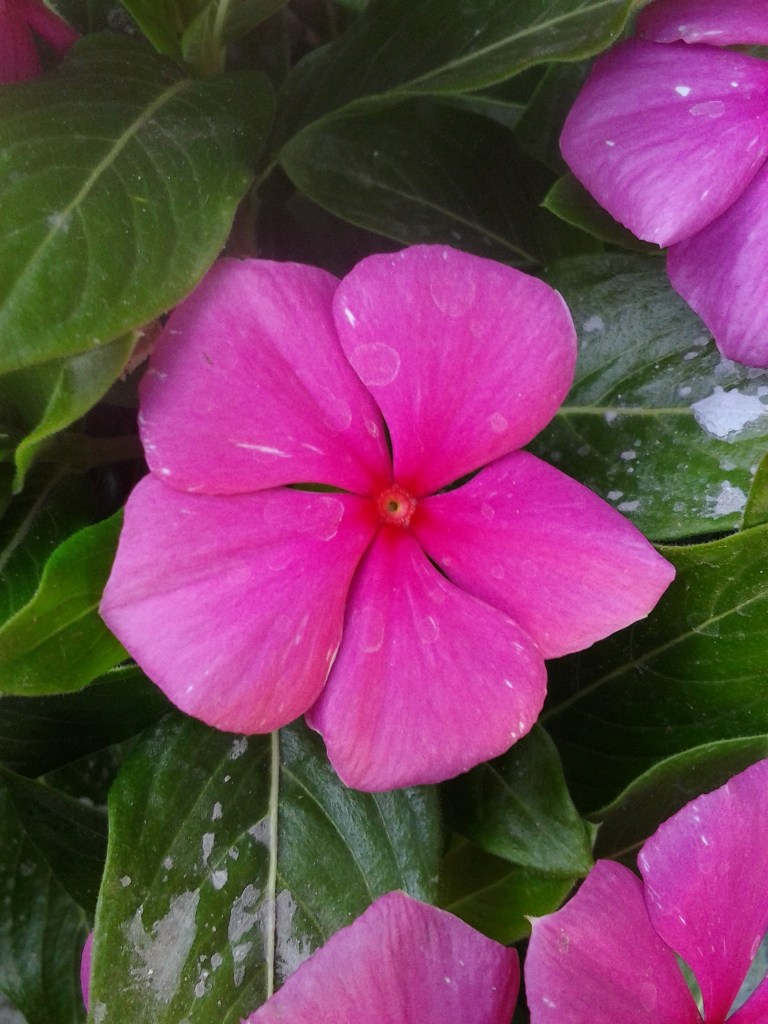
Like gardenia, dogwood and snapdragon, the potentially finicky Madagascar periwinkle, Catharanthus roseus, is often challenging to grow. It enjoys, but seems to prefer more humidity than it gets here. The happiest plants can get nearly two feet tall and wide in sheltered and humid spots. (They can get even larger in exposed spots in humid climates.) Yet, most of us are satisfied with relatively scrawny plants less than half a foot tall.