 This is a formerly unplanned sequel to the article ‘Campground‘ from last Sunday. That article described my concern for any of the homeless who might camp on the banks of an adjacent creek, below innately unstable and structurally deficient riparian trees. Just a few minutes after the article posted at midnight, the biggest and most deteriorated box elder tree in the area of concern coincidentally fell! No one was there at the time to be hurt.
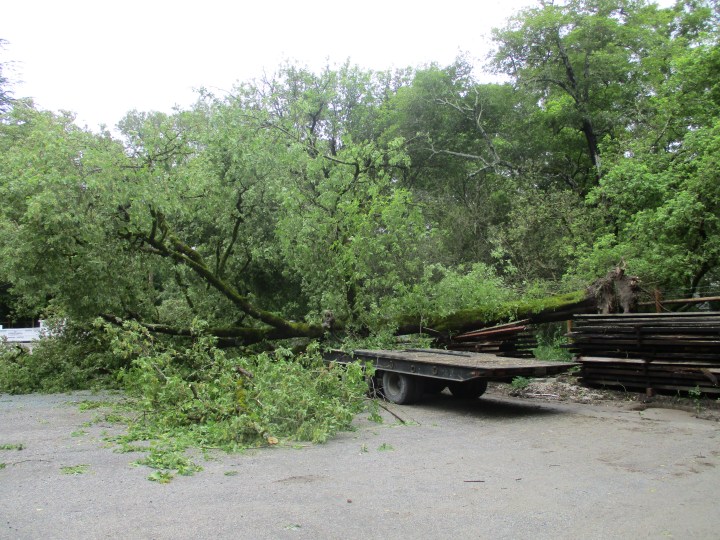
The tree that fell was located just a few yards to the right of those in the picture of the previous article. It happened to be the only tree that was inside the fence. Therefore, as it fell inward, it did not damage the fence. The trailer that it landed on is for heavy tractors, so was undamaged. Only the top few timbers of a pile of lumber that it landed on were broken, and only because the lumber was recently milled, and stacked so loosely to dry.
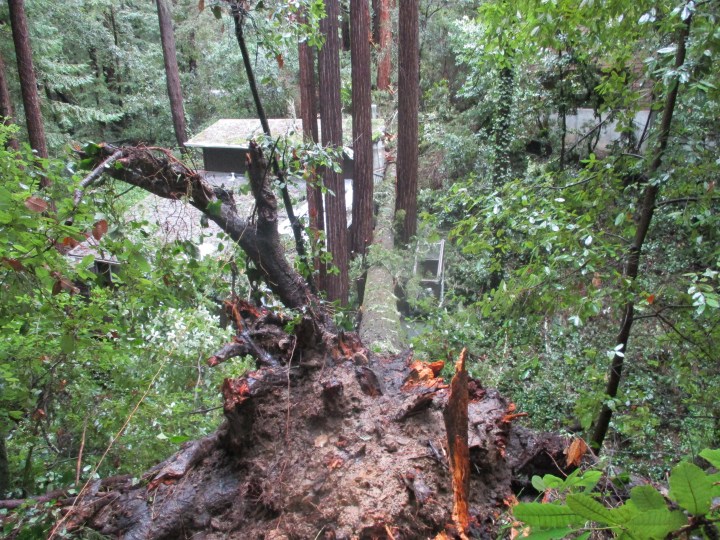
The upper picture at the top shows the fallen tree laying on the trailer and loosely stacked lumber, with its dislodged trunk suspended above the ground. The middle picture here shows the base of the dislodged trunk suspended pitiably above the ground, with no roots remaining attached to the soil.
The lower picture below shows how efficiently the trunk pulled out of the crater as if there were no roots holding it down. The few roots that were there were so decayed that none stayed attached to the soil. It is amazing that the tree did not fall earlier! When if fell, it sounded just like one might imagine it would, with a loud but quick crash. There was no sound of tearing or crunching roots. Fortunately, there was no one else there to hear it!
 There happen to be quite a few campgrounds in the region, with one about a quarter of a mile upstream from where this picture was taken, and another less than three miles past that. Both are primarily used by school age children. The vast redwood forests with creeks flowing through are ideal for such campgrounds.
 Redwoods are SO TALL!
 There are thousands of them, these weird motionless caterpillar like ‘things’, in big herds under all the cottonwood trees. They make a squishy mess in the rain, and stain concrete. They may not look like much from a distance, and are merely ignored as a minor nuisance that must be swept from pavement, but on closer inspection, they really look unworldly, like something from another planet, or a bad Japanese science fiction movie.
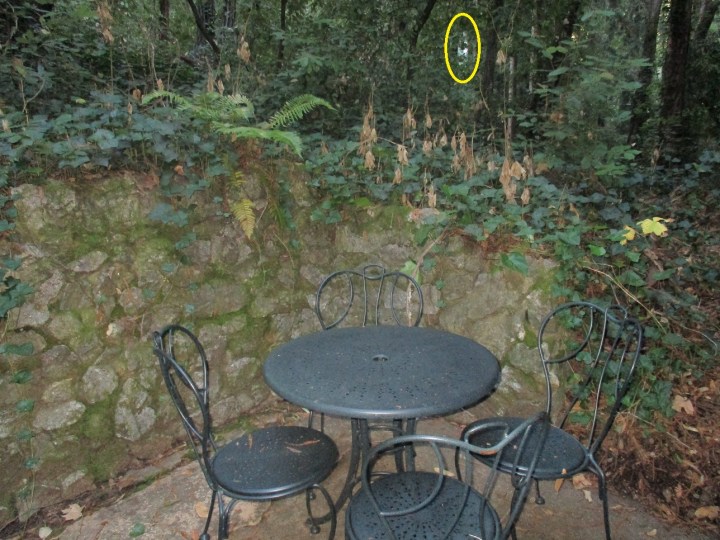
 If there were lawns and fences in this neighborhood, the grass would likely seem to be greener on the other side of the fence. In this situation, the greenhouse probably seemed to be more comfortable than being left out in the storm. This tall Douglas fir tree dropped in to find out. It did not go well. What remains can be seen in the middle of the picture above, just to the right of the fallen fir, and in the close up of the picture below.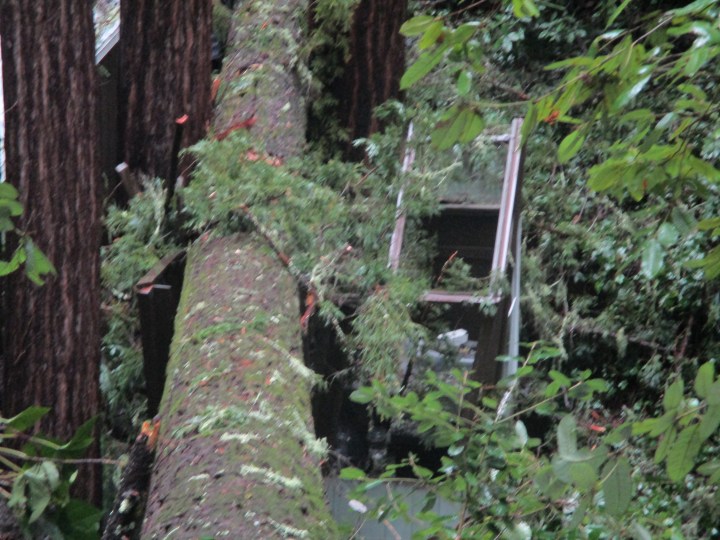

 Fire has always been a part of life in most of California. That is why almost all native flora benefits from it, and has developed an efficient system and schedule for not only living with it, but exploiting it.

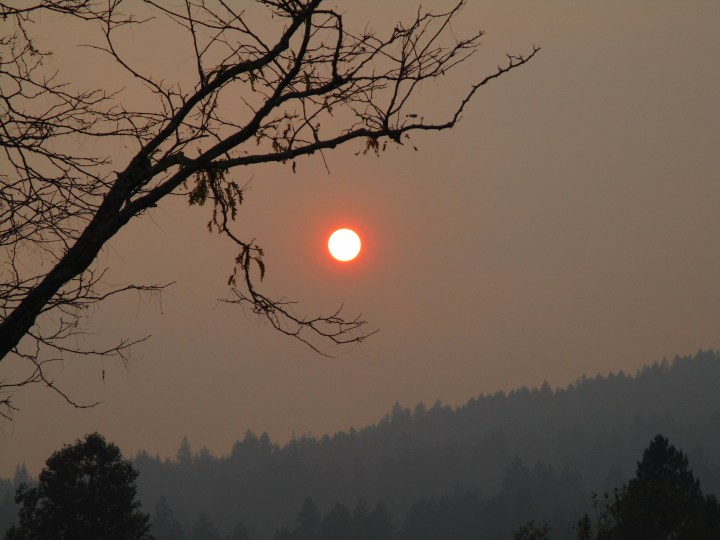
 The response to the brief article that I wrote about the smoke from a small and localized wildfire on Sunday is not easy to dismiss. The original article is at
  What a surprise. There was none when I went in to use the computer as the sun came up into a clear blue sky this morning. When I came outside just a few hours later, it was everywhere. It was so thick and so aromatic that it was obviously very close, but it did not smell like it was in the ponderosa pines around Scott’s Valley where I happened to be at the time. Once I got on the road back to Felton, I could see that besides the monochromatic ambient smoke that obscured the surrounding hills, a prominent and much thicker brown cloud of smoke hovered low over the San Lorenzo Valley. The smoke was even thicker in Felton, and obscures the range to the west where Bonny Doon is. As I write this in Felton Covered Bridge Park, ash is falling onto the computer screen.
 This sort of weather pattern does not happen very often. Late spring is normally pleasantly warm, and the weather gets progressively warmer through summer, which typically includes a few unpleasantly warm days. It rarely gets too hot here, and when it does, it does not last for more than a few days, and tends to cool off at least somewhat at night. The air is normally arid. Humidity is uncommon in a chaparral climate.

 2. These two bigger stumps are just a short distance uphill and across the small creek. Old stumps are more often single, but surrounded by multiple trunks that emerged from the roots. Because almost all of the trees here had been harvested about a century ago, there are now many more secondary trunks per area than there would naturally be. It is not much of a problem yet, but these trunks will likely become more crowded as they mature.
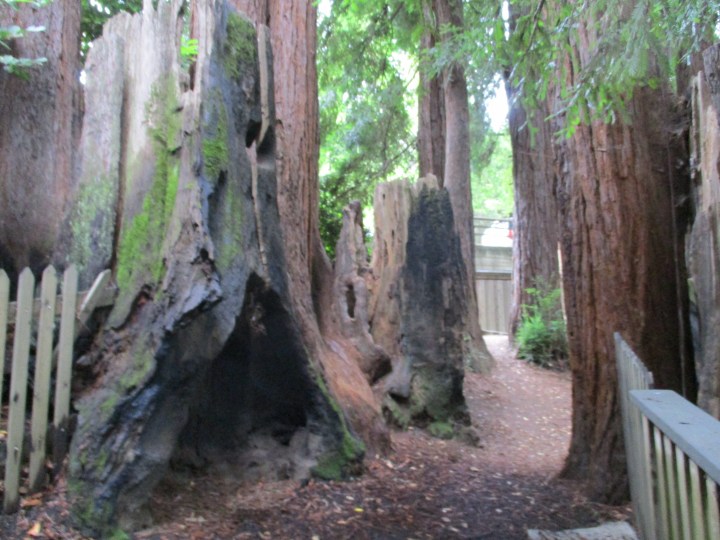 3. These are the same two stumps from the other side. This trunk coming up from within is likely from the same original root system. All trunks that develop from the same root system are genetically identical, so they look very similar from a distance. Some genetically identical groves can be quite broad, and include many trunks.
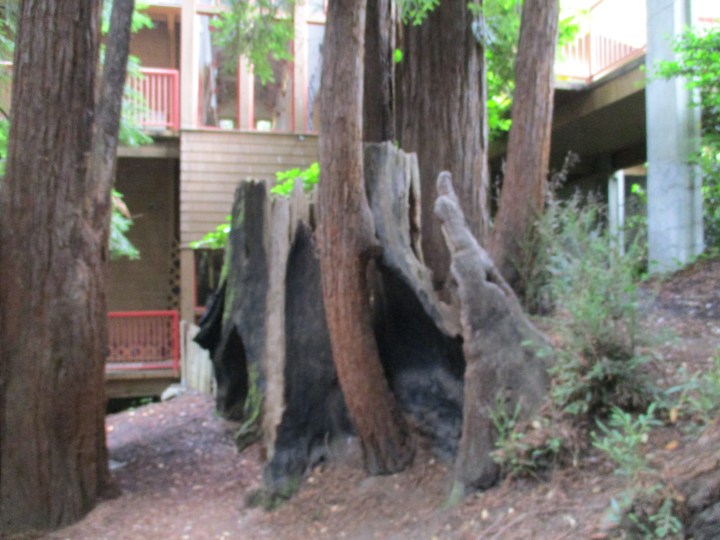 4. This small coastal redwood trunk is not happy about the fence that is nailed to it.
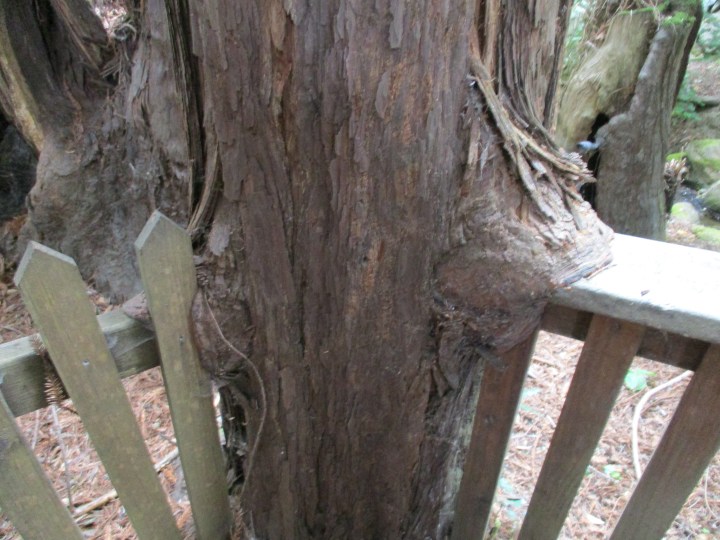 5. This is more what you expect coastal redwoods to look like. It is impossible to determine from this picture if these trunks are genetically identical secondary trees that emerged from the same root system, but their proximity to each other suggests that they likely are.
 6. This epiphyllum is the flower that I promised to those who expressed a concern than my Six on Saturday lacked adequate bloom. I shared a picture of this same epiphyllum earlier, but it has continued to bloom.
 Tony Tomeo