Pear

00122
Properly pruned peartrees produce pears prolifically.

Ancestral species of modern pears grow wild from western Europe and northern Africa to eastern Asia. Long before they were domesticated and developed in China about three thousand years ago, their fruit was eaten by indigenous people. Farther west, dozens of cultivars were developed and popularized in ancient Roman societies. There are now more than three thousand cultivars.

Most pears that are popular in America are descendants of European pear, Pyrus communis. Asian pears, which are mostly descendants of Pyrus X bretschneideri and Pyrus pyrifolia, became a fad in the 1980s, and are still somewhat popular, particularly in California. Asian pears are generally rounder and firmer than the familiar ‘pear shaped’ European pears that soften as they ripen.

There are too many cultivars of pear for all to conform to similar characteristics. All that are grown for fruit are deciduous, and almost all have potential to exhibit remarkable foliar color in autumn. Abundant clusters of small white flowers bloom in spring. Floral fragrance of some cultivars might be unappealing. Semi-dwarf trees can get more than fifteen feet tall, so should be pruned lower.

Pears can be shades of yellow, green, red or brown, and might be blushed or russeted. They can be canned, dried, juiced, or eaten fresh.

Fruit Trees Need Specialized Pruning

00122thumb
Even almond trees need some pruning.

For centuries, fruit trees have been bred to produce unnaturally abundant and unnaturally big fruit. That has worked out well for those who enjoy the resulting fruit. It is not such an advantage for the exploited trees that must produce it. Without specialized pruning, most of such trees are unable to sustain healthy development of all the fruit they could potentially produce, or support the weight.

Specialized pruning concentrates resources into less excessive fruit of superior quality. It improves structural integrity of limbs that support the weight of all the fruit too. Trees that produce smaller and lighter fruit, such as cherries, may only need to be trimmed occasionally to eliminate structurally deficient growth. Heavier fruit, such as peaches, necessitates much more aggressive pruning.

Almost all deciduous fruit trees should be pruned about now, before they bloom and foliate at the end of winter. Such pruning is too severe to be done while the trees are active in spring. Summer pruning to maximize production within less space is the only practical option to dormant pruning. Evergreen fruit trees, such as citrus and avocado, should not be pruned or groomed during winter.

The main group of deciduous fruit trees that require dormant pruning in winter are stone fruit, of the genus Prunus. This includes peach, nectarine, apricot, plum, prune, cherry, various hybrids and almond. The second main group are pomme fruit, such as apple, pear and quince. Fig, persimmon and grapevines, as well as roses, need specialized and perhaps very aggressive pruning too.

Dormant pruning of deciduous fruit trees, roses and grapevines is too complex to describe adequately here in just a few paragraphs. Nonetheless, those who grow such plants must be aware of how important it is, and ideally, know how to do it. Nowadays, it is nearly impossible to procure services of horticultural professionals who know or care how to execute such procedures properly.

Prune

00115
Prune trees get planted bare root.

Does anyone remember when champagne produced in California was formally classified as ‘sparkling wine’? ‘Champagne’ is a technical classification for that which originates from the region of France for which it is named. That makes sense. The technical classifications of prune and plum formerly made sense also, even if not universally understood. Reclassification in 2001 ruined that.

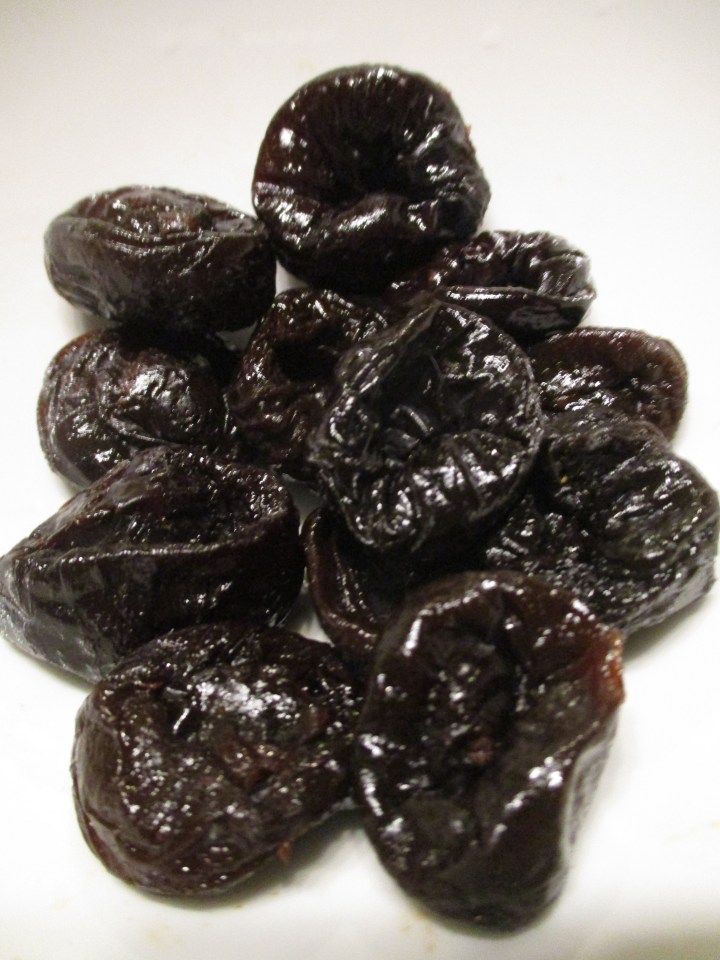
Prune, Prunus domestica, is primarily a European freestone fruit. (The pits of freestone fruits separate from the ripening flesh.) They have firmer flesh than plum, so are more practical for canning and drying. They also have higher sugar content, so might be dried without sulfuring (which prevents molding). Darkly purple and rather oblong fresh prunes are less popular than dried prunes are.

Plum is primarily a Japanese cling fruit. (The pits of cling fruits remain firmly adhered to ripening flesh.) They are softer and juicier than prune, and contain less sugar, so are not as efficiently pitted and dried without sulfuring, or canned. Larger, rounder, more colorful and more richly flavored plums are instead best fresh. They might be bluish purple, purple, red, ruddy orange, yellow or green.

Nowadays, all prunes and plums are known collectively as plums. Dried prunes are just dried plums.

Horridculture – Half-Breed

70726thumbCher explained a long time ago that a half-breed is nothing to brag about. Some of us just don’t get it. A few clients still introduce me to their weirdly bred stone fruit trees as if they are both justification for great pride, as well as something that a professional horticulturist of the Santa Clara Valley has not already encountered a few thousand times. I at least try to act impressed.

The stone fruits that grew in the orchards of the Santa Clara Valley half a century ago were the best. That is why they were grown here. The climate and soil were ideal for their production. Traditional cultivars produced so abundantly and reliably that there was no need to breed new cultivars. The quality was exemplary. Consequently, only a few were actually developed here.

Half-breeds, or weird breeds of any unnatural ratio, started to be developed more than a century ago. A few happened incidentally where different species of the same genus of Prunus grew. They were enjoyed as novelties for home gardens, but were not sufficiently productive or reliable for orchard production. Their fruit was for fresh eating only, since it did not dry or can well.

Now that the orchards are gone, and the only stone fruits in the Santa Clara Valley are in home gardens, these weird half-breeds and others are becoming more popular. Nurseries will soon be stocking several along with their incoming bare root stock. There is certainly nothing wrong with them. However, they are not necessarily any better than their well bred ancestors either.

Apricot, cherry, nectarine, peach, plum and prune, as well as almond, are the traditional stone fruits, of the genus Prunus. (Almonds are the seeds or ‘stones’ of a stone fruit that does not get eaten, but instead gets discarded as a hull.) There are many cultivars of each. Some can be canned. Prunes and some apricots can be dried. There is no need for more, or for ‘improvement’.

Pluot, plumcot, aprium, apriplum, nectaplum, peacotum, pluerry and others like them are the weird interspecific hybrids (which are hybrids of two or more species within the same genus, which for these examples is ‘Prunus‘). Some are half-breeds. Some are breeds of different ratios, such as a half-breed with a half-breed parent, or a half-breed grandparent. It is confusing!

It is also an unjustifiable fad. There are more disadvantages to these weirdly bred stone-fruits than there are advantages. They really don’t get the best of both parents, but might get half of each. Again, there is certainly nothing wrong with that. There are those who legitimately prefer such hybrids. The point is that fads are not necessarily good, and many are just plain weird.

Persimmon

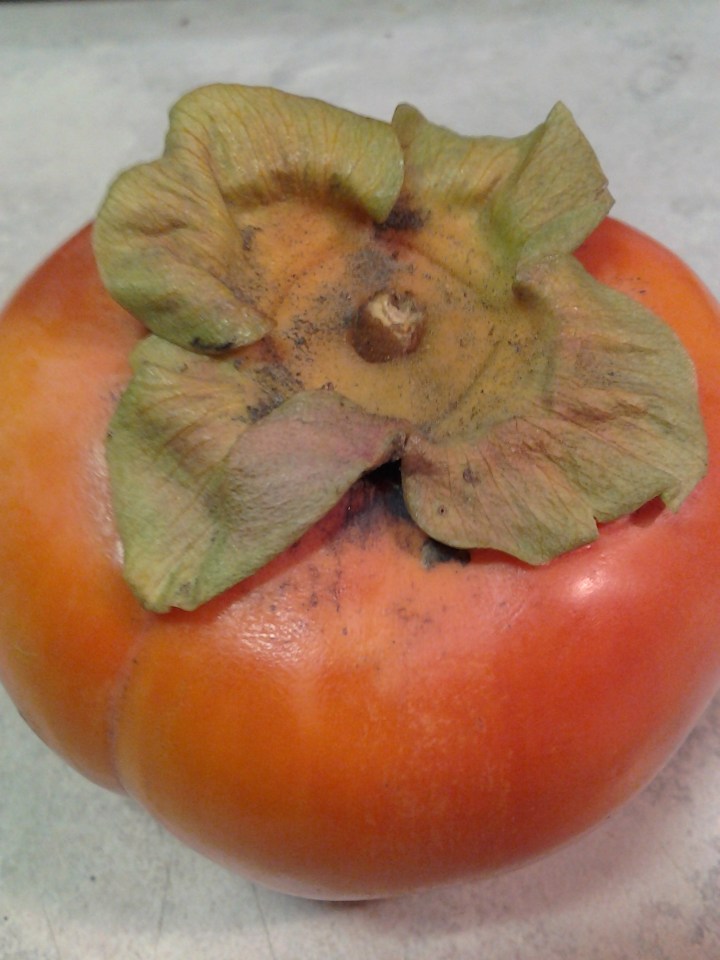
41126A mature persimmon tree, Diospyros kaki, is often too much of a good thing. The fruit is both big and abundant as it ripens this time of year. Much of the fruit in taller trees is out of reach. Nearly ripened but somewhat firm fruit can be picked and shared with neighbors for a while, but must be picked immediately once completely ripe. Otherwise, it falls and makes a squishy mess that can not be raked up! Nearly ripe fruit ripens easily off the tree. Individual fruits only need to be spread out in a single layer to limit molding.

‘Fuyu’ is probably the most popular variety because the ripe fruit can be eaten while still firm, or after it has gotten soft. ‘Hachiya’ produces the largest fruit, sometimes bigger than a softball; but the fruit is too astringent to eat until completely ripe. It is actually best after it is so overly ripe that it is too squishy to handle. Persimmon fruits are very bright orange. ‘Hachiya’ fruit can be slightly reddish. The foliage gets just as colorful. Typically, the foliage colors first, and then falls to reveal the fruit. This year, the fruit seems to be coloring first.

Colorful Autumn And Winter Berries

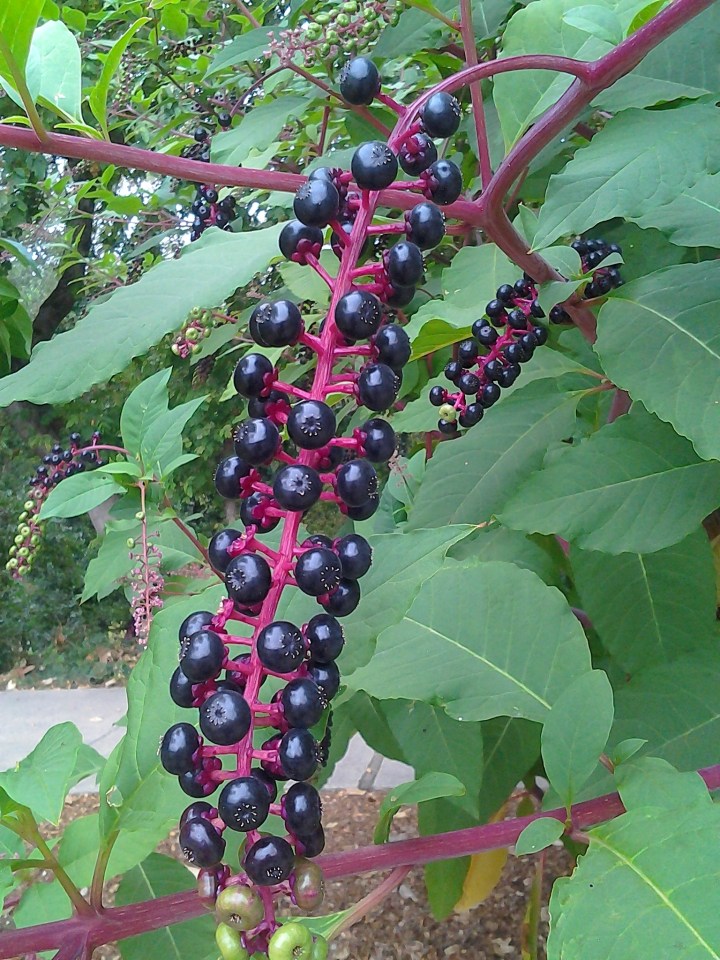
41126thumbBefore the colorful foliage of autumn falls and gets raked away, a few types of berries and fruit start to provide a bit of color to last into winter, or at least until birds and other wildlife eat them. Technically, the most colorful berries are actually intended for the birds, both those that overwinter and those that migrate south for the winter. The berries are designed by the plants that produce them to both entice birds, and to reward them for dispersing the seeds within.

Pyracantha (or firethorn) is the most colorful of the berries. Cotoneaster is similar, but not quite so prolific. Toyon and English hawthorn, which can grow as small trees, produce open clusters of similar bright red berries. Of these, only English hawthorn is deciduous, and can defoliate before the berries disappear. Although such fruit is abundant, it is not often messy because it gets devoured before it reaches the ground. However, the birds can be messy.

English holly really should produce more berries than it does, but there are not enough pollinators out there. (Hollies are dioecious, which means that plants are either male or female. Female plants need male pollinators to produce fruit.) Decades ago, when horticulture was taken more seriously, male pollinator plants were marketed with female plants. Some other types of holly somehow make a few more berries, especially as they get older.

Loquat, mahonia, pomegranate and some flowering crabapples try to produce colorful fruit, but are not quite as colorful. Pomegranate fruit can be impressive in its own way, but are just rusty reddish brown on the outside. Strawberry tree produces a few red berries throughout most of the year. Many types of pittosporum develop fruit, but most are about as green as their foliage. The sticky amber seeds are ‘interesting’ when the fruit splits open, if anyone happens to look that closely.

Oranges, lemons, grapefruits, mandarins and other citrus will be colorful later in winter, even though they do not care if they attract any birds. For now, persimmons are the biggest and most colorful fruits out in the garden.

The Wrath Of Grapes

P91006Jocular reference was made to ‘The Grapes Of Wrath’ on our our backward version on the way to Oklahoma several years ago. We happened to drive through Salinas, where author John Steinbeck was from, and Bakersfield near Weedpatch, where the migration from Oklahoma in the story ended. From there, we literally drove the same route from Oklahoma, but in reverse.

I never read ‘The Grapes Of Wrath’.

I do enjoy growing the sort of grape vines that some of us grow in our home gardens for fruit that can be eaten fresh. (I loath wine grapes and vineyards, but that is another topic for later.) There happens to be a nice big unidentified grapevine at work that needed major pruning last winter. It was a sloppy and formerly unpruned mess, with rampant long canes strewn about.

Some of these canes developed roots where they had been laying on the ground long enough to do so. The process is simply and conveniently known as ‘layering’. It is actually a technique for propagation that is sometimes done intentionally to plants that are not doing it naturally, (Again, that is another topic for later.) After giving a few rooted canes away, there were a few extra.

Since last winter, seven copies of the original grapevine are still here! I really do not know what to do with them. I could give them to neighbors before the end of this winter, but would then worry about them not getting the annual pruning they need, and overwhelming the landscapes they inhabit, just like the original vine did. Even in their cans, they are already a sloppy mess.

Many surplus plants are accumulating here. Many will go into landscapes as rainy weather starts. However, there are a few that will not be so easy to accommodate.

AGAIN – NO Blue Ribbon!

P90929After all that fuss yesterday, about how much I wanted to win a first place blue ribbon for one of my jams or jellies at the Jam, Pie and Chili Contest of the Santa Cruz Mountains Harvest Festival, I must still do without! Not only did I not win the ever elusive first place blue ribbon that I so desperately crave, but for the first time ever, I did not win second or even third place!

However, it is not as disappointing as it seems. There were no ribbons to win. There was only the same single prize for each of the three categories, which is a winter pass for the hot tub and sauna at the Bear Creek Recreation and Community Center of Boulder Creek. Although it is not the blue ribbon that I can flaunt and brag incessantly about, it is a fabulously generous prize.

What was more disappointing was that the Contest was canceled. For the Jam category, there were only two other contestants with only a few submissions, and neither showed up! How can that even happen? My six submissions were the only six to compete! It was even worse for the Pie and Chili categories, with only one contestant bringing pumpkin pie and two types of chili!

Yes, it was disappointing, but only briefly. No one minded that there were only identical pumpkin pies to vote for in the Pie category. In fact, we all easily agreed that they were the best pies in the Contest! Selection of the best of two types of chili in the Chili category was slightly more challenging only because no one wanted to say that one chili was less excellent than the other.

I still crave the elusive first place blue ribbon, but can easily do without it too.

Six on Saturday: Still NO Blue Ribbon


That could change later today, at the Jam, Pie and Chili Contest of the Santa Cruz Mountains Harvest Festival. My jams or jellies have won second place every year for the past few years, except for only one year when my mother’s peach jam won second place. How embarrassing! Anyway, for some of the past few years, my entries have won both second and third place.

However, none of my jams or jellies have won a first place blue ribbon!

This could be the year!

Will it be? Well, that is doubtful.

Blue elderberry jelly is what most often wins second place, except only when blackberry jelly . . . or my mother’s peach jam . . . is better. Unfortunately, blue elderberries were rather scarce this year, and what I got were not very good. In fact, they were downright bad. Other fruits, such as currants and gooseberries, were too scarce. Dogwood berries did not ripen soon enough.

For this year:

Peach jam looks and tastes great, but is about as chewy as a gummy bear.

Plum jelly is a sloppy mess that tastes sort of burnt.

Elderberry jelly is a bit sloppier, and, as mentioned above, is made with inferior fruit.

Blueberry jam is sort of like preserves. It is not bad. However, it is made from surplus ‘store-bought’ blueberries from a neighbor, instead of from locally grown or collected fruit.

Blackberry jam tastes great, but the seeds are weirdly tough this year, like wooden gravel.

Blackberry jelly is probably the best of the six, but tastes more like sugar than berries.

1. Do you notice anything missing among these few of the several ribbons that have been awarded to our jams and jellies in the past? There is not a single blue ribbon . . . yet. It will be mine!90928

2. Do you see what else is missing? Of course not. If you could see it, then it would not be missing. It would also be blue; as in the blue elderberries that normally make the ‘second’ best jelly!90928+

3. The native currants were no better. They are never abundant like blue elderberries are, but there are normally more than there were this year. I did not bother looking for gooseberries.90928++

4. Kousa dogwood made plenty of fruit, but it is not ripe yet! Oh well. Ironically, this particular tree might get cut down this winter. The abundant fruit is too messy on the pavement below.90928+++

5. Tomatoes are insultingly abundant where they grow wild around the compost piles and on roadsides. I do not need any more stoopid tomatoes! They will not help me win my blue ribbon!90928++++

6. Six submissions are ready for the Jam Contest later today: peach jam, plum jelly, elderberry jelly, blueberry jam, blackberry jam, blackberry jelly. I will write about the results tomorrow.90928+++++

This is the link for Six on Saturday, for anyone else who would like to participate:

https://thepropagatorblog.wordpress.com/2017/09/18/six-on-saturday-a-participant-guide/

Himalayan Blackberry

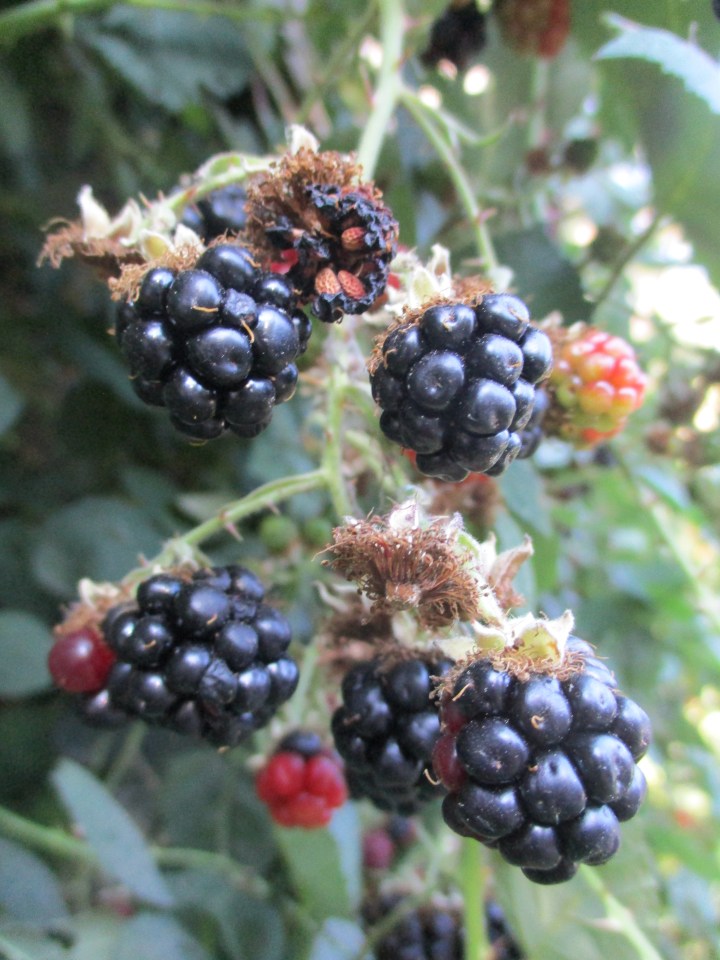
90828Of all the aggressively invasive exotic species on the West Coast, Himalayan blackberry, Rubus armeniacus, could be the nastiest! It seems to be impossible to kill. It forms dense thickets of wickedly thorny canes that develop roots where they touch the ground. Even if canes are cut to the ground, and the roots are pulled out, new plants regenerate quickly from remaining bits of roots.

Individual canes can grow more than twenty feet long in their first year! They may lay on the ground to creep under a thicket, or arch up and over other plants that are fifteen feet tall. These canes develop blooming and fruiting branches in their second year. By their third year, they are replaced by new canes. The palmately compound leaves are smaller for the fruiting second year canes.

Trusses of white or very pale pink flowers bloom late in spring. Dark purplish black berries that started ripening a few weeks ago are now being depleted. Some experts believe that Himalayan blackberries are bigger and sweeter than the fruit of most garden varieties. However, berries are only bigger among well cultivated canes; and keeping canes contained and pruned is not easy.