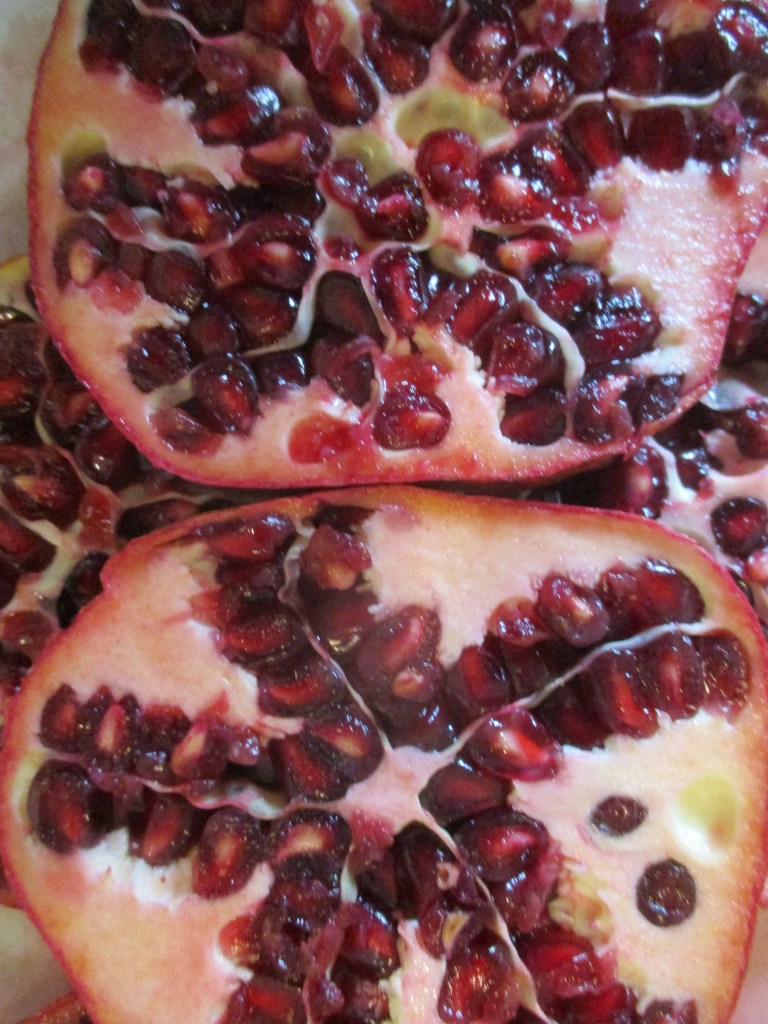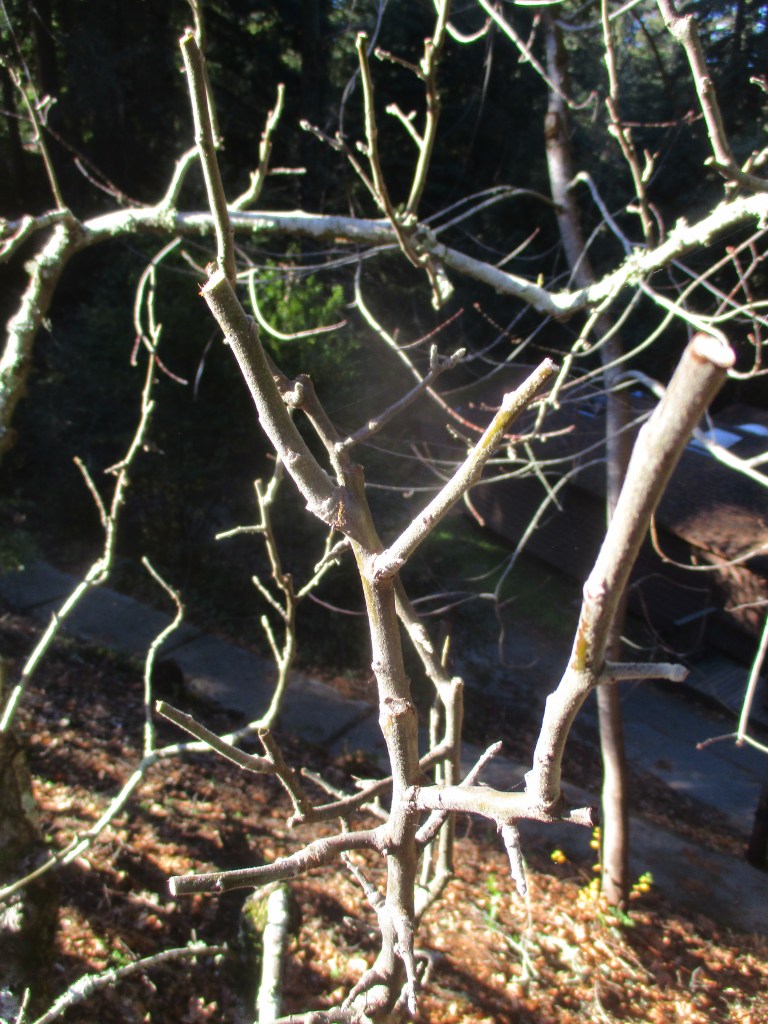
Dormant Pruning Enhances Fruit Production

Dormant pruning may not be pretty.

Adding new fruit trees to a garden is reasonably easy. Maintaining them properly as they mature is more of a challenge. Centuries of extensive breeding to enhance production of such trees has also increased their reliance on horticultural intervention. Most deciduous fruit trees consequently need specialized dormant pruning during their winter dormancy.

Without adequate dormant pruning, most deciduous fruit trees are unable to support their unnaturally large and unnaturally abundant fruit. Dormant pruning actually enhances the size and quality of fruit. However, it also limits the weight of excessiveness, and confines it to sturdier branch structure. It concentrates resources into fewer fruit of superior quality.

Dormant pruning, or winter pruning, likewise concentrates resources into more docile but healthier vegetative growth. It eliminates or at least diminishes the 4 Ds, which are dead, diseased, damaged and disfigured growth. Confinement of potentially rampant stems not only improves structural integrity, but also limits wasteful production of unreachable fruit.

Almost all deciduous fruit trees, and most nut trees, require specialized dormant pruning. So do grapevines, kiwi vines, berry canes and roses. Evergreen fruit trees, such as citrus and avocados, are exempt for now though, since such pruning promotes new growth that is vulnerable to frost. Most of such trees do not require such aggressive pruning anyway.

Almonds, apricots, cherries, nectarines, peaches, plums, prunes and all their hybrids are stone fruits of the genus Prunus. Almonds are actually seeds, or stones, of leathery fruits that are merely hulls. Various stone fruits need various degrees of similar pruning. Heavy peaches need aggressive pruning. Lightweight cherries might need only minor trimming, or no pruning at all.

Apples, pears and quinces are pomme fruits that, like stone fruits, need various degrees of similar pruning that conforms to their distinct characteristics. Persimmons, mulberries, pomegranates and figs each need specific types of pruning as well. Familiarity with each of the dormant pruning techniques that each fruit tree in the garden requires is essential.
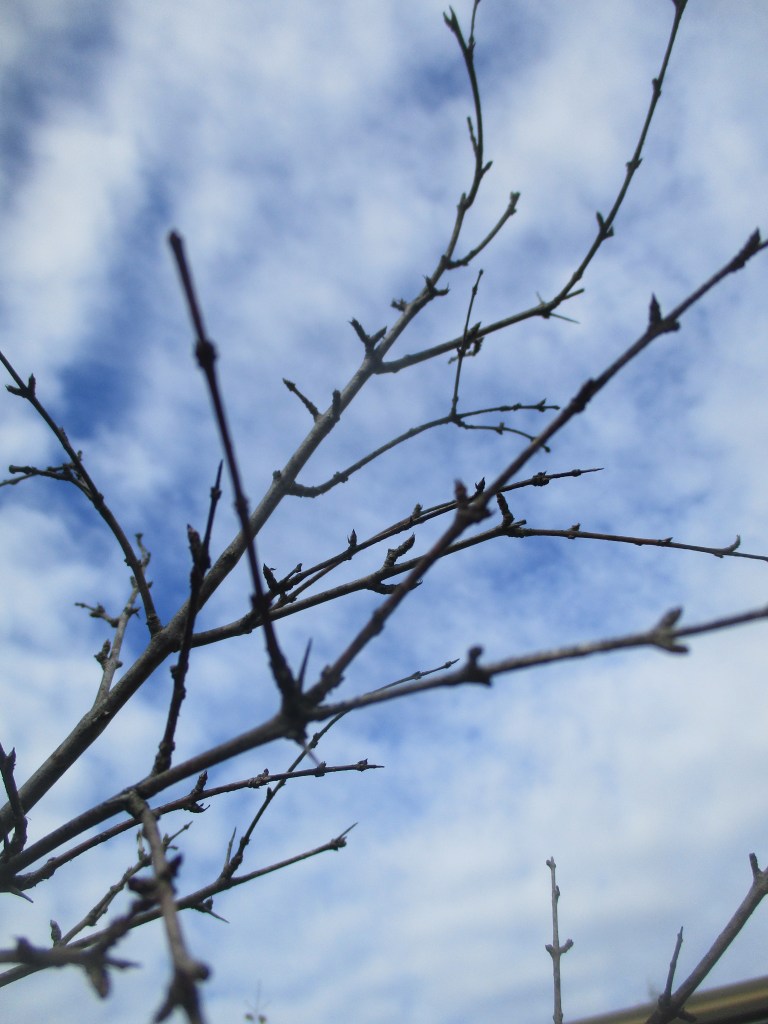
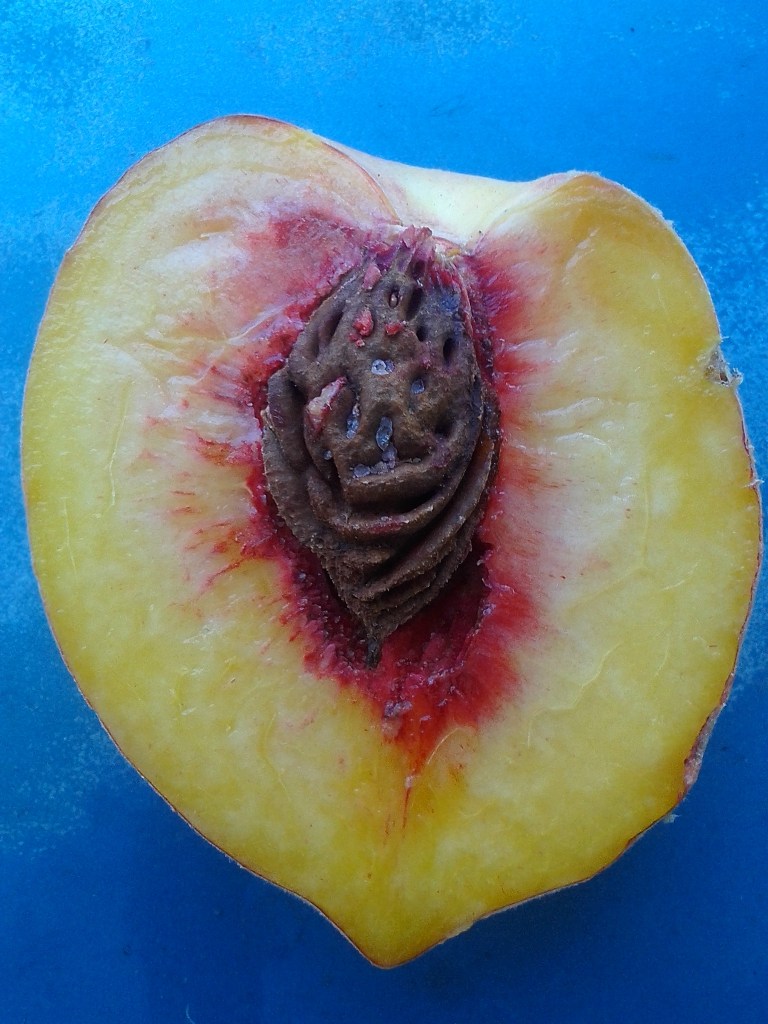
Getting an early start to winter pruning may have certain advantages

Without specialized pruning, fruit trees become sloppy and unable to sustain all of their fruit.

As long as it gets done well before buds begin to swell late in winter, the meticulous and specialized pruning that deciduous fruit trees and roses require during winter dormancy does not need to be done immediately. Here where the climate is so mild, some roses may still be blooming. The main advantage to getting an early start is that those of us who have many fruit trees and roses in need of pruning have more time to get them all done within the proper time.

If it helps to start pruning early, it is best to prune fruit trees and roses in the same order that they go dormant and defoliate. The ‘stone’ fruits (those of the genus Prunus, that have large pits known as ‘stones’), like apricots, cherries, nectarines and peaches typically defoliate earlier than the ‘pomme’ fruits, like apples, pears and quinces. Modern ‘carpet’ roses may not defoliate completely, so can be delayed until after all the bare roses get pruned, but may eventually need to get pruned while still partially foliated.

The specialized pruning that deciduous fruit trees and roses need is serious business. Those who do not know how to do it properly should learn about it before actually doing it. Improper pruning of fruit trees can inhibit production and damage the trees. Roses are not so easily damaged, but will get overgrown and not bloom as well if not pruned aggressively enough. (This sort of pruning will be a topic later in the season.)

Like fruit trees and roses, other trees and shrubs that need pruning prefer to be pruned while dormant through autumn and winter. Deciduous trees and shrubs are obviously dormant while bare, but realistically, are ready to be pruned when their foliage is no longer green.

Evergreen plants are not so obviously dormant, but will be as dormant as they get through winter. This would therefore be a good time to prune to eliminate pine limbs that are too low. If pruned a bit early, the pruning wounds will get weathered more through winter and consequently bleed less through spring.

Peach

Fresh tree ripe peaches are best.

Of all the stone fruit trees like apricot, plum and cherry, none need more aggressive and specialized pruning while dormant in winter than peach, Prunus persica. The distinctively fuzzy fruit is so big and heavy that the weight of too much fruit tears limbs down. Pruning not only limits fruit production, but improves structural integrity, fruit weight distribution, fruit quality, and tree health. Mature trees should be kept less than ten feet tall, but often get twice as tall with much of the fruit out of reach.

Squirrels Fear The Unknown Too

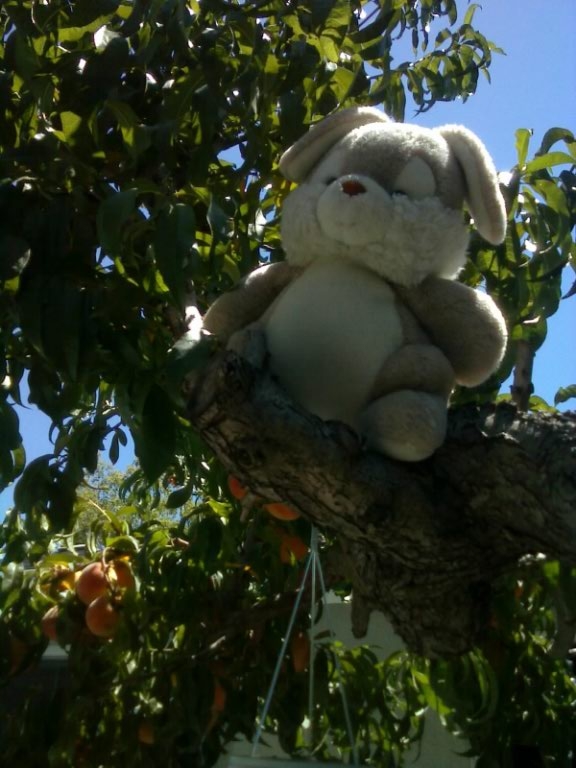
Pierre Francois dutifully protects ripening fruit.

It is embarrassing when my mother teaches me a practical gardening technique that I should have known about, especially if the particular technique is as simple and downright silly as what my mother does to protect ripening fruit from squirrels. A friend of hers suggested it; and it seems to be significantly more effective than the few fancier ideas that I recommended.

I should first mention that there is nothing new about repelling animal pests with effigies of other animals that they are afraid of. Scarecrows and stuffed snakes and owls have been around for centuries. As the name implies, scarecrows scare crows who perceive them to be potentially troublesome people. Rats and terrestrial rodents avoid snakes. Squirrels and some birds are afraid of owls.

When I was in about the fourth grade, I remember that National Geographic World magazine (which is now National Geographic Kids) featured a silhouette of a predatory bird that could be cut out and taped to windows to deter birds that might otherwise break their necks as they tried to fly through the clear glass. The associated article explained that the cut-out silhouette was effective because birds instinctively knew what to fear. A silhouette of a harmless seagull would not have been as effective.

However, some deterrents are not so specific, but instead rely on the fear of the unknown. Beach balls outfitted with decals of huge eyes look weird in the garden, but work because so many birds have bird brains that think such contraptions are big, scary and possibly predatory animals. Flash tape and old compact discs work simply because birds do not know what the reflected flashes are.

Scarecrows and other inanimate effigies should be relocated occasionally so they seem to be alive. They should stay near what they are in the garden to protect, and not loiter when it is gone. For example, if protecting ripening fruit, they should leave after the last of the fruit is gone. Otherwise, the target pest animals realize that they are fake or dead. Beach balls, flash tape and compact discs are more animated, so need not be moved so much, if at all, but are too tacky to stay all year.

All this may seem complicated, but can be simple enough for my mother to master with . . . well, allow me to explain.

Pierre Francois is a cute, fuzzy and seemingly French plush toy bunny made in China, who knows all about protecting ripening fruit from squirrels. (‘Stuffed animal’ is no longer politically correct.) After seeing how expensive a fake owl would be, my mother put Mr. Francois in the peach tree. He and his sort are free if borrowed (stolen) from the grandchildren, or very cheap at garage sales or thrift stores. Although cute and soft to us, Mr. Francois is big, intimidating and unfamiliar to squirrels. Before the squirrels get acquainted with him, the peaches will have been harvested, and Pierre Francois will have been reassigned to an apple tree.

Red Passion Flower Vine

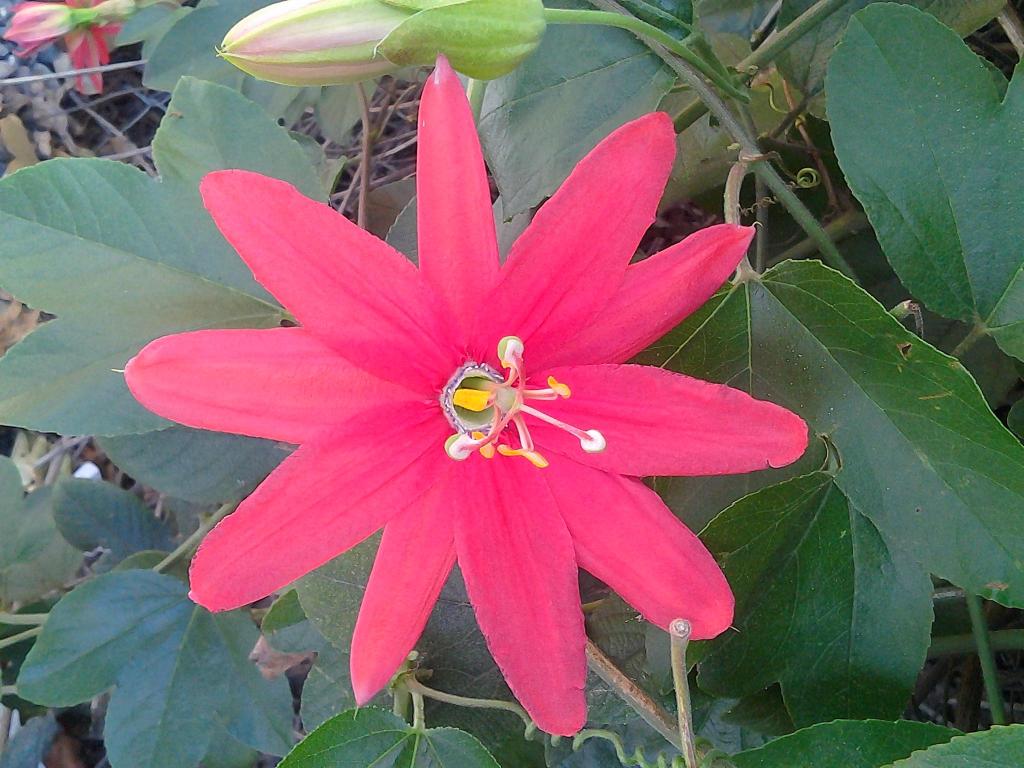
Red passion flower seems quite exotic.

Compared to the common passion flower, the three inch wide red passion flower, Passiflora manicata, is more colorful with cherry red flowers, but does not so prominently display the weirdly distended floral parts that passion flowers are known for. Bloom is not as profuse either, particularly among vigorous vines.

However, red passion flower vine has the advantages of somewhat more resilient and greener foliage, and sturdier vines that can climb almost to thirty feet high. It grows so vigorously that it can be surprisingly overwhelming, even if pruned severely or cut to the ground at the end of each winter. It is not so rampant in light shade.

Copies (new vines) are easy to propagate by layering, which involves merely burying a section of vine while still attached to the parent vine until it develops enough roots to be separated. The buried section should be at least a few inches long. At least a few inches of the tip of the vine should extend beyond the buried section.

The fruit of red passion flower vine is considered to be toxic, but often gets eaten anyway. Fortunately, fruit rarely develops.

Red Passion Flower Vine

Red is simpler but more colorful.

The mostly white and blue common passion flower likely remains the most popular. After all, it is the weirdest. Elaborate and disproportionate floral parts imply that it is of another planet. Red passion flower, Passiflora racemosa, although less peculiar, is perhaps a bit more colorful. Its brick red flowers bloom randomly for as long as weather remains warm. 

Flowers are about three or four inches wide. They develop in open racemes that seem to spread out somewhat evenly over the exterior of their foliage. Bloom is not profuse, but is somewhat continuous until autumn. Newer flowers replace older flowers within the same racemes. Leaves are as wide as their flowers, with three blunt lobes and axillary tendrils. 

The lushly evergreen foliage can get shabby through winter, or completely ruined by just mild frost. It regenerates vigorously though. Aggressive pruning as winter finishes delays bloom, but promotes vigorous growth. Vines can potentially reach more than twenty feet. Fruit is rare without manual pollination. Fruit flavor can be bland without tropical warmth.

Citrus Trees Are Dutifully Fruitful

Citrus are most abundant through winter.

Winter is the primary season for citrus fruits. Some ripen significantly earlier. Some ripen significantly later. Many citrus trees continue to produce a few fruits randomly throughout the year. Nonetheless, citrus fruits are collectively most abundant during winter. It seems odd that trees that are vulnerable to frost are so productive during the coolest of weather.

Citrus trees are fortunately only marginally susceptible to frost in only the cooler climates here. They mostly recover from minor damage where they get a bit too much chill. Those in coastal climates may never experience damaging frost. Some types of citrus are more resilient to frost than others. Vulnerable citrus trees may need frost protection when new.

Home garden citrus trees are different from orchard trees. Most orchard trees, particularly older trees, are ‘standard’ trees. They grow on standard rootstock that allows them to get larger, and therefore produce more fruit than ‘dwarf’ trees. Most home garden citrus trees are ‘dwarf’ trees. They grown on dwarfing rootstock that keeps them dense and compact. 

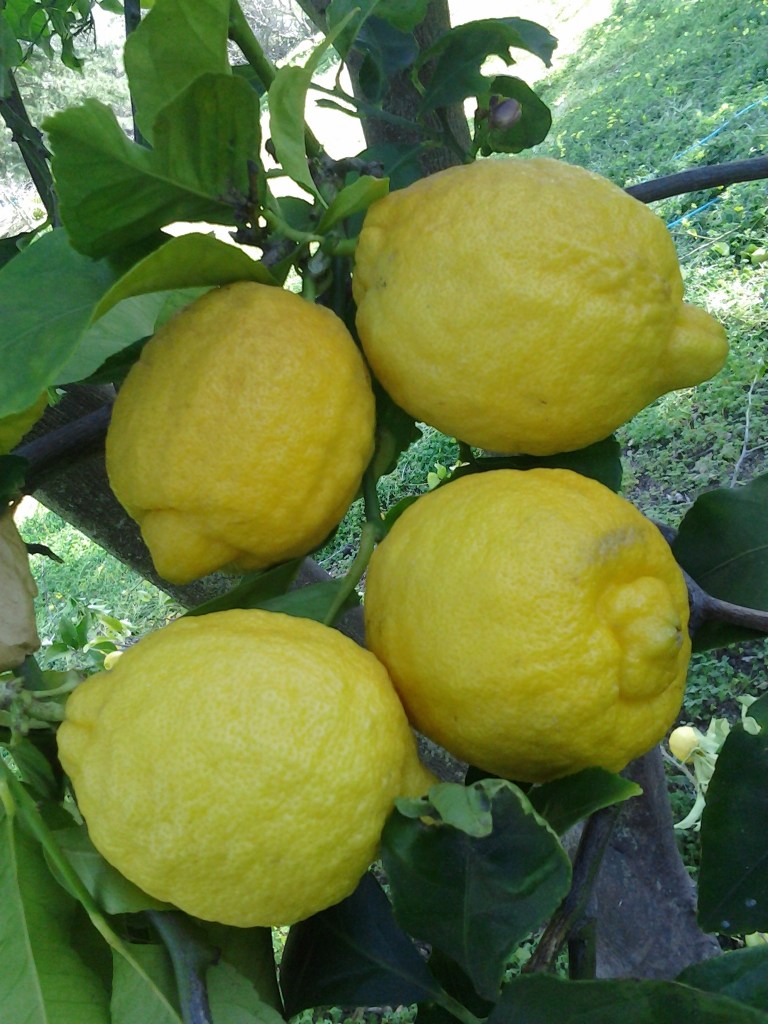
Furthermore, the many cultivars of citrus that are available for home gardening are more diverse than those that commonly grow in orchards. ‘Lisbon’ lemon is very profuse within season, so is preferable for orchards. ‘Eureka’ lemon, although a bit less productive, may be a preferable option for home gardens because it produces a few random fruit all year.

Now that citrus are in season, some last longer than others. Grapefruit can hang on their trees for months. They actually develop richer flavor with mellowing tartness as they age. Conversely, Mandarin orange and tangerine are the most perishable citrus. Because the rind is loose, their pulp within begins to oxidize after ripening. Lime eventually gets pithy. 

Although this is the time of year to enjoy fresh citrus fruits, it is not the season to do much else with citrus trees. Pruning and application of fertilizer will be more timely after winter. Premature pruning or use of fertilizer is likely to stimulate premature growth. Such growth either languishes through cool weather, or succumbs to mild frost.

Pitahaya

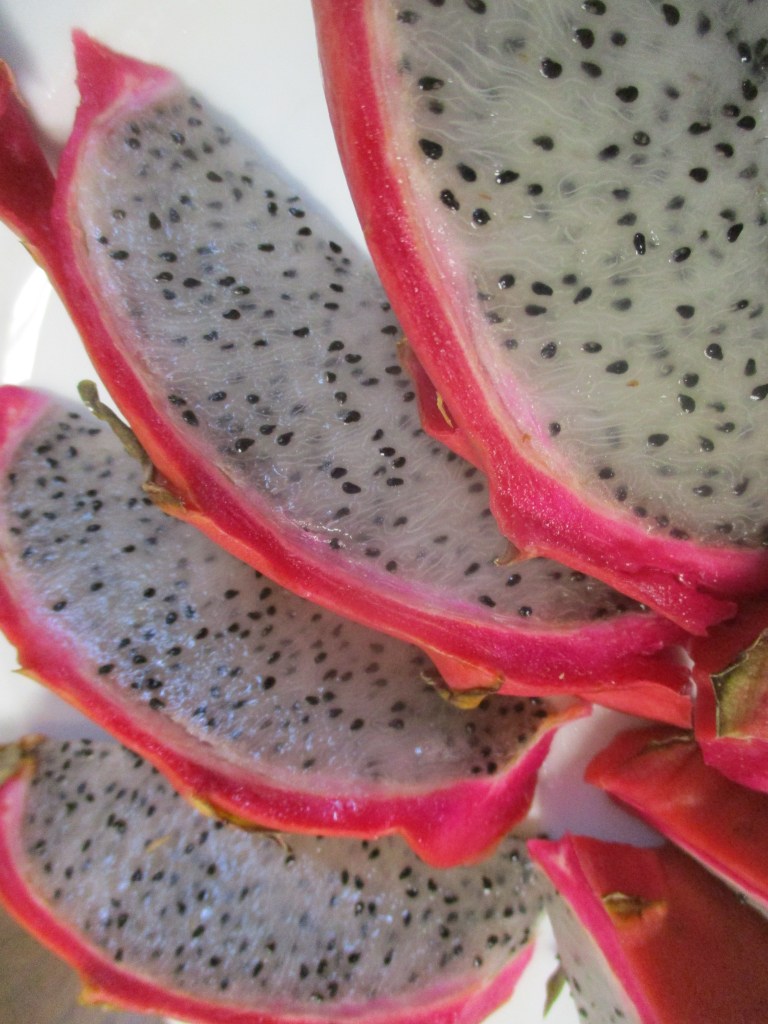
White pitaya looks almost otherworldly.

This weird tropical cactus gets mixed reviews. Pitahaya fruit, or dragon fruit, is abundant in favorable conditions, but develops potentially bland flavor. The green succulent stems may be vigorous, but develop distinctly pendulous form that resembles Sigmund the sea monster. Bloom lasts from summer to autumn, but individual flowers open for just a night. 

Selenicereus undatas is the most popular pitahaya. Its fruit weighs between half a pound and a pound, and has white flesh. Selenicereus costaricensis fruit is similar, but with red flesh, and perhaps slightly more flavor. Selenicereus megalanthus fruit is smaller, thorny and yellow, with white flesh and richer flavor. Home grown fruit is superior to market fruit.

Pitahaya grows very easily from cuttings or pruning scraps. Young stems climb with wiry aerial roots, so need substantial support. Fruiting stems hang downward from the tops of such support. Most modern cultivars need no pollinator. Some old cultivars need another of its same species for pollination. Pitahaya is vulnerable to frost where winters are cool.

Pomegranate

Pomegranates are autumn and winter fruit.

As for fig, date, avocado, grape and olive, the esteemed pomegranate, Punica granatum, has been in cultivation for a very long time. Several thousands of years of domestication have generated countless cultivars. They are now popular in many regions and cultures throughout the World. They produce very well here and in other Mediterranean climates.

Most locally popular pomegranate fruits are brownish red, and about three to four inches wide. Each fruit contains hundreds of seed, which are surrounded by juicy and delicately succulent flesh. They separate easily, like many tiny and tender berries. Most are garnet red. Some cultivars produce fruit with darker purplish, lighter pink or even colorless flesh. 

Without dormant pruning, pomegranate trees can get taller than fifteen feet, and develop dense thicket growth. Fruit is easier to collect from well groomed shorter trees. Individual trees may develop a few trunks, and live for two centuries. Orangish red flowers bloom in spring. Leaves turn yellow prior to defoliation in autumn. Fruit ripens in autumn or winter.

Persimmon

Ripe persimmon is surprisingly sweet.

Most other deciduous fruit trees provide delightfully profuse spring bloom as well as fruit. Persimmon, Diospyros kaki, does not. It compensates though, with brilliant orange foliar color for autumn. Defoliation reveals comparably bright orange ripe fruit. The awkwardly bulky fruit may look silly on lanky limbs of otherwise bare trees, but they sure are yummy! 

Persimmon trees will not require a pollinator to generate an abundance of fruit. However, according to some experts, paired trees of different cultivars produce more abundant fruit of slightly better quality. Abundance is not necessarily an asset though. Unfortunately, all that very perishable fruit ripens at the same time. Fruit is inedible before completely ripe.

Mature persimmon trees can get big enough to become moderate shade trees. If they do, their abundant fruit will be too high to reach, and will generate a horrendous mess when it falls. Although they are handsome trees, they should probably stay relatively short and compact. New trees should be planted while dormant during winter, preferably bare root.