Verbena

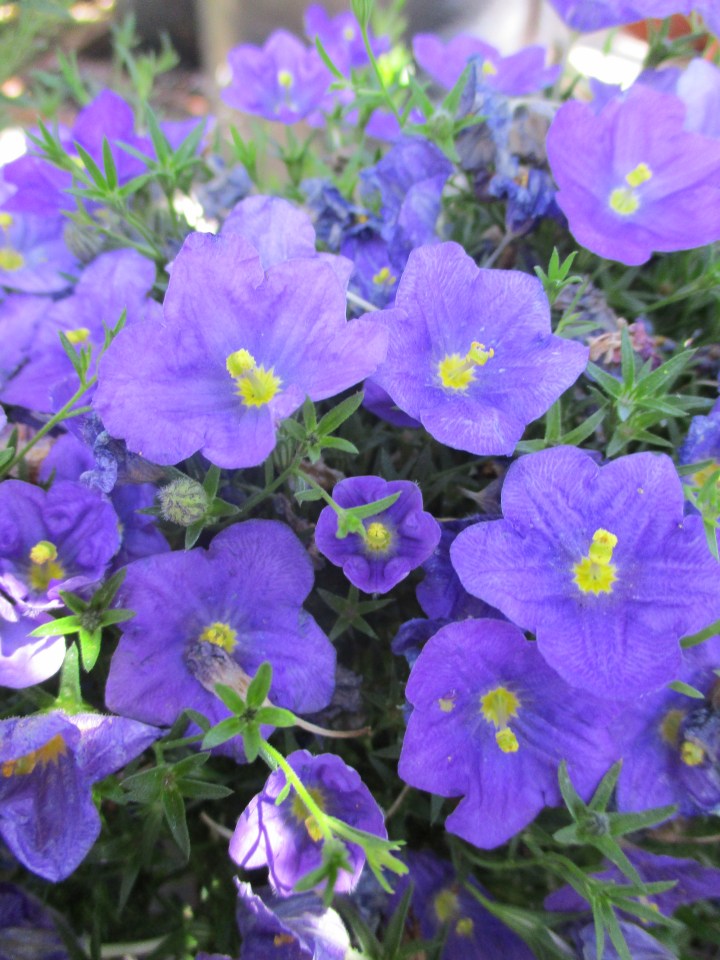
80613This is one of those warm season annuals that we do not hear much about. Verbena looks something like lantana, but rather than maturing into a nice shallow ground cover or low mounding shrub with a bit of staying power, verbena lasts only until frost next autumn. The blooms are a bit larger. The leaves are a bit greener. They stay lower than a foot, and get only a few inches wider than tall.

Floral color was already impressive decades ago when it was limited to white and rich hues of blue, red, purple and pink. Even more hues and shades are available now, as well as peach, rose, lavender and many bicolored varieties. The tiny flowers are arranged in small and dense trusses, with the outer flowers opening and fading to lighter hues before the inner flowers opening darker.

Bloom is best in full sun exposure. A bit of partial shade should not be a problem for those that cascade from planter boxes up against a wall, or pots that hang from eaves. Verbena is popularly grown as a cascading component of mixed plantings in large pots, urns and elevated planters, often in conjunction with more upright plants. Verbena works nicely for small scale bedding as well.

Anemone Clematis

70531Like Ginger and MaryAnn, choosing between the flashier hybrids of clematis and the anemone clematis, Clematis montana, might not be so easy. The fancier hybrids have the bigger, bolder and richly colored flowers that the genus is known for. Anemone clematis has smaller and more subdued flowers in soft pastel hues, but is more prolific, more vigorous, and blooms for nearly a month.

The simple spring flowers look something like those of dogwood, except that they are on wiry deciduous vines that are already outfitted with new foliage. Most are soft white with only four petals and prominent yellow anthers. Some are blushed, pale pink, rose pink or pinkish mauve; and some have more petals or fluffier ‘double’ flowers. The largest flowers are a bit wider than two inches.

The vines are more vigorous than those of clematis hybrids, but are not as aggressive as most other vines or winter clematis. With pruning, they can behave on small gate arbors, although shorter trellises would probably be too confining. If vines escape confinement, they can eventually climb more than thirty feet. The distinctively lobed trifoliate leaves are olive drab, and handsomely rustic.

Rose Campion

80606Rarely planted but often found where the wildflowers grow, rose campion, Silene coronaria, has a way of sneaking in like California poppy or sweet alyssum do. It is so rarely planted that young plants are rarely available in nurseries. Seed is somewhat more available in nurseries, and quite available online. Although they self sow freely if allowed to go to seed, they are not really invasive.

The velvety gray foliage is pretty alone, and becomes a perfect backdrop for the surprisingly bright magenta, regal red or pure white flowers that bloom through early summer. Most of the foliage forms low mounds not much more than a foot wide, while flowering stems stand almost twice as tall. Flowers are ideal for cutting. Hummingbirds enjoy magenta and red flowers more than white.

Individual plants can last for a few years as short term perennials, but because they seed profusely enough to replace themselves annually, they are often grown as annuals, and pulled up before new seedlings appear. Those who last for a second year should probably be groomed. If seedlings are crowded, some can be pulled up and relocated while young. Rose campion wants full sun.

Clematis

70524There are so many different specie involved with the extensive breeding of the modern cultivars of clematis that they are not even assigned full Latin names. They are simply known as ‘clematis’ (without a specie name), with a respective cultivar name. Clematis X jackmanii is the oldest known hybrid, so the name is often applied to other hybrids, whether or not they are actually related.

The big broad flowers are abundant and spectacular this time of year, but unfortunately do not last long. Bloom finishes before the weather gets much warmer, leaving unimpressively rustic foliage on wiry vines. The vines might reach ground floor eaves, and are just the right size for small gate arbors. If necessary, old plants can be lightly groomed of twiggy growth while bare through winter.

Flowers are rich shades of blue, purple, red, pink or white. Many are bi-colored, and some have ruffled centers. During full boom, there may be more flowers than foliage visible. Foliage is a dark shade of olive green, with a dull matte finish, which is actually a perfect background for the rich color of the bloom. Roots like rich, moist and cool soil, while the vines climb into sunnier situations.

Cherry Laurel

80530There is a reason why the most popular specie for frequently shorn formal hedges have small leaves and finely textured foliage. Technically, a formal hedge of cherry laurel, Prunus laurocerasus, can be shorn as well, but should be shorn only once or twice annually, and then allowed to fluff back out. Otherwise, the big leaves get shredded as quickly as they recover from previous shearing.

If pruned more frequently, hand pruning works best, and is not as tedious as it sounds. Informal pruning is even easier, and is done primarily to prevent hedges from getting to deep (from front to back), and to prevent individual shrubs from dominating or subordinating. Pruning also eliminates most of the abundant summer bloom of upright trusses of thirty or so tiny creamy white flowers.

Cherry laurel is densely foliated and quite stout, even without shearing or pruning, and can eventually but rarely get thirty feet tall! The glossy evergreen leaves are about three inches long. There happens to be a few cultivars, including one that is variegated with light yellow, and others that are compact dwarfs. (Prunus caroliniana is different species that is also known as cherry laurel.)

Jumping Juniper!

P80519KOh, the stigma of juniper never gets old! No matter how many cool new cultivars get introduced, and how many specie get rediscovered, they are still though of as those nastily prickly ‘tams’ that were too common in the 1950s. Even some of us who really like junipers dislike tams, not only because they share their stigma with all other members of the genus, but also because they really are nasty and prickly, and not as useful as their overuse would suggest. Are they deep ground cover or shallow shrubbery? They might work for a few years, or maybe many years, but they eventually crash into each other or other plants and pile up into a dense thicket that can not be pruned without being deprived of all dignity.

In the neighborhood where I primarily work, we have a ‘do not plant’ list. Such lists typically cite specie that are notoriously invasive, such as pampas grass, blue gum eucalyptus, Acacia dealbata and English ivy. In regions where fire is a concern, specie that are notoriously combustible, such as cedar, cypress, rosemary and manzanita, are also cited. Almost all of the specie on our list are there for good reason. I mean, we can figure out why they are undesirable in the neighborhood. Then there is juniper. No specie are cited; just the entire genus. Juniper.

Perhaps the eastern red cedar, Juniperus virginiana, is too likely to become an invasive exotic here, so the entire species was condemned. Perhaps junipers in abundance are just too combustible. The ‘do not plant’ list provides no explanation.

There are a few mature junipers in the landscapes that were installed before the list was compiled. A hedge of such junipers was recently removed because it was in the construction zone of buildings being renovated. It was no loss really. They were quite disfigured after decades of reliable service. However, at one end of the hedge, there were two much younger junipers that were added relatively recently to replace one that had been removed to facilitate access to subterranean utilities. They might have been added after the ‘do not plant list’ was compiled. No one really remembers. The list was compiled a few years ago, but distributed only recently.

Before the landscape was demolished, we took a few plants that could be dug up, and canned them back at the nursery for use elsewhere in other landscaped areas. We could not just leave the two small junipers to die. We dug and canned them too. Now they are back in the nursery, with no hope of finding a home back in the landscape from which they came. They happen to be nice specimens, and are certainly NOT tams. No one remembers what species or cultivar they are. They happened to match the original hedge remarkably well, which is rather impressive considering how modern cultivars have replaced most older cultivars.

I happen to have three canned junipers already. They are North American natives. Two are eastern red cedar, Juniperus virginiana, with two very distinct personalities. The other is the Juniperus communis ‘Compressa’, which is a compact cultivar and the closest I could get to the common juniper. Apparently, the common juniper is not so common in the natural form. I already do not know what to do with these three, although the common juniper can stay canned indefinitely.

These other two displaced junipers will probably go into a landscape pretty soon, while they are not yet root-bound. They just can not go any place close to where they came from.

Six on Saturday: Rhody


Not the terrier!

These are six of the many rhododendrons that have been blooming in the landscape for a while now. Some of the pictures are a week or so old. I do not remember when I took them. The rhododendrons did well this year, and their bloom has been lasting quite nicely. I should be pruning them next week, but can not get started until they finish. Some are very big, and some are sloppily overgrown. As much as I enjoy them in this landscape, I miss working with them on the farm. I can remember delivering the smaller rhododendrons in this landscape several years ago. Some of the bigger specimens are about as old as I am. I think I recognize a few of them, but can only positively identify the one in the first picture. ‘Annah Kruschke’ is the most popular cultivar, not only because it is so reliable, but also because it is not too bothered too much by the arid climate of the Santa Clara Valley and other regions that are somewhat farther inland.

1. Annah Kruschke is not the best purple, but is the easiest to grow. The foliage is is very nice dark green and somewhat glossy. It has a nice stout form that does not get too sloppy. Thrip do not bother it too much.P80519
2. This one looks like Taurus, and is just as popular with thrip, but I can not positively identify it. Branch structure is not only open, but has gotten quite sloppy with age. These will be a challenge to prune back.P80519+
3. I will not even guess what this watermelon red rhododendron is. There are several of them here. Although the branch structure is somewhat open, it is not a sloppy mess.P80519++
4. This one looks more like a cultivar that belongs in the Northwest. It has a nice stout branch structure, and nice round trusses of bright pink bloom. Although happy here, these types are not so happy in chaparral climates.P80519+++
5. This is probably my favorite rhododendron here because it looks so much like one of my favorite whites, “Helen Schiffner’. I could do without the yellow blotches. The foliage and branch structure are somewhat shabby.P80519++++
6. Like #3, I will not even guess what this one is. Although I typically prefer plain white, I happen to like these sorts of flowers because the blackberry stains in each floret makes the white look whiter.P90519+++++
This is the link for Six on Saturday, for anyone else who would like to participate:

https://thepropagatorblog.wordpress.com/2017/09/18/six-on-saturday-a-participant-guide/

Wax Privet

70517The pros and cons of wax privet, Ligustrum japonicum ‘Texanum’ might get it a rating of about 2.5 out of 5. It seems that every asset is offset by a liability. The profuse clusters of tiny white flowers are sweetly fragrant, but are also a serious problem for those allergic to pollen. The berries attract birds, but are also very messy, and contain seeds that can germinate in the strangest of places.

The dense evergreen foliage is prettier and actually glossier than that of the more common glossy privet. Growth is slower, and therefore easier to maintain as a shorn hedge. Regular shearing deprives wax privet of most, but not all of its bloom and seed. Glossy privet is more invasive if allowed to set seed, but less invasive as a shorn hedge deprived of bloom before producing seed. Without shearing, wax privet eventually reaches ground floor eaves, and gets about half as broad. It can be groomed into a small tree.

Unwanted feral seedlings should be pulled as soon as they are detected. If cut instead of pulled, they are likely to regenerate, and will be impossible to pull the second time around. Roots are rather greedy.

Drunk Stick

P80516Seriously, I am not making this up. ‘Drunk Stick’ is what the Spanish name of ‘palo borracho’ translates into. It is one of the few common names of the tree I know only as floss silk tree, Chorisia speciosa or Ceiba speciosa. Yes, it sounds crazy, but not as crazy as what the trunk and limbs looks like. One can speculate why it is known as ‘drunk stick’. I am not certain that I want to know.

The trunk in the picture is that of a small tree still in a #5 can. Larger trunks are no better. They are fat and green, and outfitted with these weird conical thorns. The thorns are not too terribly sharp like those of hawthorns or cacti, but they are terribly stout. Seriously! They are like made of wood! As the green trunk grows, it becomes distended, but only makes more thorns to cover the expanding surface of the bark. Even large trees are covered with these horrid things! Only the smallest limbs lack them, and even they have smaller versions. Drunk stick might be endemic to Bedrock, but Bamm-Bamm Rubble would not build his treehouse in one.

Why on Earth would anyone want this aberration of nature in the garden?! Well, it is interesting. After all, it got your attention. Several were planted as street trees in the medians of Santa Monica Boulevard through West Hollywood, to show off their weird trunks. On top of that, over the exteriors of their low and broad canopies, their fluorescent pink bloom matches their lime green trunks about as well as socks that Valley Girls (from the Santa Clara Valley of course) wore in the 1980s. Neither inebriation nor intimidation with a thorny stick is necessary to appreciate the uniqueness of the drunk stick.

Snapdragon

80523They are short term annuals in spring or autumn. Where winters are cold, they may last from spring through autumn. Where summers are hot, they may last from autumn through spring. So what are snapdragon, Antirrhinum majus, here? They can be either or both, depending on where and when they get planted. For most of us, they are a cool season annuals that finish before summer.

Although they prefer to be in full sun, the warmth of such exposure is what limits their practicality through summer. They bloom a bit less in partial shade, but are more likely to last through summer if kept cool, particularly in an innately cool microclimate. Like many annuals, they want rich soil, and regular watering. Because they are susceptible to rust and mildew, foliage should be kept dry.

Snapdragon blooms in white and many cheery hues of yellow, orange, red and pink. Some of the older varieties, particularly those developed for the cut flower industry, can get very tall, and might almost reach low eaves! Modern garden varieties are shorter and fluffier. The biggest are less than four feet tall, and less than a foot and a half wide. Deteriorating flowers should be pruned away.