New Canes Replace Old Canes

50916thumbHeavenly bamboo, or simply ‘nandina’, is one of those many plants that almost never performs like it should. The intricately lacy foliage is so appealing while plants are young, and changes color with the seasons. The red berries can be comparable to those of holly. Unfortunately, healthy plants grow, and then ultimately get shorn into globs of disfigured leaves and stems.

The same abuse afflicts Oregon grape (mahonia), mock orange (philadelphus), forsythia, lilac, abelia and all sorts of shrubby plants that really should be pruned with more discretion. Their deteriorating older stems should be pruned to the ground as new stems grow up from the roots to replace them. It is actually not as complicated as it seems.

This pruning process, known as ‘alternating canes’, prunes the plants from below. It is a standard pruning technique for maximizing production of blackberries, raspberries and elderberries. It is similar to grooming old stalks from bamboo and giant reed, even if it does not prevent them from spreading laterally.

The deteriorating older stems, or ‘canes’, are easy to distinguish from newer growth. Old canes of Heavenly bamboo and Oregon grape become heavy on top, and flop away from the rest of the foliage. Old canes of mock orange and lilac get gnarled and less prolific with bloom. Aging abelia and forsythia canes become thickets of crowded twigs.

The newer stems are likely a bit lower, but are not so overgrown. Since the foliage is not so crowded, it is displayed on the stems better. Their blooms or berries are more abundant. By the time new growth becomes old growth, there will be more newer growth right below it. In fact, the regular removal of aging canes stimulates growth of new canes.

This is the time to prune Heavenly bamboo and Oregon grape, just because the oldest foliage is as bad as it will get after the warmth of summer. Mock orange, forsythia and lilac should get pruned while dormant through winter, but are commonly pruned just after they finish bloom early in spring. Abelia should probably wait until spring because new growth can look sad through winter.
Things Heat Up In Summer

70705thumbThis does not seem like such a mild climate when it is difficult to distinguish between the time and the temperature on a local bank clock tower. You know; when punctuation is the only difference between four minutes past one, and one hundred four degrees. Fortunately, like mild frost in winter, hot weather does not happen too often, which is why this climate really is milder than most.

Most of us know what to do for the garden when the weather gets warmer. Obviously, many plants want more water. What we do not often consider is that there a few things that we should ‘not’ do. Unlike us, the plants in the garden can not find shade when the weather gets warm. Those that are exposed find creative ways to provide their own shade. We really do not want to mess with that.

By this time of year, outer foliage of exposed plants is mature enough to tolerate heat. Only foliage of plants that prefer to be partly shaded is likely to be damaged. However, inner foliage of even the toughest plants is not as resilient as outer foliage is. Simply shearing a hedge exposes inner foliage that can be scorched by overexposure. Sunlight enhances the effects of heat and aridity.

If possible, it is best to delay such pruning and shearing until after unusually hot weather. No one wants to be out working in the garden on a hot day anyway. More typical seasonable weather may not seem to be much cooler, but a few degrees can be a big difference to plants. Once exposed, inner foliage should adapt, and hopefully be resilient to heat before the weather gets hot again.

While young and thin, formerly shaded bark that suddenly becomes exposed can be damaged by sun scald. (Deciduous trees do not get scalded while defoliated in winter because the intensity of sunlight is diminished at that time of year.) Sun scald of bark is much more serious than foliar scorch because it kills bark, leaving open wounds on main limbs and trunks. Decay within these wounds compromises structural integrity, and can ruin otherwise healthy trees.

Although rare, spontaneous limb failure can occur in some trees during warm weather, particularly if humidity increases and breezes remain minimal. It sounds silly, but warmth accelerates vascular activity, possibly until foliage becomes too heavy for the limbs that support it. If limbs break, they can cause major disfigurement, and detrimentally expose bark of inner limbs and trunks.

Horridculture – Stub

P80620.JPGHow can a professional ‘gardener’ leave such a stub on the little California black oak in Felton Covered Bridge Park. It is not as if it is high in the canopy of a large tree, and out of reach to an arborist. This one is right at eye level, exactly where someone getting out of a car parked in the adjacent parking space would run into it. The entire tree needs some major corrective pruning, which would include the removal of significant limbs and portions of the canopy, but that is only because of years of neglect, and is another story. Right now, we are focusing on the eye-level stub.
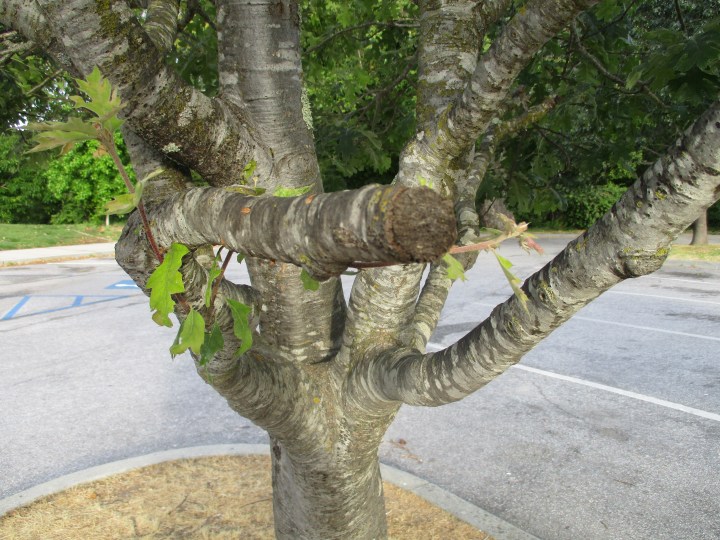
It is not easy to see in these pictures because the lower branches are so congested. The stub extends from the lower left to the upper right in the first picture. It is right in the center of the second picture, protruding upward and to the left of the trunk, and then kinking back to the right. The last picture shows how easy it would be to reach from the ground. This particular tree is located right across from the Memorial Tree. https://tonytomeo.wordpress.com/2018/04/15/memorial-tree-update-to-the-updated-update-etc-the-sequel-to-all-those-other-sequels/

We are always taught to not leave stubs. They interfere with compartmentalization of the pruning wound, or in this case, grow back into a disfigured wad of useless growth that will just need to be removed later. This poor tree already has plenty structural problems. Even if it were not unhealthy for the tree, it is just plain unsightly. Seriously, this looks ridiculous.

‘Gardeners’ do it all the time, as if they all take the same class on ‘how to leave stubs’. What was the advantage to cutting the limb right there instead of two feet closer to the trunk to eliminate the entire stub?P80620+P80620++

Horridculture – Satellite Dish

P80613

Satellite dishes, tater tots, fish sticks, soldiers, flat tops, gobstoppers, corks, oil tanks and trip hazards are just some of the many but less objectionable names that my colleague down south and I have developed for what should be good shrubbery, trees, vines or whatever that so-called gardeners got to with their hedge shears. Tater tots are usually Heavenly bamboo shorn into stout cylinders. Fish sticks are the same, but taller, narrower, and often composed of Podocarpus macrophyllus. Corks are commonly breath of Heaven, but could be just about anything shorn to be somewhat cylindrical, but narrower down low, and wider on top. Trip hazards are ground cover plants like creeping California lilac or creeping cotoneaster, shorn into absurd low hedges next to sidewalks. Gobstoppers could be just about anything, but tend to hang over the curbs in parking lots, ready to impale a radiator grill with a gnarly stub. You can use your imagination for soldiers, flat tops and oil tanks. You probably can not conceive anything more absurd than what my colleague and I see on our job sites.

‘Garage sales’ are probably the worst. They are a variety of plants that were probably intended to function as a practical landscape, but instead got shorn collectively into a large thicket of mixed foliage that rarely gets the chance to bloom. Bougainvillea, New Zealand flax, jade plant, pampas grass, wisteria, fruit trees and even the occasional century plant; anything goes! If the so-called gardeners can reach it, they will shear it.

The original satellite dish was a carob tree in Westchester. I first saw it in the early 1990s, when some homes that had a bit of space to spare were still outfitted with huge parabolic satellite dishes, before the much smaller ones that can be mounted on roofs were invented. This tree had a normal trunk that went up into a remarkably flat ceiling under which no foliage was allowed to hang. This ceiling was only about seven feet above the lawn below. Above that, there was a remarkably symmetrical but low dome of very tightly shorn foliage that looked something like a downward facing satellite dish. This dome was perhaps twenty feet wide, but less than four feet from top to bottom. So, with seven feet of clearance above the lawn, the entire tree was no more than twelve feet tall, barely higher than the eaves of the home behind it. I really wish I had a picture to share. Who puts so much work into ruining a tree?! Maintaining it properly would have been much less effort.

Earlier, we discussed renovating overgrown shrubbery as small trees. https://tonytomeo.wordpress.com/2018/05/21/overgrown-shrubbery-becomes-small-trees/ . The satellite dish was the exact opposite of such useful procedures. What is the point of planting trees and then not allowing them to develop as anything more than abused shrubbery?

The pair of satellite dishes in the picture above are Japanese maples. Their canopies are about the same depth as that of the carob tree in Westchester, but are only about half as broad. What is the point of planting Japanese maples if they are not allowed to look like Japanese maples? They look ridiculous. What is worse is that someone puts significant effort into making them look so ridiculous. They would be so much prettier if pruned only very rarely, and only for clearance above the driveway and away from the building behind. Such pruning would have been less work than shearing these disgraced trees just once.

Even more effort goes into humiliating the plants in the picture below. The fish stick to the upper right is a wisteria vine that is not allowed to bloom or climb onto the trellis that was built for it (which is not visible in the picture). The trip hazard to the lower left is some sort of lavender that is not allowed to spread out over the bare soil as it was intended to do. The cork in the middle is a New Zealand tea tree that can never develop the gracefully irregular canopy and sculptural trunks that it would be pleased to display. It is just a cork.

P80613+

Horridculture – Fat Hedges

P80606

This is the first article within the designated ‘rant’ format, that will continue each Wednesday. Articles for the other six days of the week will be more cheerful, or at least less objectionable. These articles may not always be rants, so might alternatively include discussions of particular fad, trends, gimmicks and so on. Perhaps some topics will remain just that; discussions in which the advantages and disadvantages of a particular subject are compared. Categories may develop, so besides ‘Horriduclture’, there could be a category for discussions of fads, for example. This is a new format for me, so I will keep it open to modification, and see how it goes.

Fat hedges are one of my serious peeves!

Hedges done properly are very useful landscape features, that provide privacy, obscure undesirable views, muffle outside sound or simply divide a large garden space into smaller garden rooms. Landscape designers know how to use them, and are good at planning their locations and orientations, as well as designating the plant material to be used for particular hedges. Some informal hedges or screens are outside of useful space, where they have plenty of room to grow plump and wild without becoming obtrusive. Formal hedges are those that require shearing for confinement within limited space.

Fat hedges are those that are designed to be contained, typically by formal shearing, but are instead allowed to encroach into the usable space within the landscape that they are designed to enclose. They can be a serious problem in confined garden space, and sometimes occupy most of the space themselves.

Seriously, they are very often several feet deep (from front to rear). Fat hedges on either side of a small garden room that is only about twelve feet wide can easily occupy more than half of the area. Think about it. If each hedge is just three feet deep, and there are two hedges, that means that six feet of the width of the twelve foot wide space is occupied by fat hedge! That is half of the area available! Some fat hedges are even deeper! A fat hedge does nothing more than a properly maintained hedge. Really, a three foot hedge accomplishes no more than the same sort of hedge that is only one foot deep. The interior is only bare twigs.

Fat hedges are mostly the result of inept gardeners who allow the hedges to gain a bit more width with each shearing, without ever renovating overgrown hedges. To make matters worse, they allow the tops of the hedges to get wider, which shades out lower foliage, which becomes sparse. Then the fat hedge becomes a top heavy hedge, leaning into usable space where it should be leaning slightly away. Ends of top heavy hedges often protrude a bit more than the sides of the hedges. If these hedges flank a driveway or walkway that is perpendicular to the sidewalk or a patio, the distended end is particularly obnoxious.

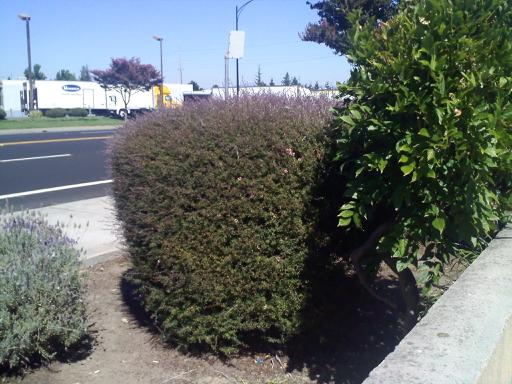
In the picture above, the low hedge seems to be well maintained. If it is a fat hedge, it is in a situation where it is not really crowding much. However, notice the width of the sidewalk. It is quite broad. Then there is a significant constriction where the hedge protrudes over the sidewalk. What is the point of so much concrete and such a wide sidewalk if almost a quarter of the width of it is overwhelmed by vegetation? It is like four lanes of freeway that merge into three, only to merge back into four.

Overgrown Shrubbery Becomes Small Trees

80530thumbThose of us with ‘maintenance gardeners’ are likely aware of how rare it is to find someone who knows how to maintain hedges properly. It seemed so simple years ago. Several identical plants could simply be planted in a row, and then somewhat regularly shorn for confinement to a prescribed space. They were not allowed to exceed a specific height or width for long between shearing.

Formal hedges are now passe. They do not conform to modern landscape style. No one wants to maintain their formality anyway. If a gap develops, it is likely to be filled with a different cultivar or species that is not identical to the rest of the hedge, merely because it happened to be available at the nursery. Feral or invading shrubs, vines or even trees get shorn right into the whole mess.

Then there is the problem with bloat. Rather than staying confined, hedges typically get slightly larger with each shearing. What is worst is that most of the extra bulk is high up and shading lower growth, causing it to grow slower. Hedges eventually develop that all too familiar top-heavy appearance, and encroach into otherwise usable space that they were designed to provide privacy for.

There are few simple options for hedges and shorn shrubbery that have gotten too big for their space. Some can be renovated and cut back beyond their outer surfaces, but recovery will take a bit of time, and can not fix unmatched plants. However, such restoration is likely better than replacement. Just like for a new hedge, feral and invading vegetation must be removed in the process.

Another option is to completely change the form of improperly shorn shrubbery to small trees. This can be done with individual shrubs, or a few selected remnants of an otherwise removed hedge. Cherry laurel, photinia, bottlebrush, tea tree, privet, various pittosporums and many other large hedge shrubs work quite nicely. Rather than getting pruned back into submission, the lower growth gets pruned away to expose sculptural trunks within, and the upper growth gets pruned only for clearance above.

Squirrel!

P80408Wildlife and domestic animals seem to follow me everywhere I go. When Brent and I lived in the dorms at Cal Poly, our room was known as the Jungle Room, not only because of all the greenery, but also because every little bird that got knocked out while trying to fly through the big windows at the dining room was brought to our room to recuperate. A baby squirrel that weaseled into my jacket while I was out collecting insects for an entomology class lived with us for a while. There were two baby ducks that need a bit more explaining.

When I moved south of town, where my roommates boarded horses, the horses worked diligently to open their gate to come to the house to eat my rare plants. The neighbor’s cattle sometimes did the same! When it rained, creepy crawdads came out of the ditch at the railroad tracks and up to my porch.

When I moved to Los Gatos, it seemed that every stray dog in town eventually arrived at my home. In fact, my home was ransacked by the FBI just because their bloodhound who was supposed to be pursuing a suspect of a crime wanted to come by! Again, that takes a bit more explaining. Birds flew through freely. A pair of some sort of small bird nested in my shower, and before I realized it, started to raise a family . . . and finished. Pigeons tried to nest repeatedly in the same spot on top of the refrigerator, but got evicted. A squirrel moved into the guest room, and refused to leave. It sometimes tried to join me for breakfast.

Then, at my second home, there was Timmy the baby deer, two feral cats, skunks, coons, squirrels and more neighborhood dogs than I can remember, as well as Bill the little terrier who actually lived there. I could go on. https://tonytomeo.wordpress.com/2018/03/14/timmy-in-the-garden/

Squirrels are a common denominator. They are everywhere.

My home in town was in the Live Oak Manor district, which, as you can guess, was dominated by huge old coast live oaks as well as comparable valley oaks. The valley oak next door was supposedly the largest in the Santa Clara Valley. Squirrels were everywhere and very well fed!

The east facing window over my desk would have had a good view of Mount Hamilton if the view had not been so cluttered with utility cables. The wildlife that used the cables could get annoying at times. Crows made their annoying noise. Pigeons just stared at me stupidly. Squirrels scurried by with bits of fruits and vegetables that they stole from the garden, and sometimes stopped to cuss at me. I sometimes cussed back, but also reminded them to be careful as they jumped from the high voltage cables into the tops of the neighbor’s hedged redwood trees below. The redwoods sometimes grew dangerously close to the high voltage cables between clearance pruning.

As you can imagine, the unimaginable but obviously predictable happened. I do not know if he was coming or going, but I would guess that he was jumping from the tree to the cable. I only heard a loud ‘ZAP’ and subsequent ‘FIZZLE’. By the time I looked out, the unfortunate squirrel was a swinging charred carcass with a death grip on the cable he was reaching for. The death grip was impressive. He stayed there for a long time, swinging in the breeze. Silent sparks could sometimes be seen at night, where his tail brushed against the tip of the redwood shoot. I do not know if a crow finally got him, or if he just fell into the neighbor’s yard. Either way, he did not get a proper burial.

Frost Is History For Now

80328thumbThere is no doubt that frost will return next autumn. It does that every year. Right now, we are more concerned that is should not return prior to that. It is now safe to plant plants that are sensitive to frost. Even if the weather were to somehow get cold enough to necessitate protection of frost sensitive plants, it will not be severely cold, and it will not last long. It is best to start now than to delay.

It is also safe to prune away foliage and stems that were damaged by frost through winter. It was best to leave it in place through winter, both to provide a bit of insulation for undamaged stems below, and to not promote new growth. Pruning it away allows warming sunlight to the undamaged stems, and stimulates generation of new growth. A bit of new growth might already be apparent.

Many leafy perennials can be cut to the ground, or at least just above their rhizomes. The tall vertical canes of cannas can be cut back to the low horizontal rhizomes that creep along the ground. The canes are not really stems anyway, but are merely upright foliar shoots. Any shorter new shoots that are beginning to develop can remain, even if a few outer leaves happen to be damaged.

Zonal geraniums can likewise be pruned almost to the ground, leaving only stubs of lower stems, even if only upper and outer foliage was damaged by frost. Although they do not need to be cut back so severely, they respond to such pruning splendidly, with vigorous new stems and foliage. The fungal foliar disease known as ‘rust’ overwinters in old leaves that get removed in the process.

Lemons, limes and any other citrus that were damaged by frost only need to have their damaged stems removed as far back as viable growth, where new buds might already be visible. However, if more pruning is necessary, this would be a good time to do it. Major pruning should not be done later in summer because the sensitive bark of inner stems can be scalded by sudden exposure to too much sunlight. Small trees that are sensitive to frost become more resilient as the grow larger.

the Good, the Bad, and they’re both UGLY!

P80307Pollarding and coppicing are bad words to most American arborists. These extreme pruning techniques are considered to be synonymous with topping. Yet, both have been around for centuries, and have actually kept some trees alive and productive significantly longer than they would naturally live.
Rather than redundantly explaining what pollarding and coppicing are, and why they are useful arboricultural techniques, I will provide this link to an article I wrote about them earlier: https://tonytomeo.wordpress.com/2018/02/12/pollarding-and-coppicing-pruning-techniques/

I am one of the rare American arborists who not only condone pollarding and coppicing, but I also use these techniques when necessary. I will be coppicing red twig dogwood soon so that it produces more vigorous red twigs next year, and also because we can not allow it to grow wild as a thicket. Some of my fig trees will get pollarded to make vigorous shoots for cuttings, and also to keep them contained in their minimal space. Both techniques are very effective if done properly.

I must stress the word ‘properly’.

Improperly executed pollarding or coppicing really is disfiguring, and can be disastrous. Yet, it is done quite often by those who get payed to maintain landscapes!

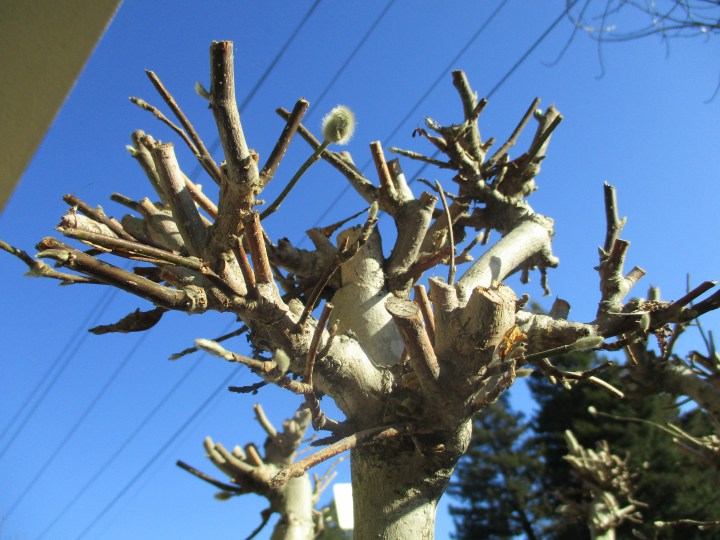
The picture above illustrates a remarkably well pollarded flowering pear tree. It was obviously done by an arborist who knows how to pollard in the English style. Although it is difficult to see in the picture, the knuckles were pruned back cleanly last year, leaving no stubble. The vigorous secondary shoots developed mostly from the knuckles, with only a few stems emerging from lower on the main limbs. When this tree gets pollarded again (and it may have already been pollarded since this picture was taken last week), it should get pruned back to the same knuckles.

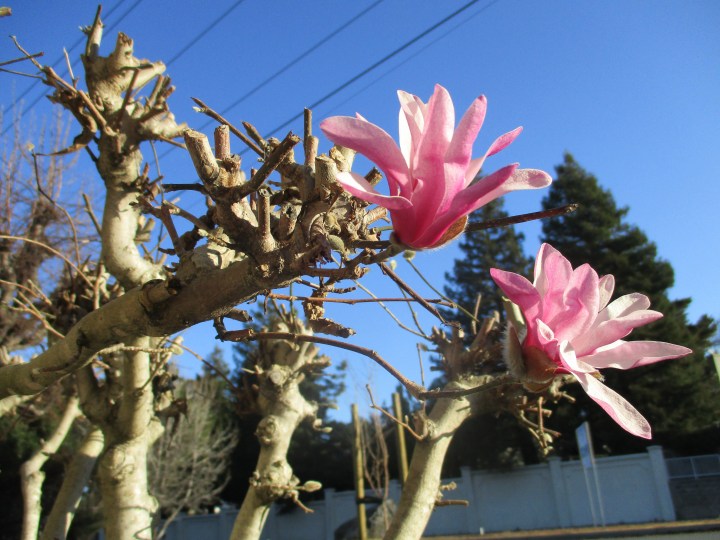
The pictures below show some sort of magnolia that was severely disfigured by maintenance ‘gardeners’, probably for no other reason than it was within their reach. A magnolia can not bloom if all of the stems from the previous year get pruned off by pollarding. This magnolia happened to bloom with a few distorted flowers only because the pollarding was so poorly done, that long stubs remain. These flowers are really nothing to look at within the context of all this unsightly disfigured stems. The long stubs can not be compartmentalized as the new growth develops in spring, so will remain as open and decaying wounds as the tree matures.

So, what is the point of this magnolias even being in the landscape? It contribute nothing. It can not bloom. It can not grow into a tree, but is unappealing as shrubbery. It will always be disfigured. The disfigurement will eventually compromise its health. It would be best if it were merely removed, or at least coppiced and allowed to regenerate. Even if it is a grafted tree, and gets coppiced below the graft, the resulting growth would be an improvement, and might actually bloom if the ‘gardeners’ do not ruing it again.P80307+P80307++

Exceptions To The Pruning Rules

80228thumbWinter is the best time for major pruning of most plants. They do not mind it so much while they are dormant. However, there are exceptions. Winter pruning might be a bit too early for a few plants that are grown for their late winter or early spring bloom. It is best to wait until immediately after bloom to prune or trim flowering cherry, flowering plum, flowering crabapple and flowering quince.

Because these trees will be in the process of coming out of dormancy, it is best to prune them just after the blossoms finish, as new foliage is emerging. Some of the new buds will likely be ruined in the process, but there should be plenty to spare. If a few extra stems were left on deciduous fruit trees when they were pruned earlier, they can be taken as cut flowers prior to or while blooming.

Forsythia and Oregon grape should also be pruned after bloom, but with different technique. Oregon grape certainly does not need to be pruned annually, and may only need to be occasionally groomed of deteriorating stems. If and when it gets pruned, the oldest canes should be cut to the ground to favor newer canes. Forsythia canes should be cut to the ground after their second year.

Red twig dogwood and small willows that are grown for the color of their twigs must be pruned aggressively to produce new twigs for next winter; but there is no point in pruning their colorful twigs off while they are at their best. It is better to wait until just before new foliage is about to come out and obscure the twigs. They can be pollarded or coppiced. This applies to pussy willows as well.

Clumping grasses will start to grow soon, so can be shorn of their old foliage from last year that likely started to look rather tired by the end of winter. If left unshorn, new foliage and flower stalks will do just fine, but will come up through the old growth from last year, as the old growth lays down next to it and continue to decay. Once new growth develops, it will be more difficult to remove the old without damaging the new. Clumped grasses will look silly longer if shorn too early.