Six on Saturday: Rain On My Parade


Actually, this rain ‘is’ the parade. In parts of California, we do not get much of it, so when rain happens, it is worth celebrating. Although this side of the Santa Cruz Mountains gets significantly more rainfall than the chaparral on the other side in the Santa Clara Valley, there are not many more rainy days here. What that means is that when it rains here, it does so with more volume than in the Santa Clara Valley.

Rain is not easy to get pictures of. The first four picture just show water from one of our first major storms of the season. The fifth pictures does not even show that much. The sixth picture is from the most recent storm that came through Sunday night and finished on Monday morning.

1. This waterfall was flowing both through and over the deteriorated and also clogged gutter on the roof of the shop building across the driveway from the gardening shop at work. The gutter is so deteriorated that I would have expected all of the water to just flow through it. Incidentally, the big roll-up door to the lower left of the picture happens to be that of the plumbing shop.P81222

2. This waterfall was flowing through a storm drain on the Mount Hermon Road bridge over Zayante Creek, East Zayante Road, and the railroad tracks in between them.. This section of Mount Hermon Road is known to some as ‘the Bypass’ because it bypassed the older Conference Drive in picture #5. What is not visible in this picture is that the upper part of the waterfall lands in the ditch on the side of East Zayante Road below. It might have seemed like a good idea when the bridge was built, but so much water falls from so high up that it erodes the ditch, and splatters gravel onto cars driving by. The lower part of the waterfall flows into a ditch on the edge of the railroad tracks, and then under the tracks towards picture #3 below.P81222+

3. This waterfall was flowing out into Zayante Creek from a culvert just downhill from the culvert under the railroad tracks mentioned in #2 above. It is the same water that was falling from the Mount Hermon Road bridge.P81222++

4. These two waterfalls were flowing from the roofs of the local supermarket and adjacent drug store and pharmacy, and onto the newsstand below. What is disturbing about this picture is these drains are merely back up drains that do not allow the flat roofs surrounded by parapet walls to fill with too much water if the main drains get clogged. The main drains are likely at the rear of the building where they can drain discretely and out of the way. These back up drains are on the front of the building so that they get noticed if they start to flow. All this water flowing out of them indicates that the main drains are clogged, and that the roofs are flooded.P81222+++

5. This is the Conference Drive bridge over Zayante Creek, East Zayante Road, and the railroad tracks in between them. It is the bridge that was bypassed by the Mount Hermon Road bridge in picture #2. The big greenwaste pile where I dump debris from the landscapes is directly below the southern edge of this bridge, which is to the left in this picture. You can not see it in this picture that was taken before the rain started, but a bit of water drains from this bridge onto the greenwaste pile. It is not much, but it is enough to be a bother when I am unloading debris in the rain. It falls from so high up, that even if I am avoiding the spot where the falling water lands, the wind can blow it all over me. From that height, any bit of road gravel that falls with it can give me quite a sting.P81222++++

6. The most recent storm finished early Monday morning, after dropping two and a half inches of rain.P81222+++++

This is the link for Six on Saturday, for anyone else who would like to participate:

https://thepropagatorblog.wordpress.com/2017/09/18/six-on-saturday-a-participant-guide/

Six on Saturday: Deodar Cedar Migration


Deodar cedars that were featured in the gardening column about two weeks ago, https://tonytomeo.com/2018/11/27/deodar-cedar/ , live in a small grove adjacent to a building that I work out of. They need a bit of pruning for clearance from the roof, but are otherwise rather nice and healthy specimens.

They are also prolific. Quite a herd of seedlings is developing on the ground below. None of the individual seedlings are more than just a few years old, which suggests that the area was cleared of seedlings a few years ago. The area needs to be cleared of seedlings again, before they grow big enough to become a messy thicket.

Part of another landscape in another area happened to be in need of a few deodar cedars. There were two established specimens there already. They suit the situation so well that more are desired. However, new trees are expensive, and because there is no irrigation system in that particular site, they would need to be watered very regularly by hose until they get established.

Well, you can guess what happened. We pulled up several of the seedlings that needed to be pulled up anyway, and simply plugged them into the site where more deodar cedars are desired. It was done just prior to rain, so the relocated seedlings did not even need to be soaked in. They were pruned so that they would not desiccate so readily. We planted way more than necessary because there were plenty to spare, and also because we expect that several will not survive the process. We also expect that we will likely need to cut down a few later because, although some will not survive, too many probably will. Because they are just tiny seedlings, they will get established more efficiently than canned nursery stock, and will not be so sensitive to lapses of irrigation.

Although way more than necessary were relocated, they were not even a quarter of what was available in the original herd. More than three quarters of the herd remain available to be planted elsewhere. More will likely be relocated to other parts of other landscapes before the rainy season is half way finished. A few will be canned and put into the nursery. Whatever we do to them should be done in the early part of the rainy season to take advantage of the weather while they get established. We prefer to relocate the larger seedlings first, so that those that remain will be the smaller seedlings that will take longer to get too big to move if they must wait until next year to be relocated.

This is actually old technology, and how tree seedlings were pulled and plugged to enhance the production of woodlots since ancient history. While undesirable seedlings were pulled and discarded, more desirable seedlings that happened to be crowded around the parent trees were pulled up and plugged in more uniformly over a larger area.

1. seedlings in the ground below the parent treesP81215

2. parent treesP81215+

3. bundle of seedlingsP81215++

4. unpruned seedlingP81215+++

5. same seedling prunedP81215++++

6. seedling in new locationP81215+++++

This is the link for Six on Saturday, for anyone else who would like to participate:

https://thepropagatorblog.wordpress.com/2017/09/18/six-on-saturday-a-participant-guide/
Six on Saturday: Too Much Autumn Color IV – Uncategorized Exotics


These are the last six of the twenty four pictures of autumn foliar color that I got before the rain knocked so much of the foliage to the ground more than a week ago. #2 is the only picture of foliage that is on the ground instead of still suspended on the stems that produced it. The fallen birch leaves were just too pretty on the stone wall to not get a picture of them.

1. Japanese maple is not my favorite species, but it does have certain attributes. There happen to be several at work just because they happen to work well there. Some that do not typically develop good color got remarkably colorful this year. I believe that this particular Japanese maple is the common ‘Bloodgood’. It had been dark reddish bronze through summer, and then turned brighter red for autumn.P81222

2. European white birch is grown for the elegant white trunks that contrast so nicely against the deep green of the redwoods. This autumn foliar color, although brief, is an added bonus. These trees were already starting to defoliate before the rain.P81222+

3. Hydrangea is not known for autumn foliar color, and as you can see, turns only pale yellow. Yet, it is striking in the shade, and contrasts nicely with the rich green of redwood and English ivy foliage.P81222++

4. Spirea is likewise not grown for autumn foliar color, or at least no so much in our mild climate. There are more than a dozen of them here, and none are doing very well. They will get cut back and groomed now that they are bare. I do not know what cultivar this particular spirea is.P81222+++

5. Golden weeping willow was not only golden with autumn foliar color, but is still golden with the yellow bark on the twigs. So far, I am not too impressed with the yellow twigs. It is still a small tree, and growing in a mild climate that may not stimulate much color. Regardless, I happen to like weeping willows. This one happens to be in a swampy spot where it is quite happy.P81222++++

6. Bald cypress is rare here, but there happens to be two at work. One was supposed to be a dawn redwood, but was obviously mislabeled. Fortunately, it just happened to be planted on the bank of a small creek where it gets plenty of water. The other was planted in an area that is too swampy for other trees. Both are doing quite well. When they defoliated, they covered the ground with finely textured needles that would have been impossible to rake up.P81222+++++

This is the link for Six on Saturday, for anyone else who would like to participate:

https://thepropagatorblog.wordpress.com/2017/09/18/six-on-saturday-a-participant-guide/
Six on Saturday: Too Much Autumn Color III – Cherries, Berries, Plums, Apples, . . . & Ginkgo


Autumn foliar color, fall color, autumn leaves or whatever you know it as; there was too much of it to fit into just six pictures. That is why I submitted two ‘Six on Saturday’ posts last week, and why this one is number ‘III’, and why there will be a number ‘IV’ right afterward. Only one reader expressed concern that submitting two posts to ‘Six on Saturday’ on the same Saturday is a violation of the rules, but I got the impression that even he did not mind. These pictures, as well as the next six, were actually taken more than a week ago, which might violate another rule. If you are seeing them now, I have not yet been prosecuted, and compelled to delete them. Much of the foliage was knocked to the ground by rain since the pictures were taken. The apple tree #4 was pruned back severely, and is now completely defoliate. The title ‘Cherries, Berries, Plums, Apples, . . . & Ginkgo’ implies that all but one are fruit trees; but they aren’t. Well, you can see what I mean.

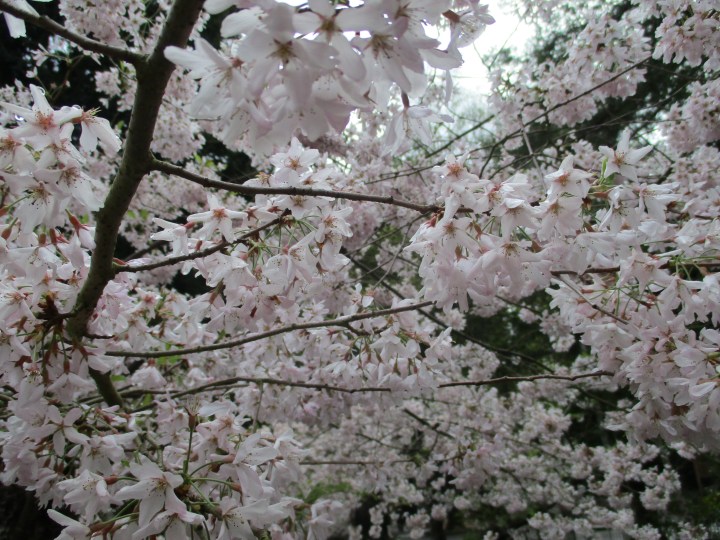
1. Yoshino flowering cherry, which I know as ‘Akebono’, just might be the most traditional of the Japanese flowering cherries in America. It is the classic cherry blossom tree around Washington D. C.. As flashy as the bloom is, it is sterile; so the trees are fruitless. You can not see it, but the home in the background is of classic Early American architecture. It is a family home, so is too big for my taste. It would otherwise be my favorite home in the neighborhood.P8215

2. Kwanzan flowering cherry is the second most popular flowering cherry in our region. The big pink double flowers are a bit too garish for my taste, but they really are flashy! Like the Yoshino cherry, the Kwanzan cherry is fruitless.P8215+

3. American plum is not native here, but naturalized. It was and probably still is a common understock for quite a few of the stone fruits. It often grows from the roots of a stone fruit tree that got cut down to the ground. It makes small tart plums that are not much bigger than fat cherries, but not many of us use them for anything. Garden varieties of plum and cherry are naturally more desirable. I Intend to use American plum for jam, but I always get out to pick them after they have fallen to the ground and gone bad. You may have noticed that the first three subjects are of the same genus, Prunus.P8215++

4. Apple happens to do very well in our region. The old apple trees on the farm are remnants of an old orchard. Others in the neighborhood are from old farms. This one is on the edge of a sidewalk where it was not likely planted intentionally. It likely grew from a seed from a discarded apple core. It does happen to make apples, but they are no good. I just cut this tree back severely. If the apples are still no good next year, the tree might get cut down.P8215+++

5. Ginkgo is an ornamental tree here. Because those of us who do not want the fruit find the stinky aroma and mess to be objectionable, garden varieties are all male, and therefore fruitless. However, in some cultures, ginkgo is grown both for fruit, and for the nuts within the fruit. There are a few female trees in older neighborhoods here. They were grown from seed before all male garden varieties were developed. Back then, there was no way to determine the gender of a ginkgo tree until it started to develop fruit . . . or hopefully didn’t.P8215++++

6. Barberry is strictly ornamental. I have never actually seen a bar’berry’ fruit. This particular unknown cultivar happens to be bronzed, with very dark foliage that turns bright yellow and orange for autumn. It is very thorny!P8215+++++

This is the link for Six on Saturday, for anyone else who would like to participate:

https://thepropagatorblog.wordpress.com/2017/09/18/six-on-saturday-a-participant-guide/

Six on Saturday: Too Much Autumn Color II – Natives & Exotics


Now we have a bit more variety than the last batch of six.

Red stem dogwood of the first and second pictures is the only species that is locally native. The California currant of the fourth picture, and the California black walnut of the fifth picture are both as native to California as the names imply, but are not native locally. The flowering dogwood of the third picture is from Eastern North America. You can guess the origin of the Chinese wisteria of the sixth picture, which happens to be the only vine represented in all four groups of six pictures.

The first three of the six pictures, or half, are of dogwood. The first two pictures are the only two in all four groups of six pictures that are the same species, namely red stem dogwood. Both were posted just to demonstrate that red twig dogwood, which typically turns only pale yellow like the foliage of the first picture, can develop a bit of red foliage like that of the second picture, if conditions are just so. Both the red stem dogwood of the second picture, and the flowering dogwood of the third picture, are the first two examples of red foliage from my four groups of six pictures. In the next two groups of six pictures, there is only one other example of bright red foliage, as well as an example of brown foliage, and an example of irregularly bronzed orange foliage. Those are topics for next week.

1. red stem dogwoodP81208

2. red stem dogwoodP81208+

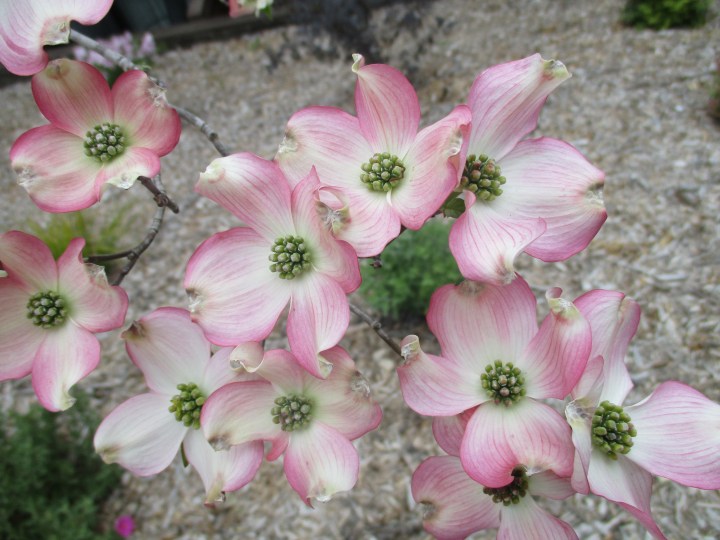
3. flowering dogwoodP81208++

4. California currantP81208+++

5. California black walnutP81208++++

6. Chinese wisteriaP81208+++++

This is the link for Six on Saturday, for anyone else who would like to participate:

https://thepropagatorblog.wordpress.com/2017/09/18/six-on-saturday-a-participant-guide/
Six on Saturday: Too Much Autumn Color I – Natives


The merely adequate color among the sweetgums early in the season suggested that color would be insipid this year. Then, the weather did something that set it all off. There was too much autumn foliar color this week to select just six pictures. So, I didn’t. These six are only the first of four groups of six. It would not be practical to post a group weekly for four weeks, particularly since some of the colorful foliage in these pictures was dislodged by generous rainstorms shortly after the pictures were taken. There will be very little foliage left by the time the last group of six posts. Instead, two groups of six will be posted presently, and the other two groups of six will be posted next Saturday, before they are two weeks old. I hope this does not violate any rules.

All six specie in this first group happen to be locally native. They are also all yellow, which is the standard color here. Regionally, there is not much orange or red. The thimbleberry in the first picture is rather pale yellow, but that is more color than it typically gets. Of these six, the thimbleberry is also the only species that does not grow as a tree, or a shrub like the hazelnut of the second picture. The hazelnut happens to be a Western hazelnut. The cottonwood happens to be a black cottonwood, although I would not know what distinguishes it from any other cottonwood. The sycamore is more specifically a California sycamore, which really is quite distinct.

1. thimbleberryP81201

2. hazelnutP81201+

3. cottonwoodP81201++

4. sycamoreP81201+++

5. boxelderP81201++++

6. bigleaf mapleP81201+++++

This is the link for Six on Saturday, for anyone else who would like to participate:

https://thepropagatorblog.wordpress.com/2017/09/18/six-on-saturday-a-participant-guide/
Six on Saturday: More Unknown Succulents


This is not as simple as it looks. It is something of a guessing game for me. I am rather certain that #1 and #2 are identified correctly. I am not so certain about #3 and #5. The name of #4 is merely a guess. #6 is the only one that I know the name of for certain, although the name that I know it as is now outdated.

The lack of a species name for the two species of Sedum #1 and #2 seems like a cop out to me. I might have discussed it in one of my Wednesday rants, or will do so soon enough. All species should be described as a ‘species’, not merely as a genus with a cultivar name tossed in as if it adequately designates the identity. I sometimes write about how the nomenclature of plants is like that of cars. Both plants and cars are distinguished by genus AND species, with some specie divided into separate cultivars and varieties. (Cultivars are merely ‘cultivated varieties’.) Depriving a plant of a species name is like describing a car as a Buick ‘Convertible’, or a Chrysler ‘Sedan’. There is a big difference between a convertible Electra and a convertible Skylark, although both are Buicks. There is also a big difference between an Imperial sedan and a LeBaron sedan, although both are Chryslers. I may not have identified the two Sedum with their correct names, but even their correct names are not very correct anyway.

Echeveria glauca #3 seems too simple. Shouldn’t it have a cultivar name too? I really do not know. I really do not even know what species it is.

The same goes for Graptopetalum paraguayense #4. Really, I do not even know what genus it is. This is merely a guess. How embarrassing.

Aloe brevifolia #5 has a different issue with its name. It seems that all aloes are known simply as Aloe vera, even though not many of us would recognize Aloe vera if we actually saw it. This makes it easier to identify unknown aloes, but complicates the identification of familiar aloes.

Then there is the easily identifiable Bulbine caulescens #6. Seriously, I recognize it, but somehow, the name got changed. The first name is how I know it. The second name is the newer correct name.

1. Sedum ‘Angelina’P81124

2. Sedum ‘Blue Spruce’P81124+

3. Echeveria glaucaP81124++

4. Graptopetalum paraguayenseP81124+++

5. Aloe brevifoliaP81124++++

6. Bulbine caulescens or Bulbine frutescensP81124+++++

This is the link for Six on Saturday, for anyone else who would like to participate:

https://thepropagatorblog.wordpress.com/2017/09/18/six-on-saturday-a-participant-guide/
Six on Saturday: Fire Season


California really does have the same four seasons that the rest of America has. They just happen to be somewhat subdued in some of the milder climates. The rumor that California has only two seasons, summer and a few days of not-summer, is completely inaccurate. In fact, besides the traditional four season, we have a fifth season that overlaps at least summer and autumn. It reality, this season never ends. It is always ‘fire season’.

Like any other season, fire season affects how we garden here. We prefer to grow plants that are less combustible, which is often contrary to the preference for native specie. In suburban and rural areas, we must manage native vegetation and keep it away from our homes and other buildings. When the weather gets smoky from forest fires, some of us postpone gardening chores for healthier weather.

The Rincon Fire near Paradise Park (not to be confused with Paradise) burned for a few days a week and a half ago, and filled the Valley with thick smoke. By the time that smoke cleared out, smoke moved in from the Camp Fire that burned Paradise more than two hundred miles to the north. Smoke from the Woolsey Fire and the Hill Fire that both started on the same day in Los Angeles and Ventura Counties stayed to the south. The Bear Fire, which was the second relatively small forest fire in our region, started and was contained just yesterday, just a few miles outside of Boulder Creek. Most of us were not aware of it until after it was contained.

Incidentally, a 50% chance of rain is predicted for next Wednesday.

1. Clear blue sky finally appeared on Thursday morning.P81117

2. The orange moon demonstrates how smoky the sky was on the previous evening. It is not easy to zoom in and get a good picture of the moon.P81117+

3. Ponderosa pine forests are the more combustible parts of our region. The darker understory is a mix of coast live oak, canyon live oak, madrone and other chaparral flora. The dead ponderosa pine that I got a picture of for ‘Six on Saturday: Dia de los Muertos’ is to the right in this picture. Sunsets were spectacularly colorful before the smoke blew away. I can not explain why the color was so bland when this picture was taken.P81117++

4. Our debris pile continues to accumulate more biomass from the landscapes and surrounding forests. It is not yet big in this picture. It will get significantly bigger before it gets taken away. Once gone, we start the process all over again. It never ends. There is so much forest out there, and we are constantly trying to keep it away from the buildings.P81117+++

5. These numbers on the side of my work vehicle allowed the volunteer firefighter who used to drive it to go into areas that had been evacuated ahead of forest fires. Several of our vehicles are outfitted with these decals.P81117++++

6. This is the picture that you probably did not want to see. It is what remains of the home of one of my colleague’s clients in Malibu after the Woolsey Fire moved through. The front garden was exquisite. The home was even better.P81117+++++

This is the link for Six on Saturday, for anyone else who would like to participate:

https://thepropagatorblog.wordpress.com/2017/09/18/six-on-saturday-a-participant-guide/
Six on Saturday: Tangly Cottage Gardening Journal


tanglycottage.wordpress.com is where you can find it. This is a blog about gardening, gardens, life, and of course, Skooter the kitty, in and around Ilwaco, in the very southwestern corner of Washington, where the Columbia River flows into the Pacific Ocean. Like so many blogs, it shares compelling insight about a culture and a region that might be very different from what one is accustomed to. Then again, it might be compellingly similar . . . or even unexpectedly familiar. You can decide for yourself.

I have been to Ilwaco only once, about twenty years ago. I spent the night in a campground there while driving from Silverdale, west of Seattle, to Saint Helens, north of Portland. It was certainly not a direct trip. That would have been a two and a half hour drive. I was on vacation, so drove around the Olympic Peninsula. I sort of intended on returning someday, but never did.

After all these years, it has been fascinating to read about the flora of the gardens of the region. When I was there, I was more interested in the native flora outside of town. Ilwaco still looks something like I remember it to look like, although I think that there is more landscaping downtown now.

A while back, I commented on Gladiolus papillio that was blooming in a planter box in downtown Ilwaco. I was impressed that it was such a reliable perennial species of gladiolus. I had been wanting to grow a species of gladiolus that was more perennial than than the common summer blooming bulbs that I am familiar with, but had not decided on which ones to try. Anyway, in response to my comment, the author of ‘Tangly Cottage Gardening Journal’ offered to send me a few of the bulbs! How could I refuse?

These six pictures are of those Gladiolus papillio bulbs that came from Ilwaco in Washington.

1. It is so excellent to get a package in the mail from such an exotic and far away place! It got here very fast. It was in my mail only two days after being postmarked on October 25.P81110

2. The contents of the package are even more excellent than the package itself! There were nearly fifty bulbs here! I planted them on the first of November, a bit more than a week ago.P81110+

3. The bulbs were planted in three groups of about a dozen, with two groups of about half a dozen between them. The first group is partly buried here because a bit of soil fell back into the hole before I got this picture.P81110++

4. This is how the same first group of bulbs looks completely buried. Aren’t they pretty? Never mind the calla. It is not vigorous enough to bother the Gladiolus papillio.P81110+++

5. This is the planting bed where the Gladiolus papillio bulbs were planted. They are up in back, in a row that extends from the left edge of the picture to the corner of the trellis with the espaliered camellia. The pinboard and mailbox in the top right corner of the picture are at the Post Office next door. I would have preferred to plant the bulbs in front of the Post Office, but there is no place to do so over there. I am pleased that these Gladiolus papillio were planted in a public space almost in front of the Post Office because that is where they originated in Ilwaco. As the proliferate, I intend to take a few to my downtown planter box in Los Gatos, and might even share a few with the lady who tends to the planter box next door to the Los Gatos Post Office.P81110++++

6. This is the Mount Hermon Post Office is next door.P81110+++++

This is the link for Six on Saturday, for anyone else who would like to participate:

https://thepropagatorblog.wordpress.com/2017/09/18/six-on-saturday-a-participant-guide/
Six on Saturday: Dia De Los Muertos


Dia de los Muertos, or Day of the Dead, was yesterday, Friday, November 2. However, the dead are still dead. They don’t need a special day to be so. In fact, they do it every day of the year. Dia de los Muertos is just one day of celebration to honor them.

Dia de los Muertos is not for plants though. Dead plants just get cut down and disposed of. Some get composted. Dead trees get recycled into firewood. These are six pictures of five species of dead plants that I needed to contend with in the week before last.

1. Rhododendron. I really do not know what killed this group of rhododendrons. It is not uncommon for one to die. With all the rhododendrons in the landscape here, a few dead ones get removed annually. However, it is rather disconcerting that a few died all in the same area at the same time. All their dead stems were rather sculptural. They were removed just after this picture was taken. Of the five specie in these six pictures, this is the only species that is not native.P81103

2. Madrone. Bits and pieces of madrone commonly succumb to blight, sort of like fireblight in apple and pear trees. Sometimes, entire trees are killed like this one. It is fire wood now.P81103+

3. Ponderosa pine. The forest does not burn as frequently as it used to before people were here to extinguish forest fires. The lack of restorative fires interferes with regional ecology. Not only is the forest becoming congested with unburned fuel, but pathogens are proliferating in the aging flora and consequently accelerating the deterioration of the forest, which increases the combustibility. It is a natural process designed to correct an unnatural lack of restorative fires, but does not go well for those of us who live here. Ponderosa pines can live for a few centuries. However, in our compromised ecosystem, many succumb to pathogens while still relatively young. This one will need to be removed next year. Once dead, they deteriorate and start to drop limbs within the year.P81103++

4. Coast live oak. This is one of the most adaptable of tree specie in California. It lives right down to the beach, and into interior valleys, and up the summit of the Santa Cruz Mountains. It does what it must to adapt to the various environments within its range. It often lives in groves of the same, where it is more likely to burn every few decades or so. In spacious valleys, it is often not so social, with individual trees living in relative isolation from their neighbors. Grass fires can burn harmlessly between such trees, allowing them to live for a few centuries. Wherever they are, they develop more trunks than they need. As they mature, subordinating trunks like this one, get shed naturally and harmlessly. It is not as bad as it looks. In the wild, it would rot and fall to the ground as the rest of the tree continues on as if nothing happened. In our landscape, it was cut and taken away.P81103+++

5. Coast live oak. This dead foliage is a bit more alarming because I do not know what caused it. It is probably superficial damage caused by a girdling beetle. I did not look for evidence. Sudden Oak Death Syndrome is a much more serious disease that is all too common here (and a very sensitive subject). Fortunately, this particular specimen is a small and unimportant tree that I would not mind cutting down if it were to succumb. I just do not like to be reminded of how rampant Sudden Oak Death Syndrome is here.P81103++++

6. Tan oak. This tree really did succumb to Sudden Oak Death Syndrome, Phytophthora ramorum, which is more commonly known here as SODS or SOD. A few adjacent tan oaks that succumbed last year are already very deteriorated and will soon be dropping limbs if not removed over winter. These particular trees are not very important to the surrounding forest. Their removal will actually improve the collective landscape, and give the surrounding redwoods more space to expand. The problem with SOD is that we never know which oaks it will kill next. It kills trees before we know they are infected. There is no remedy.P81103+++++

This is the link for Six on Saturday, for anyone else who would like to participate:

https://thepropagatorblog.wordpress.com/2017/09/18/six-on-saturday-a-participant-guide/