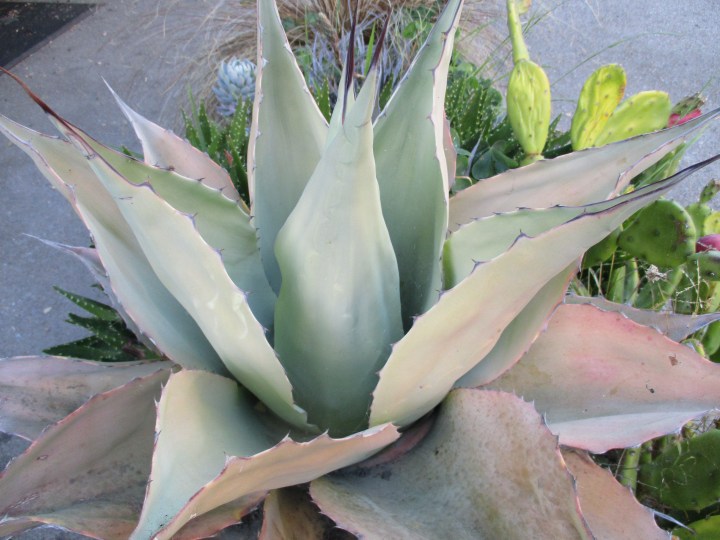
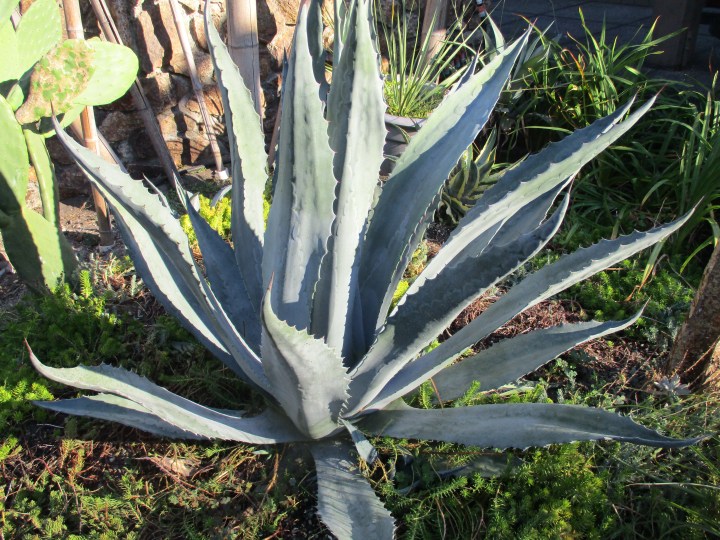
 In this situation, the point is that all those pointed tips of the leaves of this awkwardly floppy century plant, Agave americana, are extremely sharp, extremely rigid and EXTREMELY dangerous. Those shorter teeth on the margins of the leaves are just as sharp and rigid, and are curved inward to maximize injury to anyone trying to get away from an initial jab. With tips that impale, and marginal teeth that slash, this is one very hateful perennial!
Another point is that this big and awkwardly obtrusive century plant is on a patio at a Mexican restaurant. Yes, it is in a public place where people get dangerously close to it. On Friday and Saturday nights, this restaurant can get quite crowded. Some within such crowds are inebriated, so are more likely to stumble about and bump into things that are best avoided. Those concrete slabs to the left are benches where people are often seated.
The third point is that the only remedy for this ridiculously bad situation is to remove the century plant. Chopping the leaves like those that were over the bench on the left only removes a few tips and teeth, but does not make the rest of the foliage significantly safer. Nor does folding the leaves inward, like those that are next to those that were chopped. Such abuse only makes the whole mess uglier. Now it is both dangerous AND ugly.
Now, who thought that putting the most dangerous of all perennials available into this public situation was a good idea?! (Cacti with inward curving spines and other plants that are more dangerous are not even available in nurseries.) Century plants are dangerously nasty even when small and young, so even someone who knows nothing about landscape design should have known better than this!
 The dark bronze and variegated varieties of tree houseleek, Aeonium arboreum, are so much more popular than the simple species, that the simple species with plain green foliage is now rather rare. The succulent stems do not stand much more than three feet tall. They get about as broad, and can get even broader as lower stems develop roots and grow into new plants. The succulent rosettes of foliage of well watered plants can be fragile to handle. Mature plants can bloom in spring with unusual conical trusses of yellowish or chartreuse flowers.




 Immediately after the Loma Prieta Earthquake, nothing was open for business downtown on North Santa Cruz Avenue south of Bean Avenue. As buildings were inspected for safety and cleaned up, sections of cyclone fence that had kept everyone out were slowly and systematically moved out so that businesses on the east side could open for business. The same slow process was repeated on the west side, moving south from the corner at Bean Avenue, but did not get very far. The old Los Gatos Cinema, as well as the several other building between it and the seemingly destroyed old La Canada Building on the southern corner of the block, were too badly damaged for the fence to be removed.
 They sure took their time getting this far along. The bluish green succulent foliage of showy stonecrop, Hylotelephium spectabile, (formerly Sedum spectabile) first appeared at ground level in early spring, and has been growing into rounded mounds so slowly that it now stands less than three feet high and wide. Smaller types are half as big. Blooms are only now beginning to turn color.
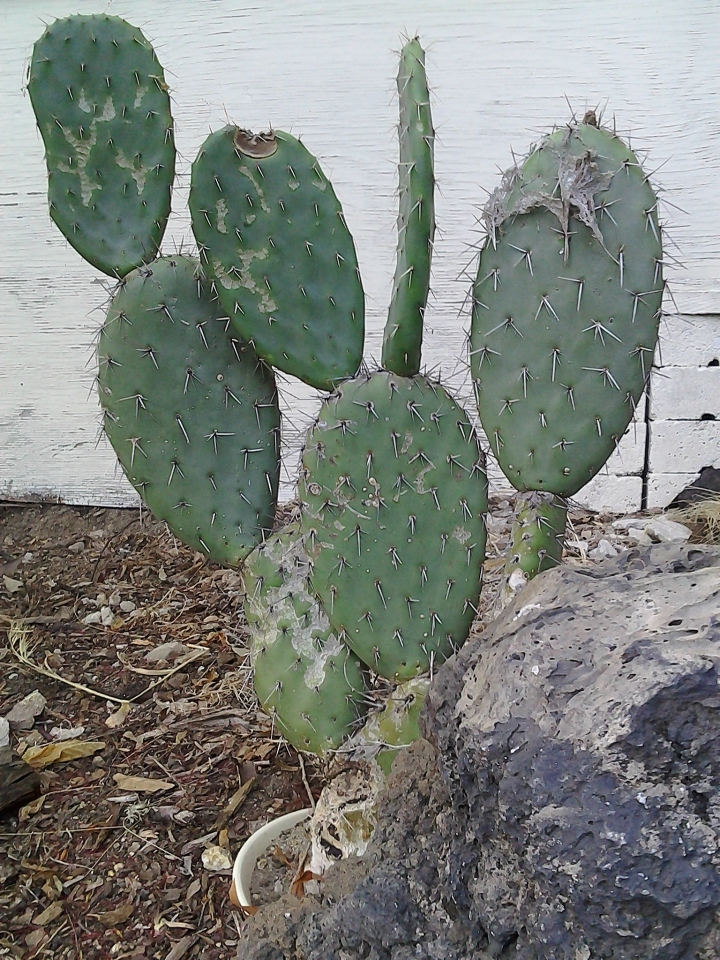 Almost everyone thinks of cacti as tough plants that live out in the hottest and driest parts of the deserts, where few other plants can survive. They are the sorts of plants that we threaten to plant out in the most inhospitable or neglected parts of the garden. We never actually do so, just because we do not appreciate cacti any more than weeds. They are fine over in the neighbor’s garden.
 Although a relatively small agave, the Queen Victoria agave, Agave victoriae-reginae, is also one of the most striking. Mature plants form dense foliar rosettes that are between only a foot, and a foot and a half tall and wide. What is so striking about them is the abundance of stout succulent leaves that can be so densely set that some older plants look like big, round and green pine cones.
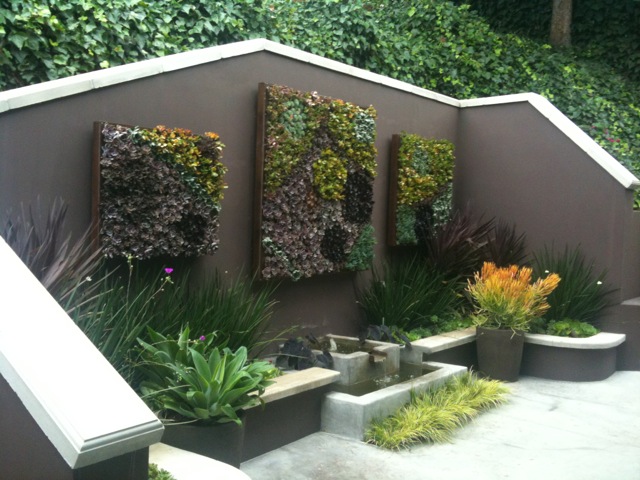 Succulent foliage is remarkably variable, even without bloom. There are so many unusual colors, textures and patterns to choose from. Many are complimentary to others. Many contrast exquisitely. What better way to display some of the favorites than to assemble them into a succulent foliar tapestry!?

 As a group, aloes really deserve more respect. Many will naturalize and thrive with only occasional watering through summer. Candelabra aloe, Aloe arborescens, wants a bit more water than most other aloes, but not much. It looks like a sensitive jungle plant, but is surprisingly durable, and very easy to propagate. Any pruning scraps can be plugged wherever new plants are desired.
