
The biggest, tallest and oldest trees in the World are all native to California. The biggest trees are the giant redwood, Sequoiadendron giganteum. The tallest trees are the coastal redwood, Sequoia sempervirens. The oldest trees are the bristlecone pines, Pinus longaeva. The biggest and the tallest are two of only three specie of redwood in the World, and except for a few coastal redwood that live barely north of the Oregon border, both are endemic only to California. Most of us know that the coastal redwood is the state tree of California. However, some believe that California is the only state with two state trees, which are the two native specie of redwood.
This gives arborists from California serious bragging rights.
Most of the arborists whom I work with are very familiar with the coastal redwood. Not only is it the most prominent tree in the Santa Cruz Mountains, but it is also a common tree in landscapes of the Santa Clara Valley.
The other two specie are not nearly so common. Neither perform well in landscape situations, and certainly not locally. Even if they did, the giant redwood gets much too bulky to fit into urban landscapes, and the bristlecone pine is a bit too irregular for refined landscapes. Because they both live in somewhat remote regions within California, some very experienced arborists have never seen either of them in the wild. Of course, it is not something we talk about much.
I still have not seen bristlecone pine in the wild. The only specimens I have ever seen were bonsai stock that had not yet been cultivated as bonsai specimens.
In the late 1990s, I had not seen giant redwood in the wild either. I had only seen the unhappy specimens that were planted on the sides of roads between San Jose and nearby towns during the Victorian Period before the urban landscape had become so inhospitable to them. One of my respected colleagues who had seen many of the more interesting trees of California in his travels had not seen them either.
Fortunately, it was nothing that a good old fashioned road trip could not fix. Without much planning at all, we drove out to Sequoia National Park and met with the General Sherman Tree. There was too much snow to get very far, so we did not get similarly acquainted with the General Grant Tree farther up the road. It was one of the most compelling horticultural trips of my lifetime, right up there with going to see the native California fan palm, Washingtonia filifera, outside of Palm Springs, or the Joshua tree, Yucca brevifolia, outside of Palmdale. I know that the picture above is not a good picture of my colleague with the General Sherman Tree. It is from a time when cameras still used film. Getting pictures transferred to a compact disc was merely an option back then. The sepia toned picture below is even older, but it is not mine.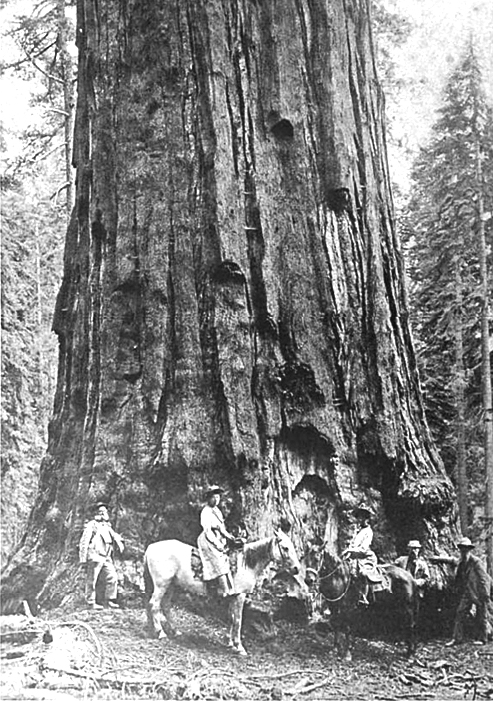
 If it has bark like a coastal redwood, and foliage like a coastal redwood, and a slender conical structure like a coastal redwood, it is most likely a coastal redwood. If it turns orangish brown in autumn and defoliates through winter, it is the much less common dawn redwood, Metasequoia glyptostroboides. It is one of only a few distinctive genera of coniferous trees that are deciduous.
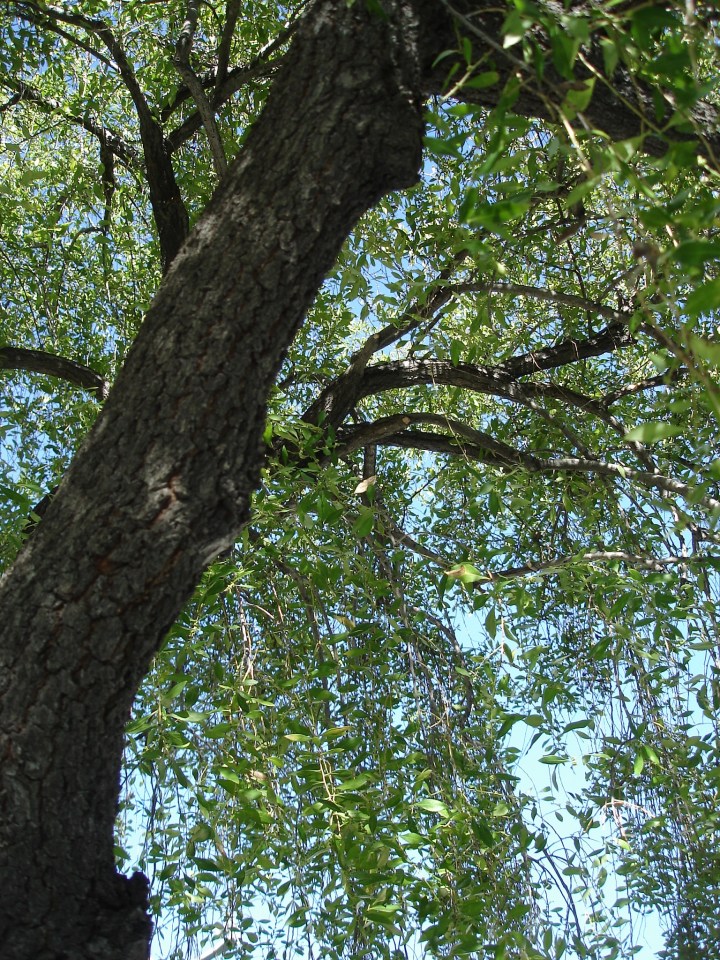 Many of our trees live at our homes longer than we do. Some of our trees were there before we got there. Some of the trees we plant will be there for whomever comes along after we are gone. Trees very often evolve into something very different from what they were intended to be. Nonetheless, since they are the most significant features of our gardens, trees must be selected carefully.
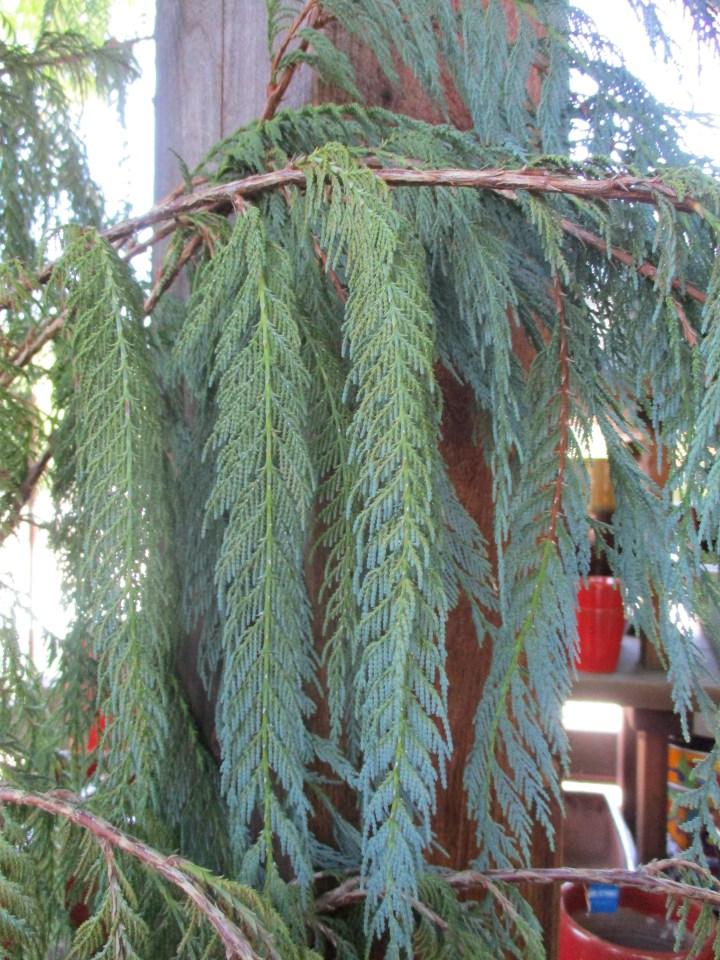 Plants are usually well suited to the climates that they are native to. Glaucous (slightly reflective grayish) foliage is more common in harsh climates where darker green foliage might get cooked by the sun. Pendulous growth is more common among plants that want to shed heavy snow efficiently. Kashmir cypress, Cupressus cashmeriana, has both, but is from a tropical monsoonal climate.
 This rant may not go in the direction you expect it to. The pictures suggest that this would be about the bad vegetation management crews who severely disfigure trees that get too close to utility cables. It is not.
 This brief article from a few days ago discusses a few more details about easements.
 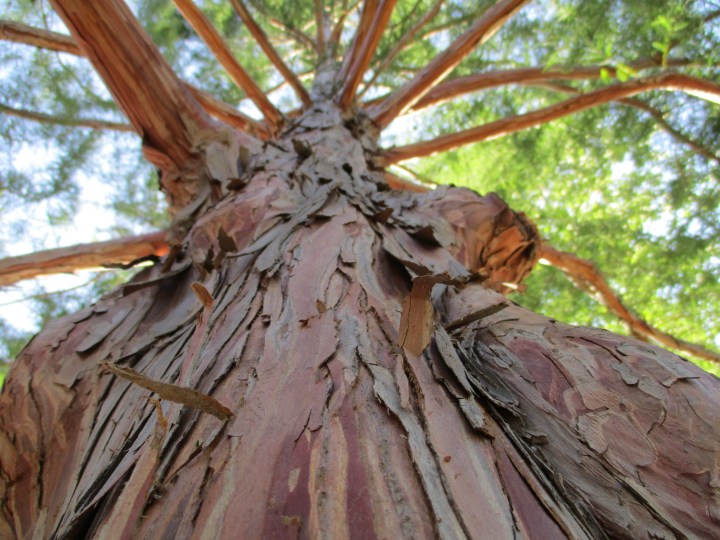 When a plant that should be compact or shrubby gets too lanky with exposed lower stems, it is described as ‘leggy’. We do not hear much about plants that develop ‘knees’. Perhaps that is because there is only one species that does so. That one species happens to be very rare here. If there are other specie that develop knees, I do not know what they are.
 Like Michael Jackson said, “You got an easement on down the road.”. . . or something like that. In older neighborhoods, that is where the utility easements are usually located. These are zones for utility poles that suspend electrical, telephone and television cables. When electricity first became available, that was the easiest place to put the cables, and the practice continued for decades.
 Coppiced trees and shrubs are just like pollarded trees, but without the trunk and main limbs. Instead of getting cut back to the same distended knuckles at the ends of disproportionately stout limbs, they get cut back to the same stump just above grade over winter. Some get coppiced annually. Others get coppiced only when they get too big. The coppiced California sycamore in this picture may never get coppiced again.
 Before I continue, I should mention that I have worked for some of the BEST horticultural professionals in the entire Universe! Seriously! I have worked for the single most excellent nurseryman EVER, and not one, but a FEW of the most excellent arborists EVER! YES, I am bragging! I can write about some of them another time.
 This sort of weather pattern does not happen very often. Late spring is normally pleasantly warm, and the weather gets progressively warmer through summer, which typically includes a few unpleasantly warm days. It rarely gets too hot here, and when it does, it does not last for more than a few days, and tends to cool off at least somewhat at night. The air is normally arid. Humidity is uncommon in a chaparral climate.


