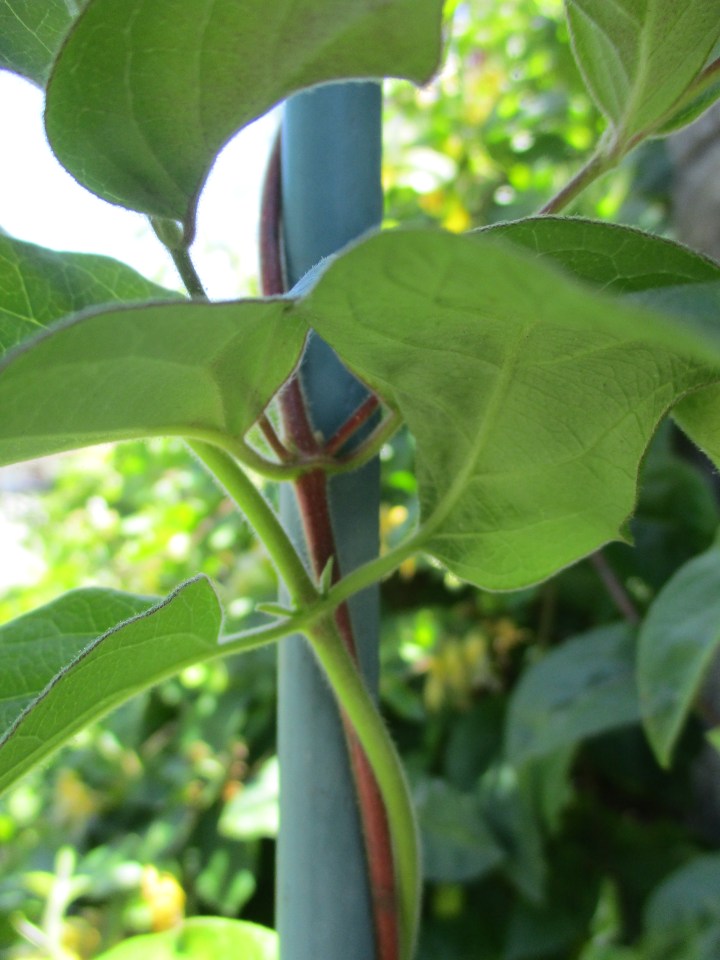
 Vines in the wild are downright exploitative. They do not support their own weight, so instead climb or sprawl over shrubbery and trees. Some are satisfied staying down below the canopy of the hosts who support them, as if aware that a healthy host will support them for a good long time. Many vines climb aggressively to the top and overwhelm their hosts, even if it eventually kills them.
There is nothing civil about the technique of the strangler figs, which incidentally includes two popular houseplants, fiddle-leaf fig (Ficus lyrata) and creeping fig (Ficus pumila). They wrap their hosts in networks of stems and roots that strangle the hosts as both the hosts and the clinging vines grow and expand. As the hosts die and rot, the vines develops into self supporting tree trunks.
That is how fiddle-leaf fig, as it is known as a houseplant, grows as a free standing tree rather than as a creeping vine. It is grown from cuttings from the self supporting adult growth rather than the creeping juvenile growth. Conversely, creeping fig is grown from juvenile vines, which find a support to cling to, and ultimately develop shrubby adult growth when they get to the top of the support.
English and Algerian ivies are not quite as aggressive, since they do not intend to kill their hosts. They are not often intentionally grown as vines, and are almost never planted anymore, but their juvenile growth still works as ground cover in many mature landscapes. One of the main problems with ivy is that it is constantly trying to climb walls and trees so that it can bloom and toss seed.
That is not such a problem on concrete walls, but ruins wooden and painted surfaces, and makes a mess of trees. Boston ivy (which is not really an ivy) lacks a juvenile ‘ground cover’ phase, but if kept off of painted and wooden surfaces, happens to work better on concrete infrastructures. It is important to know how a particular vine will behave before selecting it for a particular application.
Carolina jessamine, mandevilla, lilac vine and star jasmine are a few complaisant vines.
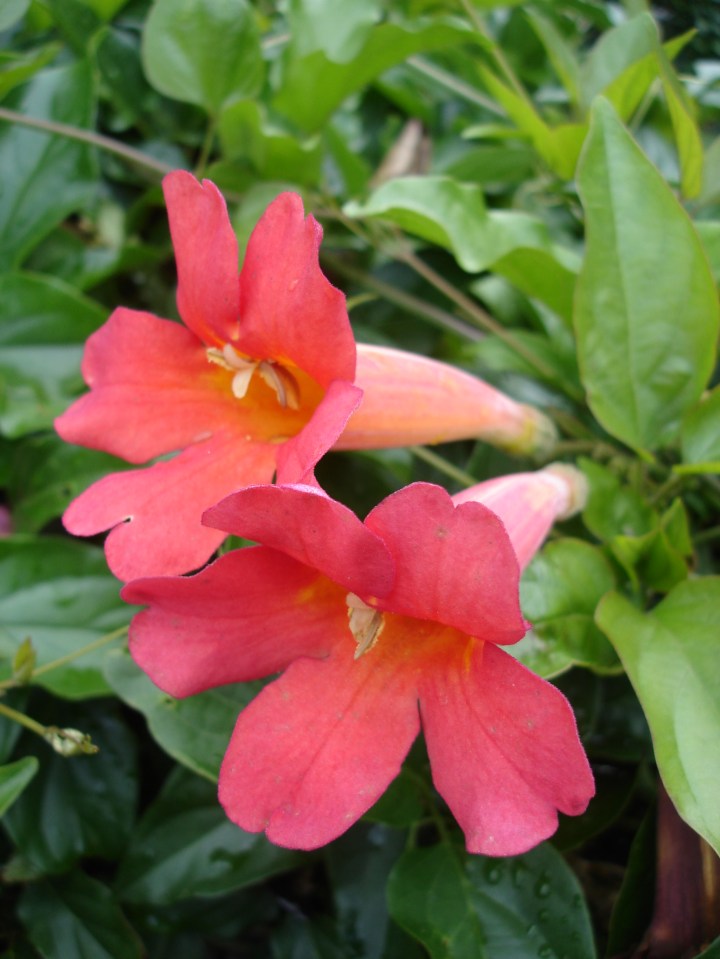 Red trumpet vine, Distictis buccinatoria, is more green than red. The tubular orangish red flowers with yellow throats are pretty while weather is warm, but not too abundant. Slightly distressed plants tend to bloom more abundantly. Each evergreen compound leaf is a pair of leaflets with a sneaky central tendril that will grab onto anything while holdfast discs get a more permanent grip.
 If more of us knew how vines compete in the wild, fewer of us would grow them in our home gardens. Understory plants that are satisfied with the sunlight that reaches them through a higher forest canopy are the most passive. Taller trees compete for sunnier exposure above. Vines are the most aggressive as they climb and overwhelm trees to get the best exposure on top of everything.
 English ivy, Hedera helix, is probably the nastiest and most aggressively invasive exotic species that I work with. It climbs high into redwood trees and overwhelms understory plants (that live below the trees). It invades many of the landscapes, and worst of all, it climbs building where it ruins paint and causes rot. It grows faster than we can keep up with it.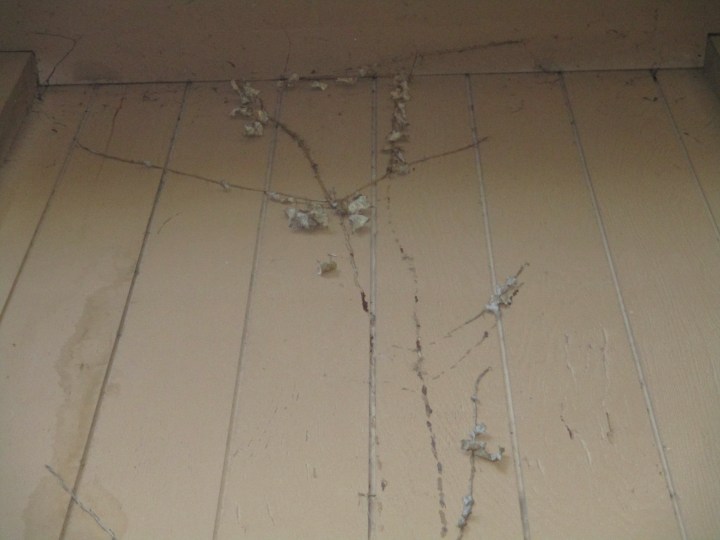
 This is a recycled picture that still annoys me. There was another that I did not want to use because it happens to be from a landscape that I sometimes work in.
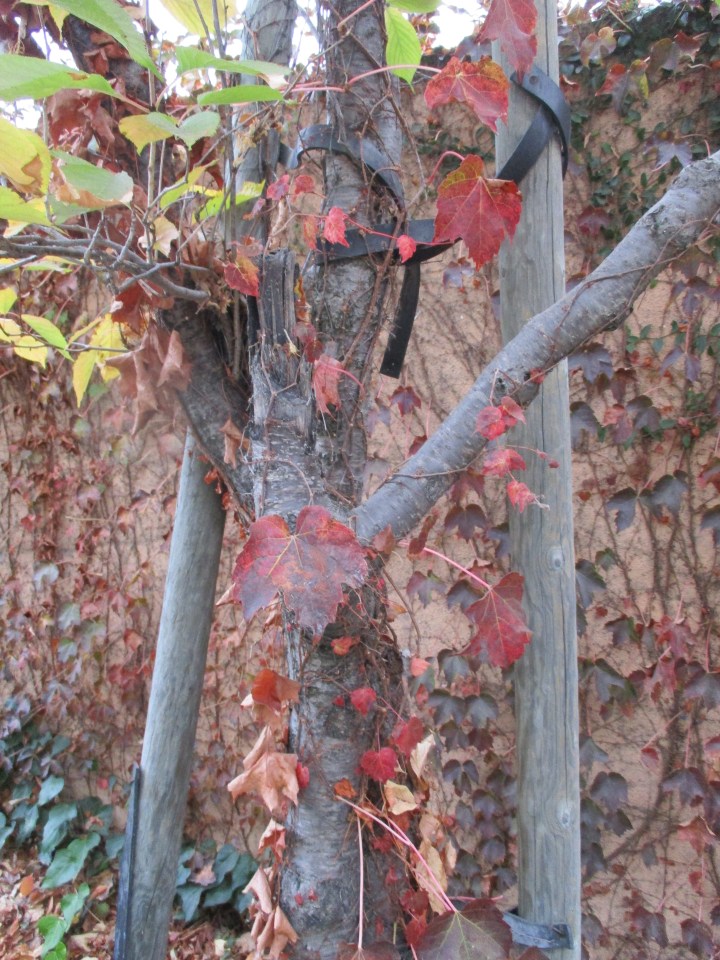
 Boston ivy is not really ivy at all; but is more closely related to grape. Along with creeping fig, it is one of the two best vines for freeway sound-walls. It protects the walls from graffiti and muffles sound. Unlike creeping fig, which is evergreen, Boston ivy is surprisingly colorful through autumn. Unfortunately, it clings to whatever it climbs with holdfast discs, so ruins paint, stucco, and any other surface it gets a hold of.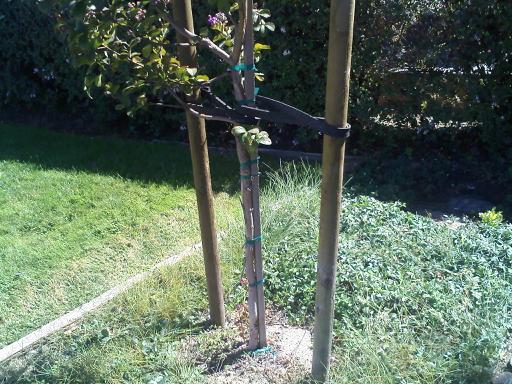
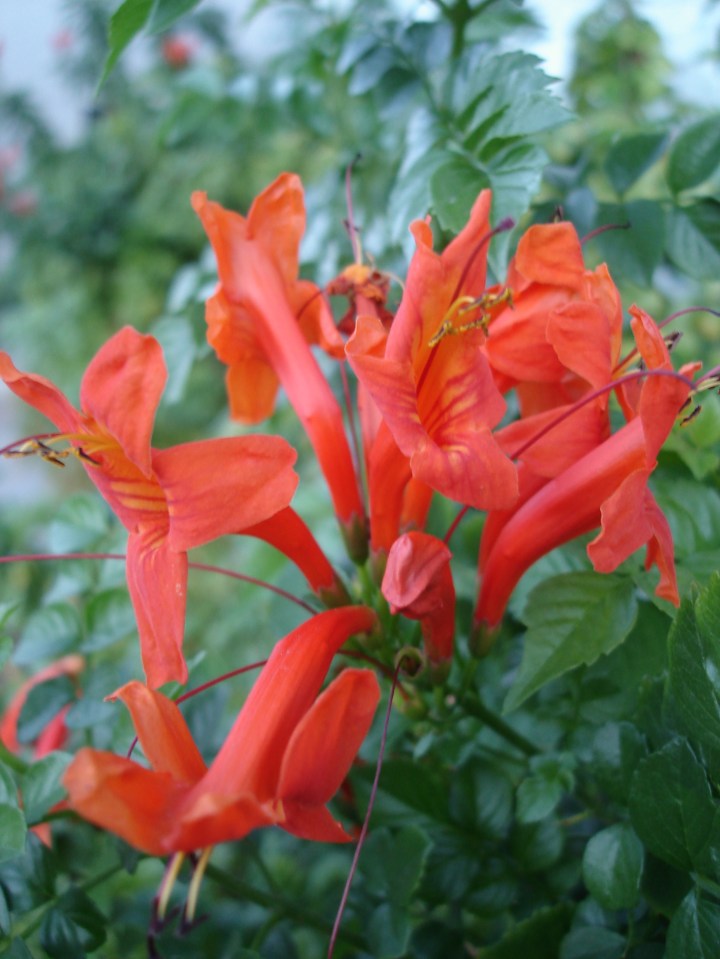 It may not bloom profusely, but cape honeysuckle, Tecoma capensis, blooms sporadically at random times throughout the year, and often while not much else is blooming. The bright reddish orange flowers contrast nicely against glossy evergreen foliage. Some blooms are slightly more reddish, while others are slightly more orangeish. A somewhat more compact cultivar blooms with light yellow flowers.
 If shade trees are the ceilings, and hedges and shrubbery are the walls, then turf and other groundcover plants are the floors of some of our outdoor living spaces. Except for turf grasses, most groundcovers are not as useful as hardscapes like pavement and decking, but they perform other functions in areas that do not get such use. Groundcovers inhibit weeds, erosion, dust and mud.
 Pink, red or white are the only choices. There happens to be a darker shade of red. Yellow throats are more conspicuous in white flowers. Otherwise, there is not much variation of color amongst the various mandevillas. The flowers are very similar in both color and form to those of related oleander, but are larger. Some are as wide as three inches. Small flowers can have pointed petals.
 Tony Tomeo