Electric Snow

P81230It was one of the more common types of snow in the Santa Clara Valley in the early 1970s.
In school, we made paper snow by folding paper squares in half and then into thirds (so that they were folded into sixths), and then cutting notches and slices out of them. They unfolded into the prettiest and laciest snowflakes!
In Westgate Mall, snow was blown by small fans about the new models of Singer sewing machines that were magically suspended in big acrylic spheres. We children could not get into the spheres, so were left wondering if the snow within was as cold and wet as we were told it was, and why it was necessary to demonstrate that the new sewing machines were resistant to weather. Our mother did her sewing inside.
We sort of suspected that the snow around the Nativity at Saint Thomas of Canterbury and other local parishes might be artificial because it looked like the stuffing of a pillow, which is something that all children seem to be familiar with. We said nothing about it, just in case our parents were not aware of the potential deception. However, it was rather disturbing to see so much of the same sort of snow at Christmas in the Park in San Jose. At that point, we accepted that either it must be genuine, or that we were committed to just going along with it.
Snow that was sprayed onto Christmas trees was rather interesting. It was neither wet nor cold, and sometimes it wasn’t even white. It could be pastel blue or pink, and was often sparkly with glitter! Wow!
Off in the distance, we could see snow on top of Mount Hamilton. Sometimes it was just on top. Sometimes, it was spread out from left to right, along the ridge. On rare occasion, snow appeared on the ridge of the East Hills, in front of the Diablo Range that Mount Hamilton is part of. We never saw who was up there folding and cutting all that snow, but they must have been VERY busy!
Snow on top of the Santa Cruz Mountains, right behind our part of the Santa Clara Valley, was closer to home, but did not look like much. The greenish blue of the forest was just a lighter hue of blue, with more mottling. It was exciting anyway.
Then, on February 5 in 1976, it actually SNOWED on the floor of the Santa Clara Valley!
It really was as awesome as snow was supposed to be. It was cold. It was wet. It was white. It was fun to wad up and throw at each other. It accumulated just like it would in a blizzard, and got almost an inch deep!
. . . but . . . was it really SNOW?P81230+

Windows Of Heaven

P81229KOr . . . a close encounter of the third kind. Let’s just go with the former rather than the latter.

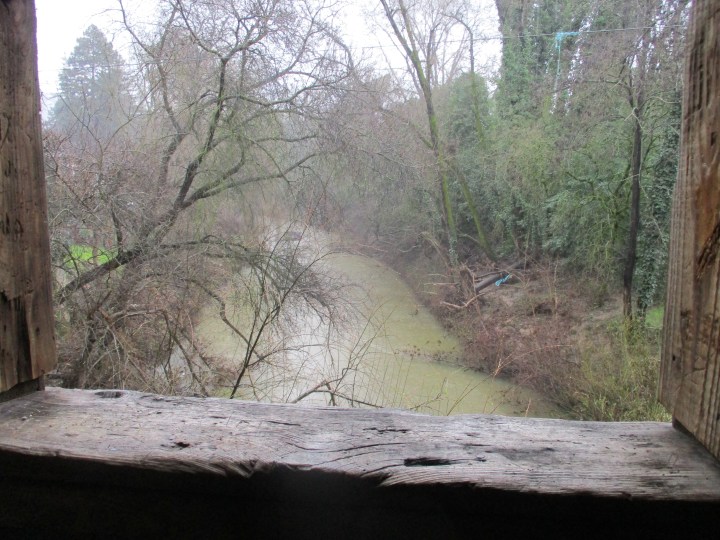
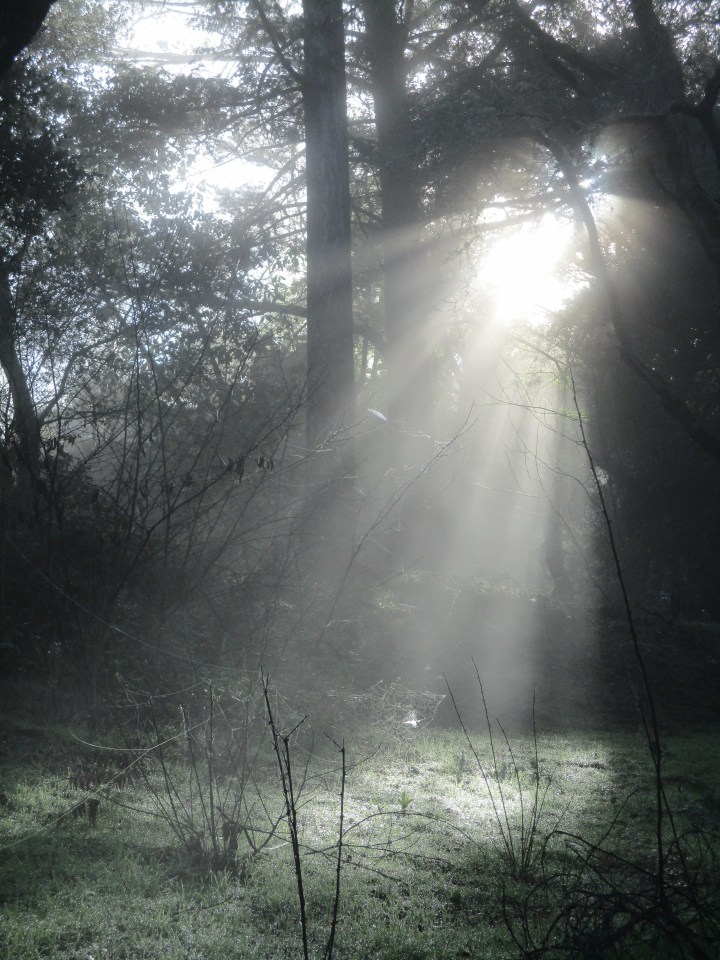
I am no photographer. The pictures that I post are merely illustrations for articles from my gardening column, and other articles. This picture just happened to make itself available while I was getting the first of the six pictures of the earlier ‘Six on Saturday’ post. The location is nothing special. It is not really out in the forest like it seems to be. A lodge building of six suites is directly to the left. A big ‘housekeeping’ building is to the right. There is a road in the background above, as well as below, from where the picture was taken.

Even the flora in uninteresting. The most prominent straight trunk in the middle is that of a young Douglas fir. The slightly leaning trunk with upward reaching branches to the right is some sort of cypress. There are a few nice small coast live oaks to the left. Most of the other trees to the right are black locusts that I really should cut down. The small shoots in the foreground are watersprounts from black oak saplings that were already cut down. There are some California bay trees in there somewhere, probably off in the background to the very far left.

The deteriorated colony of oak root rot fungus, Armillaria mellea, that was described too graphically in the earlier post was located in the foreground of the lodge building to the left. https://tonytomeo.com/2018/12/02/the-humongous-fungus-among-us/ . There was not much left of it then, so there would be even less now. . . fortunately.

Well, isn’t this way more information than necessary? I should have left this (too artistic for my ability) picture with just the title.

Winter

P80110We are now two days into it. Is it any different than three days ago, the last day of autumn? Not really. Even in harsher climates, the changes from one season to the next are gradual. Like the phases of the moon, the seasons are constantly phasing out of the previous, and into the next. The dates of the first and last days of each season, which are determined by the position of the Earth within its orbit around the sun, are technicalities.
Seasons in the Southern Hemisphere are of course opposite of what they are here. That seems odd to me. The calendar is the same there as here. It seems obvious to me that winter and all seasons should be determined by the same dates there that they are determined by here. If winter began last Friday here, it should have done the same there, on the the same date. Longer days and warmer weather are consequences of location, south of the Equator. It is hard to imagine that January and February are summer there.
It also seems odd to me that all maps are oriented with North directed towards the top. Shouldn’t South be at the top South of the Equator? Must Australia be the ‘land down under’ to those who live there? Things would be so much simpler if Columbus has just stayed home, and the World was still flat.
Anyway, we do not get much winter here. The weather gets a bit cooler, and we will eventually get more rain. When I went to Oklahoma six years ago, I thought that I would finally get to experience a real winter, but we left just before New Year’s Day, while the weather was still somewhat mild. This little bit of snow was about all we got.

Red Sky At Morning

81222K.JPGRed sky at morning; sailor take warning. Stormy weather is to be expected.
Back before modern meteorology, there were all sorts of ways to predict the weather. Some of the ways to know what to expect in the short term were obvious, such as simply observing what was happening off in the distance in the direction from which the weather comes. For the experienced, it is easy enough to feel changes in humidity and temperature in an incoming breeze.
Halos around the moon or sun, as well as the color of the sky at sunrise, provided a bit of insight about what could be expected a bit farther out than the short term. Some techniques were not always accurate, and some were not accurate at all.
Flora and fauna are better at predicting the weather than we are. Horses, dogs and cats get extra fluffy if they expect the winter weather to be colder than it normally is, and they shed early if they expect an unusually warm summer. Sycamore trees are so responsive to the weather that what they are saying about it is not always obvious. Are they browning and defoliating just because the weather got too hot and arid late in summer, or because autumn is going to be extra cool? Experts could tell, but because of modern meteorology, there are not many experts left here.
This red sky over Mount Hermon occurred at sunrise last Sunday, just prior to the storm that finished early Monday morning, and provide picture #6 for my earlier Six on Saturday post. I tried to avoid the streetlamp at the bottom of the right edge. I did not see the bird when I took the picture. The tree to the left is a golden honeylocust.

Six on Saturday: Rain On My Parade


Actually, this rain ‘is’ the parade. In parts of California, we do not get much of it, so when rain happens, it is worth celebrating. Although this side of the Santa Cruz Mountains gets significantly more rainfall than the chaparral on the other side in the Santa Clara Valley, there are not many more rainy days here. What that means is that when it rains here, it does so with more volume than in the Santa Clara Valley.

Rain is not easy to get pictures of. The first four picture just show water from one of our first major storms of the season. The fifth pictures does not even show that much. The sixth picture is from the most recent storm that came through Sunday night and finished on Monday morning.

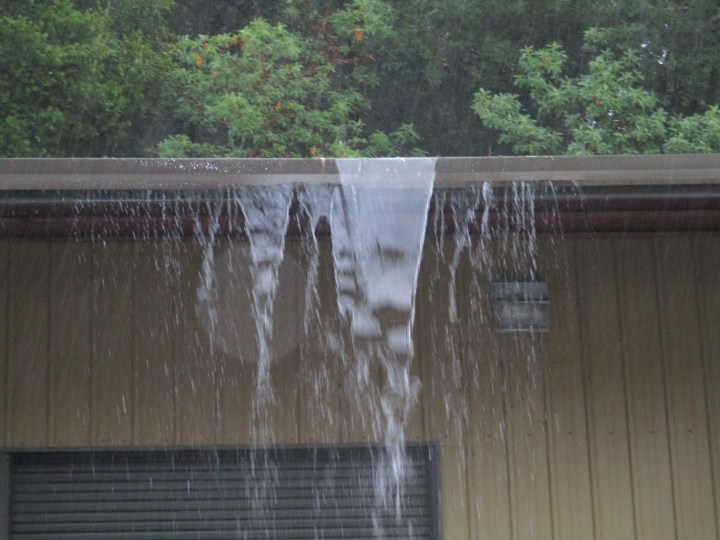
1. This waterfall was flowing both through and over the deteriorated and also clogged gutter on the roof of the shop building across the driveway from the gardening shop at work. The gutter is so deteriorated that I would have expected all of the water to just flow through it. Incidentally, the big roll-up door to the lower left of the picture happens to be that of the plumbing shop.P81222

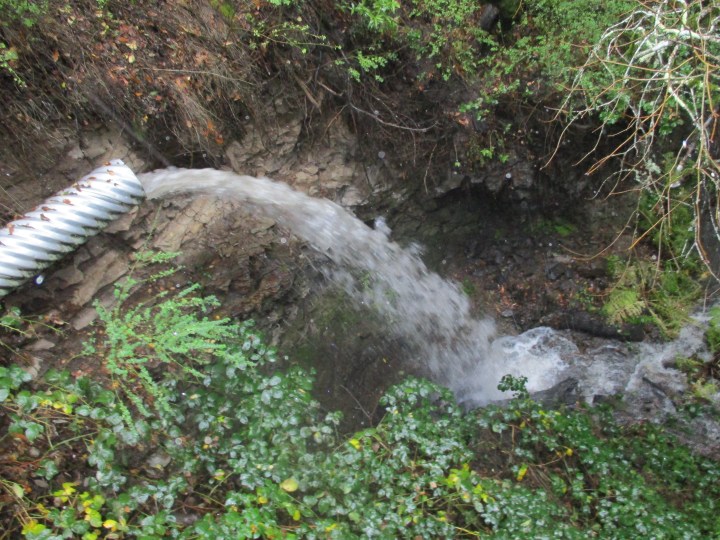
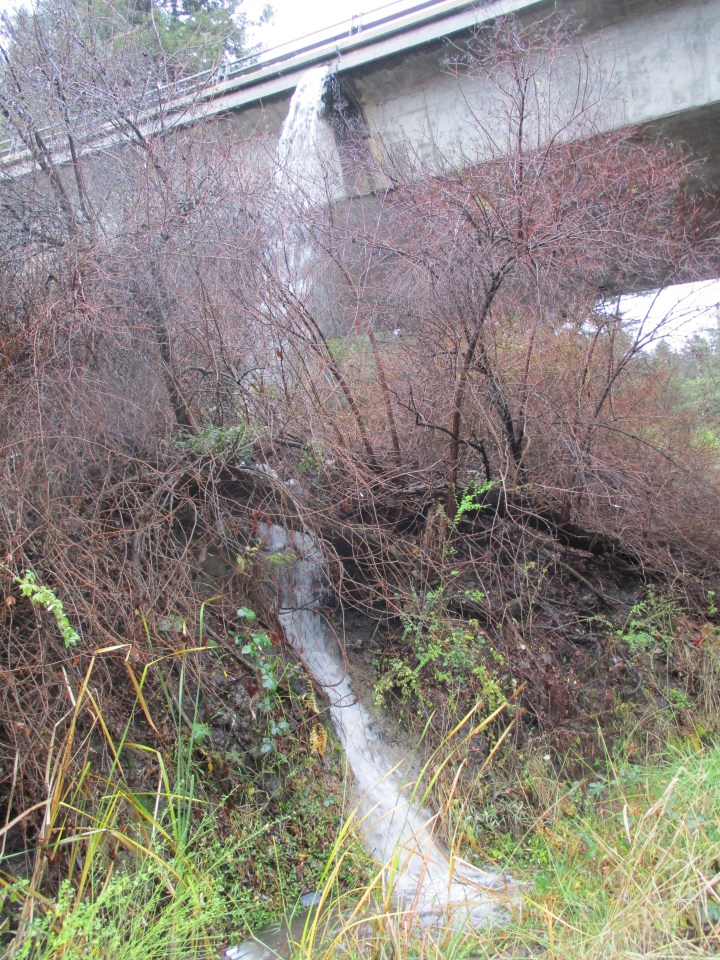
2. This waterfall was flowing through a storm drain on the Mount Hermon Road bridge over Zayante Creek, East Zayante Road, and the railroad tracks in between them.. This section of Mount Hermon Road is known to some as ‘the Bypass’ because it bypassed the older Conference Drive in picture #5. What is not visible in this picture is that the upper part of the waterfall lands in the ditch on the side of East Zayante Road below. It might have seemed like a good idea when the bridge was built, but so much water falls from so high up that it erodes the ditch, and splatters gravel onto cars driving by. The lower part of the waterfall flows into a ditch on the edge of the railroad tracks, and then under the tracks towards picture #3 below.P81222+

3. This waterfall was flowing out into Zayante Creek from a culvert just downhill from the culvert under the railroad tracks mentioned in #2 above. It is the same water that was falling from the Mount Hermon Road bridge.P81222++

4. These two waterfalls were flowing from the roofs of the local supermarket and adjacent drug store and pharmacy, and onto the newsstand below. What is disturbing about this picture is these drains are merely back up drains that do not allow the flat roofs surrounded by parapet walls to fill with too much water if the main drains get clogged. The main drains are likely at the rear of the building where they can drain discretely and out of the way. These back up drains are on the front of the building so that they get noticed if they start to flow. All this water flowing out of them indicates that the main drains are clogged, and that the roofs are flooded.P81222+++

5. This is the Conference Drive bridge over Zayante Creek, East Zayante Road, and the railroad tracks in between them. It is the bridge that was bypassed by the Mount Hermon Road bridge in picture #2. The big greenwaste pile where I dump debris from the landscapes is directly below the southern edge of this bridge, which is to the left in this picture. You can not see it in this picture that was taken before the rain started, but a bit of water drains from this bridge onto the greenwaste pile. It is not much, but it is enough to be a bother when I am unloading debris in the rain. It falls from so high up, that even if I am avoiding the spot where the falling water lands, the wind can blow it all over me. From that height, any bit of road gravel that falls with it can give me quite a sting.P81222++++

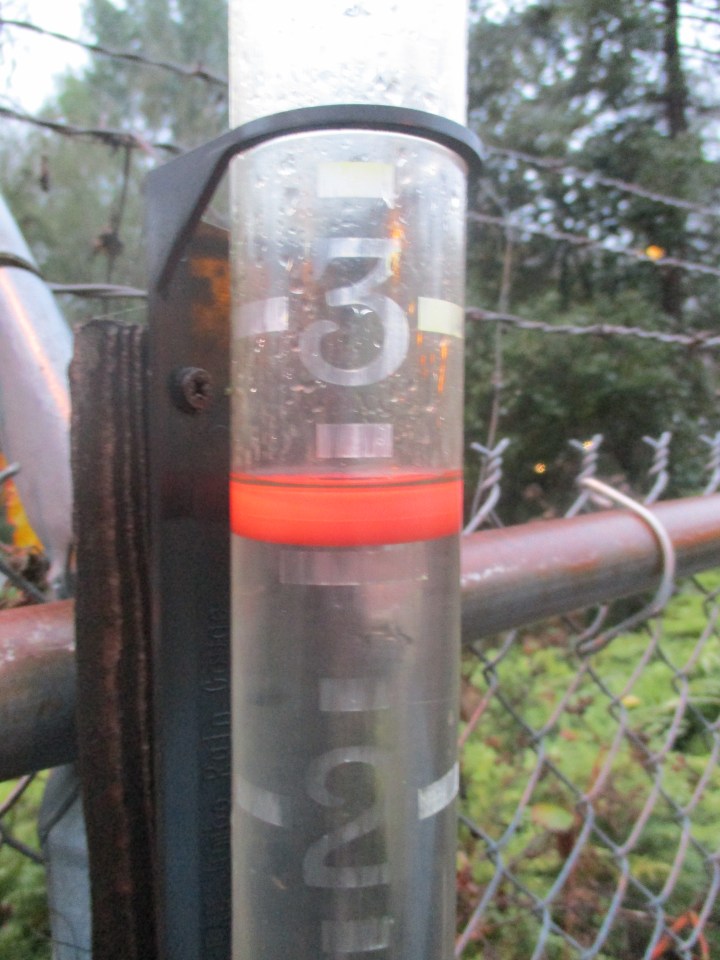
6. The most recent storm finished early Monday morning, after dropping two and a half inches of rain.P81222+++++

This is the link for Six on Saturday, for anyone else who would like to participate:

https://thepropagatorblog.wordpress.com/2017/09/18/six-on-saturday-a-participant-guide/

Frost

P81125We do not get much frost here. This picture of the view through the windshield of one of the work vehicles was taken more than a week ago, while the humidity and the temperatures were still quite low. The sparse and angular pattern of the frost on the windshield is a result of the minimal humidity. There will be more frost later in winter, although there will not be nearly as much as most other climates get.
After a cool Monday morning last week, the weather got a bit warmer, or really just less cool. Rain started about midnight between Tuesday and Wednesday, and continued through the day and into the night. More rain is predicted to start after noon next Tuesday, and continue through Thursday. There will be no frost during this weather pattern. Frost happens here only between rainy weather. One might think that since we do not get much rain, there would be plenty of time in between for frost. Really though, much of our winter weather is simply quite pleasant, neither rainy nor frosty.
As appealing as this might be to those in harsher climates, it has certain disadvantages.
So far, there was just enough chill to start defoliation of the black locusts and box elders in the background of the picture, and just enough rain to almost finish it. Trees that need more of a chill to start this process are not so impressed with the weather. Many of the crape myrtles have not even started to color yet. Cottonwoods are starting to defoliate, but are doing so while still only dingy greenish yellow because they did not get enough chill for better color.
Spring bulbs that got planted earlier or are being planted about now will bloom next spring because they were so optimal and primed to do so before they were planted. However, many will not get enough chill in their second winter to bloom again. Consequently, many of the bulbs that would be perennial in other climates are grown as expensive annuals here. Likewise, seed of certain specie that self sow may not get enough chill through winter to germinate next spring.
So again, what is comfortable for us is not so ideal for everything in the garden.

FINALLY! We have RAIN!

P80103+For those who do not remember what ‘rain’ is, it is, it is those odd drops of water that fall so mysteriously from the sky in other regions. We get it here too, just very rarely, and almost exclusively within a limited season centered around winter. Rain tends to be affiliated with storms. The last storm moved through here last spring.
Rain may not be much to look at, and is nearly impossible to get a picture of, but it adds up to become a very important commodity known as ‘water’. Some believe that California does not have enough water. We natives know that there is actually plenty of water, but merely too many people in need of it, and a few of those many who capitalize on that need. Anyway, I did not even try to get a picture of the rain that is falling so nicely now, but recycled this old picture of a small volume of water in what is known as a puddle, which is merely an accumulation of water within a low spot on a flat surface.
As unpleasant as rain is to work in, we are very pleased to get it. The sky is rinsed of smoke, and despite the unpleasant news that rain will interfere with searching for remains of those killed by the Camp Fire, there is also the excellent news that the rain is falling over a large area, and making forests significantly less combustible. The formerly crispy forest is again lush and damp and sloppy. What had been a Dust Bowl down where we dump greenwaste is now an epic mud pit! Everyone here is delaying other work to clear drains on roads and roofs. The first storm of the season is always something to celebrate.

Neither Here Nor There

P81103KIs it coming or going? Autumn that is. It normally gets here last. We are typically only beginning to see the first foliar color of autumn while other parts of America get their first snow. We typically get a few more tomatoes out of our vegetable gardens long after most everyone else has pulled out their frosted tomato plants.
Well, we still got it. Tomatoes that is. The plant that produces these bright orange cherry tomatoes is looking a bit tired and pale, but the tomatoes are as good as ever. It probably will not last until frost. The plant might get pulled out when the tomatoes run out. Without bloom, that could be pretty soon. Frost does not happen until well into winter. Regardless, tired tomato plants say that autumn is coming.
We got foliar color too. This Japanese maple turned this nice garnet red quite some time ago. Sweetgum trees all over town are also well colored. They seem to be ahead of schedule, as if winter is on the way. Defoliating black oak trees say that autumn is going.
While the days are still pleasantly warm, with temperatures into the 80s, the nights get cool enough to color deciduous foliage. Warm days are quite normal for this time of year. So are cool nights. However, the two typically do not happen together for more than a few days. Warm days typically alternate with mild nights. Cool nights typically alternate with cool days.
Well, even in our mild climate, the weather is always full of surprises. We will enjoy it while it lasts. Autumn has always been a mere in-between season anyway. In the chaparral and desert climates of California, winter and the rain that comes with it will be welcome when they arrive.P81103K+

No Rain

P81006KFor the first time since last winter, a few raindrops were heard on the roof early last Monday morning. It was over by the time I realized that the odd and unfamiliar noise really was that of raindrops. By the time the sun came up, everything was dry. I do not even know if these few raindrops could be considered to be the first rain of the season. There were a few similar raindrops on my windshield a while back, but they were dismissed as such; merely a few random raindrops rather than a confirmed rain shower.
That is how our climate works here. The Santa Clara Valley is in a chaparral climate. Much of Southern California is in a desert climate. We do not get much rain, and it is almost exclusive to a limited rainy season that is centered around winter.
Dust and crud that accumulates on foliage through the long dry season tends to stay there until the rain rinses it away. Oddly, many native plants do not mind, and a few seem to appreciate it. Some have tomentum (fuzz) on their leaves that collects dust, particularly during the warmest and driest summer weather when foliage is most sensitive to desiccation and scorch. Others have sticky foliage that does the same. However, such foliage is remarkably efficient at allowing such crud to rinse away in the first rain. Both deciduous foliage that will be shed shortly after the rainy season starts, and evergreen foliage that will be replaced through winter, seem to prefer to start the rainy season clean. Is this just coincidental, or do the plants intentionally collect dust and crud to shade and insulate their foliage through the harshest summer weather, and then wash up for a good sunning at the last minute?

Indian Summer Is The Norm

70920thumbThe popular definition of ‘Indian summer’ suggests that it is unseasonably warm and dry weather in spring or autumn, and that it typically happens after frost. Well, that definition just does not work here. It makes about as much sense as our so-called drought, which is actually the normal weather for our chaparral climate. Weather that repeats annually is neither unseasonable nor abnormal.

There are certainly years with more or less rain, and years with warmer or cooler weather in late summer and early autumn. Weather is naturally variable. It does not work like the thermostats in our homes, or the automated irrigation systems in our gardens. It is impossible to predict precisely how this summer will end, but it will likely have some characteristics of a normal Indian summer.

The one characteristic of the popular definition of Indian summer that will be notably absent is frost. That will not happen until after autumn. Locally, Indian summer can either be what seems to be a continuation of summer weather, or a resumption of warm summery weather after a bit of cooler weather. The main difference from earlier warm weather is that the nights are significantly cooler.

That is more important than it sounds. We do not notice the cooler nights as much as the plants that are outside all night do. While the days are as warm as they had been, some deciduous plants will begin to defoliate. Eventually, those that get colorful in autumn will begin to do so. Roses can be fertilized one last time, but even as they continue to bloom, they should not be fertilized again.

Indian summer prolongs the summer growing season significantly, but also has the potential to interfere with the winter growing season. Warm days keep warm season vegetables and flowering annuals performing so nicely that we do not want to remove them to relinquish their space for the cool season plants that will be needing it soon! In other climates, frost ends the summer season for us, and necessitates the transition to cool season crops. Indian summer can be too much of a good thing.