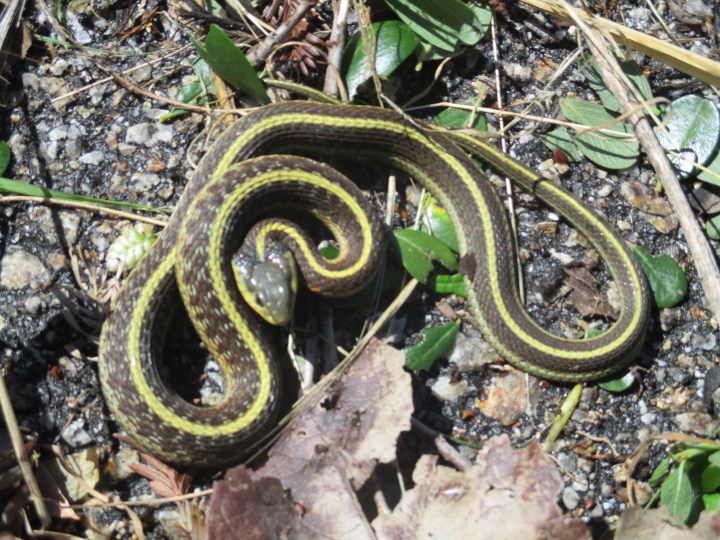
 This little critter surprised me at work last week. Even though I knew it to be harmless, my instinctual response was to get away from it fast. I have encountered enough rattlesnakes to know better than to take the time to identify a snake before getting some distance from it. Even after identifying a snake as a harmless garter snake, I still prefer to avoid it as it leaves. This one was in no hurry, so got picked up with a rake and set safely aside.
Between high school and college, I took a summer job for a (primarily) retail nursery in Miramar on the coast of San Mateo County. At this job, I sometime went with the maintenance crew to work in a few home gardens. At one such job, just overlooking the beach in Montara, I needed to mow an overgrown lawn. Rather than mow back and forth from the upper edge to the lower, I mowed a concentric pattern inward from the outer edge.
What that meant was that I mowed the edge first, and then just inside the freshly mown edge, and then just inside that second track, and so on, with the intention of finishing at the center of the lawn. What I did not consider was that this technique concentrated the several garter snakes that happened to be on the lawn at the time into the diminishing unmown center. Needless to say, I needed to stop mowing while I chased them off with a stick.
What I also neglected to consider during my Indiana Jones experience was that these were no ordinary garter snakes. They were the more colorful and endangered San Francisco garter snake. I remember their extra pair of red stripes on top. Supposedly, they also had an extra pair of blue stripes underneath. I did not get close enough to notice.
Banana Slug
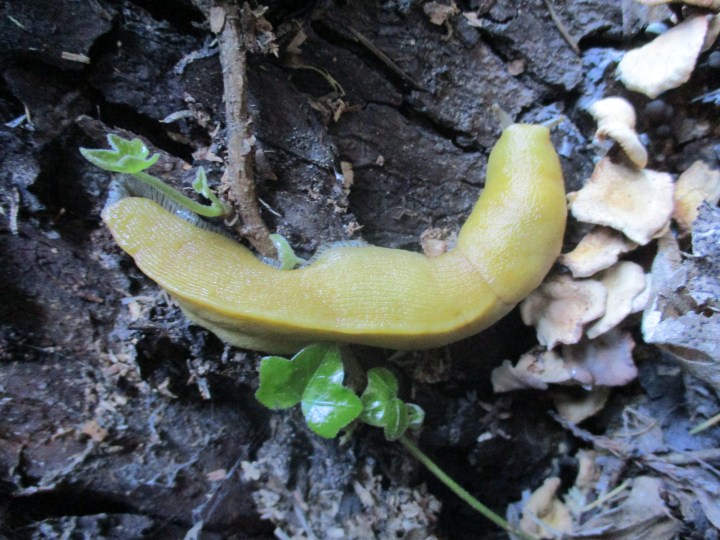 They are not as dangerous as they look. Really. If they were, just one could do more damage than an entire herd of average slugs. The fortunate truth is that banana slugs consume only decaying plant parts and fungus. Yes, they literally cruise about the garden eating bits of decomposing debris that we may not want there anyway, and converting it into a very nutritious and nitrogen rich ‘fertilizer’. They are actually beneficial to home gardening.
Of course, this does not necessarily mean that we ‘want’ them in our gardens. They really do look scary. This one is only about four inches long, but larger ones can get nearly twice as long! Some rats are not that big! Their bright yellow color, which is typically brighter yellow than this one is, is an expression of defiance. They only stay out of the way because they prefer damp and shady situations. Otherwise, they do not care if we see them.
Contrary to popular belief, they do not really taste like chicken. They taste more like the blandest of escargot. If not purged with corn meal and partly deslimed with vinegar, they can taste much worse. Even if the myth about the slime on their undersides containing more vitamin C than a bucket of oranges is true, it does not justify licking them. It is more degrading to you than it is to them; and no one needs that much vitamin C anyway!
As revolting as they are, they are not completely disdainful. It is fun to point them out to friends who have never seen them before, but only after they have gotten close enough to be startled, and jump away as if being chased by something that can actually move . . . quickly. Banana slug races are also fun.
Gophers Go For Spring Vegetation
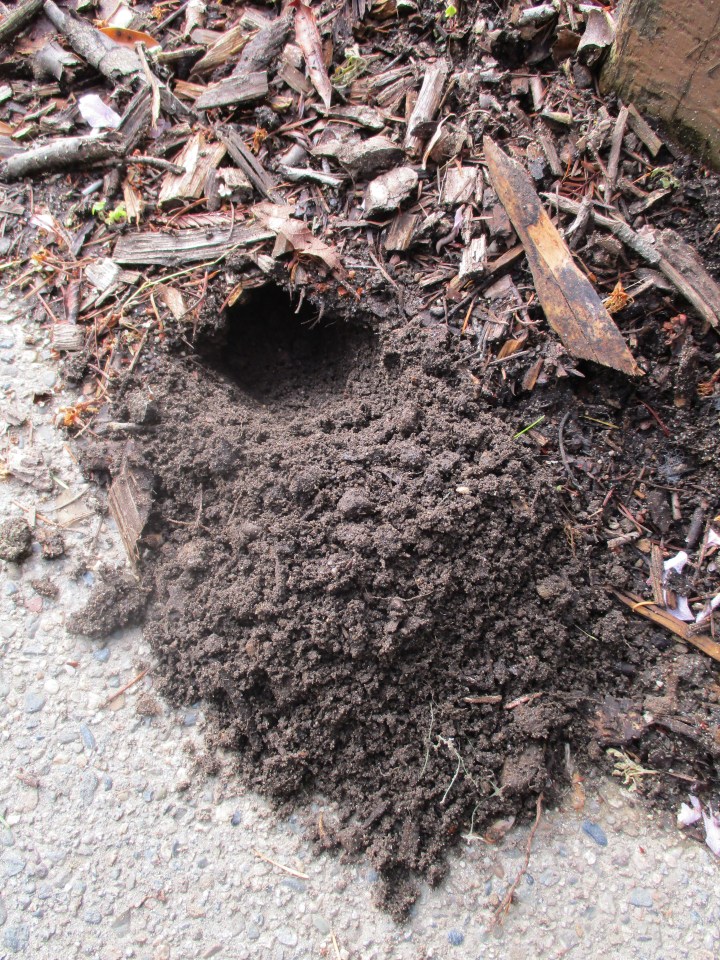 Hibernation is a luxury enjoyed by different animals in different climates, where much colder weather inhibits activity through winter. Gophers take no such extended time off here. They merely work less diligently through the cooler and rainier times, and maybe get out of the way if the soil they live in gets too saturated. Their minimal damage had probably been easier to miss or ignore.
Now it is spring! The weather is warming. The soil is draining. All the roots and vegetation that gophers eat are growing. The gophers that were here and somewhat active all through winter are really making a scene now, as they clean mud from their homes and excavate new tunnels. Babies are growing up fast and leaving home, and excavating new homes of their own. What a mess!
Many of the primitive techniques that were used in the past to mitigate gopher problems are ineffective, impractical or even dangerous. Pouring gasoline into tunnels and waiting a few minutes to ignite the fumes can start fires anywhere such tunnels resurface, and possibly out of view! Bare razors dropped into tunnels are potentially dangerous to anyone who happens to dig them up later.
Traps take some work and experience to set properly, but are still the best way to deal with gophers. They do not involve poison that can be dug up and eaten by someone else, or eaten by a gopher who staggers from underground to get eaten by someone else. As long as dogs are not allowed to dig them up, traps are likely only be dangerous to gophers and those setting the traps.
Conventional traps are set in pairs, in each of both directions of a lateral tunnel that is found by excavating back from the tunnel under an active gopher volcano (pile of displaced soil). Once set, the tunnels must be back filled to eliminate air circulation into the tunnel, which would warn a target gopher of intrusion. A bit of weedy vegetation added before back fill might help attract a gopher.
Setting gopher traps is easier to read about than to do safely. It is best to learn how to do it from someone who is proficient at it..
Pantry
 Birds do some odd things. They seem to know what they are doing. The odd things that they do make sense. Nonetheless, some of what they do out there is just plain odd.
I mean, who was the first woodpecker who thought it might be a good idea to bang his head against a tree? What prompted the first sapsucker woodpecker to bore through bark of a healthy tree to lap up the sap from the cambium within? Why do other woodpeckers bore into rotting dead trees for grubs, and to make nests? The different types of woodpeckers seem to be related, but they are after different things. Did one just accidentally bore into the wrong sort of tree, and discover something more than what was expected?
Various species of woodpeckers are surprisingly omnivorous. Those who eat termites also eat other insects, nuts, acorns, berries and fruit. Sapsuckers also eat insects, berries, small nuts and such.
Many woodpeckers are social, and live in significant communities. Those who bore into dead tree tops to nest prefer to live where there are several dead trees tops to bore into, probably because too many nests in the same tree would compromise the structural integrity of the already decaying trunk. Besides, if they all lived in the same dead tree, they would all become homeless at the same time if the tree fell down.
Colonies of some species of woodpecker store nuts or acorns in rotting dead trees. They can store quite a bit in each tree because the holes bored to hold the individual nuts and acorns are not as big as the holes that they nest in, so do not compromise the integrity of the trees as much. Besides, it is easier to defend many acorns and nuts in a few trees than it is to defend them in many trees. Squirrels who want the same acorns and nuts are very sneaky!
The problem with putting all their eggs in the same basket, or all their acorns in a few trees, is that when one of such trees falls, it takes a significant portion of their stored nuts and acorns with it. Once on the ground, it is impossible for them to defend it from squirrels and rats.
This particular rotting ponderosa pine fell and needed to be removed from the roadway that it fell onto before woodpeckers could recover the acorns that they so dutifully stored in it. The precision with which the holes were carved to custom fit each acorn that they hold is impressive. The woodpeckers who did this really know how to manage their pantry.
Looks Like Rain
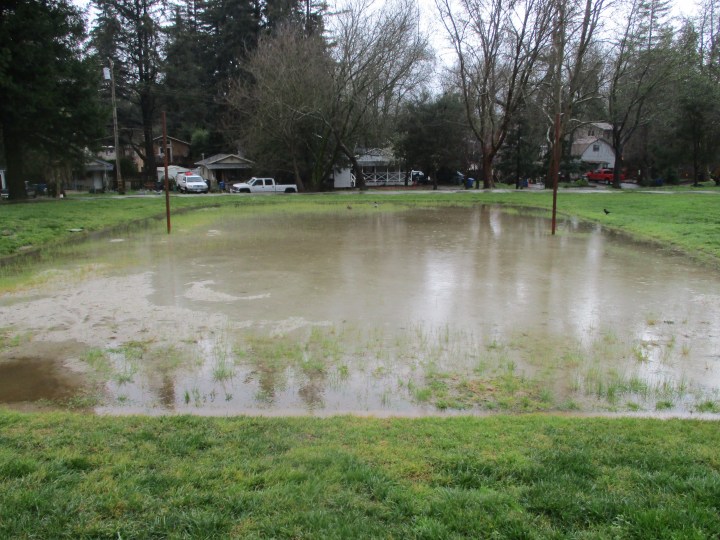 Supposedly, all this rain has not been too terribly excessive. It seems to have been raining more frequently than it normally does, with only a few days without rain in between, and more often, many consecutive days of rain. The rain also seems to be heavier than it normally is. Yet, the total rainfall is not too much more than what is average for this time of year, and well within a normal range.
The volleyball court at Felton Covered Bridge Park looks more like a water polo court at the moment. The pair of ducks out of focus on the far side seem to dig it. The water is not as turbulent at it is the San Lorenzo River where they live.
Speaking of the San Lorenzo River, it has been flowing very well and at a relatively continuous rate. It came up high only for a short while. None of the heaviest downpours lasted long enough to keep it very high for very long. The ivied log laying in the river in the middle of the picture below was an upright cottonwood tree only recently, but fell into the river as many riverbank cottonwoods do when the ground is softened by rain and higher water.
When things get as soggy as they are now, this great blue heron strolls the lawn at Felton Covered Bridge Park, probably because the San Lorenzo River is too turbulent, and also because the worms that live in the lawn come to the surface as the lawn gets saturated. He or she is never in a hurry, but just strolls about slowly, occasionally prodding the muddy soil. However, when it wants to move fast, it is quick enough to catch small frogs. Supposedly, this great blue heron caught and ATE a small gopher!
Wild Turkey
 This is a relatively new development. The first few arrived here only two years ago. By last year, a few more arrived to make a significant herd that split into two smaller herds. Now these two smaller herds are quite significant. If they continue to proliferate as they have been, they will become more of a problem. They are already shredding flowers and colorful berries that are within their reach, and digging up flexible irrigation hoses.
They are not really wild turkeys, since they are not native here. They are actually feral turkeys that escaped into the wild and naturalized. They may have moved in from surrounding areas, or they may have escaped locally. Turkeys have been roaming parts of Scott’s Valley and my neighborhood in the Los Gatos Hills for a few years. Much larger herds roam other regions, particularly the Diablo Ranges east of the San Francisco Bay Area.
My former neighbor knew how to select the good ones. They all look the same to me. When they showed up on the road at my home, I could just chase them to the neighbor’s home, where he would take what we wanted. They were so stupid that he probably could have grabbed the good ones rather than shoot them. It is amazing that they could survive in the wild so stupidly.
I suppose that it was good that they survived to keep the meat fresh. However, I am now concerned about how these exotic and prolific birds might affect the ecosystem. Are they taking food from other wildlife? Are they dispersing seeds of the fruits they eat differently from other birds who eat them and fly away to other areas? Are they providing too much food for predators, and allowing them to proliferate more than they should naturally?
Kenny
If you watch Southpark, you shouldn’t.
If you do anyway, you shouldn’t admit to it.
If you happen to know someone who watches Southpark, you might have heard indirectly about Kenny. He dies in every episode. Actually, he typically dies a few times in each episode, and typically does so violently. Experts claim that there are two episodes of Southpark in which Kenny does not die, but proof is all too conveniently scarce.
There is also an opossum named Kenny. Like Kenny of Southpark, Kenny the opossum dies in every episode.
Apparently, Kenny startled someone who was working too intently in the garden to notice his approach on top of a fence directly behind where this unnamed someone was working. This unnamed someone grabbed a stick and clobbered Kenny right across the backside. Although the blow was not terribly aggressive, and not intended to be harmful, Kenny surprisingly died violently in a fit of hissing, gnashing and flailing. After falling to the ground, he smelled as if he had been dead for quite a while.
The surprised unnamed assailant went to find a box to put Kenny’s remains into for a proper ‘burial’, but upon returning to the scene of the incident, could not find Kenny.
Others briefly observed Kenny frolicking about in the same garden later, but when the unnamed assailant came within view, Kenny again died in a violent fit of hissing, gnashing and flailing, accompanied by the aroma of well aged death. Again, the unnamed assailant was unable to locate Kenny’s remains after retuning with a box in which to put them.
After a few more similarly violent deaths, it became apparent that Kenny was merely playing possum, likely in response to being clobbered with a stick by the startled unnamed assailant during their primary encounter!
I apologize for the length of the video. My attempts to trim it compromised the quality of the imaging. The important part of the video is between ten and thirty seconds. This is not the real Kenny anyway, but merely a random opossum who happened to be frolicking in the garden.
I also apologize for posting this at noon rather than at midnight when I typically schedule my articles for the day. For midnight, I posted a short excerpt from an old article from the gardening column instead.
Dogs
It is now September 2, the day after both the feastday of Saint Fiacre, patron saint of gardeners, and the first anniversary of this blog. It is also the anniversary of the only day in the last year that I did not post anything. Yes, the second day of the blog was the only day without a post. Early in those first few days, I posted the only article that was irrelevant to horticulture, and an explanation that I would not make a habit of doing so. I wanted to try it just once to see if I could do it like so many others do. It was overrated. Nonetheless, after almost a year since that naughty diversion from my self imposed discriminating standards, I want to try it again. After all, I have not yet posted a horticulturally oriented article on September 2 within the context of this blog, so why start now.

This is Privet. He passed away on December 1, 2004, after about eleven years of devout service since about 1993 or so.
Privet was a feral dog who lived in Thomspson Creek behind a retail nursery in the Evergreen District of San Jose where I worked temporarily in the early 1990s. Late every afternoon, he commuted down Thompson Creek to a neighborhood pet store where food was left out for him. Aster and Yarrow, two angry guard dogs who lived in the nursery, would thrash about on the inside of the enclosing cyclone fence as they tried to get to him, but only damaged the merchandise inside the fence. I would cuss at him and threaten him through the fence. He would just stare at me blankly, and keep a safe distance.
One day, Privet was noticeably absent. He was likewise absent the following day. In fact, I did not see him again until several weeks later when we went to the Humane Society of Santa Clara County to adopt a cat to help with the mice in the office. We happened to go through the wrong door to where the adoptable dogs were. There he was! As usual, I cussed at him and said all sorts of mean things to him . . . .until I noticed that his time was up. I asked someone who worked there what that ominous date on his placard meant, only to be told something too unpleasant to repeat here. They were understaffed, so had not gotten around to it yet. Well, the next thing I knew I had payed the adoption fees, and Privet was sitting defiantly next to me in the Buick as we drove away real fast. We never spoke of it again.

My niece named this cool dude Willow, but we just called him Bill because I was told that Willow is a girly name. He was not planned either. In about 2008, I saw his picture on the website of the Peninsula Humane Society in Burlingame. Without thinking, I drove up and adopted him on the spot. On the way, I telephone a friend who I though would try to talk me out of it. He did not. Those working at the Humane Society asked if I would like to interview other dogs. I told them who I was there for. Bill was a several years old when we met. He became blind and deaf in old age, but was still happy until he passed away on December 4, 2016.

Rhody arrived only a few months later, early in 2017 and in the traditional unplanned manner. I can not imagine why he was available for adoption for several months in Santa Cruz. It was not my idea for him to come live with me. It was his. I could not talk him out of it. He seems to be remarkably happy with his simple lifestyle, although I can not imagine why. I wish I could provide better for him. Like Privet and Bill, he has more friends than he can keep up with. Privet was a Pontiac man. Bill was an Oldsmobile man. So far, Rhody seems to be a simple Chevrolet man.
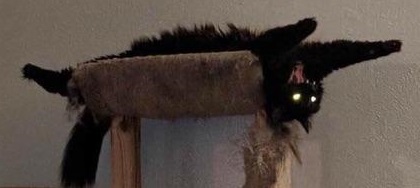
Blackjack does not live with me. He is not a dog either. He is a big kitty who has enslaved one of my colleagues, although my colleague does not seem to be aware of it. Cats are of course masters of mind control techniques. Blackjack did not get his name from the blackjack oak. It is just a cool name that suits him well. He is not really as demonic as he seems to be in this picture. Nor is he trying to fly upside down. He just happened to yawn while laying on his back and stretching.
Of course, only the names are horticultural. None of these guys cares about gardening. I sort of feel guilty about not writing about a horticultural topic today, but perhaps I will get over it.
The Birds And The Bees
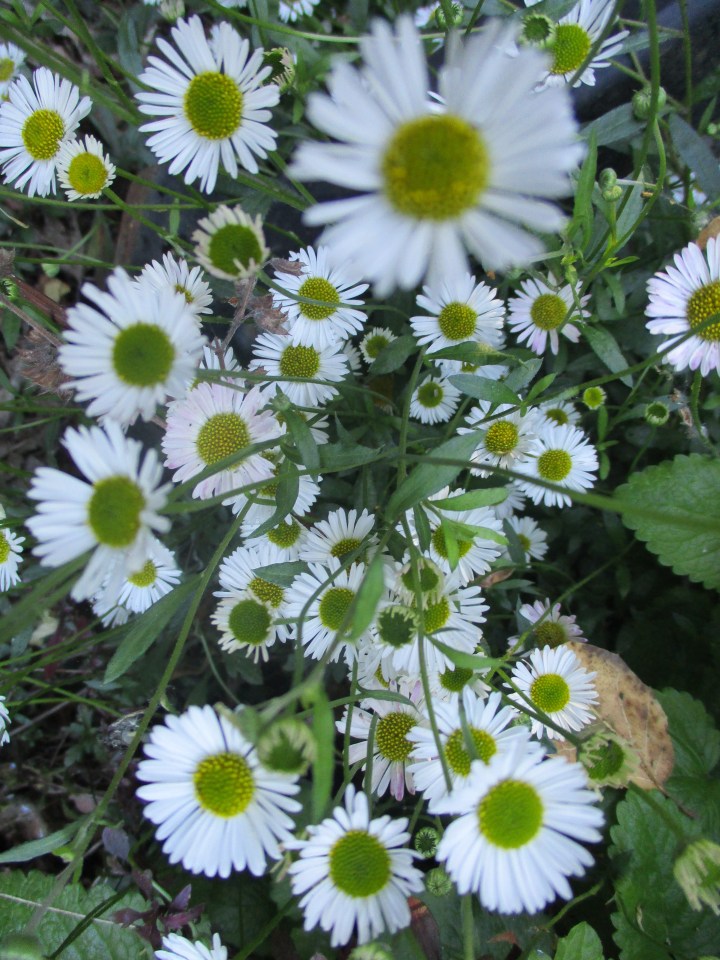 There is so much more to gardening than mere horticulture. There is so much more to horticulture than mere plant life. Plants get eaten by insects and animals, and also take advantage of insects and animals for pollination and dispersion of seed. Some of us who enjoy gardening also like to attract some types of animals and insects to our gardens because they are nice to have around.
The birds and the bees, as well as butterflies, squirrels, lizards, snakes and other small animals add color, motion and vibrancy to the garden. Destructive animals like gophers, rats and deer, and cumbersomely big animals like moose and bears, are not so popular. Mosquitoes and flies are the sorts of insects that we would like to repel with aromatic herbs. Some but not all are welcome.
‘Pollinator’ flowers have become a fad recently, not only to attract bees, but also to provide them with more of what some believe they are lacking out in the wild. There is certainly nothing wrong with attracting bees. Those who are enslaved in honey production are best! Children learn as much about nature from bees as from other wildlife. The soft hum of big herds of bees is quite nice.
Beyond that, we should think outside the box of our home gardens. The unnatural disruption of local ecology can not be repaired by throwing more unnatural resources at it. Honeybees who were imported to make honey are not native, but displaced and interbred with natives enough to interfere with their natural pollinating behavior, as well as their resistance and susceptibility to disease.
Almost all plants in urban as well as agricultural areas were imported too. They were perpetuated until they dominated the localized ecosystems. There is now much more flora in places like the Los Angeles Basin and the Santa Clara Valley than there has ever been before! There is no shortage of bloom for bees. In fact, there is an overabundance of bloom potentially distracting bees from pollinating native specie who need them. Invasive exotic eucalypti might enjoy their popularity at the expense of California poppy.
O
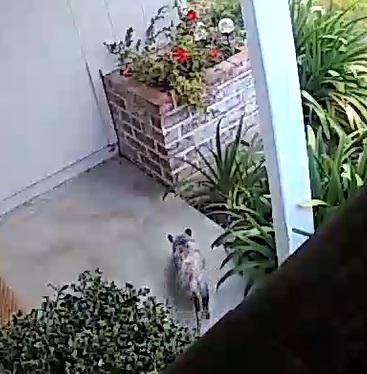
‘O’ is for ‘opossum’. That it the proper common name for the familiar North American critter who lives in or near many home gardens where fruit, vegetables or pet food are available. When a similar critter was found in Australia, it was given the same name by someone who did not spell it properly, hence ‘possum’. It is marsupial, and therefore related to many familiar Australian critters like koalas, kangaroos and the most terrifying of all, wallabies. Well, if the North American name can be applied to an Australian critter, it only makes sense that the Australian name can be applied to the North American critter. Thought technically and correctly ‘opossum’, many of us know them simply as ‘possum’, without the preceding ‘O’.
Opossums have a vast native range in North America. They can live anywhere that does not get too cold for them. They have likely always lived in the Santa Clara Valley to a limited degree. There was not much for large populations of opossums to eat just a few centuries ago.
As orchards grew and displaced native vegetation, there was more fruit that they could eat in season, but still not so much else during the rest of the year to sustain large populations of opossums. It was not easy for opossums to make homes at the modest home sites isolated by large orchards with only seasonal vegetation on the ground.
As orchards were developed into suburban neighborhoods, more habitat was created for opossums. They lived in and around homes, woodpiles, sheds, and areas landscaped with permanent vegetation. Vegetable gardens and more varieties of fruit trees in home gardens provided food throughout the year. There were citrus, avocados, guavas, persimmons and loquats, as well as ornamental berries like pyracantha and cotoneaster. Pet food and household trash were abundant. While San Jose was still a small town, it was inhabited by more opossums than could have been sustained in the entire Santa Clara Valley only a century earlier.
Those old suburban neighborhoods are now even more urban, and their landscapes are much more overgrown than they were when the homes were new. Rats, snails, slugs, grubs and large insects that live in the landscapes are fair game for opossums. Aging and deteriorating homes are easier for opossums to get access to, so finding shelter is easier than it has ever been. With more than a million people just in San Jose, there is no shortage of trash.
All through history, people have been moving in on wildlife. However, what we do not often hear about is the wildlife that moves in on humans.
 Tony Tomeo