 Winter is for pruning. Any good native of the Santa Clara Valley knows that. It starts as soon as the first deciduous fruit trees defoliate and continues to the last minute rush to finish before the buds start to swell at the end of winter. It may seem like there would be no last minute rush now that all the orchards are gone, but there is so much in landscapes to prune that prioritizing and scheduling pruning takes a bit of effort. Just like we know that apples and pears can be pruned slightly later than apricots and prunes, in the landscape, we know that sycamores might be delayed until the birches are done. Naturally, I feel compelled to prune the flowering cherries and fosythias, but am almost content to wait until after they finish blooming in early spring. Of course, I cringe as I write this.
Roses are getting pruned now. I first finished a few scrawny hybrid tea roses, including a few ‘tree roses’. They really should be relocated to a sunnier spot, but not this year. Afterward, I did a row of climbing roses that are not exactly climbing the fence that they were planted against. They really should be moved too, but like the others, not this year. I still need to prune a bank covered with modern carpet roses. I am none too keen on them. Actually, I rather dislike them. However, of all the roses, they are the only ones that happen to be in the right situation, and are doing a nice job.
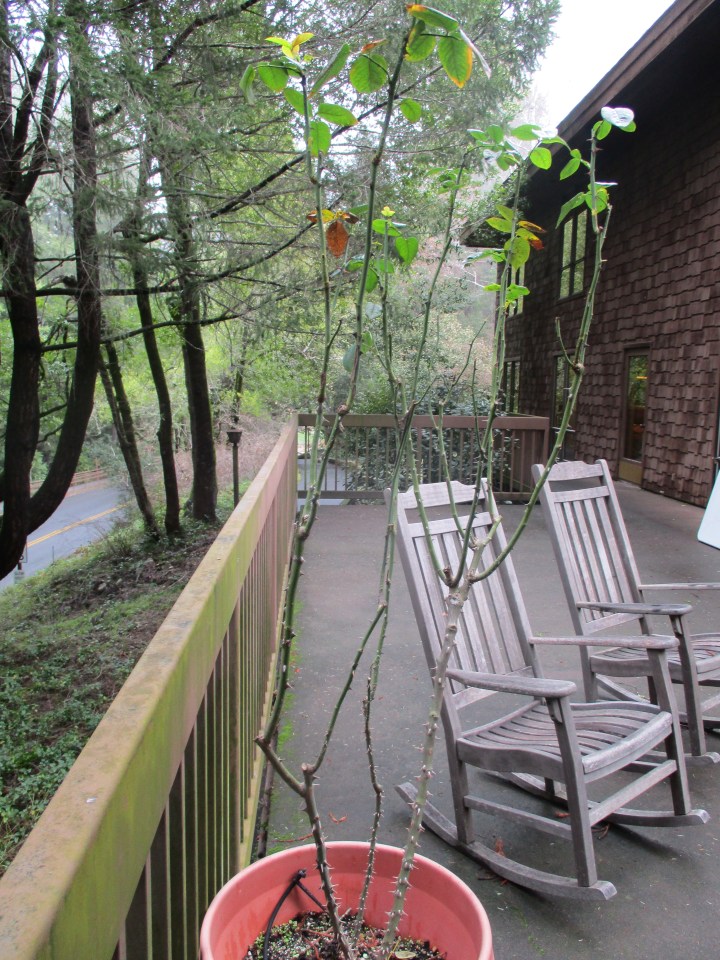
Just before I started with the first batch of hybrid tea roses, I pruned a single potted hybrid tea rose that is all alone on a deck across the street. I wanted to get it done when I thought about it so that I would not forget about it in the process of pruning everything else. It had bothered me for some time because it was so tall. I mean, I could not reach the top of it. The blooms up there were closer to upstairs windows than to anyone wanting to seem them from ground level. The supporting lower canes were bare of foliage, but well armed with nasty thorns. Honestly, I thought that the deck would have been more inviting without it.
Pruning it was rather simple; just three major cuts. Since the rose is where people mingle, I chopped the thorns just so that they are not so sharp. The remaining three canes were older than one year, but did not seem too terribly old. In fact, there was still a bud to cut back to on one of the canes. For the other two, I had to cut back to old petiole scars, expecting that dormant buds are still in there. That was about it.
The problem that I was not aware of is that the rose was left that tall intentionally because a former gardener liked it that way! Now I feel badly. I really thought that it had just been neglected. Like I mentioned, the canes did not seem to be several years old. They must have replaced older canes in just the last few years. Regardless, I can not put it back. In the partial shade there, it will probably grow back as tall within the year. I hope that the former gardener does not find out about it before then. I know that if someone did that to a roses that I had pruned in a specific manner, I would be really angry about it.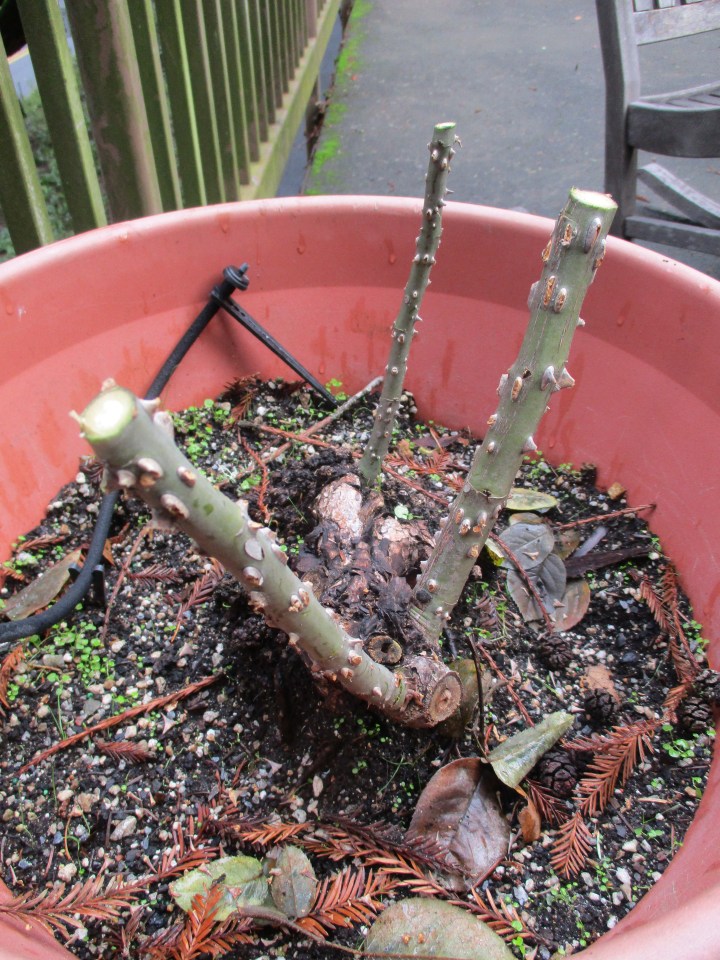
Electric Snow
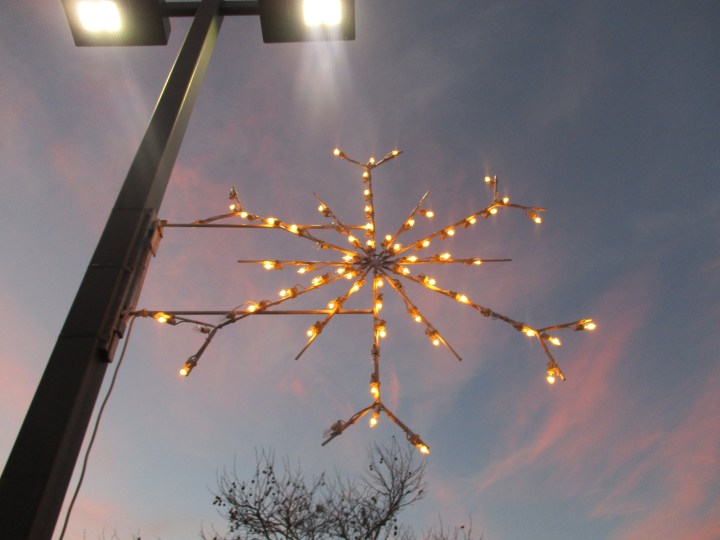 It was one of the more common types of snow in the Santa Clara Valley in the early 1970s.
In school, we made paper snow by folding paper squares in half and then into thirds (so that they were folded into sixths), and then cutting notches and slices out of them. They unfolded into the prettiest and laciest snowflakes!
In Westgate Mall, snow was blown by small fans about the new models of Singer sewing machines that were magically suspended in big acrylic spheres. We children could not get into the spheres, so were left wondering if the snow within was as cold and wet as we were told it was, and why it was necessary to demonstrate that the new sewing machines were resistant to weather. Our mother did her sewing inside.
We sort of suspected that the snow around the Nativity at Saint Thomas of Canterbury and other local parishes might be artificial because it looked like the stuffing of a pillow, which is something that all children seem to be familiar with. We said nothing about it, just in case our parents were not aware of the potential deception. However, it was rather disturbing to see so much of the same sort of snow at Christmas in the Park in San Jose. At that point, we accepted that either it must be genuine, or that we were committed to just going along with it.
Snow that was sprayed onto Christmas trees was rather interesting. It was neither wet nor cold, and sometimes it wasn’t even white. It could be pastel blue or pink, and was often sparkly with glitter! Wow!
Off in the distance, we could see snow on top of Mount Hamilton. Sometimes it was just on top. Sometimes, it was spread out from left to right, along the ridge. On rare occasion, snow appeared on the ridge of the East Hills, in front of the Diablo Range that Mount Hamilton is part of. We never saw who was up there folding and cutting all that snow, but they must have been VERY busy!
Snow on top of the Santa Cruz Mountains, right behind our part of the Santa Clara Valley, was closer to home, but did not look like much. The greenish blue of the forest was just a lighter hue of blue, with more mottling. It was exciting anyway.
Then, on February 5 in 1976, it actually SNOWED on the floor of the Santa Clara Valley!
It really was as awesome as snow was supposed to be. It was cold. It was wet. It was white. It was fun to wad up and throw at each other. It accumulated just like it would in a blizzard, and got almost an inch deep!
. . . but . . . was it really SNOW?
Winter
 We are now two days into it. Is it any different than three days ago, the last day of autumn? Not really. Even in harsher climates, the changes from one season to the next are gradual. Like the phases of the moon, the seasons are constantly phasing out of the previous, and into the next. The dates of the first and last days of each season, which are determined by the position of the Earth within its orbit around the sun, are technicalities.
Seasons in the Southern Hemisphere are of course opposite of what they are here. That seems odd to me. The calendar is the same there as here. It seems obvious to me that winter and all seasons should be determined by the same dates there that they are determined by here. If winter began last Friday here, it should have done the same there, on the the same date. Longer days and warmer weather are consequences of location, south of the Equator. It is hard to imagine that January and February are summer there.
It also seems odd to me that all maps are oriented with North directed towards the top. Shouldn’t South be at the top South of the Equator? Must Australia be the ‘land down under’ to those who live there? Things would be so much simpler if Columbus has just stayed home, and the World was still flat.
Anyway, we do not get much winter here. The weather gets a bit cooler, and we will eventually get more rain. When I went to Oklahoma six years ago, I thought that I would finally get to experience a real winter, but we left just before New Year’s Day, while the weather was still somewhat mild. This little bit of snow was about all we got.
Six on Saturday: Rain On My Parade
Actually, this rain ‘is’ the parade. In parts of California, we do not get much of it, so when rain happens, it is worth celebrating. Although this side of the Santa Cruz Mountains gets significantly more rainfall than the chaparral on the other side in the Santa Clara Valley, there are not many more rainy days here. What that means is that when it rains here, it does so with more volume than in the Santa Clara Valley.
Rain is not easy to get pictures of. The first four picture just show water from one of our first major storms of the season. The fifth pictures does not even show that much. The sixth picture is from the most recent storm that came through Sunday night and finished on Monday morning.
1. This waterfall was flowing both through and over the deteriorated and also clogged gutter on the roof of the shop building across the driveway from the gardening shop at work. The gutter is so deteriorated that I would have expected all of the water to just flow through it. Incidentally, the big roll-up door to the lower left of the picture happens to be that of the plumbing shop.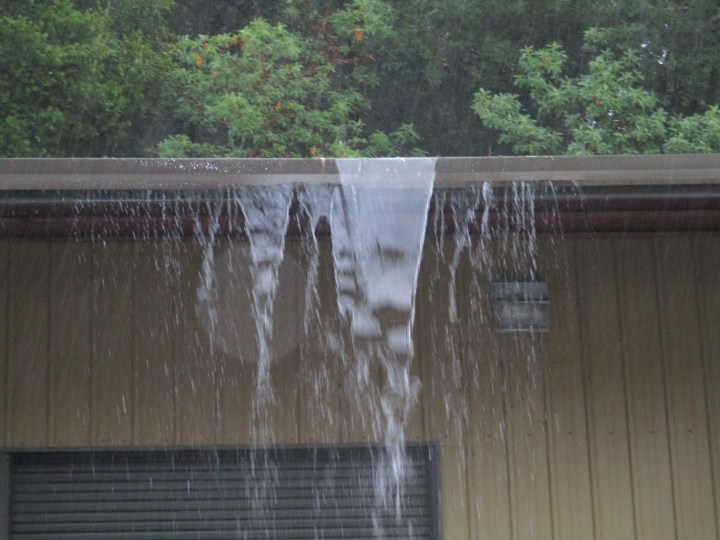
2. This waterfall was flowing through a storm drain on the Mount Hermon Road bridge over Zayante Creek, East Zayante Road, and the railroad tracks in between them.. This section of Mount Hermon Road is known to some as ‘the Bypass’ because it bypassed the older Conference Drive in picture #5. What is not visible in this picture is that the upper part of the waterfall lands in the ditch on the side of East Zayante Road below. It might have seemed like a good idea when the bridge was built, but so much water falls from so high up that it erodes the ditch, and splatters gravel onto cars driving by. The lower part of the waterfall flows into a ditch on the edge of the railroad tracks, and then under the tracks towards picture #3 below.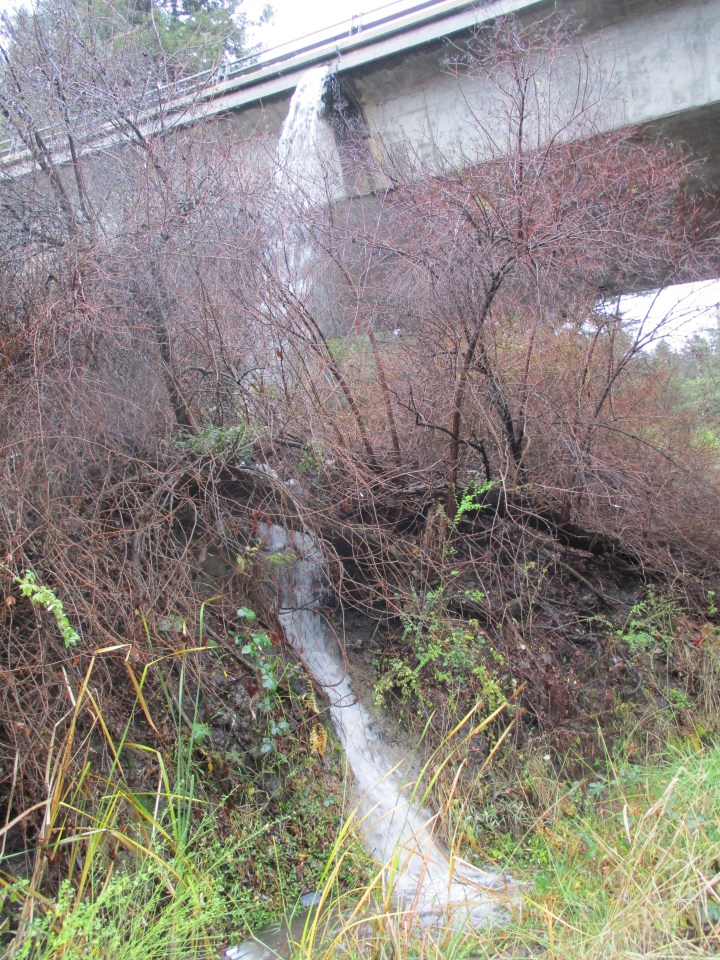
3. This waterfall was flowing out into Zayante Creek from a culvert just downhill from the culvert under the railroad tracks mentioned in #2 above. It is the same water that was falling from the Mount Hermon Road bridge.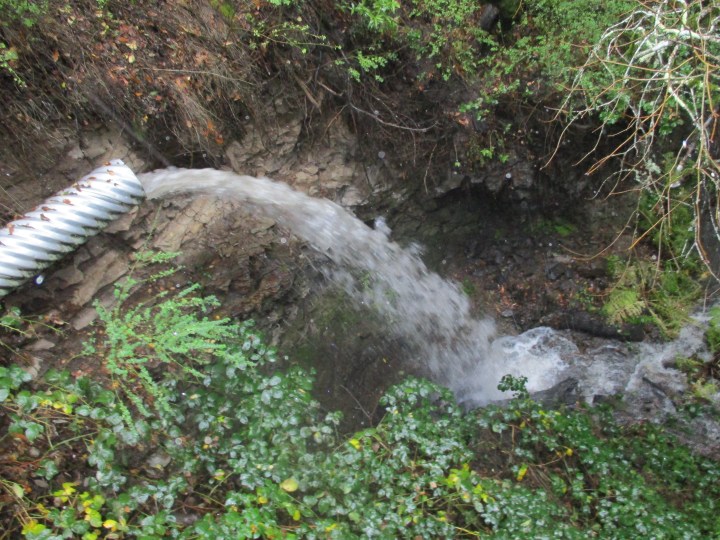
4. These two waterfalls were flowing from the roofs of the local supermarket and adjacent drug store and pharmacy, and onto the newsstand below. What is disturbing about this picture is these drains are merely back up drains that do not allow the flat roofs surrounded by parapet walls to fill with too much water if the main drains get clogged. The main drains are likely at the rear of the building where they can drain discretely and out of the way. These back up drains are on the front of the building so that they get noticed if they start to flow. All this water flowing out of them indicates that the main drains are clogged, and that the roofs are flooded.
5. This is the Conference Drive bridge over Zayante Creek, East Zayante Road, and the railroad tracks in between them. It is the bridge that was bypassed by the Mount Hermon Road bridge in picture #2. The big greenwaste pile where I dump debris from the landscapes is directly below the southern edge of this bridge, which is to the left in this picture. You can not see it in this picture that was taken before the rain started, but a bit of water drains from this bridge onto the greenwaste pile. It is not much, but it is enough to be a bother when I am unloading debris in the rain. It falls from so high up, that even if I am avoiding the spot where the falling water lands, the wind can blow it all over me. From that height, any bit of road gravel that falls with it can give me quite a sting.
6. The most recent storm finished early Monday morning, after dropping two and a half inches of rain.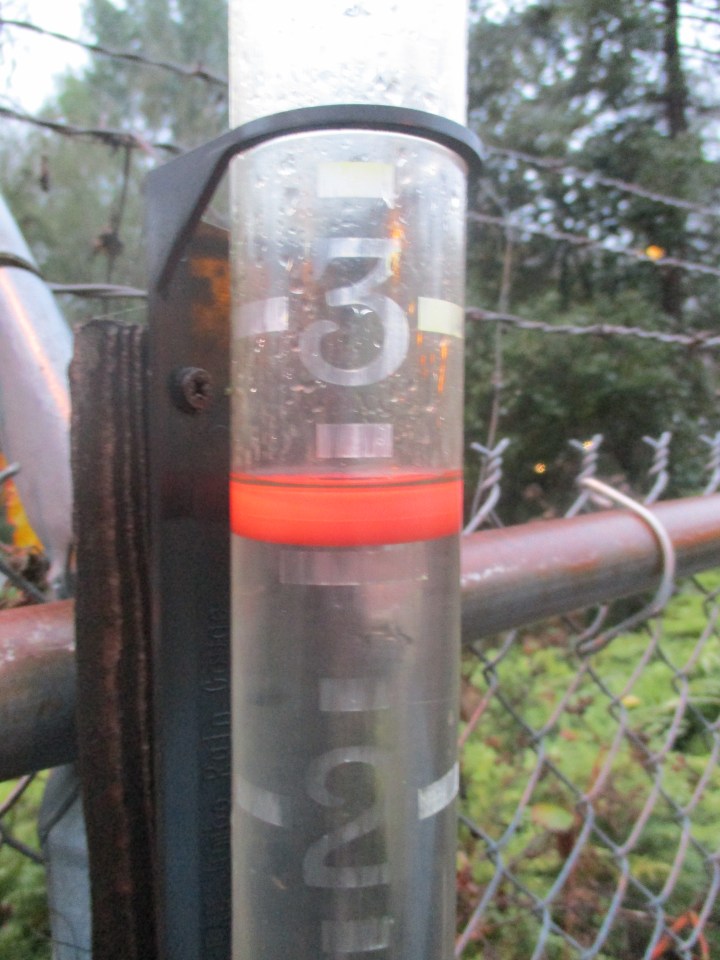
This is the link for Six on Saturday, for anyone else who would like to participate:
https://thepropagatorblog.wordpress.com/2017/09/18/six-on-saturday-a-participant-guide/
Frost
 We do not get much frost here. This picture of the view through the windshield of one of the work vehicles was taken more than a week ago, while the humidity and the temperatures were still quite low. The sparse and angular pattern of the frost on the windshield is a result of the minimal humidity. There will be more frost later in winter, although there will not be nearly as much as most other climates get.
After a cool Monday morning last week, the weather got a bit warmer, or really just less cool. Rain started about midnight between Tuesday and Wednesday, and continued through the day and into the night. More rain is predicted to start after noon next Tuesday, and continue through Thursday. There will be no frost during this weather pattern. Frost happens here only between rainy weather. One might think that since we do not get much rain, there would be plenty of time in between for frost. Really though, much of our winter weather is simply quite pleasant, neither rainy nor frosty.
As appealing as this might be to those in harsher climates, it has certain disadvantages.
So far, there was just enough chill to start defoliation of the black locusts and box elders in the background of the picture, and just enough rain to almost finish it. Trees that need more of a chill to start this process are not so impressed with the weather. Many of the crape myrtles have not even started to color yet. Cottonwoods are starting to defoliate, but are doing so while still only dingy greenish yellow because they did not get enough chill for better color.
Spring bulbs that got planted earlier or are being planted about now will bloom next spring because they were so optimal and primed to do so before they were planted. However, many will not get enough chill in their second winter to bloom again. Consequently, many of the bulbs that would be perennial in other climates are grown as expensive annuals here. Likewise, seed of certain specie that self sow may not get enough chill through winter to germinate next spring.
So again, what is comfortable for us is not so ideal for everything in the garden.
Colorful Berries Linger Through Winter
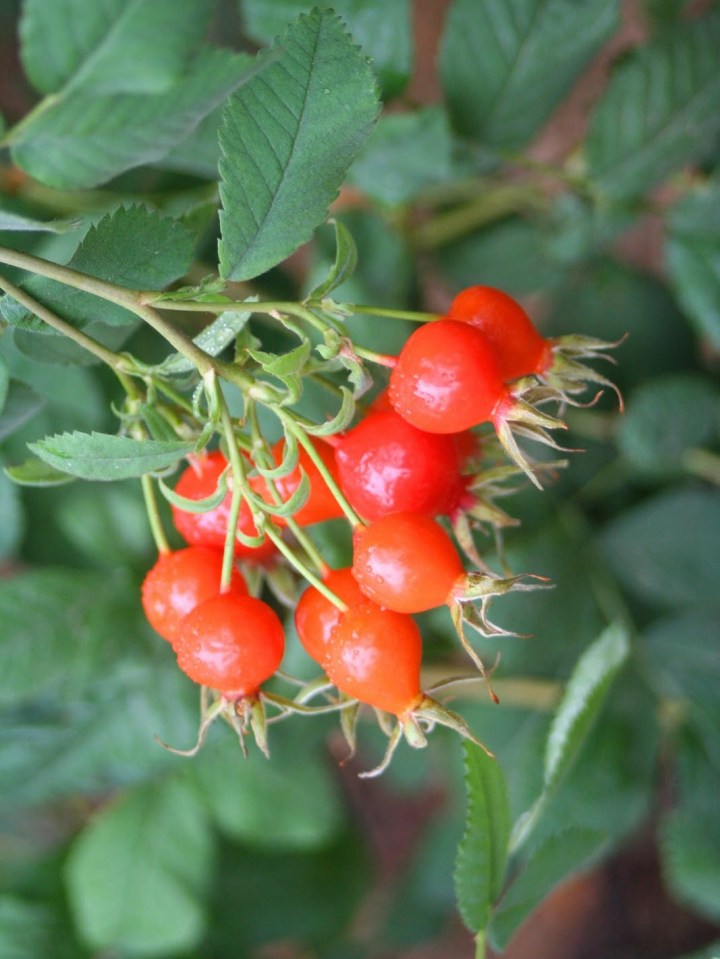 Just as many flowers attract pollinators with color, some types of fruit employ color to get the attention of birds and other animals. Just as many flowers reward their pollinators with nectar, fruit is its own reward to the animals that eat it. The only catch is that those who want the fruit must disperse the seed within. For both the hungry animals and the fruiting plants that lack mobility, it is a rather equitable arrangement.
Much of the fruit that uses this technique ripens in autumn, and linger through winter, when there is not much other fruit. It is available to migratory birds and animals that want to fatten up for winter. Unlike nuts and large seeds that get buried locally by squirrels, the tiny seeds of winter berries typically get eaten and ‘dispersed’ more remotely. Some actually need to be scarified by digestion before they will germinate.
Because they put as much effort into attracting vectors to disperse their seed as flowers put into attracting pollinators, fruit and berries can add significant color to the home garden. Oranges, mandarins, lemons, grapefruits and other citrus are quite colorful, even though they do not expect to be taken away by birds, To attract crows, persimmon fruits get as colorful for winter as their foliage was through autumn.
Firethorn (pyracantha) is probably the most colorful and profuse of the ornamental berries. Various specie and cultivars of cotoneaster produce similar berries, but not quite so prolifically. They are popular for their resiliency. Toyon, which is the native ‘California holly’ that Hollywood is named for, is a bit too finicky for irrigated and refined gardens, but can be quite colorful with berries in wild or casual landscapes.
Firethorn, cotoneaster and toyon, as well as English hawthorn, all produce similar ‘pomme’ fruits, which are actually more like tiny apples than real berries. They are so popular with the birds that they are not very messy; although the birds may be if they loiter. English hawthorn is a small deciduous tree, so yellows and defoliates as the bright red fruit ripens.
SNOW!?
If you do not know what it is, ‘snow’ is like frozen rain.
If you do not know what rain is, I wrote about it earlier for those of us who are native to the drier parts of California. If you notice strange drops of water falling from the sky tonight, that would be rain. There is no need to be alarmed. It is expected to happen here tonight, and a few times for the next few days. Contrary to former experience, it is normal for this time of year.
Anyway, getting back to snow. Unlike rain, which sometimes happens here, snow does not happen here.
Well, perhaps that is not entirely true. It might have happened as recently as 11,700 years ago, as the Ice Age ended, and again in more recent history, in February of 1976, when an epically humongous snowstorm deposited as much as half an inch of snow over the Santa Clara Valley!
It is difficult to imagine such a huge volume of snow! It must have been disastrous! It would be even more disastrous now, with more than a million people just in San Jose, and many of them driving cars!
In 1976, we third graders did not consider it to be disastrous. We were not old enough to drive. We were perplexed and mystified at first, but rather quickly discovered that snow had serious potential for being fun. Our parents wadded it up into something known as ‘snowballs’ and then threw these snowballs at each other and the neighbors. Yes, I know it sounds crazy. Nonetheless, it looked like fun, so we tried it. It really was fun. We also discovered that we could just as easily throw snowballs at cars driving by, but we were instructed to not do that. We could see that the Santa Cruz Mountains were discolored by snow. They were an almost white hue of very pale blue, speckled with the more typical darker blue.
On very rare occasion, when the ‘smog’* and smoke blew away on clear and cold wintry days, we could see snow on the tops of the highest peaks of the Diablo Range east of the Santa Clara Valley, particularly on Mount Hamilton where Lick Observatory is located. We did not know what it was. Before snow happened in our own neighborhood, we wondered what discolored the peaks like that.
Now that smog rarely obscures the view of the Diablo Range, snow is visible on the group of peaks around Mount Hamilton almost annually. If it gets cold enough, a slight blush of snow might be seen on the lower East Hills in front of the Diablo Range. It is quite scary to think of how close to home snow can be. There happens to be snow up there right now!
I am sorry that I do not have a picture of the snow on Mount Hamilton. I will just recycle this picture of Bill trying to escape snow south of Oklahoma City.
* Historical notation – The East Hills and Diablo Range to the east of the Santa Clara Valley were rarely visible in the olden days because of ‘smog’. If you do not know what smog is, you are fortunate. I have not written about smog yet because it is a part of our history that we would prefer to forget. To be brief, smog was a common form of air pollution. Although there was less smog in winter, there was more smoke from ‘fireplaces’ and burning ‘orchard’ stubble. A fireplace was a primitive heating device that warmed the interiors of homes and other buildings with the combustion of wood. An orchard was a grove of trees that were installed and maintained for the production of fruits, nuts and a few other horticultural commodities. Orchards once occupied vast areas of the Santa Clara Valley. Orchards that were removed to relinquish space for other development provided some of the wood for fireplaces. Perhaps I should write more about these later. I understand that the ancient history of the Santa Clara Valley can be rather baffling at times.
The Weather Outside Is Frightful
It is certainly not as cold as it is in other regions at or north of this latitude. Nor is it unusually cold for this time of year. It is not stormy. We got only a few heavy but brief rain showers with a bit of small hail. A slight bit of snow fell only on the Summit of the Santa Cruz Mountains
The problem is that the weather had been so mild earlier, and at times, downright warm. Many plants were coerced into premature bloom. Some started to generate new spring growth. When the weather suddenly became more seasonably cool, many of the flowers and new growth got frosted and ruined.
Fortunately, most of the deciduous fruiting trees seemed to know what they were being set up for, and abstained from bloom. So far, even the early blooming apricots, cherries, almonds prunes and plums are safe. The wild American plums bloomed, but not many of us use their fruit anyway. (I want some – both amber and red – for jelly, but there will be plenty of other fruit.)
Saucer magnolias were just beginning to bloom when the cool weather moved in. Now, some of the big pink flowers are spotting and melting before they open completely. Many of the camellias are succumbing to blight, and falling to the ground shortly after they open.
Weather is always risky, even in mild climates. Actually, our mild climate allows us to grow more of the plants that are sensitive to anomalies of the weather. Perhaps such anomalies would be less of a problem in harsher climates where the weather is naturally more variable. If so, it is probably a fair compromise. The problems with such a mild climate are still less significantly less than the advantages.
Weather To Die For
 Don’t worry. He is not really deceased. He is just making good use of the lawn. The well foliated trees in the distance are a clue that this pictures was not taken recently, although it illustrates the current weather conditions accurately. We all want to be out in it, whether getting lazy in a local park, walking on the beach, or just staying home and working in the garden.
It seems that almost everyone else is contending with less pleasant weather. The summer in much of Australia had been historically hot. Much of Europe got some nasty storms. Parts of the Southeastern United States of America that get snow only on rare occasion got more than they have in recent memory.
We are certainly used to our share of pleasant weather through winter. We can only see snow in the distance on top of Mount Hamilton. Frost only happens a few times through winter. We often get a few consecutive days at of spring weather. What we are not accustomed to is this sort of duration of pleasant weather.
Many years ago, such a long duration of pleasant weather would have been bad for the orchards of the Santa Clara Valley. It would have prompted them to bloom prematurely, only to get the blossoms and developing fruit knocked off by subsequent rain. Although the orchards are gone, many of us still grow similar fruit trees in our home gardens. Apricots, cherries, nectarines, peaches, plums, prunes and almonds are all susceptible to premature bloom.
We really could use some wintry weather about now. Rain here with snow in the watersheds of the Sierra Nevada would be the best. Otherwise, cool weather to delay bloom of fruit trees until after the rain would be the second best option.
Roses Get Pruned In Winter
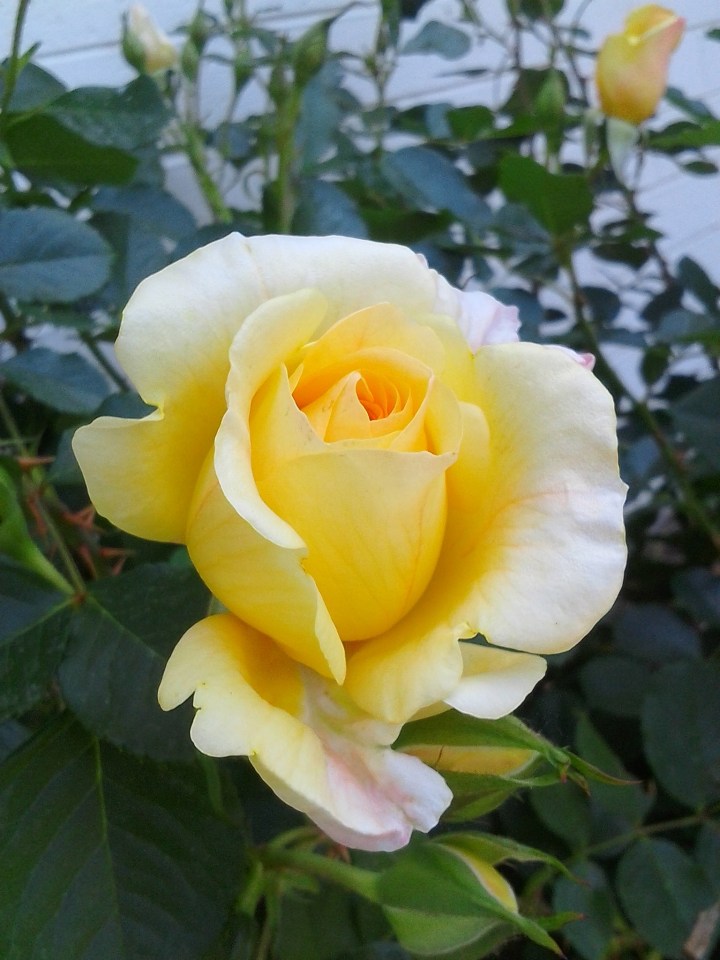 Winter is no excuse to be less diligent in the garden. It would seem that gardening would be less demanding because there is less going on, and so many plants are dormant. However, dormancy is precisely why there is so much to do through winter. Bare root plants and bulbs are planted because they are dormant. Fruit trees get pruned because they are dormant. Now it is time for roses.
Just like fruit trees, modern roses were intensively bred for enhanced production. Their flowers are too big and abundant for overgrown plants to sustain. Consequently, aggressive specialized pruning is necessary to concentrate resources and promote vigorous growth. Rather than producing an abundance of inferior blooms, well pruned canes produce fewer blooms of superior quality.
Also like deciduous fruit trees, roses should be pruned while dormant, preferably after defoliated, and before new buds swell. This sounds easier than it really is. Some roses might still be trying to bloom on canes from last year. Others might be trying to generate new foliage for this year. Fortunately, they are tougher than they look. Besides, early or late pruning is better than no pruning.
Hybrid tea, floribunda and grandiflora roses need the same sort of pruning. They all should be pruned back to only a few canes that grew last year. Older canes should be pruned out completely, unless there are not enough new canes that grew last year. Hybrid tea and floribunda roses need only three to six canes, only about two feet tall. Floribunda roses might have a few more canes. Tree roses should be pruned just like shrub roses, as if the upper graft union is at ground level. The canes can be pruned shorter.
Suckers from below the swollen graft union (from where canes emerge) should be removed completely. If possible, they should be pulled or peeled off instead of cut. This seems harsh, but leaves less of a stub from which more suckers might develop later. Because fungal spores and bacterial diseases overwinter in decomposing foliage, fallen leaves should be raked from around roses.
 Tony Tomeo