It is only coincidence that all of the bloom for today happens to be white. Again, these are old pictures, from two weeks ago or so. The mock orange, Philadelphus lewisii, and black locust, Robinia pseudoacacia, finished bloom a while ago. Both were very fragrant.
I wanted to get these pictures of the ‘Black Lace’ elderberry, Sambucus nigra ‘Black Lace’, and the native blue elderberry, Sambucus cerulea, in bloom, not because they are remarkably pretty, but for comparison. Their more recent bloom has been more impressive, with wider floral trusses. The blue elderberry is very common here, and because common black elderberry are uncommon here, it is our standard elderberry. ‘Black lace’ is only rarely available in nurseries, and grown primarily for the dark foliage and nice bloom. However, some mail order catalogs describe it at a productive fruit ‘tree’, as if it is comparable to other elderberries. It came here as an ornamental. Fruit would be an added bonus. I am very interested to see how it compares to the native blue elderberry, which is excellently productive, particularly if cultivated. It is ideal for award winning jelly, even if it does not win the blue ribbon: https://tonytomeo.wordpress.com/2017/10/01/blue-ribbon/
Elderberry bloom is useful as well, although we have not used it for anything here. I prefer to leave the bloom to make more fruit. However, because there are so many around here, we could easily get a significant volume of bloom without significantly compromising the availability of fruit later on. Bloom can be battered and fried like fritters, or used in beverages. I will leave that work to someone else.
1. ‘Black Lace’ elderberry bloom
2. blue elderberry bloom
3. ‘Black Lace’ elderberry foliage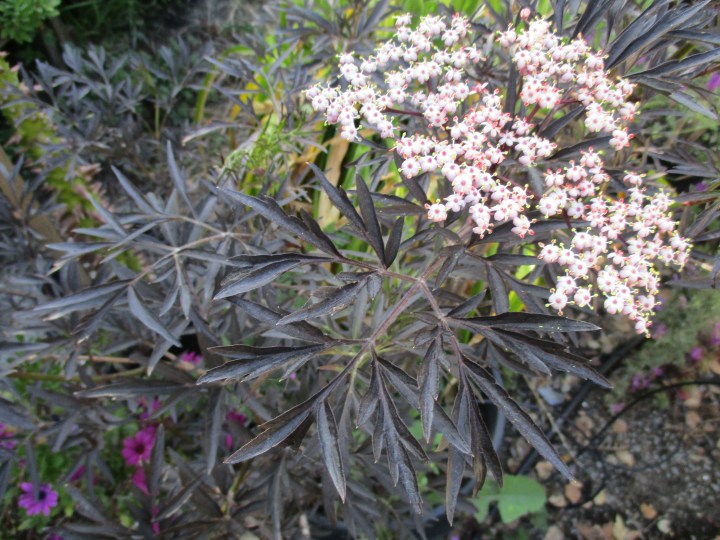
4. blue elderberry foliage
5. mock orange
6. black locust
This is the link for Six on Saturday, for anyone else who would like to participate:
https://thepropagatorblog.wordpress.com/2017/09/18/six-on-saturday-a-participant-guide/


As you said, fewer colors this week but not without interest! I learned that elderberries could be so different … It’s been a long time since I made jelly… a idea for this summer ….Mine is a common elderberry I suppose but flowers and leaves look like the #4.
LikeLike
Elderberry wine coming up?
LikeLike
I simply love the cutleaf purple elderberry, so thanks for putting this up. I have a photo of one at the Eden Project – sadly not available in NZ. We have lots of the normal weed forms and it is illegal to plant, propagate or sell, a pity as they have a nice form and are easily transplanted even when large. But no one has told this to the Sambuca yet as they are very widely distributed.
LikeLike
My mom once tried to make Elderberry wine – it was horrible :)! That experiment was not repeated. The pineapple beer she made was much more successful.
LikeLike
Black lace is often used in gardens in the mid-Atlantic region.
LikeLiked by 1 person
It seems to be more popular than fruiting types. I can not imagine why elderberries are not more popular than they are. They just are not trendy.
LikeLike
The elderberry appeared in garden tours here years ago and now is widely planted, but I still enjoy it (although don’t grow it yet.) Fellow white=in-the-garden lovers think alike. My post is six white as well!
LikeLiked by 1 person
Preferring white can be a problem while growing rhododendrons, for which color is very important. We grew hundreds of cultivars, and only two were pure white, and both of them were not very good plants.
LikeLike
My Mother talked of elderberry wine her folks made.
LikeLiked by 1 person
Some make it here, but unlike wine made with grapes, there is not much elderberry in the elderberry wine I have seen made. I think that it more often gets mixed with other fruit, like dandelion wine.
LikeLiked by 1 person
My dad used to make Elderberry wine it was lethal!
LikeLiked by 1 person
Ha! Lethal! I do not know what that means, but it sound unpleasant. The guy who makes it here adds sugar and water to it. I do not know how much of it is actually elderberry. I have not tried it.
LikeLike
Really interesting contrast between elderberries. I think the native elder in Europe and parts of North America is just plain Sambucus nigra – we have lots here around midsummer which is great for making cordial.
LikeLiked by 1 person
Yes, that is how it is described, just Sambucus nigra, the same species on both continents. The North American elderberries are supposed to be different, and look quite different, but are of the same species. I prefer the North American elderberries, but can not get them here anyway. I gave up and stuck with the blue elderberries.
LikeLike