 It is as scary as it sounds. Well foliated limbs or entire trees really do fall spontaneously during the calmest of warm weather. It never fails to frighten anyone who witnesses it. Those who witness it always express the same difficulty with trying to explain it to those who did not witness it, as if they know that no one will believe them.
Several people heard this cottonwood limb fall onto a bridle path in Felton Covered Bridge Park. It is not a particularly large limb. The diameter about a foot above the flared union is only about seven inches.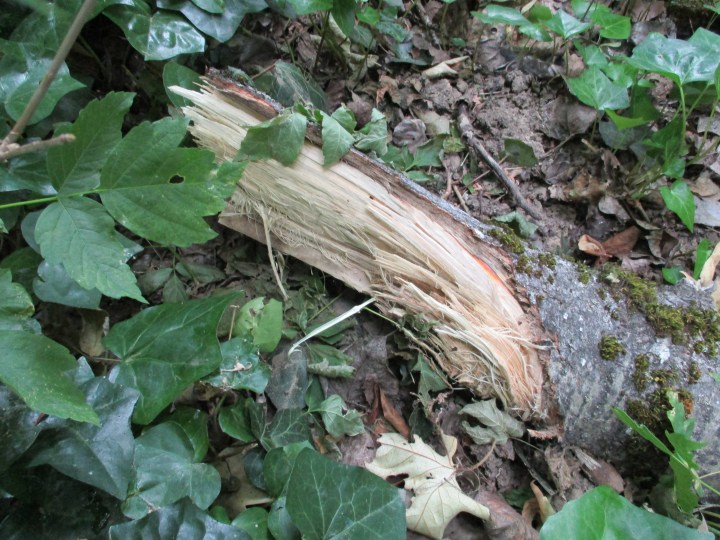
Yet, even this relatively small limb is seriously dangerous when it falls from above, and from such a height.
A much larger sycamore limb that was almost two feet in diameter fell nearby a few years ago. It was like a full sized tree falling from the sky!
What makes it so frightening is the spontaneity. We expect limbs to break when the wind is blowing. Trees are more likely to fall when the soil is saturated from an abundance of rain. Dynamic weather like wind, rain and snow are expected to be the cause of limb or tree failure. Passive weather like warmth and humidity seem like they should be innocent of causing such damage. Not so.
Warmth accelerates vascular activity, which increases the weight of healthy foliage.
Humidity inhibits evapotranspiration (evaporation from foliar surfaces) that would otherwise decrease the increasing foliar weight.
Breezes that are normally thought of as a cause of limb failure would actually enhance evapotranspiration. Therefore, a lack of any breeze actually increases the potential for spontaneous limb failure.
So, while the weather is warm, humid and still, just when you least expect it, spontaneous limb failure is most likely to happen.
 Tony Tomeo
We have this in Australia with the eucalypts- it’s known here as “summer branch drop”. It happened at my place once, overnight at the height of summer, a Spotted Gum dropped a limb which brought down the electricity wires at the front of my house, just outside the front door. Scary.
LikeLiked by 1 person
The blue gum is a common weed tree here, and we know how they can drop their limbs. Any eucalyptus can do it, but he blue gums are the worst because they are so big They drop massive limbs from very high up!
LikeLiked by 1 person
There’s a large cottonwood I drive by every couple of weeks en-route to Dunedin (just north of Waihola, NZ) – a huge branch is jutting over the highway and it has a weak crotch to boot – it’s a definite spontaneous candidate for the coming summer – the traffic department was puzzled when I called and not to interested in doing anything about it.
LikeLiked by 1 person
Our Cal-Trans (traffic department) does about the same because they do not have arborists or horticulturists on staff. They do not even know what the trees they work with are. I suppose that is acceptable most of the time. However, some of the bad situations could have been taken care of before they happened, such as limbs that are obviously going to fall soon.
I will eventually be writing an article about how Cal-Trans employees were selling palms right off of the Santa Monica Freeway! It was so sleazy!
LikeLike
That is very scary. They call them “widow makers” over here
LikeLiked by 1 person
That term gets thrown around a bit.’Widow makers’ is what we arborists called limbs that were cut from a large tree, but got caught up in the tree before reaching the ground. Those who work with forest fires use the term for limbs or trees that continue to smolder, and then fall after a forest fire is put out. I think it refers to any limb or tree that falls when not expected.
LikeLiked by 1 person
Yes that is how I would use it
LikeLiked by 1 person
I suppose the origin of a ‘widow maker’ does not matter to any deceased victim.
LikeLiked by 1 person
A friend and I were talking about this just yesterday. Thanks for the explanation. We were stuck at “wind, lightning, ice” explanations, and unable to account for limbs dropping in ‘perfect’ summer weather. This makes perfect sense.
LikeLiked by 1 person
It typically baffles people.
LikeLike
I’ve heard that sound before, and it is a bit unnerving to have one fall just feet from you! We have lost a couple of large branches on our Chinese Elm that fell, one in a wind storm and one during the summer. There’s another on that same tree that has us a bit worried. We meant to get it cut back this last winter, but just didn’t get to it. Need to do it soon!
LikeLiked by 2 people
Chinese elm happens to be one of those that is notorious for spontaneous limb failure.
LikeLiked by 1 person
When I was living in Mississippi I heard of when they had a severe ice storm. When a contactor came to cut down damaged trees, he told the residents that if they didn’t cut the oaks down, they would fall within 10 years. It actually happened. One resident lost five HUGE trees within 30 minutes one calm day… Ten years after the ice storm.
LikeLiked by 1 person
Not all oaks are remarkably susceptible to spontaneous limb failure, but the live oak group is, particularly specimens that get water through summer.
LikeLiked by 1 person
This wasn’t limb failure. The entire trees fell over. Many all over the area as a result of the ice storm years earlier.
LikeLiked by 1 person
I have a wooded lot and many limbs fall from my trees. I have been calculating my odds of being hit. My neighbor had a tree fall on his house on perfectly nice day. I guess you never know.
LikeLiked by 1 person
My neighbor had a massive valley oak (which rarely drops limbs spontaneously) drop a huge limb onto a carport full of cars. It landed so squarely that most of the building survived. One brand new Saab was impaled right through the pavement, but all other cars were fine.
LikeLiked by 1 person
Reblogged this on Tony Tomeo and commented:
This is just as relevant now as it was when this article posted three years ago, but happened to be relevant a bit earlier this season than it was then.
LikeLike
I did not know this. What a lucid explanation. I’m surprised we don’t have more falling limbs here during the summer…
LikeLiked by 1 person
Your trees may be more accustomed to it, and it may be more common in riparian situations where it is not so obvious. Most of our problematic trees are in riparian situations. However, as an arborist, I used to inspect non riparian trees that were within landscapes in which they were irrigated too generously. It is a major problem there.
LikeLiked by 1 person