Giant bird of Paradise, Strelitzia nicolai, is a grand perennial. It develops several trunks like those of palms, with lush leaves like those of bananas, and bold white flowers. Their bloom can be messy with its sticky and viscous nectar though. Brent and I refer to them as drooling seagulls. For this reason, these giant bird of Paradise needed to be removed. I was pleased to recycle them. They look pathetic now that most of their foliage has been pruned away to minimize evapotranspiration during their recovery. Most should begin to regenerate roots through summer, and then resume growth for next spring and summer.
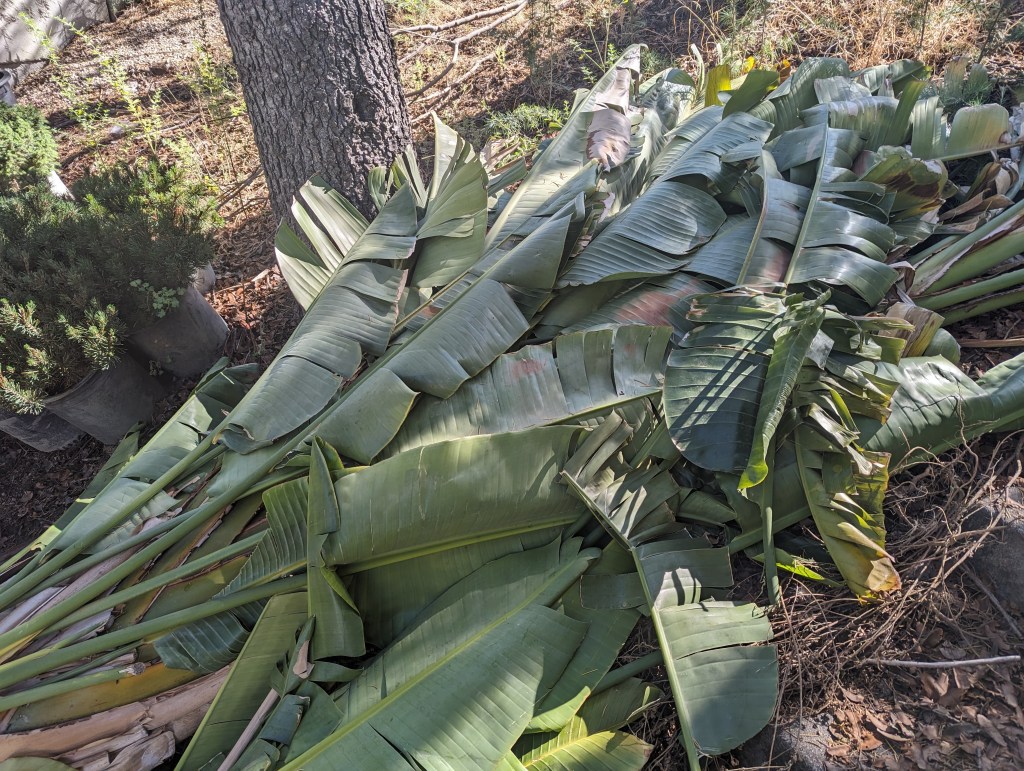
1. Giant bird of Paradise does not look so impressive laying on the ground. This is one of two piles of well foliated trunks that must be processed and heeled in until next autumn.
2. ‘A Flock of Seagulls’ demonstrates how abundantly these mature specimens bloomed. They are not just any seagulls, but are dead drooling seagulls. I will glean them for seed.

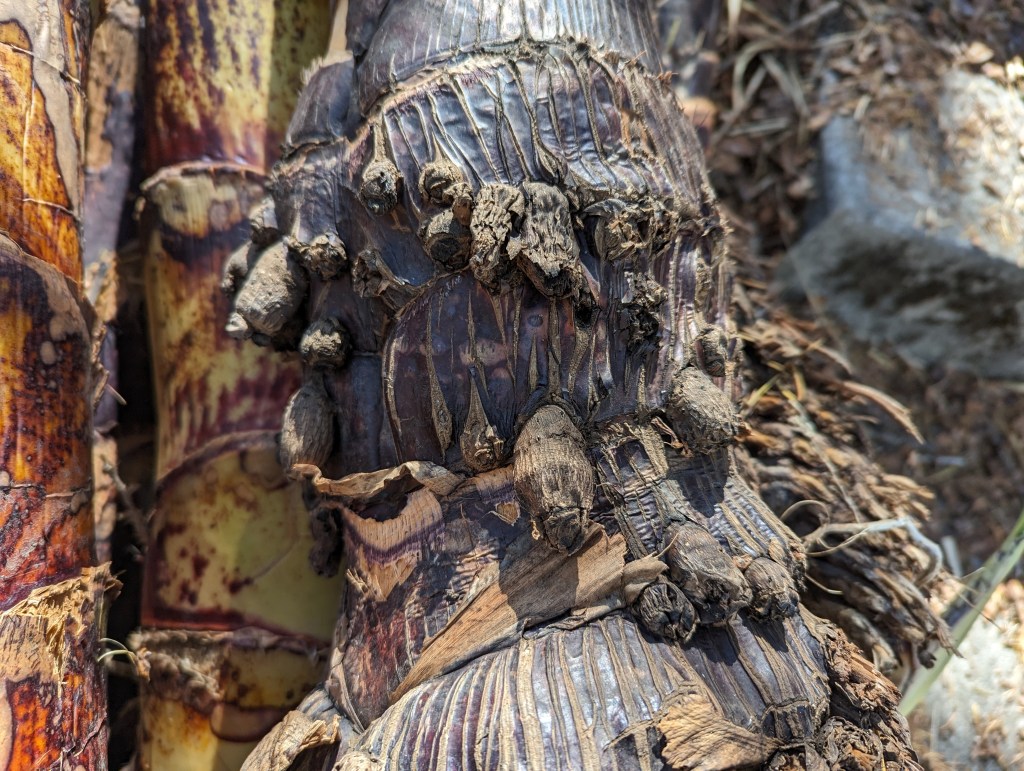
3. Husks make the trunks seem to be bigger than they are. They are the bases of petioles of leaves that were pruned off over the years. Trunks are leaner and tidier without them.

4. Severed roots are unimportant. They merely indicate that a portion of a subterranean rhizome remains attached to the base of a trunk. Trunks are neater without their husks.
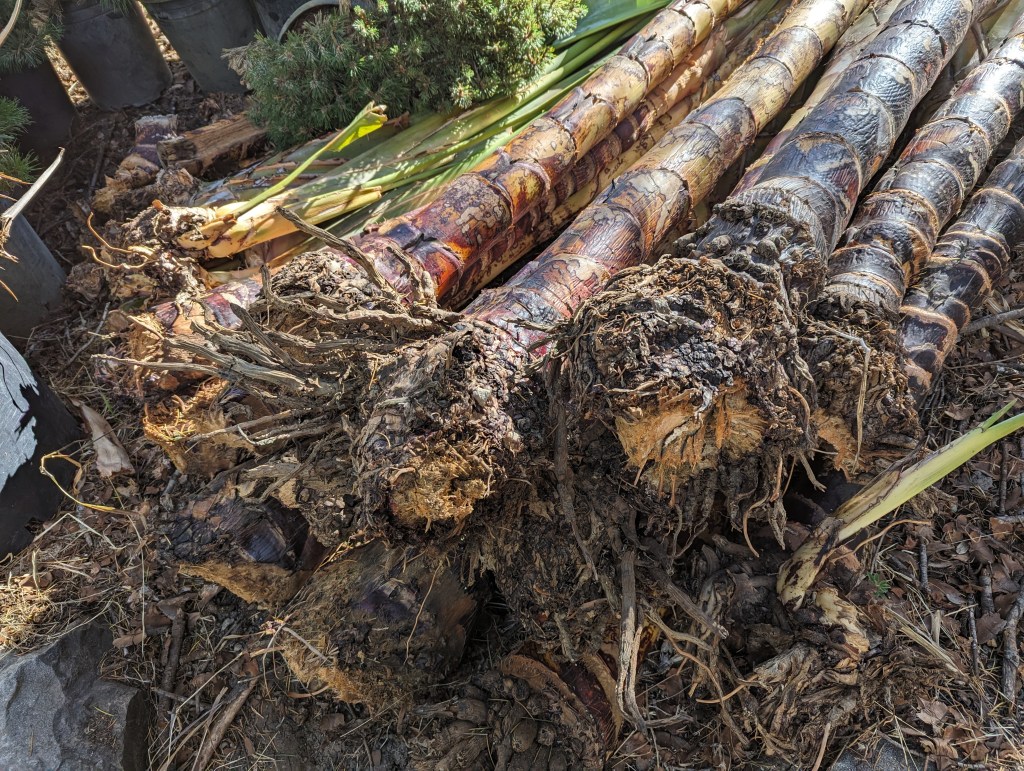
5. Adventitious roots grow from portions of rhizome that remain attached to the bases of the trunks, and from the bases of trunks near the rhizomes. These roots are now buried.
6. Lineup shows that there are about a dozen significant trunks, a dozen shorter trunks, and half a dozen pups. They are heeled in here to begin rooting with frequent irrigation. They will be relocated to their permanent landscape after the rain starts during autumn.

This is the link for Six on Saturday, for anyone else who would like to participate: https://thepropagatorblog.wordpress.com/2017/09/18/six-on-saturday-a-participant-guide/
 Tony Tomeo
Blimey, Tony, I had no idea that this plants grew so enormous. They are considered house plants in the UK. “Drooling seagulls” made me laugh.
LikeLiked by 1 person
They get about twenty feet tall, and can get a bit taller. However, by the time they get that tall, they are getting shabby on top. The tall old trunks should get cut down as they are replaced by fresher trunks from below. Two of the trunks are so tall that I should not have bothered to recycle them. I only took them here because I could not leave them there. I almost cut the tallest in half just to remove it safely, which would have killed it. (Each trunk must have a portion of its rhizome on the bottom, and its terminal bud on top.) Instead, I cut all the foliage off above its terminal bud to get it here intact. It is on the far left in the last picture. Only the lower half of the trunk fit within the pickup. The upper half hung out over the tailgate. Unfortunately, after all the effort, it will likely begin to deteriorate soon after it recovers and begins to generate pups to replace itself with. It may simply generate pups without bothering to recover. I will find out.
LikeLiked by 1 person
I’m impressed that they will survive and grow again from such big trunks. Will they need support until they’re well rooted again?
LikeLiked by 1 person
My question as well!
LikeLiked by 1 person
Yes, but not simple vertical support. They are only vertical now while they recover and begin to regenerate roots. When they go into the landscape, they will need to be supported with the same lean at which they grew, so that the terminal buds are vertical. If we install them vertically, the terminal buds will be leaning, and will then grow vertically, which will cause a kink in the tunk. Supporting them with a lean will take more effort than supporting them vertically.
LikeLike
I have seen some pretty impressive house plant versions of these but it always amazes me when I see something that I think of as a “house plant ” growing outdoors. Oh my goodness!
LikeLiked by 1 person
They are more common in Southern California, particularly within regions that lack frost. Their foliage sometimes gets damaged by frost here, which might be why they are less popular.
LikeLiked by 1 person
Likewise, I’m amazed by the size.
LikeLiked by 1 person
Although they have potential to get a bit taller, they are prettier if shorter than about twenty feet tall. The trunks are sculptural, but the foliage gets shabbier as it gets higher.
LikeLiked by 1 person
Wow, thanks for the gardening lessons too.
LikeLiked by 1 person
You are welcome, but it is only about giant bird of Paradise. It is nothing too complicated.
LikeLike
I love how you are able to recycle one unwanted plant to yield 30 new plants which can be installed in a more appropriate spot to grow with appreciation. I would love to see these in full bloom, covered by their dripping white seagulls! As others have observed, back here ‘Bird of Paradise’ comes in a small pot at the nursery and is not more than 2′ tall. It may be another species of the plant, but I suspect it is just that we don’t allow it to grow into its potential. I tend to pass it by as a fussy florist plant. You’ve demonstrated how tough and resilient the plant can be! Thank you for the botany seminar today!
LikeLiked by 1 person
There is no way to predict how many will survive. I brought back about as many seedlings from Brent’s garden, and most succumbed to the unusual frost last winter. They started as three mature specimens. This species is popular a big interiorscape plant even here and in Southern California. I have never observed it blooming inside. Common bird of Paradise is more proportionate as a houseplant, but does not perform well inside. I would like to grow it here for the bright orange bloom rather than the foliage and sculptural trunks.
LikeLiked by 1 person
That’s one tough plant! Amazing that it can be abused to such an extent and still survive and thrive.
LikeLiked by 1 person
Abused?!
LikeLike
I too, am amazed by the size of this , I have seen them growing, but never as big as this. And ‘ drooling seagulls’ made me laugh.
LikeLiked by 1 person
The common bird of Paradise resembles this species, but does not leave the ground.
LikeLike
Nice plants, dead seagulls or not!
LikeLiked by 1 person
Oh, they will be exquisite as they recover and grow next year. I would like to add some to my garden also. They have such a distinctive style though. They can look silly amongst redwoods. The area into which we would like to install most of them is surrounded by majestic ponderosa pines, . . . but we really want them there.
LikeLike
Nice, I enjoyed seeing the rhizomes. I have one in my garden and a few Travellers Palms. The orange BOP always die – no idea why.
LikeLiked by 1 person
Wow! I find that both species are difficult to kill. I would like to add some of the common orange bird of Paradise for their bloom.
LikeLike
You gave the nicolai their own post! I’ve mentioned before how fond I am of them, so this was awesome to see. Good to know about being able to trim and separate them like that, should the need ever arise.
LikeLiked by 1 person
They are brutal to work with, but worth it. They looked shabby after relocation, and look even shabbier now, but are already beginning recovery.
LikeLiked by 1 person