The definition of perennial is vague. Technically, it refers to anything that persists for any significant time. This should include trees, shrubbery and vines. Horticulturally, though, it refers to persistent species that lack any woody parts. Even this definition is vague, as it includes ferns, palms, yuccas and succulents. Perennials certainly are a diverse group.
Annuals are not perennials, since they finish their respective life cycles within one year. However, most annuals have potential to perform as perennials. They merely do not get opportunities to do so as other annuals become more seasonal. Biennials complete their life cycles within two years, so also do not qualify. Persistent bulbs might qualify, though.
Canna, for example, grows from thick and fleshy rhizomes that qualify as summer bulbs. Once established they are resiliently persistent. They proliferate and can migrate as they do so. Calla and various ginger do the same. All are easy to propagate by division while more or less dormant. They defoliate where winters are colder, but regenerate for spring.
Lily of the Nile is among the most popular and common perennials. It is very resilient and persistent. It does not need much attention or water, and is very easy to propagate. Even without bloom, its evergreen foliage is appealing. African iris, or fortnight lily, is probably the second most common perennial. It requires a bit more grooming than lily of the Nile.
New Zealand flax is a bigger perennial, although some cultivars are relatively compact. It is more foliar than floral, since its thin floral stalks are not as striking as its bold foliage. Daylily is among the more floriferous perennials, with bright yellow, orange or red bloom. Beard tongue is another efflorescent perennial, but with white, pink, red or purple bloom.
These are merely a few examples of the most locally popular and practical of perennials. This list should also include hosta, coral bell, yarrow, Shasta daisy and various salvias. It is impossible to mention all of the perennials that perform well here. Although most are evergreen, some are deciduous. Most need irrigation while some can actually naturalize.


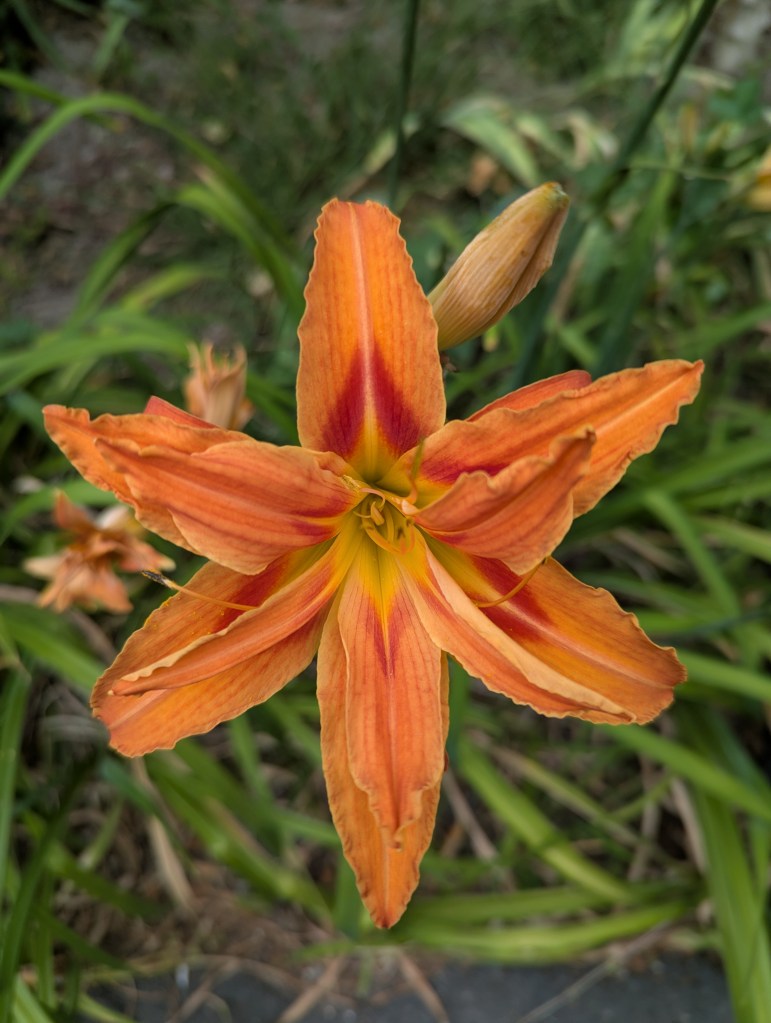
I have a lot of orange daylilies along the border to the woods. I know they are referred to as ditch lilies, but I enjoy them anyway.
I have a question for you. I have an old oak tree with hosta planted around it. The deer eat the hosta, and I’d like to remove them but they are entrenched with the tree, and I can’t move them. Any suggestions on how I can kill them out and cover with mulch? Cardboard was the only thing I could think of. Thanks.
LikeLiked by 1 person
Goodness, I have no idea how to kill hostas because I have always been more concerned with keeping them alive. They do not do well in our climate, so would die without any assistance if we did not pamper them. I am sorry that I do not have any recommendations.
LikeLiked by 1 person
Hmm, I have named cultivar Purslane I have been wondering exactly the same thing about..it was insinuated to be perennial, but I am not so sure. I love those daylilies H. fulva?
LikeLiked by 1 person
I believe that common purslane is an annual, but that it can provide cuttings like portulaca. Because the daylily is so much more vigorous than the cultivars, I suspect that it is Hemerocallis fulva.
LikeLiked by 1 person
I have been trying to figure out what the purslane is.. I have annual purslane that is native but not the same thing..
LikeLiked by 1 person
Is is shrubby or a ground cover? Rock purslane is perennial.
LikeLiked by 1 person
This is a goundcover. I will look up rock purslane.
LikeLiked by 1 person
I do not know if it is a real purslane, but that is its common name.
LikeLiked by 1 person
https://www.danzigeronline.com/series_annuals/pazzaz-nano/ I finally found it! I have mango, it is holding up beautifully now and they claim it is perennial??
LikeLiked by 1 person
Wow, I am completely unfamiliar with it. It is related to the common annual purslane.
LikeLike