Horridculture – Watersprouts or Suckers?!

90501thumbDo we really know the differences between watersprouts and suckers? It seems simple enough. The definitions of each should be rather distinct.

When I grew citrus, I knew what sort of sucker that I had to contend with. Suckers were any unwanted stem and foliar growth from the understock below the graft union. In the picture of the trunk of the young plum tree above, the graft union is clearly visible between the scion to the upper left and the understock to the lower right. Suckers would be below such a graft union.

This sort of sucker is known as such because it sucks resources that should be directed to the more desirable but often weaker scion. A sucker that is more vigorous than its associated scion is likely to overwhelm and replace it if not removed. Scions are expected on freshly grafted plants, but should become less prevalent as they mature, and the scion dominates the understock.

Suckers might develop either on the short section of understock trunk between the graft union and the ground, or on the roots below the ground. They only need to be below the graft union.

Okay; that definition is simple enough. Here is another.

Watersprouts, as far as I am (still) concerned, are unusually vigorous and typically adventitious stem growth that can resemble suckers, but develops above a graft union. They should likely be removed, but might just be pruned back a bit if they happen to be where a new branch is desired. After all, they are genetically identical to the desired plant, whether it is grafted or not.

Because watersprouts grow above a graft union, they occur only among the branches and main trunks above the ground. They do not grow from the roots of understock below the ground.P90921+++

The picture above shows watersprouts on (VERY badly) pollarded bay trees.

Okay; that is another simple definition.

What about vigorous stems that grow from the roots of ungrafted trees? Can they be suckers if they are not sucking resources from a scion above a graft union? Can they be watersprouts if they are not growing from stems or trunks? It seems that the simple distinction between watersprout and sucker was the location relative to a graft union. What if there is no graft union?!

The vigorous black locust stems in the picture below are growing from the roots of ungrafted black locust trees (which, incidentally, were cut down last winter). Some might say that they are root suckers, which is a third and accurately descriptive designation for such vigorous stem growth. Otherwise, they could be either (or both) suckers or (and) watersprouts. Both work.

I know that many arborists refer to such root suckers from ungrafted trees as watersprouts, which is not at all inaccurate. I am also aware that many arborists refer to watersprouts like those on the bay trees above as suckers, . . . which is sort of inaccurate. I will not argue. I know what they mean.P90921+

Carrot

91002Bugs Bunny was an expert. He was always chewing on a carrot, Daucus carota, and rudely talking with his mouth full. Because carrots can be stored in refrigeration for a few months, Bugs Bunny could get one whenever he wanted to. However, in home gardens, they are cool season vegetables that are grown through spring and autumn, but not through summer or the middle part of winter.

Carrots are biennial. They complete their life cycle in two seasons. They are vegetative during their first season, as they produce their edible and elongated conical taproot. If not harvested, they bloom and go to seed in their second season. By then, their fat roots are tough and useless. Carrots are ready for harvest in three to four months after their seed are sown, depending on variety.

Carrots are famously bright orange. Yellow, white, red, purple and black varieties have been gaining popularity in the past many years. The longest carrots might be a foot and a half long, but most are less than half as long. Many are only about four inches long, or less. They may be as narrow as half an inch, or wider than two inches! Some carrots are more uniformly cylindrical than conical.

Get Cool Season Vegetables Going

91002thumbThe difficult part will be removing the aging warm season vegetable plants while they are still trying to produce. That is one of the disadvantages of gardening in such an excellently mild climate. It would be easier if frost or cooling weather caused them to start deteriorating by now. Perhaps some are already getting tired. Regardless, their space is needed for new cool season vegetables.

Some of us like to amend the soil in between some of the lingering warm season vegetable plants, and add seedlings of cool season vegetable plants. Then, there is less of a rush to remove the warm season vegetables as they succumb to autumn weather. Some of us just wait for the warm season vegetables to finish, which is a delaying compromise for the new cool season vegetables.

Whatever the preferred technique is, it is now getting to be time to plug in seedlings of broccoli, cauliflower and cabbage. Kale seedlings may be added as much as a month later. Seedlings can be purchased from nurseries. Those of us who want particular varieties that are unavailable in nurseries might have sown preferred seed in flats a month or so ago, to be ready for planting now.

Beets, carrots and turnips, like all root vegetables, should be grown from seed sown directly into the garden. Roots get disfigured if grown in flats or cell packs, and then transplanted. Besides, so many individual plants are needed, that such quantities of cell packs would be expensive. Seed for turnip greens, although not grown for their roots, likewise gets sown out directly, and about now.

Seed for leafy lettuces, spinach and peas should have been sown already, but it is not too late. Kale can alternatively be grown from seed sown directly now, rather than from seedlings plugged in later. If preferred, larger heading lettuces can be grown from seedlings plugged within the next month or so. Cucumbers can be risky. If seed has not yet been sown, seedlings can still be plugged.

Whether grown from seedlings or seed, this is only the first phase of cool season vegetables. For some, later phases will prolong harvest.

Gopher Architecture

P90922If gopher burrows had windows, this burrow would have hillside views. If gophers had better eyesight, the one who lives here could enjoy the views from such windows. Of course, views are not a concern for any gopher. They just want to burrow through the soil to eat the many roots they encounter. They do not often emerge from their homes for more than the ejection of soil.

If it happens in gardens and landscapes, the consumption of roots by gophers is a serious problem. It can kill substantial plants faster than associated symptoms become apparent. Agaves and yuccas that are safe from grazing animals that might want to eat them from above have no protection from gopher who attack from below. Small perennials and annuals get taken whole.

Excavation such as that in these two pictures is a major problem too. When I see soil accumulating here, I wonder where it came from. Should I expect a sink hole to appear somewhere else? Soil displacement can enhance and promote erosion, and displace pavers. Holes and volcanoes (mounds) are tripping hazards in lawns, especially if the holes do not appear until stepped on.

The damage seen here is not yet as serious as it looks. The only roots for gophers to eat here are those of black locusts that I must eradicate anyway. Gophers will not bother the bay trees or redwood trees; and if they do somehow bother the bay trees, I would not mind. However, I don’t want gophers to eventually find and kill any of the lauristinus that I just installed nearby.

It all would be so much easier and mutually beneficial if inconsiderate gophers could be trained to be neater and discrete with their otherwise sloppy excavation, and to eat only weeds and other unwanted plants.P90922+

Six on Saturday – II: Six More


Six on Saturday‘ is a popular popular gardening meme that many of us garden bloggers participate in on Saturdays. The link explains how it works. Simply, we post six pictures of what is happening in our gardens or landscapes at the time, along with brief explanations. Mine just posted at midnight. I know I should be done, but I happened to find a few more pictures to share.

These six pictures of marigolds that were just installed at work are not as interesting as the topic I wrote about earlier, but are just too pretty to be discarded before I show them off. The second and third pictures, as well as the fourth and the fifth pictures, might be redundant to each other if they show the same varieties of marigolds, but I do not care. They are all so pretty.

Marigold will not likely be featured in my weekly gardening column this year, because the bigger but related African marigold was featured last October. These here are the smaller and more traditional French marigold. Their bright yellows, bright oranges and rusty reds suit late summer and autumn like miniature chrysanthemums. Their foliage is so delightfully aromatic.

Although I am none too keen on annual bedding plants, I happen to like marigold. They were more popular when I was a kid. They were not so variable back then; and there were certainly none of those pathetic fake white sorts that are really just pale yellow. They were plain and simple orange, yellow and rusty red, in blends or uniform. We could easily grow them from seed.

Unfortunately, marigolds will not be with us for long. They were planted to replace petunias that did not last long enough. At the end of autumn, they will be replaced by cyclamen for winter.

P90921KP90921K+P90921K++P90921K+++P90921K++++P90921K+++++

This is the link for Six on Saturday, for anyone else who would like to participate:

https://thepropagatorblog.wordpress.com/2017/09/18/six-on-saturday-a-participant-guide/

Six on Saturday: Locust


John the Baptist did not really eat orthopteran insects out in the desert. The locust he ate were the beans of the carob tree, Ceratonia siliqua. They are actually quite nutritious. Supposedly, they are known as locust because they resemble the elongated abdomens of the insects with the same name. A few other related trees that also produce beans are collective known as such.

Robinia pseudoacacia happens to be known as black locust, even though there is nothing black about it, and the tiny and papery beans do not even remotely resemble insects. Supposedly, it arrived with Gold Rush prospectors who wanted something of their homes in Eastern North America. It naturalized aggressively, and is now an invasive exotic species in much of the West.

We tolerate a few at work. They are too pretty to cut down without a good excuse. However, one gave us a good excuse when it fell last winter. It was notably polite about it, by falling into a gap between two roofs that a cat could jump across. Damage was very minimal. Nonetheless, the tree and its destabilizing associates needed to be removed. They are gone but not forgotten.

1. Thorns of black locust only look blurry in this picture. They are wickedly sharp! The sharpest are on the most vigorous stems, which is exactly what the freshly cut stumps here generate.P90921

2. Thickets of suckers (or watersprouts) like these developed where black locust trees were cut down last winter. Most developed on freshly cut stumps. Many emerged from random roots.P90921+

3. More than half of the suckers from the formerly impenetrable thicket around the stump at the center of the picture were removed to relinquish space for the lauristinus in the foreground.P90921++

4. A few bay trees got cut down with the black locust trees. I wanted them coppiced, but was away when they instead got VERY badly pollarded. Oh, the shame! (I will coppice them later.)P90921+++

5. As nasty as black locust is, it has a few attributes. Spring bloom resembles that of white wisteria, and is almost as fragrant. This finely textured pinnately compound foliage is quite elegant.P90921++++

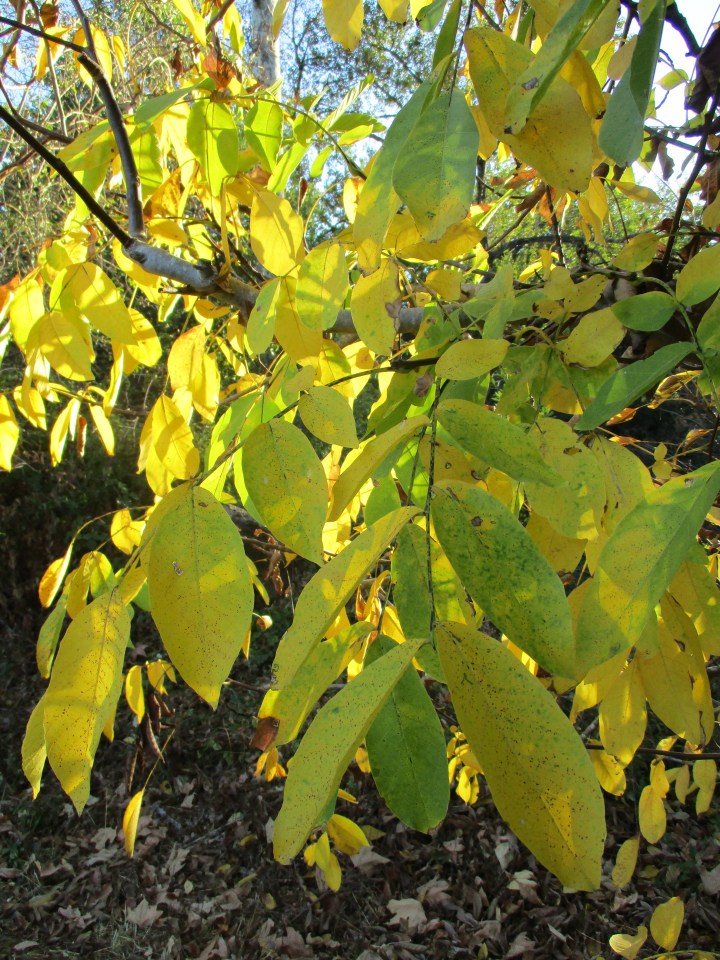
6. Their high and open canopies provide nice shade too. It is just enough for warm summer weather, but not too much to exclude turf grass and understory plants that tolerate partial shade.P90921+++++

This is the link for Six on Saturday, for anyone else who would like to participate:

https://thepropagatorblog.wordpress.com/2017/09/18/six-on-saturday-a-participant-guide/

Gardenia

40917It seems that everyone who has ever experienced the seductive yet powerful fragrance of gardenia, Gardenia jasminoides, wants to grow it, but very few actually can. Gardenias like warmth, but prefer more humidity than they get here, which is why they seem to be happier in partial shade, in atriums, or in urns that can be moved out of harsh exposure during summer. In such sheltered spots, aphid, scale and sometimes whitefly can be problematic.

Gardenias want their own space, where their roots will not be bothered by excavation or roots of more aggressive plants. They do not even want annuals around them, because annuals need such regular cultivation. Docile ground cover plants or simple mulch is best. Gardenias like rich soil and acid fertilizer or fish emulsion to be applied regularly as long as the weather is warm.

The creamy white flowers that fade to French vanilla can seem mundane relative to their alluring fragrance and handsomely glossy foliage. The largest flowers rarely get to three inches wide. ‘Mystery’, which can slowly get four feet tall, is the most familiar cultivar, even though it does not bloom so much after spring. ‘Veitchii’, which can eventually get three feet tall and twice as wide, has small inch-wide flowers, but is still blooming. Modern cultivars bloom just as late, but with larger flowers.

Autumn Simply Will Not Wait

40917thumbReady or not, it will be autumn in just a few days. Formal hedges can be shorn one last time if they need it. They will not grow much until spring. Actually, photinia and the various pittosporums should not be shorn much later than now if they exhibit any dieback. Some of the diseases that cause dieback are more likely to infest freshly cut stems during rainy weather. Citrus and plants that can be sensitive to frost should not be pruned later, since pruning can stimulate new growth that will be more sensitive.

For the same reason, most plants should not need fertilizer as their growth naturally slows. Through winter, new growth is likely to be damaged by wind or discolored by nutrient deficiency. Even if the nutrients that keep foliage green prior to autumn are in the soil, some are less soluble at cooler temperatures. It is really best to allow plants to get some rest. Only plants that are active through winter, like cool season vegetables, cool season annuals, and some cool season turf, will benefit from fertilizer.

However, some plants that are generally dormant through cool winter weather will not be completely inactive. Many plants, particularly tough evergreen perennials like lily-of-the-Nile, African iris and many ferns, continue to disperse their roots to be ready to sustain new foliar growth next spring. This is one of the reasons why autumn is the best time to get such plants into the garden, even if they do not seem to do much until spring. Autumn is also a good time to seed lawns or install sod.

The other reason for planting in autumn is that, as the weather gets cooler and rainy, new plants that have not yet dispersed their roots will be less likely to dry out than they would be in spring or summer. Some bulbs that will soon be available in nurseries want to be in the garden before winter because a bit of cold weather promotes healthier bloom.

Horridculture – On The Fence

P90522Where I lived in town, the backyard was surrounded on three sides by fences, with the house on the only unfenced fourth side. These were the sort of fences that were common in suburban neighborhoods. They kept children and dogs in or out of adjacent gardens, and probably provided some sense of privacy, although I never understood why we all needed such privacy there.

I mean, if I really wanted significant privacy, I would not have lived in town, where the homes and gardens were all so close together. I enjoyed living there, and I enjoyed my neighbors. We could hear some of each others conversations and televisions, but no one seemed to mind. It was worth living in such an excellent neighborhood so close to everything we could want in town.

Years ago, suburban fences were not too obtrusive. They were only about four feet high. Some of the older homes were still outfitted with picket fences that were only about three feet high. We could still talk to neighbors over them, and sometimes pass over a bag of extra fruit or vegetables, or even flowers, from the garden. Dogs and young children were effectively contained.

Then everyone became obsessed with privacy. At the same time, many of us added onto our homes or replaced them with new homes that occupied more of the allowable space within their compact formerly suburban, but now urban parcels. Smaller remaining garden spaces became more shaded by bigger houses and taller fences. Gardening, as we once knew it, became passe.

What are all these big fences for? What are they keeping out? . . . or . . . What are they keeping in? Why do so many who want so much privacy live so close to so many who crave the same?!

Pittosporum tobira

90925A surplus of common names seems to be a common theme for many plants that we thought we knew the names of. The simple Pittosporum tobira, which might be known here by its Latin name, might instead be known as mock orange, Australian laurel, Japanese pittosporum, and Japanese cheesewood. Its native range is about as diverse, including Greece, Japan, Korea and China.

Back in the 1990s, the compact cultivar known as ‘Wheeler’s Dwarf’ was common enough to be as cliché as tam junipers were in the 1950s. There are actually a few other dwarf and variegated cultivars that do not share that reputation. Most are low, dense and mounding. ‘Variegata’, although not a compact dwarf, grows slower and stays smaller than the unvariegated straight species.

Otherwise, Pittosporum tobira gets about ten feet tall and wide. It can eventually get significantly taller, especially if lower growth is pruned away to expose the sculptural trunks within. If shorn as a hedge, it should not be shorn so frequently that the dense foliage is always tattered. Leaves are delightfully glossy and convex. Small trusses of modest pale white flowers are sometimes fragrant.