Vegetables Change With The Seasons

90814thumbRight smack in the middle of the warm part of summer, it is already time to be getting ready for autumn gardening. This involves more than just ordering our autumn planted spring bulbs while the selection is still optimal. Most of us purchase bulbs from what is available in nurseries when they are in season anyway. Seed that gets sown in the next few weeks is a more immediate concern.

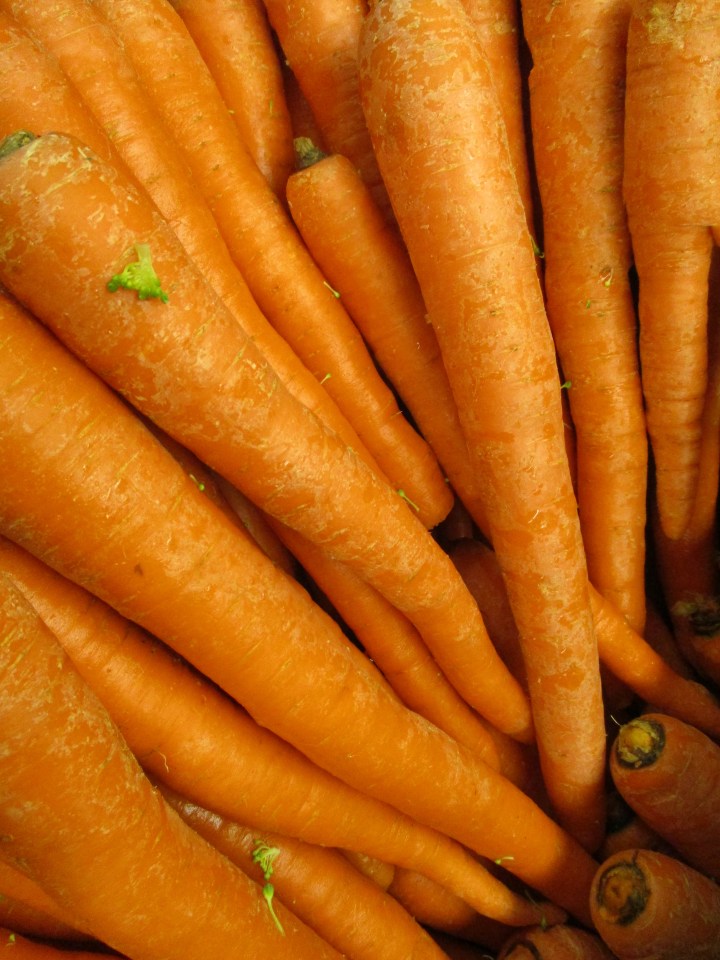
The majority of cool season vegetables will get planted later, when the seasons actually start to change to become . . . well, cool. Seed for beets and carrots gets sown directly in about a month, followed by pea seed even a bit later. At about that same time, many of us will plant small seedlings of other cool season vegetables, like broccoli, cauliflower, cabbage, lettuce, spinach and kale.

For many of us though, it is not that simple. If we want varieties of these cool season vegetables that are not likely to be available as seedlings in nurseries later, we must grow our own from seed. Whether they get sown directly into the garden, or into flats to be grown as seedlings to be planted later, broccoli seed should be sown about now. By the time it gets to growing, it will be autumn.

Seed purchased online or from mail order catalog should be ordered by now. It is not too late for broccoli if the seed arrives and gets sown soon. Cauliflower and cabbage seed gets sown within a month or so, as late August becomes early September. Lettuce and spinach seed should wait half way through September, like beet and carrot seed. Kale seed can wait until after September.

Seed for secondary phases of most of these cool season vegetables can be sown early next year.

In the meantime, warm season vegetables must continue to be harvested very regularly. If they stay in the garden long enough to get tough and bland, they also interfere with continued production. Foliar herbs can be harvested for drying just about any time they are fresh and not blooming. Regular harvesting inhibits bloom, and therefore promotes more of the desirable foliar herbal growth.

Suckers For Street Trees

P90804This grand sycamore has likely been here since the third day of Genesis. A few of the top branches got broken off when Noah’s Ark floated over. When I was a little kid, it was on the edge of a vacant field where road debris was dumped, and older kids rode their dirt bikes. Now it is on the western edge of the parking lot of Felton Covered Bridge Park. I write about it sometimes.

California Sycamore‘, ‘Hanging Gardens Of Babylon‘, ‘Nature Is Messy‘ and ‘Tufts‘ are some of the articles that feature this exquisite specimen. The last three of these examples describe some of the difficulties of old age for sycamores. Something that I may not have mentioned in these article though, is that such mature sycamores eventually develop root suckers.

I use the term ‘suckers’ loosely. For those of us who grow grafted trees, ‘suckers’ are stems that develop from below the graft unions of grafted trees, even if above the roots. They are from the understock below, so are genetically different from the scions above. Unusually vigorous stems above graft unions or on ungrafted trees, including the roots, are known as ‘watersprouts’.

For all other intents and purposes, ‘suckers’ really are just vigorous stems that emerge from roots, which is what we have here. Because no one was here to graft this grand sycamore on the third day of Genesis, these ‘suckers’ are genetically identical to the main tree. Unfortunately, their appearance indicates that the tree is finally acknowledging that it is slowly deteriorating.

Many trees do it, especially old riparian trees. When they know that they will not be around much longer, but still have some time to do so, they divert resources into their own replacement. Suckers are expected to mature into new trees after the original is gone. They recycle the mature original root system until they eventually replace it with younger and more vigorous roots.

Arborists may try to interfere with this process by removing suckers and watersprouts, and diverting resources back into older stems. This is actually helpful for trees that are distressed, but not yet decaying. For trees as mature as this sycamore, removal of vigorous suckers and watersprouts is mostly cosmetic, because thickets of such rampant growth becomes unsightly.

As violent as it sounds, it is best to abscise suckers like these when they first appear, and any that appear afterward. That involves literally tearing them from their roots to remove some of the callus growth from which they emerged. Cutting them at the ground not only leaves the callus growth to develop into distended burls, but also stimulates more vigorous sucker growth!

Now that these suckers have been cut down repeatedly over the past several years, simple abscision is no longer possible. Callus grown has expanded and fused into broad subterranean burl growth. Removal of such extensive burl would severely distress and possibly contribute to the destabilization of the already distressed tree. Suckers can now only be cut down to the ground.

Several years ago, when the first of the suckers started to appear, they were much easier to abscise. The process was delayed until winter dormancy. The small defoliated suckers were then abscised along with much of their associated callus. It did not accomplish much for the massive tree, and only delayed the inevitable for a few years, but generated an interesting byproduct.

The bare suckers with their bit of callus were ideal for growing into copies of the same tree. Most were plugged back into the riparian area nearby, but later killed by necessary vegetation management. A few others were canned (potted), and grew into small sycamore trees that were planted, with other sycamores, into broad medians and parkstrips in Mid City Los Angeles.

It is a long story about how those few trees ended up in Los Angeles, and were added to the fifty or so Birthday Trees that we plant annually on January 18. Sadly, their identities were lost in the process. If the other sycamores are genetically identical clones of each other, it may eventually be possible to distinguish genetic variations of those that were once root suckers here.

Bad Picture Of Good Berries

B90803KHimalayan blackberry is to cane berries what blue gum is to eucalypti. It is what gives all cane berries a bad reputation, and is why so few of us want to grow them. Himalayan blackberry grows as an extremely vigorous weeds, extending sharply thorny canes over anything within reach. When the canes are removed, the tough roots are extremely difficult to remove and kill.

If ignored, the canes ‘leap’, which means that they develop roots where they arch back downward to touch the ground. From there, they grow into new plants that extend new canes in all directions, to start the process all over again. (‘Leaping’ is like ‘layering’, which involves the development of roots where stems ‘lay’ on the ground.) Their seed gets where their canes do not.

The thorns are ‘prickles’, which really is a technical term for sharply pointed distensions of bark or epidermis. They are more like stout prickles of rose canes than the more finely textured prickles of garden varieties of cane berries. They are rigid, extremely sharp, and curved inward to snag victims on their way out; so are seriously wicked and potentially dangerous to handle.

Harvesting berries from second year canes is not easy. Most are out of reach within bramble thickets. Because they ripen through a long season, they must be harvested repeatedly, as those that were unripe during a previous harvest finish. This is why there are black, red and green berries in the same picture. The berries are small and variable, with good years and bad years.

This happens to be a good year. The thorny truss of a few small berries in the picture may not look like much; but there are plenty of them. The berries are quite richly flavored too. Those who have the patience to collect them will get some good jam or jelly out of the deal.

Six on Saturday: Cannas – Mostly


There are only four pictures of cannas here. I could have gotten two more for an even six, but would have needed to get them elsewhere. These six pictures were obtained within one of the landscapes at work. Except for pruning a grapevine and flowering cherry trees, I do not work in this garden, so can not take credit for these cannas. I will take credit for the pictures though.

However, I probably should have taken pictures that show the foliage in conjunction with the bloom. Without the foliage there is not much to distinguish the big orange flowers of the last two pictures from each other.

1. Kangaroo paw, Anigozanthus, is one of my lesser favorite perennials, but happens to be one of the more practical for the chaparral climate. Besides, this one happens to be rather pretty. I do not know what cultivar, or even what species this one is. The Eucalyptus cinerea to the upper left is the same that was featured in ‘Silver‘ and ‘Exfoliating Bark‘.P90803

2. Honeysuckle, which I believe might be Lonicera periclymenum ‘Peaches & Cream’ was featured as the second picture of ‘Six on Saturday – Not My Garden‘, and was likely also featured in other posts that I do not want to go looking for right now. When I first met this honeysuckle, it was rather grungy and mostly defoliated. I thought that it was Lonicera sempervirens ‘Major Wheeler’, which looks nothing like this.P90803+

3. Canna with wispy orange flowers and big green leaves is probably my favorite of the four. The big leaves, which are not shown here, are quite lush. I believe that this one can get quite tall.P90803++

4. Canna with bigger red flowers and simple green leaves is more what we expect a canna to look like. The bronze foliage to the right and in the background actually belongs to #6 below.P90803+++

5. Canna with big orange flowers and yellowish variegated leaves was the fourth picture of ‘Six on Saturday – No Silver‘. That picture shows only a close up of the foliage, without bloom.P90803++++

6. Canna with big orange flowers and bronze leaves was the third picture of ‘Six on Saturday – No Silver‘. That picture also shows only a close up of the foliage without bloom. I believe this to be the cultivar ‘Wyoming’.P90803+++++

This is the link for Six on Saturday, for anyone else who would like to participate:

https://thepropagatorblog.wordpress.com/2017/09/18/six-on-saturday-a-participant-guide/
Mandevilla

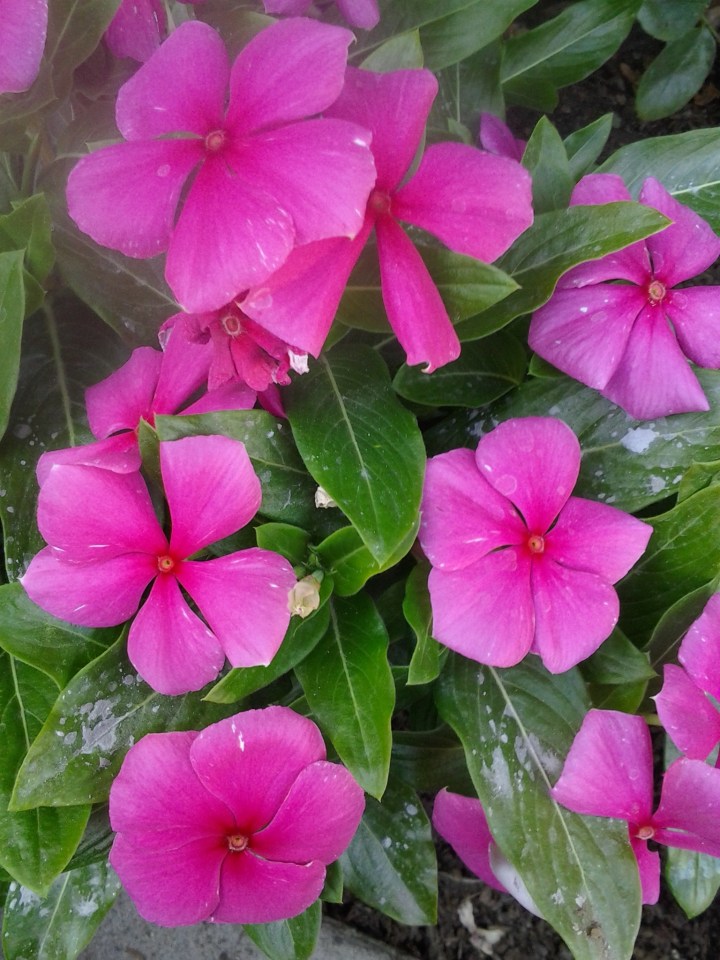
60803‘Alice Dupont’ mandevilla that was so popular through the 1980’s was already a cool vigorous but not too overwhelming vine, with big clear pink radial flowers. It grows rather vigorously to upstairs eaves, and tends to get bunched where it reaches the top of its support. Modern cultivars with red, white or bright pink flowers are more compact and tame, and can stay below downstairs eaves.

The wiry twining stems neither root into their support like ivy does, not get bulky enough to constrict and crush their support like wisteria does. However, old vines might get thick enough to split lattice apart. New plants are greener in partial shade, although they will probably climb to where they get full sun exposure. The glossy evergreen foliage is surprisingly sensitive to even mild frost.

Mandevilla is tropical, so enjoys warmth, but not aridity (minimal humidity). Overly exposed foliage can get scorched by hot weather. Sporadic bloom continues from spring through autumn, with more prolific bloom phases in response to warm weather. Unfortunately, mealybug, aphid, scale and whitefly enjoy warm weather too. While pruning, the caustic white sap can be a toxic nuisance.

Vines Do Not Replace Hedges

90619thumbUrban homes are innately close to other urban homes. Newer homes are even closer to each other than older homes are, and are more imposing. Establishing or maintaining privacy can be a challenge, especially for high windows in narrow spaces. Even though home builders prefer to place windows strategically, some windows invariably face into neighboring windows or gardens.

Trellised vines are a popular but rarely effective remedy to this dilemma. The narrow spaces between houses and below the eaves can be dark enough to inhibit growth. Consequently, vines are typically sparse or bunched on top of their trellises. Their most vigorous growth is often awkwardly long shoots trying to find a way out of the shade. Vines are not exactly easy to work with anyway.

There are of course exceptions. With regular maintenance, some finely textured vines that are reasonably tolerant of shade can be effective for downstairs windows. (Upstairs windows are out of reach.) If shorn very regularly, English ivy on lattice works almost like a hedge. (Ivy does not fill in on more open trellises.) Trellised star jasmine is even better, but needs more depth (front to back).

Yet, with few exceptions, big evergreen shrubs or small evergreen trees that tolerate shade are more practical. They support their own weight, so only need to be pruned for confinement and clearance from the houses that they provide privacy for. Some shrubs and trees should be pruned to stay at the desired height, so that superfluous upper growth does not shade out lower growth.

The various podocarpus are some of the better small trees for narrow spaces between houses because they are are somewhat tolerant to shade, and are so easily pruned into shape. Some of the taller and more upright pittosporums work nicely in sunnier spots. Arborvitae tolerates more shade, and naturally stays narrower. Since some of these better options might grow slowly, they can be planted with faster growing shrubbery that can be pruned back, and eventually removed as the preferred plants mature.90619

Horridculture – Microtrees

P90731We arborists happen to like trees. That is why we are arborists. Most of us also understand that trees are not appropriate for every situation, or where they are not appreciated. There is no point in planting a tree where it will just get cut down by someone else who does not like it. We want trees to be happy. We also want those who live with them to be happy with their trees.
Trees are ‘generally’ desirable over parking lots and roadways. They provide shade that cools the pavement during hot summer weather. Arborists naturally prefer trees that get big enough to make substantial shadows. It is also important for such trees to get high enough to be pruned for minimal clearance above the biggest vehicles to use the roadways or paring lots. They should also be pruned above streetlamps and signs.
Clearance of signs is a serious problem in strip malls and commercial districts, where trees are regularly disfigured by those wanting to keep them below their signs rather than above. It takes a few years to prune trees upward, and many merchants do not want to wait that long. There is also a concern that substantial trees will make substantial messes, and damage concrete curbs, gutters and sidewalks.
Microtrees are not always the answer! They are a cop out! For many situations, it is better to contend with the problems of larger trees than to pretend that microtrees are somehow better.
These dinky crape myrtles will never be proportionate to the roadway to the left or the parking lot to the right. They will not get high enough to be pruned for adequate clearance, so will instead be mutilated for confinement. They will likely get shorn into nondescript globs that rarely get a chance to bloom, and that pedestrians will need to duck under.
Crape myrtle is the most common of the microtrees that so commonly end up where other trees would be better. That is why so many arborists sometimes misspell ‘crape myrtle’ without the first ‘e’.

Morning Glory

90807A landscape designer would have more fun describing both the modern and the good old fashioned varieties of morning glory. Their vivid colors are so resplendent. Their rich green foliage is so luxuriant. Their delicate vines are so elegant. Hey, perhaps this is not so difficult. Anyway, the popular garden varieties of morning glory are descendents of various species of the genus Ipomea.

Except for a few obscure types, and the perennial blue dawn flower, popular garden varieties of morning glory are surprisingly complaisant annual vines, which grow from seed sown at the end of winter. Without getting too invasive or weedy, they sometimes reseed where they get watered, although they might revert to a more feral state after a few generations, or after the first generation.

Some varieties of morning glory have the potential to reach single story eaves, although most stay a bit lower, and some varieties do not get much higher than a doorknob. They work well on small trellises, or even simple stakes, and are just right for picket fences. The simple two or three inch wide flowers are rich hues of blue, purple, red, pink and white, some with spots, stripes or streaks.

Docile Annual And Perennial Vines

90710Most of the familiar vines really are exploitative bullies. They shade the same trees and shrubs that they climb for support. Some will even strangle and kill those who make it possible to get where they want to be. If they do not find trees or shrubs to victimize, they are likely to climb walls and ruin the paint, stucco or siding. Their aggressive nature can be a problem in landscape situations.

Fortunately, there are several vines that are not so aggressive or destructive, such as mandevilla, lilac vine, star jasmine and Carolina jessamine. Other vines that are even more complaisant are light duty perennials and annuals that might grow like weeds while the weather is warm, but then do not have enough time to grow too big or do much damage before they die back through winter.

If flashy color is not important, vining vegetable plants such as pole beans, cucumbers and peas, can cover fences very nicely. On flat fence surfaces, such vines will climb string strung in a vertical zigzag pattern between a horizontal row of protruding nails at the top, and another similar row at the bottom. Unsightly cyclone fences are even better, but will need be harvested from both sides.

Although it is too late to sow beans and cucumbers, a new phase of peas can be sown in mid summer for production in autumn. Fragrant and subtly colorful sweet peas, which are grown for their flowers rather than as vegetable plants, take considerably more effort here. They get started in autumn for the following spring. Trailing nasturtium can get sown at any time, for summer or winter.

As the name implies, perennial pea is a perennial that can get almost rampant, but dies back by autumn.

Passion fruit vine can either be a perennial that dies back to the ground in winter, only to regenerate the following spring, or a somewhat woody vine with wiry stems that survive for several years. Those that retain their vines through winter can get cumbersomely big, or can alternatively be cut back severely late in winter, to behave almost like more docile types that die back for the winter.

Workday

Felton League is another blog that I sometimes share articles from here with. This is the first article from Felton League that got shared here. It is more about ‘Workday’ that was posted here earlier.

tonytomeo's avatarFelton League

Workday at Felton Presbyterian Church, from eight to noon on Saturday, July 27.

Yes, that was yesterday. I would have written about it earlier, and in time to plan for it; but I was just informed about it less than a day earlier, on Friday morning. Fortunately, plenty of parishioners attended and got quite a bit done. In the future, we will need to be more diligent about announcing the workdays at lunch on Tuesdays. Even though some of us who attended more regularly in the past are no longer here, there are newcomers.

The biggest project was the removal of those rotting benches on
the northern half of the patio out front. The sturdy posts that
supported them for all these years were surprisingly sound, and the
last few needed to be pulled out by a pickup with a tow chain. It was
a mess, but worth the…

View original post 306 more words