Too Much Grapefruit

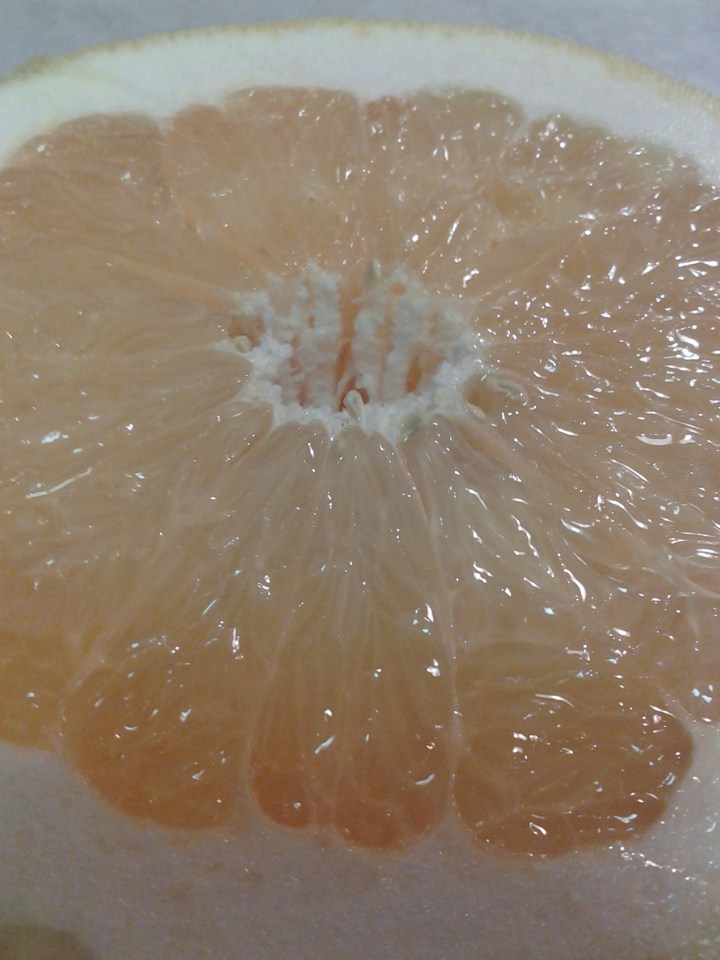
P80303KThere really is such a thing as too much grapefruit. I know; I have witnessed it more than once.

The most recent occasion was two years ago. We were pruning a few fruit trees for a client in San Jose. One of the trees was an old fashioned ‘Marsh’ grapefruit, which happens to be my all time favorite grapefruit.

As we were pruning, the client was dragging brush away to curbside recycling. Most of our clients prefer to do the ‘cleanup’ to save money. The client asked me if I would like some of the fruit. Of course, surplus fruit is one of the many benefits of our work; and of course, I told the client that I would be pleased to take some of the excellent grapefruit. I then went back to work on a nearby persimmon tree.

While busy with the persimmon tree, I was unaware of what the client was doing with the grapefruit. I knew that there was quite a bit of it. She and her sister bagged it and took it out front. From there, they loaded as much of it as they could into the little Blazer (Roy, the ‘Bravada’. It is a long story. I will explain later.). By the time I finished, the Blazer was FILLED with bagged grapefruit! I really should have gotten a picture.

There was no way I could eat or share all that grapefruit before most of it went bad. However, it would have been rude to leave the fruit there after they had so nicely loaded it into the car. Naturally, I ate a lot of grapefruit. It was excellent! The good news is that I really was able to share all that I could not eat or juice. None of it was wasted.

Six on Saturday: My Favorite Color II – The Sequel!


WHITE!

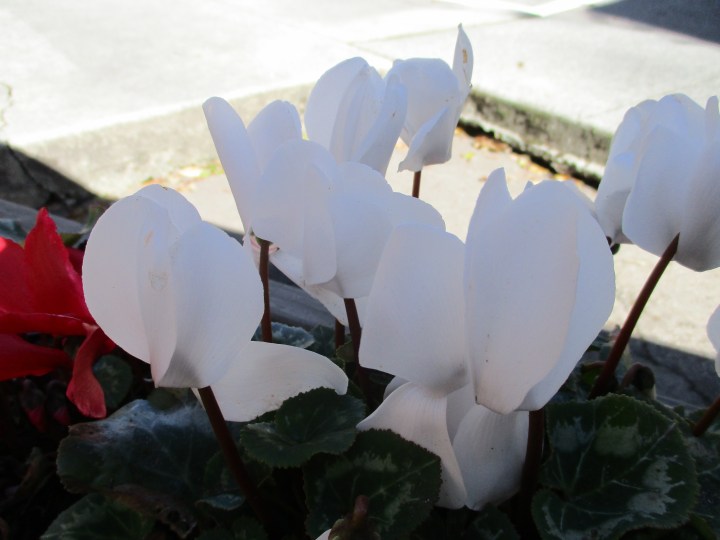
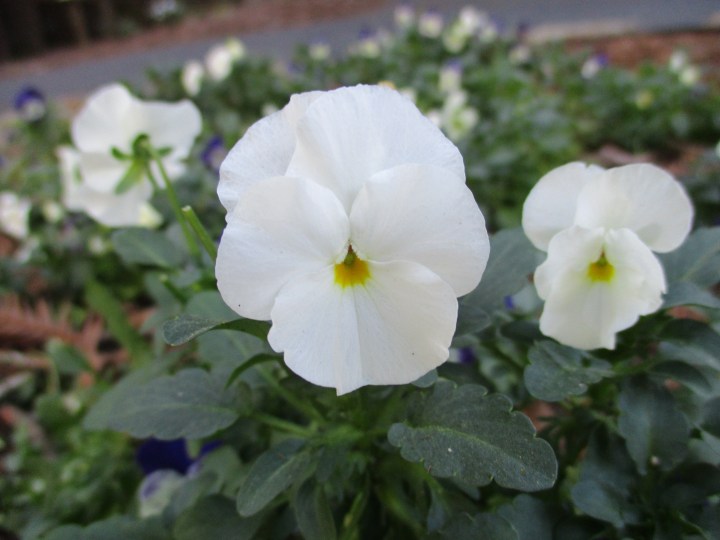
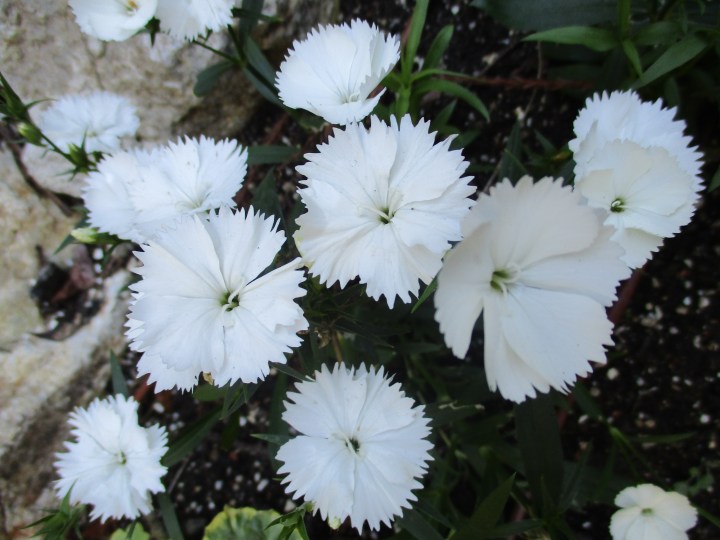
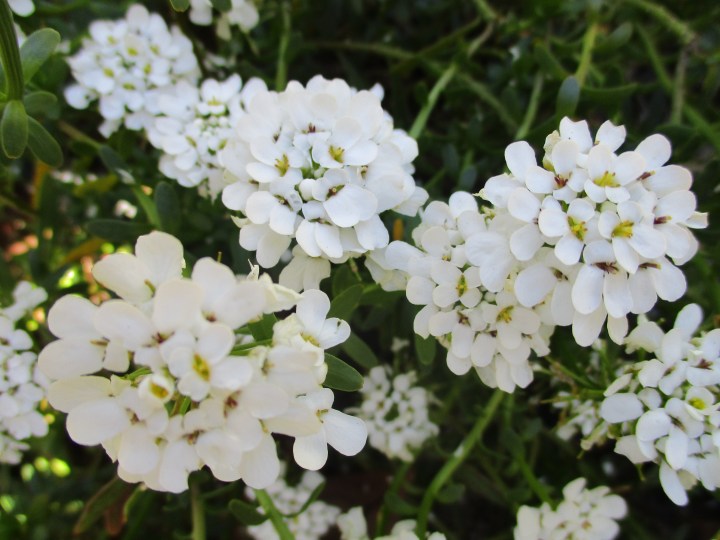
These are a few more of the flowers I get to work with. The cool season annuals will eventually be replaced with warm season annuals. The English daisies are warm season annuals that replaced cyclamen. Candytuft stays as a perennial. The viola and dianthus are sparse because of the shade from the big redwoods.

If you are easily offended, you should not read this article I wrote earlier about my favorite color: https://tonytomeo.wordpress.com/2017/09/21/white-supremacy/

1. cyclamenP80303
2. violaP80303+
3. dianthusP80303++
4. primroseP80303+++
5. English daisyP80303++++
6. candytuftP80303+++++
This is the link for Six on Saturday, for anyone else who would like to participate:

https://thepropagatorblog.wordpress.com/2017/09/18/six-on-saturday-a-participant-guide/

Almond

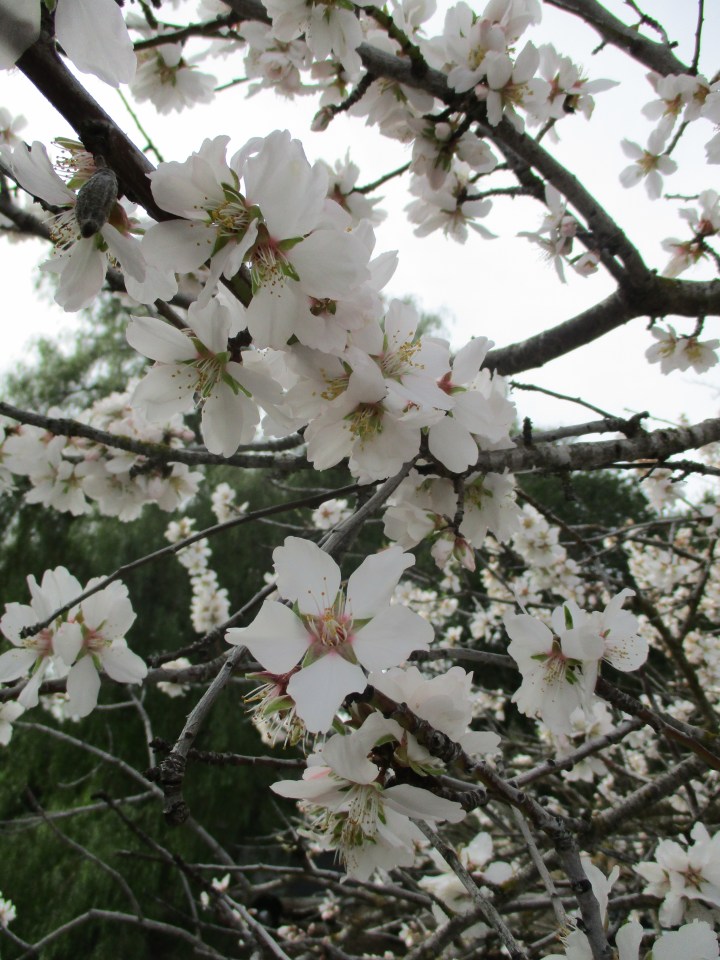
70301It is known more as a small to mid-sized shade tree that produces edible nuts, but almond, Prunus dulcis, also blooms magnificently as soon as the weather allows. Actually, it often blooms a bit earlier than it should. Nut production can be ruined if rain dislodges blossoms or developing nuts. The profuse white flowers are small but slightly larger than those of other related stone fruit trees.

Yes, almond is the same genus as apricot, cherry, plum, peach and the other stone fruits. The fruit is actually very similar, but instead of developing into sweet flesh, it merely forms a hull that dries and separates from the nut within. The nuts are the large seeds or stones, like peach pits that can be eaten. Hulled but unshelled almond nuts are about one or two inches long. Because the nuts get shaken from trees instead of picked, trees can be allowed to get about two stories tall.

RAIN!?

10914This is not sequel to ‘SNOW!?’ from yesterday.

Nor is it a sequel to any of the other brief article about rain in the past.

I just recycled the picture because I still find it to be amusing.

If you are a native of California like I am, and are wondering what ‘rain’ is; I have already explained it sufficiently in previous articles. Basically, it is those unfamiliar droplets of water that fall mysteriously from the sky and get everything wet. Look it up if you must.

The article that I posted earlier this morning was recycled from this time last year, long before I started posting articles here. Our rain has actually been very deficient. It has rained only a few times this season.

We tend to talk about rain often here because it is so important to us. So much of California gets such a limited supply. Although our annual rainfall is technically sufficient, and has been sufficient longer than anyone can remember, there are millions of people living here who need the water that it provides. Fluctuations of weather are normal, but are somewhat distressful for those of us who are aware of how weather affects the water supplies that rely on rainfall. Much of the population of California gets water from surprisingly remote sources that are much more reliable than local sources. However, some regions rely on local aquifers that are sustained by local rainfall.

The ‘mostly’ good news for now is that is it raining presently. Seriously! It is raining; and is expected to continue raining through Saturday.

I say that this is ‘mostly’ good news because so much rain within a short time is likely to be disastrous to areas burned by wildfires just a few months ago. Floods and mudslides could, and are actually expected to cause significant damage near Montecito and in other areas of Santa Barbara and Ventura Counties. Highway 101 could be closed again.

We just can’t seem to get it right. If we get enough rain, vegetation in wildlands becomes more combustible. If the combustible vegetation burns, the burned area is more susceptible to mudslides and flooding if we get enough rain again in the subsequent season. So, major wildfires, as well as mudslides and floods, are less likely if we do not get enough rain. If we get enough rain, we are more likely to get a messy situation.

Rain Makes Watering Seem Obsolete

IMG_1921Watering has not been much of a concern lately. All the rain has kept our gardens too wet to work in. Some of us have been more concerned with erosion caused by runoff. Automated irrigation systems are probably disabled until the rain stops. Soil can drain somewhat between rain, but will not really dry out until the weather gets warm again. Dormant plants do not draw much moisture.

However, as strange as it may seem, there are a few plants that might want to be watered. Potted plants on roofed porches are sheltered from rain, just like houseplants. They will not dry out nearly as quickly as they would during warm summer weather, but they do eventually get dry if not occasionally watered. Hanging pots and small pots containing big plants typically dry out faster.

Plants that were moved onto porches for shelter from frost can be moved out into the rain if that would be easier than watering them. It is very unlikely that they will be damaged by frost this late. Besides, as long as it is raining, the weather can not get cold enough for frost. (In fact, any frost damage that was left through winter can be pruned away now that fresh new growth is developing.)

Small plants in the ground under big eaves might need to be watered as well, if they have not been in the ground long enough to disperse their roots beyond the eaves. Annuals do not last that long. Mature plants might have dispersed their roots well enough to get enough moisture from outside. They might not notice if the soil inside is too dry, as long as the weather is cool and humid.

Houseplants are of course in a league of their own, and as long as they are inside the home, get no water from rain. They might need less watering in winter if the home stays cooler; or they might need slightly more watering if the home heating system reduces humidity. Regardless, some might enjoy going outside to a spot sheltered from the wind, for a brief rinse from a mild rain shower.

Eventually, the weather will get warmer and drier, and automated irrigation systems will need to be reactivated. When that happens, the emitters and sprinklers should be checked for efficient function. While inactive over winter, they can get grungy or clogged with mineral deposits. Plants will not need much water early in the season. Irrigation increases as spring and summer progress.

SNOW!?

P80110If you do not know what it is, ‘snow’ is like frozen rain.

If you do not know what rain is, I wrote about it earlier for those of us who are native to the drier parts of California. If you notice strange drops of water falling from the sky tonight, that would be rain. There is no need to be alarmed. It is expected to happen here tonight, and a few times for the next few days. Contrary to former experience, it is normal for this time of year.

Anyway, getting back to snow. Unlike rain, which sometimes happens here, snow does not happen here.

Well, perhaps that is not entirely true. It might have happened as recently as 11,700 years ago, as the Ice Age ended, and again in more recent history, in February of 1976, when an epically humongous snowstorm deposited as much as half an inch of snow over the Santa Clara Valley!

It is difficult to imagine such a huge volume of snow! It must have been disastrous! It would be even more disastrous now, with more than a million people just in San Jose, and many of them driving cars!

In 1976, we third graders did not consider it to be disastrous. We were not old enough to drive. We were perplexed and mystified at first, but rather quickly discovered that snow had serious potential for being fun. Our parents wadded it up into something known as ‘snowballs’ and then threw these snowballs at each other and the neighbors. Yes, I know it sounds crazy. Nonetheless, it looked like fun, so we tried it. It really was fun. We also discovered that we could just as easily throw snowballs at cars driving by, but we were instructed to not do that. We could see that the Santa Cruz Mountains were discolored by snow. They were an almost white hue of very pale blue, speckled with the more typical darker blue.

On very rare occasion, when the ‘smog’* and smoke blew away on clear and cold wintry days, we could see snow on the tops of the highest peaks of the Diablo Range east of the Santa Clara Valley, particularly on Mount Hamilton where Lick Observatory is located. We did not know what it was. Before snow happened in our own neighborhood, we wondered what discolored the peaks like that.

Now that smog rarely obscures the view of the Diablo Range, snow is visible on the group of peaks around Mount Hamilton almost annually. If it gets cold enough, a slight blush of snow might be seen on the lower East Hills in front of the Diablo Range. It is quite scary to think of how close to home snow can be. There happens to be snow up there right now!

I am sorry that I do not have a picture of the snow on Mount Hamilton. I will just recycle this picture of Bill trying to escape snow south of Oklahoma City.

* Historical notation – The East Hills and Diablo Range to the east of the Santa Clara Valley were rarely visible in the olden days because of ‘smog’. If you do not know what smog is, you are fortunate. I have not written about smog yet because it is a part of our history that we would prefer to forget. To be brief, smog was a common form of air pollution. Although there was less smog in winter, there was more smoke from ‘fireplaces’ and burning ‘orchard’ stubble. A fireplace was a primitive heating device that warmed the interiors of homes and other buildings with the combustion of wood. An orchard was a grove of trees that were installed and maintained for the production of fruits, nuts and a few other horticultural commodities. Orchards once occupied vast areas of the Santa Clara Valley. Orchards that were removed to relinquish space for other development provided some of the wood for fireplaces. Perhaps I should write more about these later. I understand that the ancient history of the Santa Clara Valley can be rather baffling at times.
Tent City

P80224KIn the autumn of 1989, small and temporary tent cities appeared in parks and other public spaces around the San Francisco Bay Area and the Monterey Bay Area, where many homes had been damaged or destroyed by the Loma Prieta Earthquake. They were necessary at the time, but were not intended to be permanent features of the landscapes. For a while, they were unpleasant reminders that some people could not go home until their homes were repaired or rebuilt.

In more recent history, ridiculously expensive real estate and rents have increased homelessness in the same regions. Even gainfully employed people are homeless because they can neither purchase nor rent a home, either because of expense or because of a lack of availability. Those who live in homes complain about the unsightliness and other problems associated with the homeless living in homeless encampments and small tent cities.

We get it. Tents are bad.

So then, what is this small tent city on one of the main roadways in town?

Good planning and bad planning.

First the good. Each of the shop spaces in the contemporary retail building behind this tent city needs its own water meter and valve manifold. Each of these meters and manifolds must be easily accessible. Because they are accessible, they are also exposed, so they need to be insulated so that they do not freeze during the very rare occasion (in our mild climate) that the weather gets cold enough to do so. This explains why the water meters are next to the sidewalks, and the upright valve manifolds behind them are covered with these billowed tents.

The bad? Good landscape design should have been considered with the location of these meters and manifolds. A water main line should have been routed so that this whole complex could have been constructed within a utility closet or shed, or even a small utility yard that could have been fenced in a less prominent location. If constructed inside a utility closet or shed, the insulating tents would not be necessary. Now that it is too late for that sort of planning, there is not even enough clearance from the sidewalk for hedging or low fencing to obscure the meters and manifolds without obstructing access. It really would not have taken much of a landscape modification to obscure the view of all this infrastructure, if only more space had been made available where it is needed.

Sadly, landscape design was not a priority on this building. Although the water meters and manifolds are completely exposed, shrubbery obscures window and more appealing features of the buildings, such as ornamental stonework. The view from inside many windows is of the unsightly backsides of pointlessly shorn shrubbery. Trees were crowded and planted directly in front of signs, even though there is plenty of frontage without signs where trees could have been planted. It is amazing what some landscape designers get away with.

Transvaal Daisy

80307There is some controversy about the identity of the flowers that Micky Mouse picks at the porch to present to Minnie Mouse when she answers the door. Some insist that they are Transvaal daisy, Gerbera hybrida. When they are not in black and white, the substantial daisy flowers are cartoon hues of yellow, orange, red, pink and white, sometimes with chocolatey brown or black centers.
Transvaal daisies are always available as cut flowers, but bloom best in cool spring and autumn weather in home gardens. Most garden varieties have single flowers on bare stems. Most cut flowers are semi-double. Double flowers that resemble zinnias, and spider flowers that resemble spider mums, are rare. Coarse basal foliage gets almost a foot high and a foot and a half wide.

Because the foliage is so vulnerable to snails, Transvaal daisy is usually grown in pots rather than in the ground or immobile planters. Besides, potted plants can be brought into the home or put in prominent spots while blooming, and then put out of sight between bloom. Transvaal daisy wants partial shade, regular watering and occasional feeding. It can take full sun exposure if not too hot.

Plants Are Masters Of Deception

80307thumbMany of us already understand that daisies, sunflowers, asters and all related flowers are composite flowers, which bloom as many tiny flowers clustered tightly together to form what appears to be significantly larger single flowers. Distended ‘ray’ florets around the edges imitate petals that other types of flowers are equipped with. It is like one stop shopping for pollinators craving nectar.

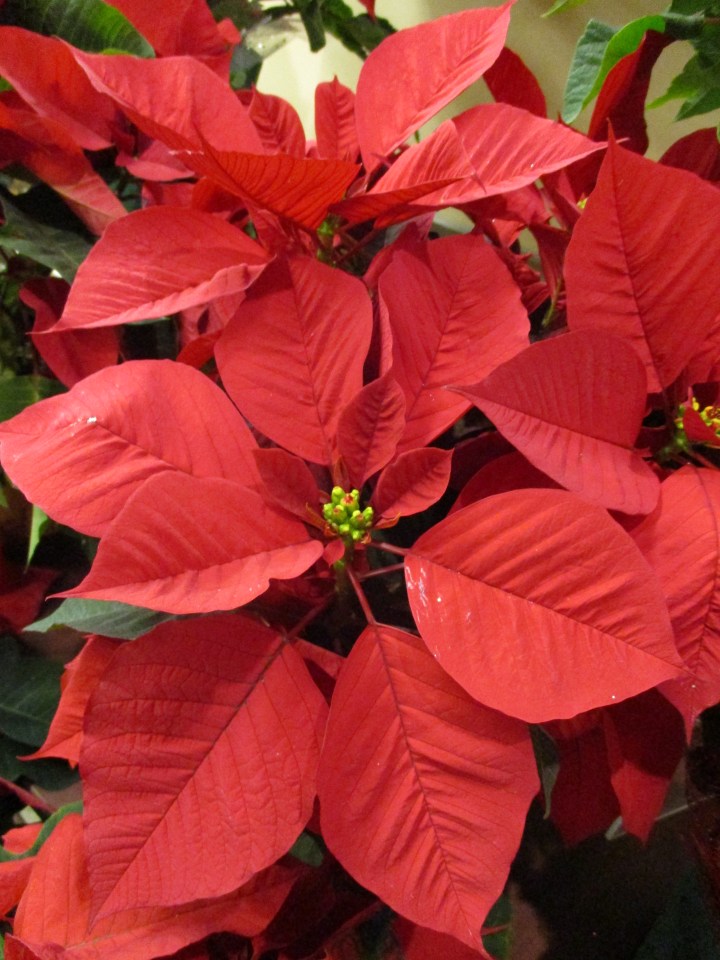
Many other plants have developed comparably ingenious techniques for facilitating what they need to do. Flowers are the more common beneficiaries of their creativity. Fruits, leaves, stems and roots have also been modified out of necessity. For example, the colorful bracts around tiny poinsettia and bougainvillea flowers are modified leaves that pretend to be petals to attract pollinators.

We think of strawberries, pineapples and figs as fruit. Strawberry fruits are actually the small specks on the outside that resemble seeds. The sweet and juicy part that suspends these fruits is a modified stem. Each ‘eye’ of a pineapple is a swollen flower, that is fused with flowers around it. Tiny fig flowers bloom and produce seed all within the fleshy floral structure that is eaten like fruit.

Some types of acacia trees have no real leaves. Their foliage is comprised of distended petioles (leaf stems) known as ‘phyllodes’, but without the leaves that petioles normally support. Juvenile leaves that actually look like lacy acacia leaves do not last long. Makrut lime has big phyllodes too, but in conjunction with leaves, which is why they seem to have double leaves joined end to end.

Cacti and the euphorbs (poinsettia relatives) that resemble them are among the most deceptive of plants. Euphorbs that have both recognizable leaves and thorns provide hints about how they work, since some tufts of thorns and spines also have leaves. Each tuft is a node. Small bristly spines are modified leaves. Larger and stouter thorns are modified axillary stems. A few stems develop into limbs or segments. Without leaves, the fleshy green stems do all the work of photosynthesis.

Foliar Tapestries

P80224Succulent foliage is remarkably variable, even without bloom. There are so many unusual colors, textures and patterns to choose from. Many are complimentary to others. Many contrast exquisitely. What better way to display some of the favorites than to assemble them into a succulent foliar tapestry!?

This is actually old technology that started to become a fad again only somewhat recently, after these foiar tapestries were installed on a retaining wall in North Hollywood a few years ago by GreenArt Landscape Design. Small cuttings of succulent plants were plugged into rigid mesh panels that hold growing medium vertically against another flat panel of the same size. The whole contraption was suspended against the concrete wall, with a bit of space in between to limit staining and bleeding onto the wall.

With the fountain, potted plants and other features, the limited space was insufficient for a hedge to obscure the retaining wall. Besides, the uniform foliage of a hedge or clinging vines climbing upward, or cascading plants hanging downward, would have been rather boring. These foliar tapestries look like artwork that might hang on walls inside the home, except that they are outside, visually extending the interior living space out onto the patio.

Foliar tapestries certainly are not for everyone. There is nothing ‘low maintenance’ about them. The small plants must be groomed regularly, and trimmed to stay flat. Flowers will need to be snipped off before or after bloom. The heavy planters must only be installed onto concrete walls or walls that are able to support the weight, and must be installed properly to avoid staining and bleeding. Wooden walls would be likely to rot so close to so much moist growing medium. However, as you can see, in the right situation, such tapestries are worth the effort.P80224+P80224++