Median Landscapes

P80311Medians are nice on the widest of boulevards. They break up the expansiveness of otherwise contiguous lanes. They make a four lane boulevard seem more like a pair of two lane roadways. Berms and other obstacles within medians limit the potential for head on collisions with traffic from opposite sides of the medians. Trees shade and cool some of the pavement when the weather gets warm. Besides all that, medians that are modestly landscaped simply look nice.

Notice that I said ‘modestly’ landscaped. There really is no need to get carried away with landscapes in medians. No one is really looking too closely at them anyway. People are driving past them, and really should be paying more attention to the road ahead rather than what is blooming to the side. Even passengers who are not driving probably are not seeing much of what goes into median landscapes. Color in such landscapes is nice; but no one cares if the color is provided by plants that are expensive and consumptive to maintain, or plants that can more or less survive on their own. It other words, resources should not be wasted on medians. Expensive and consumptive public landscapes should be installed only in parks or other places where they can be seen and appreciated.

Then there are those who must perform the maintenance. It is not safe for them. It will of course be necessary for crews to go out to maintain medians sometimes, and sometimes they might need to block a lane to do what needs to be done; but they should be out there as little possible. They should not be out there deadheading roses, pruning wisteria or planting petunias. They certainly should not be mowing lawns that no one can use! High maintenance features, like formal hedges, fountains, espaliers, trellises, arbors and beds of seasonal annuals, have no business out in medians! Such features require too much attention from those who must interact with traffic to attend to the maintenance.

Turf uses too much water anyway. It is useful in parks and athletic fields, but should be limited to situations where it can actually be useful for something. It is not useful in medians.

Trees are perhaps the best features of median landscapes, but even they are often not well thought out. They should be proportionate to the roadways that the get installed into, and get high enough for adequate clearance above truck traffic. Vertical clearance is not important if small trees can fit between the curbs of wide medians, but such wide medians should probably be outfitted with larger and taller trees. Trees in medians should exhibit complaisant roots that are less likely to damage curbs and pavement.

Landscape design takes serious work; and there is a lot to consider when designing landscapes for medians.
Look What The River Washed In!

P80224KWhat is it?!?

Is it alive?

Was it alive?

Is it moving?

Should we roll it back into the river?

Can we eat it? Someone actually asked that.

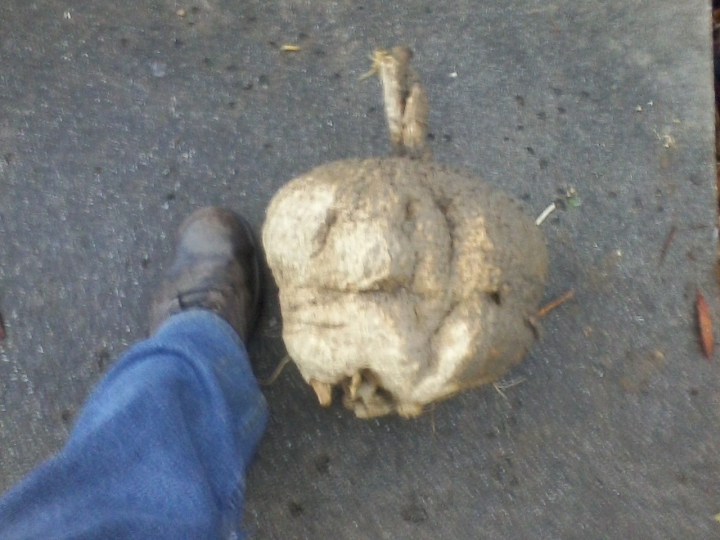
It really is as big and ugly as it looks. That is a size 11 boot next to it to demonstrate how big it is. We can not eat it. There is no need to put it back into the river. It is not moving. It was alive, and still is. It is the distended tuberous root of a wild cucumber, of the genus Marah, which is also known as ‘manroot’ because of how big it can get. That stub protruding from the top (toward the top of the picture) is the remnant of a stem. A few thin roots protrude from the lower half, with thicker root stubs at the bottom.

This picture was taken last winter after the San Lorenzo River flooded and then receded. There has not been enough rain this year to wash more than leaves and a few pinecones downriver.

If this tuberous root had not been unearthed and scoured clean by floodwater, it would have been actively growing through winter. The surprisingly thin and wiry vines appear in autumn and climb with tendrils over shrubbery and small trees. The palmately lobed leaves are rather fragile, and tear easily. Loose clusters of small pale white flowers are followed by weirdly spiny round fruit that ripens from light green to greenish yellow. Each fruit is about the size of a golf ball, and contains a few big seeds. As the weather gets warm in summer, the vines die completely to the ground, leaving the drying fruit dangling from whatever the vines grew onto earlier.

Why can’t the river bring us something useful?

Six on Saturday: Blackwood Acacia


Blackwood acacia, Acacia melanoxylon, happens to be one of my least favorite trees, but it does happen to be rather interesting. Mature trees have no leaves. Really. I don’t mean that they defoliate through winter and refoliate in spring. Only juvenile growth has bipinnately compound leaves. As growth matures, leaves are smaller, and are outfitted with distinctively winged petioles. As growth progresses, the winged petioles, known as ‘phyllodes’, become more prominent, and lack vestigial leaves. Therefore, once mature trees outgrow their juvenile growth, no leaves remain.

I dislike blackwood acacia because it is an invasive exotic species, like Acacia dealbata, but not as invasive. Mature trees sucker profusely from roots to form groves of several straight and vertical trunks. Where they are not a problem, groves of mature trees are rather handsome, but do not last long before they start to deteriorate. Foliar liter has an herbicidal effect that inhibits weed growth, but also inhibits the growth of desirable plants. It also produces an objectionable aroma.

1. Juvenile leaves are bipinnately compound, like those of Acacia dealbata.P80310
2. Leaves become more diminutive with distinctively distended petioles as growth matures.P80310+
3. Adult foliage is comprised exclusively of phyllodes, without leaves. The phyllodes function and look just like simple leaves.P80310++
4. Blackwood acacia flowers are not much to look at. Even in full bloom, they are grungy yellowish white.P80310+++
5. At least the bark is handsome.P80310++++
6. The best blackwood acacia is a dead blackwood acacia.P80310+++++
This is the link for Six on Saturday, for anyone else who would like to participate:

https://thepropagatorblog.wordpress.com/2017/09/18/six-on-saturday-a-participant-guide/

Purple Leaf Plum

70308Of all the fruitless fruit trees, the purple leaf plum is the most popular here, but probably not for the obvious allure of its rich purplish or bronze foliage that maintains color until it falls in autumn. Purple leaf plum is simply so easy to grow. It does not need to be pruned as regularly as flowering peaches or flowering crabapples do. It is not as sensitive to sunscald as flowering cherries are.
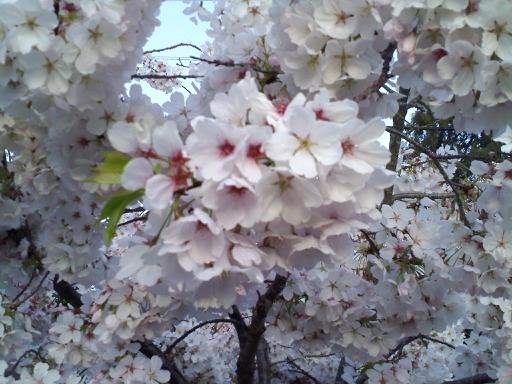
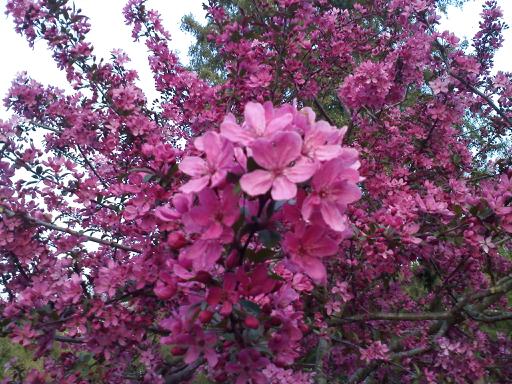
Most purple leaf plums bloom with double or single pink flowers. Old varieties that bloom with white flowers are uncommon. Mature trees might get taller than a two story house, with nicely rounded canopies. Trees are usually pruned up onto single straight trunks, although mature trees in older landscapes might have a few sculptural trunks. Purple leaf plum want full sun and occasional watering.

Spring Blossoms Precede Summer Fruit

00407

Cherry blossoms are such an excellent tradition in Washington D.C., as well as in Japanese neighborhoods of the West Coast. ‘Kwanzan’ and ‘Akebono’ flowering cherries in Japantown of San Jose are glorious when they bloom early in spring. They are less common but just as spectacular in Los Angeles. More varieties grow in the cooler climates of Sacramento, Portland and Seattle.

Yet, after all the work the trees put into bloom, they produce no fruit. These prettiest of the cherry blossoms are sterile. They are known as ‘flowering’ cherries, which is a polite way of saying that they are ‘fruitless’. Cherry trees that produce fruit are very similar and bloom about as profusely, but do so with somewhat more subdued utilitarian flowers. After all, they have to work for a living.

Many of the deciduous fruit trees have ‘flowering’ counterparts that are grown for their showy flowers. Purple leaf plums, which are really flowering plums that happen to have purplish or bronze foliage, are the most popular because the foliage is so colorful after bloom. Flowering nectarines and flowering peaches are rare, but not as rare as flowering apricots and flowering almonds are.

Flowering crabapples are the counterparts to the entire fruiting apple group. They are not really sterile, so produce tiny fruits that mostly get eaten by birds. Flowering pears, which are commonly known as ‘ornamental’ pears, are grown more for their impressive autumn foliar color than for their potentially modest bloom. They also produce tiny fruits. The evergreen pear lacks autumn color. Flowering quince is an odd one. It is not even the same genus as fruiting quince.

Fruit trees bloom too. They may not be as colorful, but their simpler and paler blossoms are about as profuse as those of their flowering counterparts. Their stems are usually straighter and more vigorous because they are pruned for fruit production instead of allowed to develop naturally. A few stems can be left unpruned to be cut and brought in as cut flowers when they eventually bloom.

Whether flowering or fruiting, almonds and plums should bloom before pears and apples. There is no guarantee though. Weather can delay early bloomers, or accelerate late bloomers. Earlier frost promoted healthy bloom, but the subsequent abundance of rain is unfortunately ruining flowers that are blooming now. For fruiting trees, this means that much or all of the fruit will be ruined.00414

the Good, the Bad, and they’re both UGLY!

P80307Pollarding and coppicing are bad words to most American arborists. These extreme pruning techniques are considered to be synonymous with topping. Yet, both have been around for centuries, and have actually kept some trees alive and productive significantly longer than they would naturally live.
Rather than redundantly explaining what pollarding and coppicing are, and why they are useful arboricultural techniques, I will provide this link to an article I wrote about them earlier: https://tonytomeo.wordpress.com/2018/02/12/pollarding-and-coppicing-pruning-techniques/

I am one of the rare American arborists who not only condone pollarding and coppicing, but I also use these techniques when necessary. I will be coppicing red twig dogwood soon so that it produces more vigorous red twigs next year, and also because we can not allow it to grow wild as a thicket. Some of my fig trees will get pollarded to make vigorous shoots for cuttings, and also to keep them contained in their minimal space. Both techniques are very effective if done properly.

I must stress the word ‘properly’.

Improperly executed pollarding or coppicing really is disfiguring, and can be disastrous. Yet, it is done quite often by those who get payed to maintain landscapes!

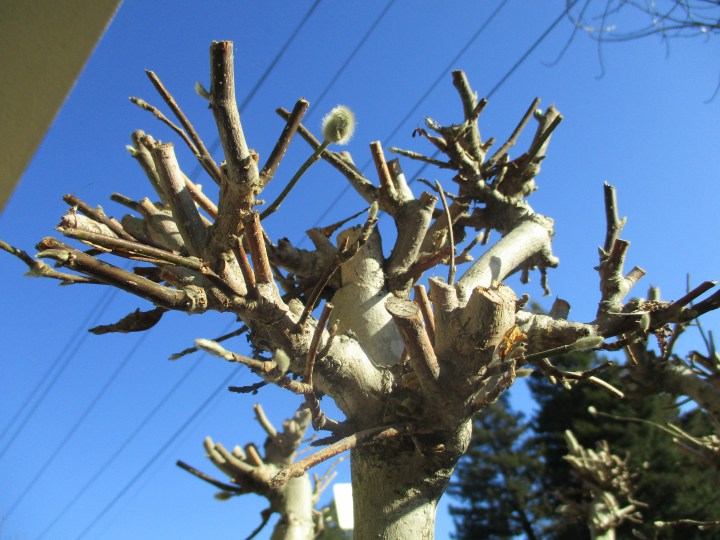
The picture above illustrates a remarkably well pollarded flowering pear tree. It was obviously done by an arborist who knows how to pollard in the English style. Although it is difficult to see in the picture, the knuckles were pruned back cleanly last year, leaving no stubble. The vigorous secondary shoots developed mostly from the knuckles, with only a few stems emerging from lower on the main limbs. When this tree gets pollarded again (and it may have already been pollarded since this picture was taken last week), it should get pruned back to the same knuckles.

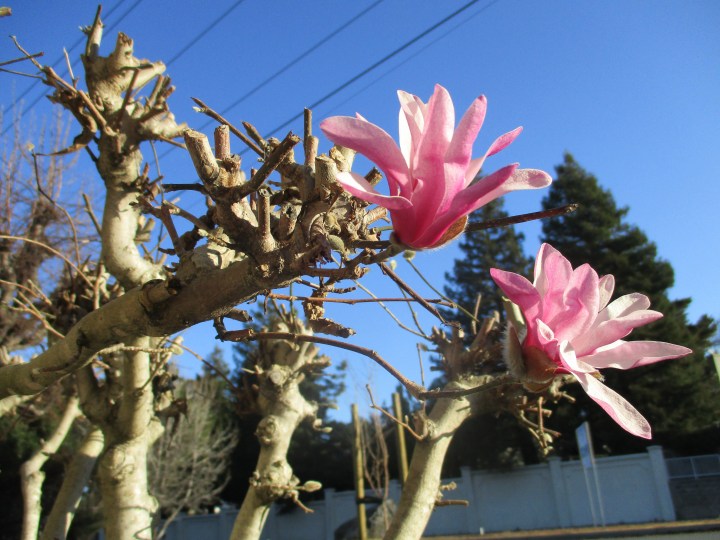
The pictures below show some sort of magnolia that was severely disfigured by maintenance ‘gardeners’, probably for no other reason than it was within their reach. A magnolia can not bloom if all of the stems from the previous year get pruned off by pollarding. This magnolia happened to bloom with a few distorted flowers only because the pollarding was so poorly done, that long stubs remain. These flowers are really nothing to look at within the context of all this unsightly disfigured stems. The long stubs can not be compartmentalized as the new growth develops in spring, so will remain as open and decaying wounds as the tree matures.

So, what is the point of this magnolias even being in the landscape? It contribute nothing. It can not bloom. It can not grow into a tree, but is unappealing as shrubbery. It will always be disfigured. The disfigurement will eventually compromise its health. It would be best if it were merely removed, or at least coppiced and allowed to regenerate. Even if it is a grafted tree, and gets coppiced below the graft, the resulting growth would be an improvement, and might actually bloom if the ‘gardeners’ do not ruing it again.P80307+P80307++

Cineraria

80314This is an extreme bloomer! Cineraria, Pericallis X hybrida, blooms with composite flowers, which means that each small daisy flower is really a whole bunch of minute flowers clustered together to look like a single flower. As if this were not impressive enough, a whole bunch of these composite flowers are clustered together on top of each big wide floral truss. They are not easy to ignore.
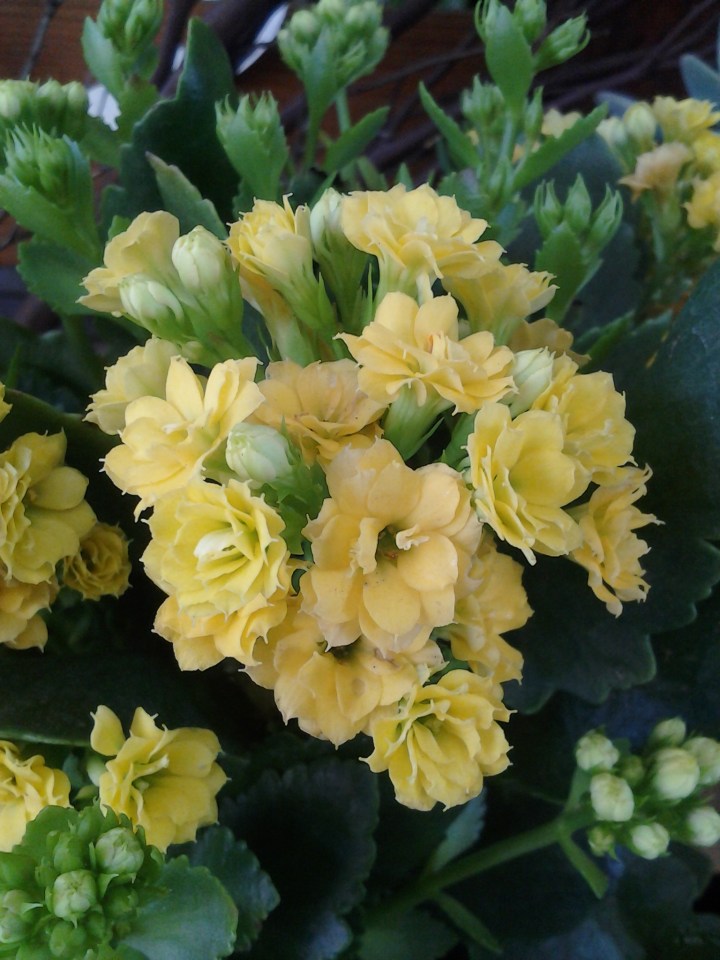
Blue, red, purple or pink bloom can be so profuse that the rich green basal foliage is only visible around the edges and below the domed trusses. Individual flowers usually (but not always) have white halos around dark centers. The soft leaves below are somewhat wide and rounded, with variably toothed margins. Big plants can get as high and wide as a foot. Some are more compact.

Cinerarias are most often obtained while blooming, enjoyed as potted plants, and then discarded after bloom, although with a bit of effort and shelter from frost and heat, they can be sustained as potted perennials to bloom again. They can be grown as short term bedding plants after frost in spring, but they require a slight bit of partial shade, regular watering and richly organic medium.

Potted Plants Going To Pot

80314thumbIt seems like such a waste that so many of the prettiest blooming plants are generally regarded as temporary. They are grown in the most synthetic of environments, forced into bloom, sold at their prime, and kept as potted plants just long enough to finish their bloom cycle. When their bloom deteriorates, they typically get discarded, or planted out into the garden where they rarely survive.
Poinsettias epitomize these flowering potted plants, which are known in the nursery industry simply as pot plants. Almost all of us have given or received them as gifts or decorated our home with them prior to Christmas. Although they are not considered to be annuals, few survive as houseplants, and almost none survive in the garden. No one wants to admit to what happens to the rest.

Okay, so it is not really a big loss. Poinsettias do not do well here anyway; and even if they survive, they are not as appealing in the landscape as they are as pot plants. What about all the others? Easter lilies, chrysanthemums, amaryllis, hydrangeas, orchids, azaleas, miniature roses, kalanchoes and even a few evergreens and living Christmas trees are all grown as forced potted plants.

It is important to be aware that all of these forced plants were grown in very synthetic environments, in which temperature, humidity and perhaps even day length were manipulated to coerce the plants to bloom, or for evergreens to be as lush as they are. Some were stunted with growth regulators. Recovering from such manipulation takes some time and effort, but for most, it is possible.

Of course, they all have their own personalities, and require different sorts of pampering. Some only need their old flowers to be pruned away, and will be able to produce new foliage that is adapted to their new environment. Amaryllis starts out without foliage, so has the advantage of making all new foliage after bloom. Chrysanthemum will eventually want to be cut back to favor new basal foliage. Easter lily foliage should be left while it dies back slowly until dormancy. New foliage grows next year.

Pepe

P80304Coons are not much of a problem in the garden; but they can be a problem around the home. They scatter trash, eat dog and cat food, and can be dangerous to dogs and cats. They get into places we do not want them, including basements, attics, and even our homes. Once inside, they can cause significant damage.
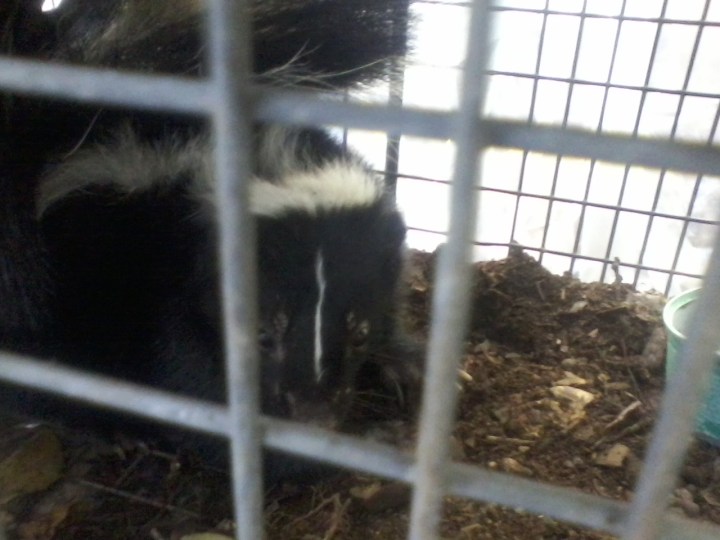
That is why they sometimes need to be trapped. No one wants to do it, but it is sometimes necessary.

One problem that we did not consider when putting out a trap for a coon who was getting into the trash was that we might not actually catch the offending coon. Actually, not catching the coon was not as much of a problem as who we caught instead.

Pepe got to the trap first.

Pepe was none too happy about it.

Neither were we.

You see, Pepe, who is difficult to see in the picture, is a skunk.

Normally, skunks are more destructive to gardens than coons are. They dig grubs out of lawns, but damage the lawns at least as much as the grubs do. They pull out freshly planted seedlings because insects tend to congregate right underneath. Although they are good at controlling some types of plump insects among tough perennials, they are not very careful about getting to the insects that they pursue in more sensitive young plants and vegetable gardens.

However, this was in a situation where landscaping is minimal, and there is no lawn. Skunks had not been a problem . . . until now.

Once in the trap, we did not know what to do with Pepe. No one wanted to get close enough to open the trap. We could not leave Pepe trapped without food or water. Because Pepe had been harmless, we could have released Pepe on the spot, but instead decided to relocate Pepe nearly a mile away, on the far side of Zayante Creek, where there is more insects and water. It was a good distance between us and Pepe, but not so far that Pepe could not return if Pepe wanted to.

I got close enough to the trap to cover it with a trash bag, and then put the covered trap into a trash bag so that it was wrapped almost all the way around. Surprisingly, Pepe did not seem to mind the procedure, and watched calmly. The bagged trap went into the back of a pickup, and was taken to the relocation site. Of course, no one came with me to help.

Once at the relocation site, Pepe did not want to leave the trap. I had to literally dump Pepe out; and then step aside PROMPTLY. Once on the ground, Pepe, who had seemed to be about as big as a big kitten unfolded into a huge fluffy skunk with a big fluffy tail! I have no idea where all that fluff came from!

I had guessed that Pepe would be thirsty from his incarceration, and would be in a hurry to get down to the brambles near Zayante Creek. Instead, Pepe just stared at me sadly. I tried to explain the situation to Pepe, but my French is lacking. Apparently, Pepe did not understand.

As I turned and started to walk back to the pickup, Pepe ran past me and got there first. Pepe stopped at the open door, and looked back at me as if requesting help getting in. This was not good. I stayed back, which annoyed Pepe, who had been a good sport through this entire procedure so far. Pepe sort of hopped about with his fluffy tail flailing, as if frustrated that the floorboard of the pickup was just out of reach.

I tried to explain in English and really bad French with maybe a bit of Italian and Spanish mixed in where I could not remember the words, that the relocation site should be satisfactory. Eventually, Pepe seemed to agree to give it a try. Pepe slowly waddled away and downhill to Zayante Creek. In the second picture, that black and white blotch to the left of the roots of the alder tree is Pepe, looking back at me sadly.P80304+

Too Much Grapefruit

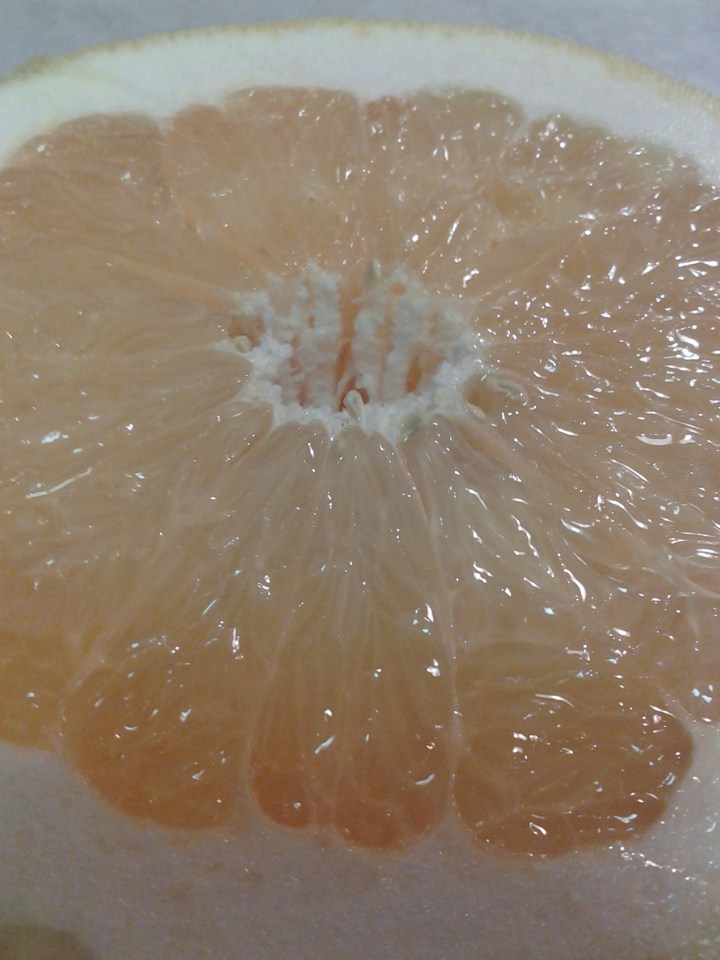
P80303KThere really is such a thing as too much grapefruit. I know; I have witnessed it more than once.

The most recent occasion was two years ago. We were pruning a few fruit trees for a client in San Jose. One of the trees was an old fashioned ‘Marsh’ grapefruit, which happens to be my all time favorite grapefruit.

As we were pruning, the client was dragging brush away to curbside recycling. Most of our clients prefer to do the ‘cleanup’ to save money. The client asked me if I would like some of the fruit. Of course, surplus fruit is one of the many benefits of our work; and of course, I told the client that I would be pleased to take some of the excellent grapefruit. I then went back to work on a nearby persimmon tree.

While busy with the persimmon tree, I was unaware of what the client was doing with the grapefruit. I knew that there was quite a bit of it. She and her sister bagged it and took it out front. From there, they loaded as much of it as they could into the little Blazer (Roy, the ‘Bravada’. It is a long story. I will explain later.). By the time I finished, the Blazer was FILLED with bagged grapefruit! I really should have gotten a picture.

There was no way I could eat or share all that grapefruit before most of it went bad. However, it would have been rude to leave the fruit there after they had so nicely loaded it into the car. Naturally, I ate a lot of grapefruit. It was excellent! The good news is that I really was able to share all that I could not eat or juice. None of it was wasted.