Six on Saturday: Zoning Out


Zonal geraniums, Pelargonium hortorum, can bloom anytime it wants to here, but really does tend to slow down somewhat through autumn and winter. As growth slows, older foliage will deteriorate and become more susceptible to rust and decay. Where exposed, older grown might succumb to frost over winter. Zonal geraniums will soon be zoning out.

Such deterioration and winter frost damage is not as bad as it looks, unless of course, frost is severe enough to kill the entire affected plants. By the time old growth looks shabby enough to be removed, new growth is probably already starting to develop down near the roots. After the last frost date (when no more frost is likely), old growth can be cut back to expose new growth that will soon replace it. Even if new growth is very minimal, growth will accelerate once exposed by the removal of old foliage, and as weather warms into spring.

That is still a few months away. For now, zonal geraniums are just beginning the process of zoning out, which is why their floral trusses are neither as big nor as abundant as they had been through summer. While they are busy with that, autumn flowers are beginning to bloom, and some of the winter flowers are getting ready for their season. Winter flowers get started in autumn because growth is slower in cooler weather, even for plants that prefer cool weather.

1. Chrysanthemum is ‘the’ classic autumn flower. These are blooming well enough in the infirmary that they will soon be relocated out into prominent spots or pots out in landscaped areas.P81006

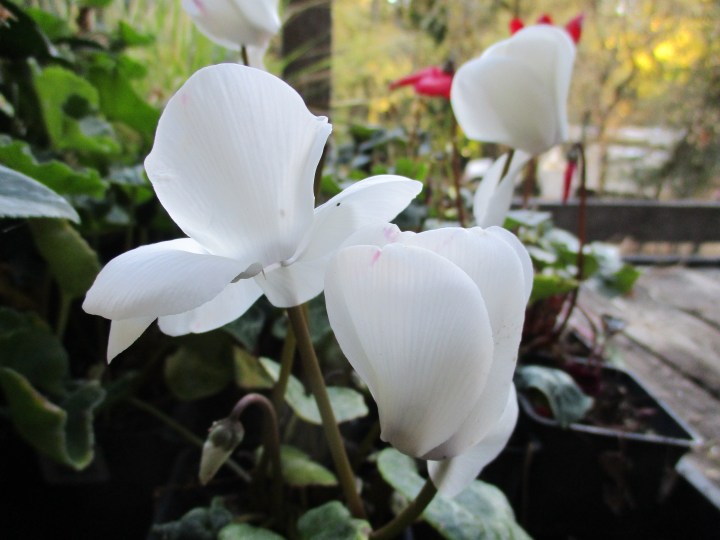
2. Cyclamen is a winter flower that is just now starting to grow after its long summer dormancy. These rudimentary first blooms are not much to brag about, but will likely be followed by enough for these plants to also be recycled back into the landscape from which they came last spring. These white flowers really are the best of the cyclamen for now. (I did not take this picture just because white is my favorite color.)P81006+
3. Reddish orange zonal geranium, and the magenta zonal geranium below, exhibit two more of those colors that I can not identify. I will just say that it is reddish orange. I happen to like it because the color resembles that of one of my two first zonal geraniums. Mine is not so well bred, so exhibits weedier growth and less prominent bloom. Nonetheless, I like mine because it is so resilient and predictable. I cut it to the ground at the end of winter, before new growth develops, and it grows right back. This prettier garden variety would probably prefer a gentler process.P81006++

4. Red zonal geranium seems to me to be the most elegant of those blooming here presently. Of course, I do not know for certain if it is. I do not know much about color. It just seems to me that this color is not as garish as the magenta sort of color below, or as unrefined as the common reddish orange above.P81006+++

5. Magenta zonal geranium, like the reddish orange zonal geranium above, is another color that I can not identify. It is a bit too flashy for my taste. However, the other one of my two first zonal geraniums blooms with a softer hue of a similar color. As much as I prefer to not admit it, my two first zonal geraniums are still my favorites, even though they bloom in colors that I am none too keen on.P81006++++

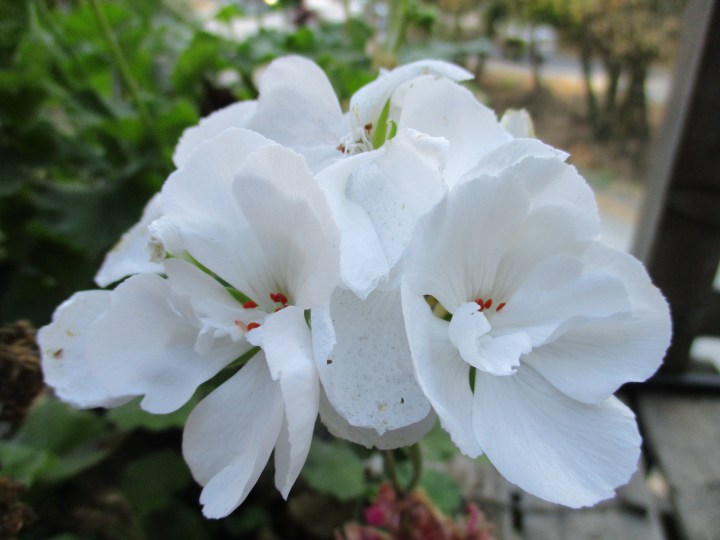
6. White zonal geranium happens to contrast well with the dark greens of landscapes in the redwood forests. Although it is my favorite of the four zonal geraniums that are blooming here now, my first two weedy zonal geraniums that bloom with unrefined reddish orange and garish magenta are still my two favorites.P81006+++++
This is the link for Six on Saturday, for anyone else who would like to participate:

https://thepropagatorblog.wordpress.com/2017/09/18/six-on-saturday-a-participant-guide/
Horridculture – Ignoring Arboriculture

P81003There are too many different types of horticultural professionals to count. There are nurserymen who grow horticultural commodities. There are landscape architects and landscape designers who design the landscapes into which some of these horticultural commodities will go. There are landscapers who install such landscapes. Of course, there are gardeners who maintain the landscapes after they are installed. These are just a few of the more familiar horticultural professionals.
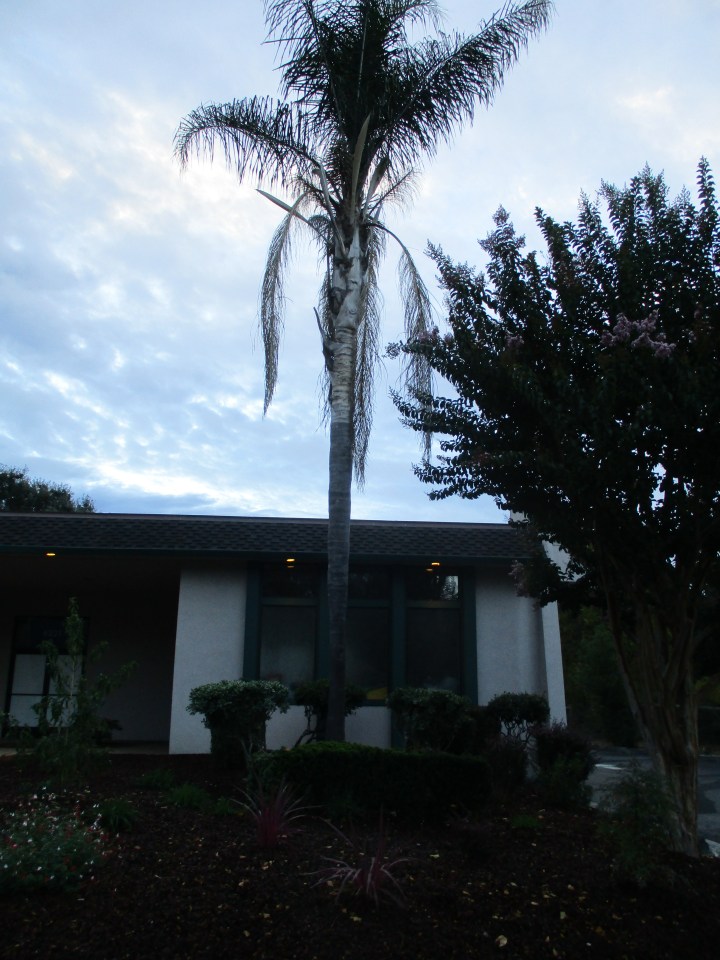
I will refrain from my typical ranting about the extreme lack of professionalism among almost all horticultural professionals who are not nurserymen or arborists (okay, and one landscape designer), but must point out something in the picture above. Do you see it?
It is not the fact that this once very well designed landscape was dismantled and mostly replaced with a cheap slapped together assemblage of cliché plants by someone who just needed work.
Nor is it the pointlessly disfigured shrubbery from the original landscape that was salvaged while the best features that could have been salvaged were removed.
Nor is it the fact that this process has been repeated a few times since the building was originally landscaped back in the 1980s, leaving a nicely maturing but weirdly non conforming crape myrtle in front of the queen palm that should be the focal point, as well as a new dogwood that will compete with both focal points.
It is the fact that despite all the effort that went into the installation of this garage sale style landscape, no one bothered to procure the services of an arborist to groom the queen palm. Do you see it now; all those dead fronds hanging from the canopy of the queen palm? It is like taking a pick up through a car wash while it is loaded with garbage.

Gilley’s

P80930Immediately after the Loma Prieta Earthquake, nothing was open for business downtown on North Santa Cruz Avenue south of Bean Avenue. As buildings were inspected for safety and cleaned up, sections of cyclone fence that had kept everyone out were slowly and systematically moved out so that businesses on the east side could open for business. The same slow process was repeated on the west side, moving south from the corner at Bean Avenue, but did not get very far. The old Los Gatos Cinema, as well as the several other building between it and the seemingly destroyed old La Canada Building on the southern corner of the block, were too badly damaged for the fence to be removed.
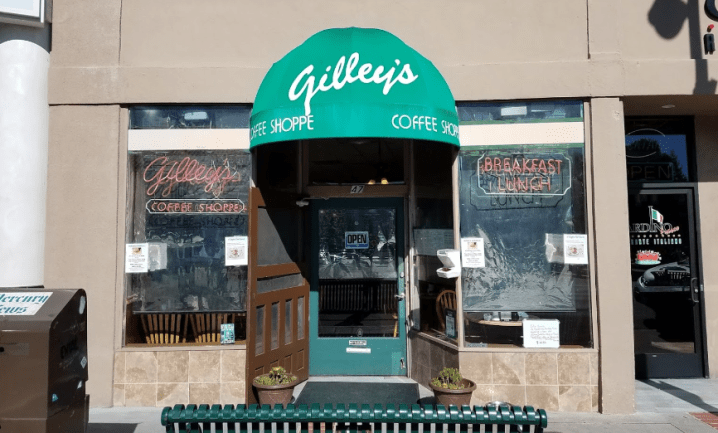
Right there next door to the Cinema where the fence stopped moving, Gilley’s Coffee Shoppe happened to be one of the fortunate businesses that was able to open for business again, and serve breakfast and lunch to those so diligently reconstructing downtown. It had always been there, longer than anyone can remember. Older people knew it as the ‘Sweet Shoppe’, a soda fountain that was very popular with those who cruised North Santa Cruz Avenue. It was the last of the first business that that moved into the old Cannery Building when it was converted to retail stores. Gilley converted it to more of a coffee shoppe and named it after himself in the 1970s. While everything in Los Gatos changed around it, Gilley’s remained about the same. Everyone knows Gilley’s.
I had not gone there more than a few times prior to the Loma Prieta Earthquake. I was away at school for the second half of the 1980s, and just did not go downtown much while in high school or earlier. I stopped by on the way to work early one autumn morning in 1990 because it was the only restaurant that was open in the recovering downtown neighborhood It instantly became my place to go for breakfast, and sometimes for lunch. It was nothing fancy, but it was what I wanted.
For the past twenty eight years, Gilley’s was where many of my work days started. I used their tables to sketch out irrigation systems and small sections of landscapes. I met clients there rather than at my home office. Back when I was able to write about local gardening events in my gardening column, I conducted interviews there. Readers sometimes brought me pieces of plants for identification, or for diagnoses of a disease. When Gilley’s sold and was prettied up a slight bit in the early 1990s, I procured small potted bromeliads, and later, cut flowers for the tables. Before permanent succulent were installed into the big pots flanking the door, I cycled flowering annuals for a little bit of color out front. A whole lot of horticulture went on at Gilley’s.
Sadly, nothing is permanent. Los Gatos is always changing, just like it has always done. By the time you read this, after 3:00 on September 30, 2018, Gilley’s will have closed for the last time.

Not Enough Blue

P80929KThere were barely enough blue elderberries left this late in the season for the blue elderberry jelly that should have won the blue ribbon at the Harvest Festival. It’s a long story.
After the main supplier of blue elderberries was removed to widen the driveway that it was next to many years ago, I started collecting blue elderberries from other wild shrubs on roadsides about town. At the time, the berries were very abundant. No one else was collecting them, and the doves did not come down to eat them until later in the season.
A friend eventually asked me why I was collecting the berries. I informed him that they could be used just like the black elderberries that grow wild in Eastern North American and Europe. He decided to make wine and booze with them, and payed others for whatever they could harvest. The berries were much more scarce the following season, not because they had been any less prolific, but because others were collecting them as quickly as they ripened. They became comparably scarce elsewhere as well, seemingly since the blue elderberry jelly started winning second place annually at the Harvest Festival. https://tonytomeo.com/2017/10/01/blue-ribbon/
This year, the elderberries were collected faster than I could get them. Even the berries at work that were out of reach of those collecting berries closer to town were taken by the doves who arrived early, and could not get enough to eat around town. Some of my friends insisted that they could find berries for me, but by the time I asked one of the them to do so, it was just too late in the season. She found barely enough for the two half pints of jelly needed to enter into the competition at the Harvest Festival. I was pleased with that much. It would have been all that I needed for my blue ribbon. However . . .
The Jelly and Jam Competition at the Santa Cruz Mountains Harvest Festival was canceled for this year!
That too is a long story. There are not enough entries to make it worth the bother. A few years ago, there were only seven entries, and five were mine (which makes my ‘temporary’ lack of a blue ribbon even more embarrassing)! The competition will resume next year, and it will get more publicity. The Santa Cruz Mountains Harvest Festival is happening right now (until 6:30 this evening), but without the Jelly and Jam Competition.
For now, I made only one pint of elderberry syrup.

Six on Saturday: Beat Box


It sounds more compelling that way, like the old song by Art of Noise in 1984. It was . . . unique for the time. I suppose it still it. Brent introduced me to that Beat Box when we lived in the dorms at Cal Poly in 1986. Otherwise, to me, the name would have suggested a shallow wooden box for storing root vegetables in a cellar, or a crisper drawer of a refrigerator – a box for beets.

Well, I am just beeting around the bush to avoid sharing the unsightly pictures of my beat-up and neglected planter box downtown, which, incidentally, features neither beets, nor bushes.

The last update was only six weeks ago. https://tonytomeo.com/2018/08/18/six-on-saturday-out-with-the-old/ There has not been much improvement. I manage to remove the litter that accumulates. The condition of most of the plants is unfortunately natural for this time of year. It will not last long. For now, it is what I have to share.

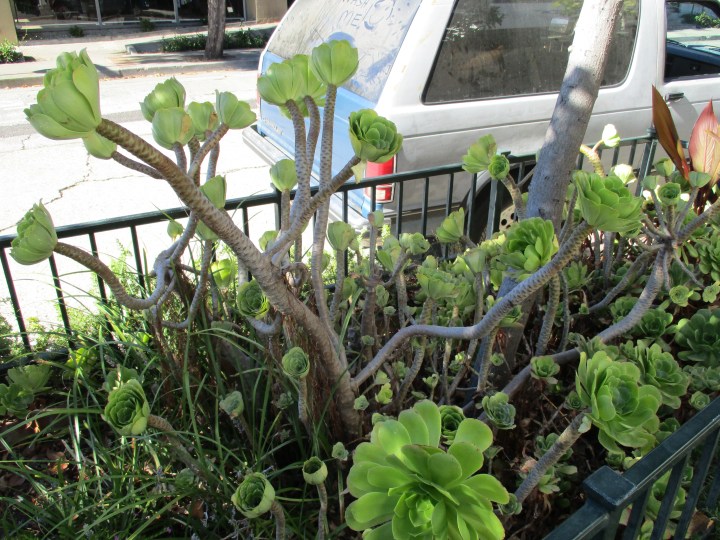
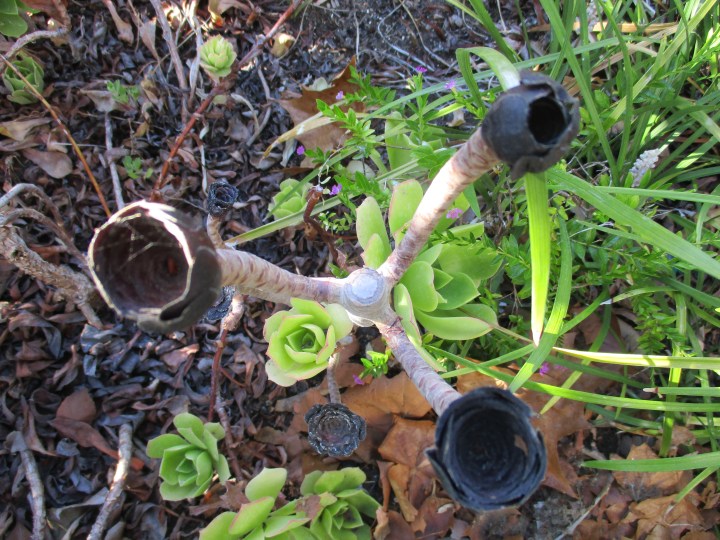
The main problem now is that the common houseleeks, which are the most prominent perennials, naturally looks very tired. I would have no problem with it in my own garden. I know that they look great for most of the year. They look like they do now only in late summer. They recover immediately as soon as the rain starts in autumn. I do not know what is so great about rain, or what rain does that the irrigation does not do. I think that it coincides with cool humidity. Warm aridity is probably what causes the houseleeks to fold up and shed much of their foliage the way they do.

1. Common houseleek was grown from two tiny cuttings that I acquired from the garden of a friend’s deceased mother as we were emptying her home in Monterey. They arrived with a bronze common houseleek, another unidentified houseleek, an unidentified aloe, and, of all things, a bearded iris. They grew like weeds, and are now the most prominent features in the planter box. They would not have been my first choice, but once they started to grow, everyone liked them. I sometimes consider cutting them back so that they regenerate as lower foliar plants; but most people like their height and sculptural stems. I will instead groom out some of the superfluous grown to display their stems better. Once the rain starts, and they regenerate new foliage, they will look exquisite! For now, they look like . . . this.P80929

2. Bronze common houseleek was planted between the two common houseleeks, and at the same time, but never gets going well. As soon as it tries to grow, someone takes the top off of it. It would be an excellent contrast if it gets the chance. It really looks bad right now, but like the others, it will fluff out with the rain. The third smaller houseleek is right below it.P80929+

3. One never knows what might be found in a roadside planter box or landscape. Besides the concrete slurry (that was dumped by a tile-setter working in the adjacent building) and big puddles of vomit (such as those commonly found outside of downtown bars), I have found discarded bicycle parts (that were replaced by the adjacent bicycle store), baggies of dog poop, loaded diapers, small bags of trash, and a variety of dishes, glasses and flatware from neighboring restaurants. This disfigured fender is certainly not the strangest item to appear in my planter box, but is one of the largest.P80929++

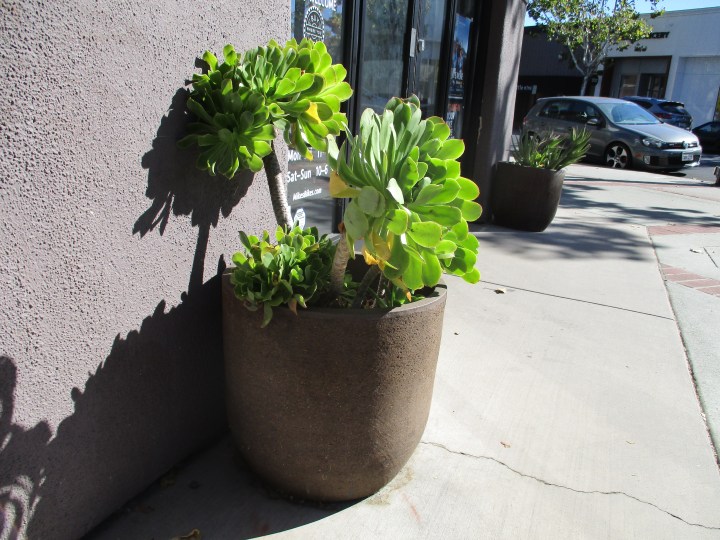
4. Two nice urns outside of the adjacent bicycle shop always look so much better than my planter box. They are filled with nice potting soil, and get watered more generously. The big houseleek in the closer of the two urns was removed from my planter box when it got too crowded. I would have planted a matching pair, but the farther of the two urns had been temporarily removed to make room for a sign. Now that it has returned, it is outfitted with a big aloe from the planter box. The aloe was cut back when the tile on the corner of the planter box where the aloe is located was repaired. I was not there when it happened, but I am very pleased that someone in the bicycle store salvaged the severed bits of aloe. I would have been annoyed if they had been wasted. They are quite large now. It would be excellent if they bloom soon. Most aloes bloom in summer, but this species has tried to bloom at really odd times . . . except in summer! The floral stalks in the planter box have always gotten broken off before they bloom, so I do not even know what the flowers look like. If they never get the chance to bloom, the foliage still looks great.P80929+++

5. The adjacent tree well really did not look this bad after I pulled up some of the debris that collected in it a month or so ago. It now looks as nasty as it did during my previous update. I know the bit of housleek looks really nasty, but it stays because I expect it to recover once the rain resumes. Nasturtiums grow here too. I will sow seed for ‘Jewels Mix’ nasturtiums in the planter box only because nasturtiums do not regenerate there as reliably.P80929++++

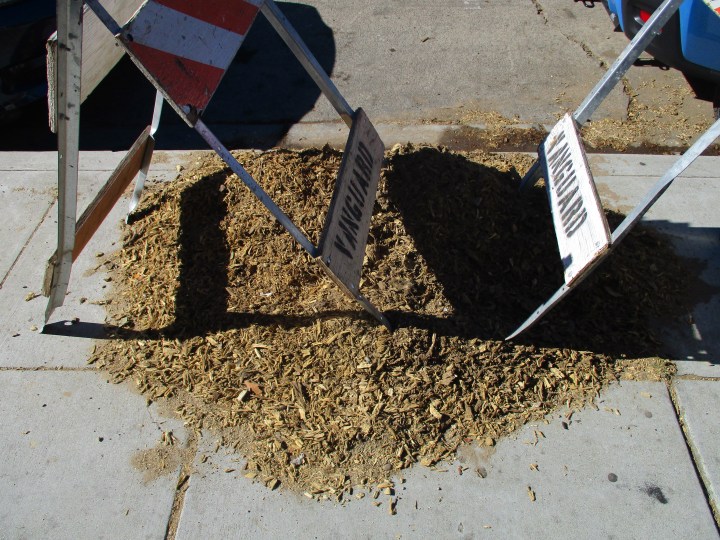
6. This second tree well that is just west of that in the #5 picture above had a nice magnolia tree in it a month ago. Only this pile of chipped stump remains. The sidewalk, curb and road pavement will be replaced soon. Street trees will be added later. The magnolias were so pretty, but were too impractical and messy. I am impressed that they did not do more damage than they did during the half century that they were there.P80929+++++

This is the link for Six on Saturday, for anyone else who would like to participate:

https://thepropagatorblog.wordpress.com/2017/09/18/six-on-saturday-a-participant-guide/

Horridculture – Vandals

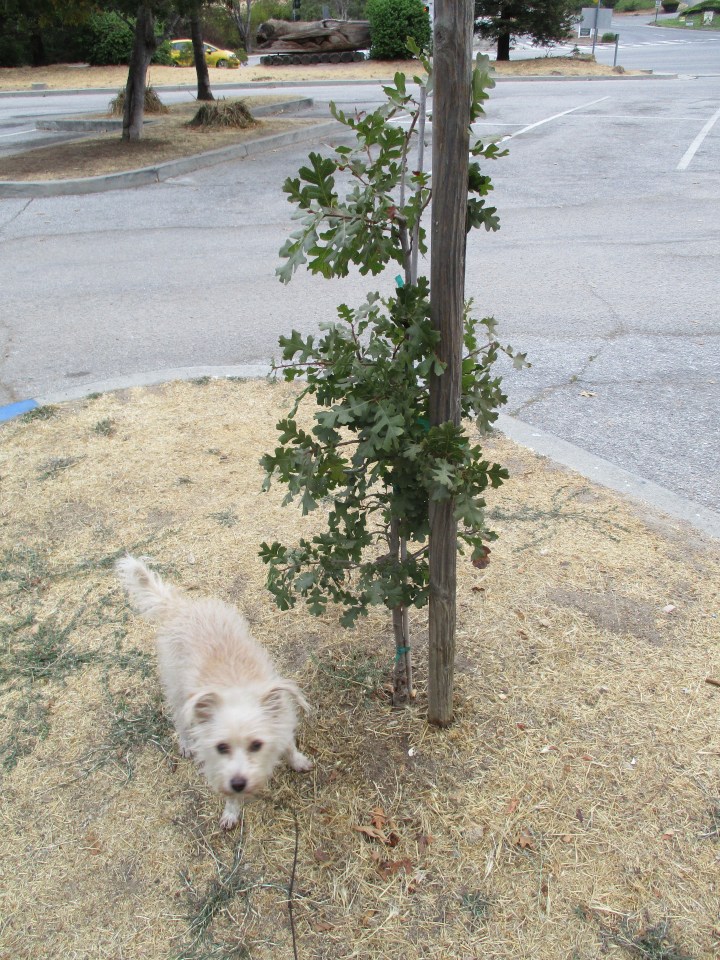
P80926It wasn’t even two days. The article about the ‘Illegal Planting’ of the Memorial Tree in Felton Covered Bridge Park posted at noon on Saturday, and then on Sunday night or early Monday morning, the Memorial Tree was vandalized. Fortunately, it is nothing serious. A small bag of trash was impaled onto the binding stake that is there to keep the trunk straight, which pushed the top of the small tree aside. It needed to be bound to a new stake anyway.
(I do not often condone the use of binding stakes, but this particular tree contends with considerable abuse that causes structural distortion. The article from noon last Saturday is https://tonytomeo.com/2018/09/22/illegally-planting/ .)
Was it done by the haters who snivel about the Memorial Tree just being there? Probably not. The timing is suspicious. The technique is consistent with their style. However, they have been behaving for quite a while, and have not yet posted pictures of the vandalism to blame those they dislike, as they typically do. They are predictably vain in regard to gloating about such ‘community’ activism, particularly if they can also blame their victims for any incidental damages. ( https://tonytomeo.com/2017/12/09/hate-destroys/ )
As annoying as it is, this particular vandalism was most likely executed by someone who just did not put much thought into how bothersome it would be. It might have been done because of the lack of receptacles in which to deposit trash. Perhaps the bag of trash was impaled onto the stake so that it would be easier to retrieve and dispose of when the trash receptacles were returned to the site. The option of dropping it onto the ground might have been been perceived to be more like littering.
Perhaps I am being too optimistic and too generous with excuses.

Guilt Trip

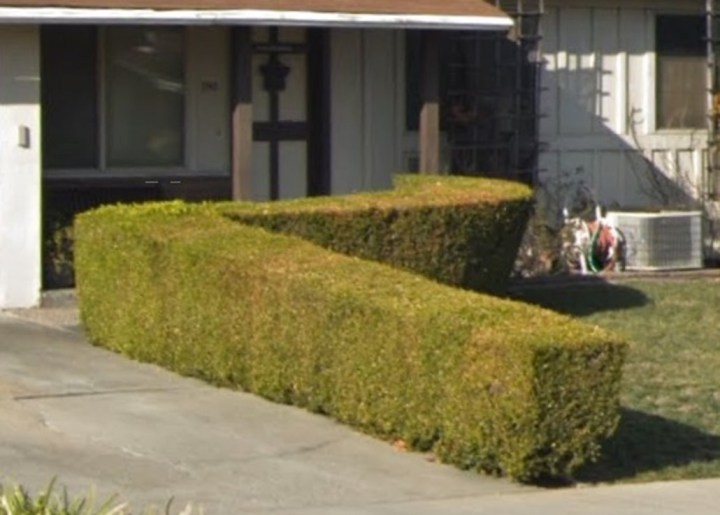
P80923It was so long ago that I barely remember it. I was just a little tyke. My older sister tripped on the driveway and broke one of the Japanese boxwood shrubs in the hedge on the edge of the driveway and front walkway. The hedge was still young then, and not completely filled in. My Pa replaced the missing shrub shortly afterward, but not before my younger brother and I learned that the gap was a shortcut through the hedge. The puny new shrub was not enough to compel us to go around like we had done before. Of course, it did not survive for long. It too got broken off.

We did feel sort of guilty, but only for a while. The second shrub was replaced with a third, which seemed like it should be sufficient to patch the gap in the otherwise formally shorn hedge. We were careful with this one, and actually got into the habit of going around the hedge to avoid altercation with it. However, it died even without our influence. Again, we felt guilty about the g. ap.
I do not remember if there were more attempts to fill the gap in the hedge with other shrubs. When we moved away from that house, the shrubs on either side were slowly filling in to obscure the void. A few years later, the gap could not be seen.
However, many years later, the hedge was pruned with an up-do, which exposed the lower few inches of trunk of each of the individual shrubs. Although there was no gap in the very uniform hedge, it was very obvious that one of the trunks was lacking, right where it had always been lacking. Oh, the guilt!
Even if someone wanted to go through the effort to cut a hole in the otherwise exemplary hedge to replace the missing shrub, it would be very difficult or impossible to find a shrub of that now old fashioned cultivar of Japanese boxwood. Modern cultivars are darker green. A single shrub of a modern cultivar would only compromise the uniformity of the now very uniform hedge. The missing shrub will need to stay missing forever. More guilt on top of guilt!
The satellite image below and the street level view from Google Maps shows that the hedge is now foliated all the way down the the ground. I will not even bother mentioning where the the missing shrub is missing from. I know you could not see it anyway. The hedge is a bit more overgrown than I can remember it ever being before, and it has a bit of that fat hedge syndrome going on, but it still looks great for half a century old. The gap is long gone. Only the guilt remains.P80923+

Illegally Planting!

P80902K“ . . . others illegally planting whatever they wish . . . illegally.” Someone actually said that about the installation of our little Memorial Tree in Felton Covered Bridge Park. It was within the context of a review of the Park on Facebook, written by someone who has not stopped complaining about Felton since she moved here. It was forwarded to me quite some time ago by someone who documents and files such information that is relevant to hate crimes, and what is now known as ‘hate speech’, which is another completely different topic that we can not get involved with here.


Technically, it is accurate. The tree was planted without a permit, and does not comply with the standards of Santa Cruz County Parks. Compliance would have been quite an expensive imposition. It would have required an expensive #15 (15 gallon) tree, outfitted with lodgepole stakes and straps. The overworked gardener would have needed to take time from his busy schedule to install it. Because the irrigation system to the site is now defunct, the gardener would have needed to irrigate the tree until it got established. It was easier, much less expensive, more horticulturally correct, and socially responsible for us install the tree and maintain it on our own. Call 911 if you must.

There are of course reasons why we should not plant trees or other plant material in parks and public places. We do not want to make more work for gardeners, interfere with the landscape plan, or add plants that are inappropriate to the situation. This Memorial Tree happened to have been planted with the supervision of a horticulturist and arborist (me), on the exact spot where another oak that was installed with the original landscape had been knocked down by a car. Otherwise, in most places in Felton Covered Park, vegetation management, including the removal of large volumes of biomass and invasive exotic specie, should be the priority. (Unfortunately, the overgrowth of invasive exotics is mostly within a protected environmentally sensitive riparian zone.)

The little Memorial Tree has quite a history, even though it is still a baby. I do not want to post links to all the other updates about it, but I can post this link to another article that contains another link to others . . . Oh, you can figure it out if you like: https://tonytomeo.com/2018/04/15/memorial-tree-update-to-the-updated-update-etc-the-sequel-to-all-those-other-sequels/ .

Six on Saturday: Gazania


Gazanias were not planned. The English daisies that were planted last spring as warm season annuals that might hopefully continue as perennials succumbed to rust. Seriously! This rust was nasty! I had no idea that English daisy was so susceptible to rust! They were so ugly that they needed to be removed. They were replaced with the gazanias a bit more than half way through.

Gazanias are not the flashiest of choices for the prominent planters that they went into, but they work. If they continue to bloom through winter, they can stay as long as they like. If they stay long enough to get bald spots, we can trim around the edges and plug the scraps back into the bald spots. I would rather put a bit of effort into maintaining them than replace them as the seasons change.

These pictures were taken about two weeks ago, along with the picture of the gazania that was posted last week. For some unknown reason, the gazanias are presently taking a break from blooming.

1. White is actually not my favorite color for gazanias. Yes, white is my favorite color. I just think that gazanias are at their best in brighter colors like yellow and orange. This white is not the best anyway. It looks like very pale yellow to me.P80922

2. Yellow, in conjunction with orange, is one of the two classic colors for gazanias, and is one of my two favorites . . . in conjunction with orange.P80922+

3. Orange is the other half of the caption to the picture above. (Just read the same caption, and switch ‘yellow’ for ‘orange’, and ‘orange’ for ‘yellow’.)P80922++

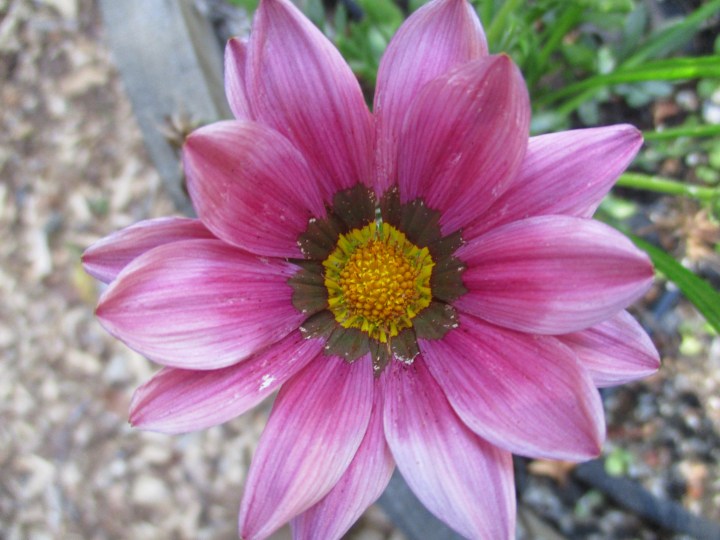
4. Pink might really be light burgundy. It was a bit darker when it first bloomed. This might be one of those colors that only girls can identify.P80922+++

5. Yellow with red stripes looks like something that blooms in the garden of Ronald McDonald.P80922++++

6. Cream with burgundy stripes looks like something that blooms in the garden of a clown with slightly more discriminating taste.P80922+++++

This is the link for Six on Saturday, for anyone else who would like to participate:

https://thepropagatorblog.wordpress.com/2017/09/18/six-on-saturday-a-participant-guide/

Horridculture – Needle Mania!

P80919Throughout my career as a horticulturist, I have worked in more public landscapes than most. Some of these landscapes were in some of the most notorious neighborhoods of the San Francisco Bay Area and the Monterey Bay Area. Yes, I have found some rather strange items strewn about, including a few that necessitated telephone calls to local law enforcement. Yet, I have never once found a single used syringe.

Syringes are more commonly known as ‘needles’ by those who fear them. We are sometimes warned about them, particularly in areas where the sorts of people whom we are supposed to fear might have left them strewn about, whether or not these fearsome people actually use syringes. If found, such syringes are dangerous because they are used to inject illicit narcotics, and are consequently contaminated with the blood of those who use them. Such blood is always assumed to be infected with any variety of the communicable diseases that afflict all fearsome people, and is assumed to stay infectious for all eternity.

When I consider some of the situations that I have worked in, I believe that I am fortunate to have never found a syringe. On rare occasion, I have been presented with pouches and ‘sharps’ containment boxes containing syringes so that I can dispose of them properly. I actually expect to find a few at a site that I will be inspecting this next week or so, which will be a new experience for me. Caution is justified.

I know that syringes are out there, and that they are dangerous. So are rattlesnakes. I have seen and killed many rattlesnakes. They used to be quite common at the farm, and are still somewhat common at home. I know people who have been bitten by rattlesnakes, even though we all know to be careful out in regions where we expect them to be. Signs warning those who might not be familiar with rattlesnakes are posted in county and state parks inhabited by rattlesnakes. People are bitten by rattlesnakes much more commonly than people are accidentally pricked by used syringes. Accidental ‘needle pricks’ are actually extremely rare. For those unfortunate enough to experience such an injury, infection with any one of the communicable diseases that we all fear is very rare. Contrary to popular belief, infectious blood does not stay infections forever.

Needle Mania is really the most infectious affliction associated with used syringes. In a nearby Community, several people are so obsessed with discarded syringes that they have developed a ‘needle watch’ online, in order to monitor the number of syringes found, and the locations of where they were found. Some like to post pictures of the syringes that they find, sort of like trophies. Some people have found several syringes; which is quite commendable for those who live and work mostly inside. (I spent my entire career outside, but have never found a single syringe.) The numbers of syringes found is disturbing. So are the many pictures of syringes laying out in public spaces.

A few pictures are perplexing as well. One locally found syringe was pictured laying out neatly on a serpentinite outcropping. Another that was found in spring on the bank of the San Lorenzo River was laying on top of fallen autumn leaves of quaking aspen, Populus tremuloides. Neither serpentinite nor quaking aspen are endemic to this region.

A syringe was recently found in my neighborhood! As unfortunate and disturbing as this news was, it is not completely unexpected. Syringes can be discarded anywhere, and are probably likely to be discarded on isolated rural roads.

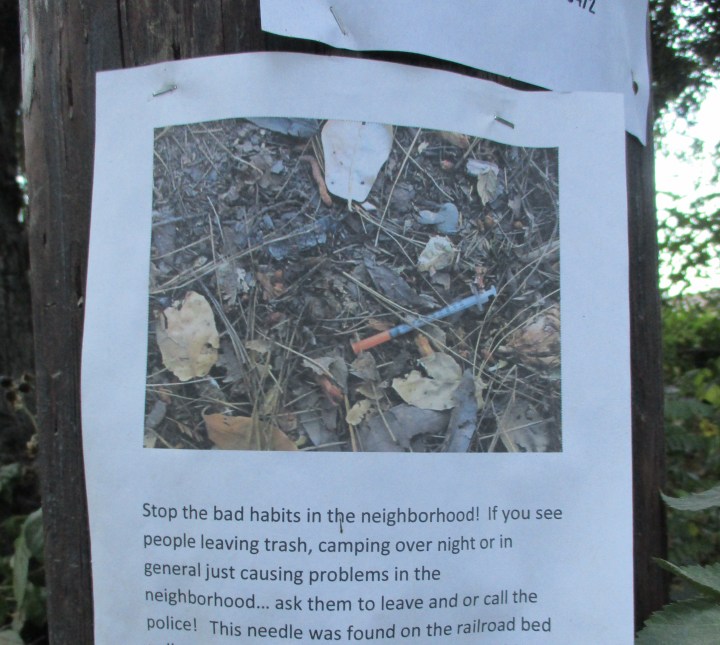
The neighbor who found the syringe believes that it is a problem that is serious enough to justify posting pictures of it all over the neighborhood! These pictures include a description of where the syringe was found, and instructions of what to do to curtail suspicious activity. They are everywhere! They were originally just stapled to trees, utility poles, mail boxes, fences, barns . . . and anything that a staple would stick into. Now that they have been out in the weather for a while, some are blowing about in the roadway and collecting in ditches. When they were first posted, a few were within view from every point on the road. More posters were added to replace those that blew away. These posters are now a prominent feature of our Community landscape.

I do not doubt that the discarded syringe is a problem for the Community. However, the pictures of it posted so prominently and abundantly throughout the neighborhood landscape are unsightly, trashy and unbecoming of such a safe and idyllic neighborhood.P80919K