This would be a good topic for one of my rants on Wednesday, except that it is too silly for that.
Many years ago, before I started writing my gardening column for our local newspapers, my colleague Brent and I used to exchange funny newspaper gardening articles. Some were obviously not written for local climates. Some were just very inaccurate. Back then, it was done by mail, so the articles were added to anything that we happened to be sending to each other at the time. If I sent him some seeds, I would add an article or a few from the San Jose Mercury News. If he sent my cuttings, he would add an article or a few from the Los Angeles Times. They eventually became the inspiration for my gardening column, when Brent and others told me that rather than making fun of the inaccuracies of the articles, I should provide accurate articles.
One of the silliest that Brent sent to me was an otherwise well written article about star jasmine. Most of the information about it was accurate, until it got to describing the colors of the exclusively white bloom. The article explained that star jasmine bloomed in vivid shades or blue, purple, red, orange and yellow; just about every color except for white!
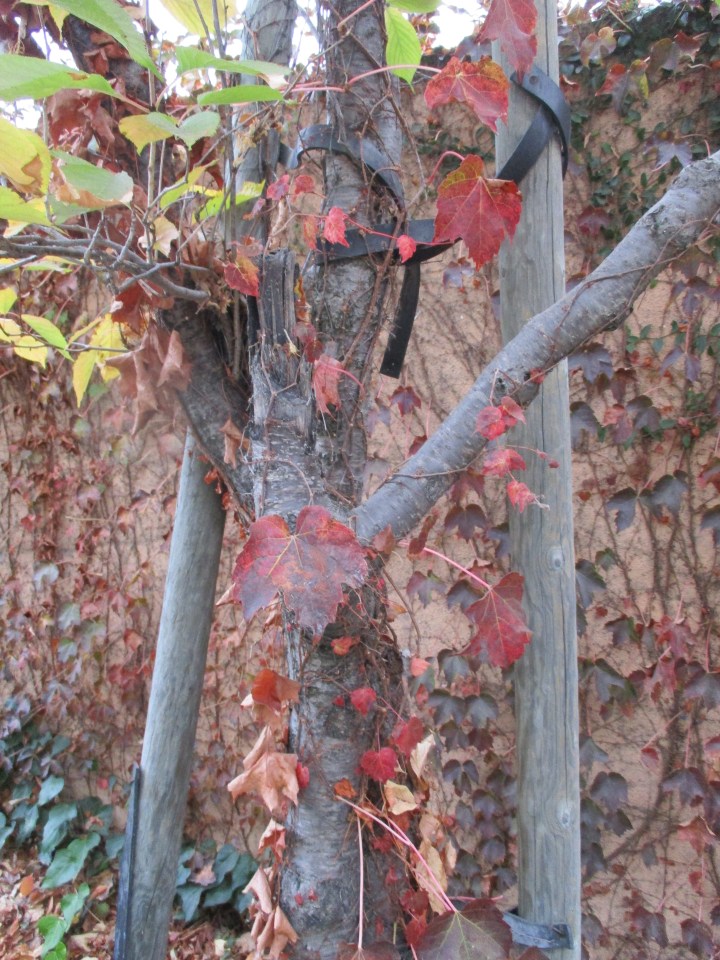
Well, I topped that with an article about protecting Japanese maples from theft, which sounded crazy even before reading the article. There were three recommendations. The first was to surround the subject Japanese maple with razor wire. Ah, the ambiance! The second recommendation was to dig a hole about as big as a trash can and fill it with concrete with a curved piece of rebar to make an enclosed loop on top, and then chain the subject Japanese maple to it. How about we just do without a Japanese maple in the front yard in a neighborhood where we expect it to get stolen. The third recommendation was to plant poison oak around the subject Japanese maple. Yes, good old fashioned poison oak, Rhus diversiloba, which is also known by the more descriptive Latin name of Toxicodendron diversilobum, and commonly available at . . . . some nursery . . . . somewhere. . . . You know, one of those . . . . garden centers . . . . or something.
Silly? Yes! What is sillier is that poison oak really IS available from certain nurseries that sell native species! What is even SILLIER than that incredible degree of SILLINESS is that one of the so-called landscape companies that I worked for in about 2006 actually procured some for habitat restoration outside of, but adjacent to a newly landscaped area on the banks of where the Guadalupe River flows through San Jose. Poison oak and other native vegetation needed to be eradicated for the installation of the new poison oak and associated irrigation system, because nothing is more natural than supplemental irrigation! Then, the ‘gardeners’ had to conduct regularly scheduled weed abatement so that poison oak growing from seed tossed by the pre-existing poison oak did not grow up and compete with the new poison oak in the new ‘natural’ ‘landscape’. We certainly would not want poison oak taking over the poison oak.
Okay, this is not Wednesday, so I will finish this rant.
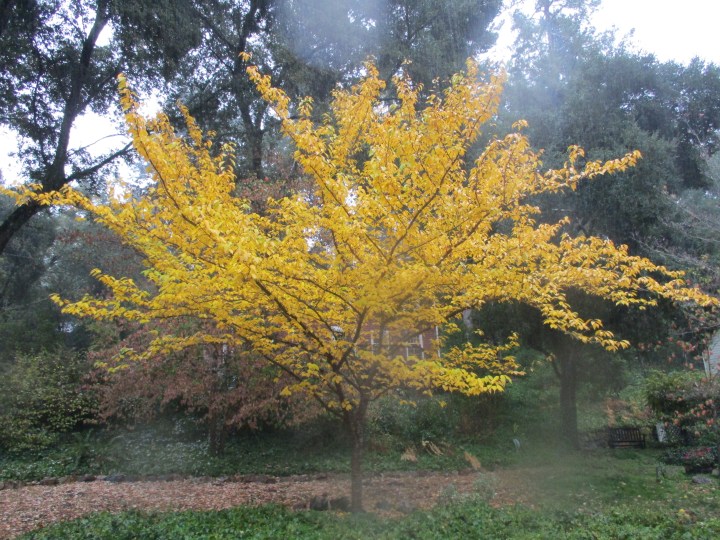
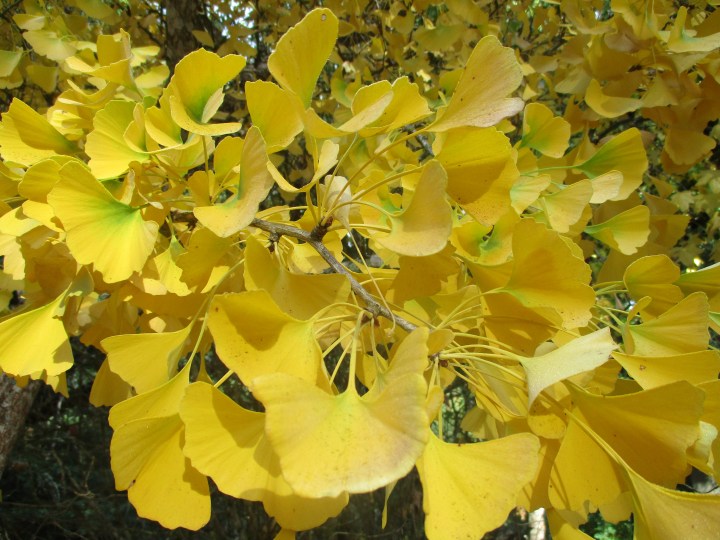
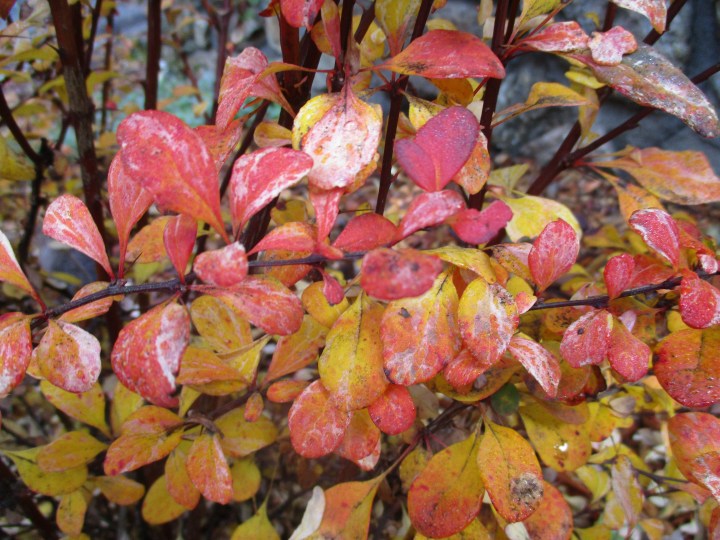
Poison oak happens to provide some of the best orange and red autumn foliar color in our region where almost all of such color is simple yellow. Where it is out of the way and not bothering anyone, it is sometimes left to climb high into trees, where it colors almost as well as flowering pear. Yes, it is pretty, but I will not be planting any of it.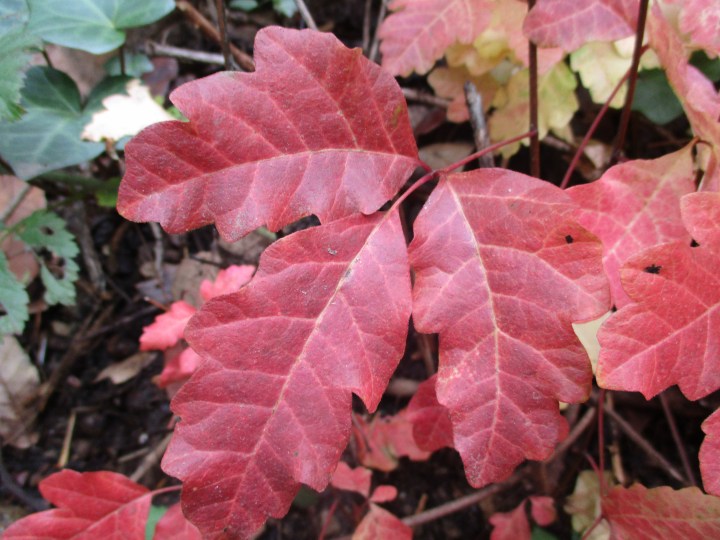
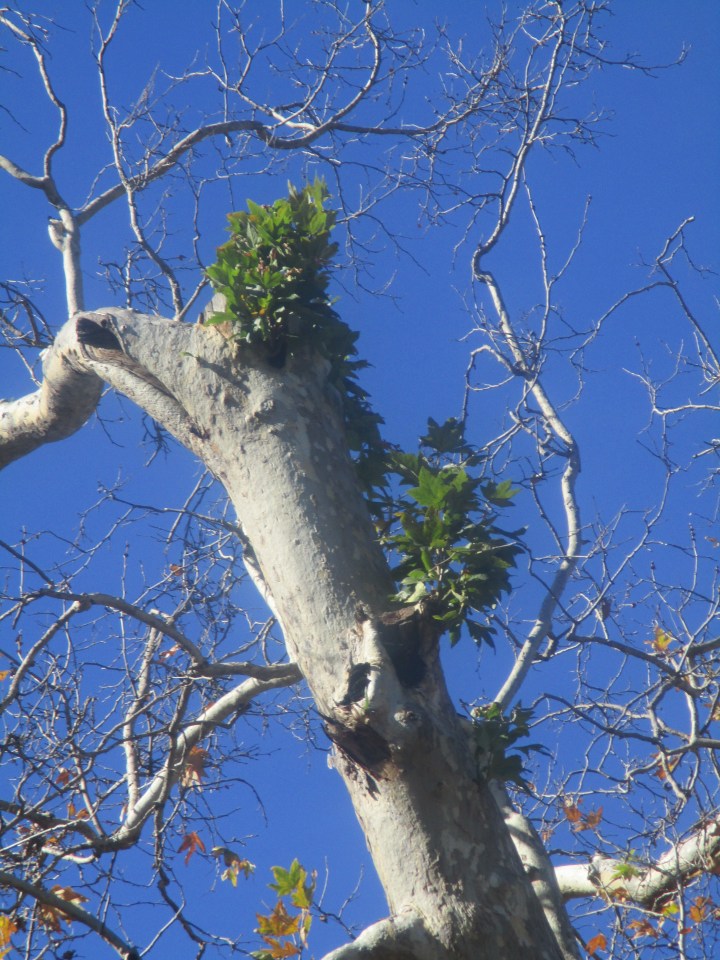 The tufts of small branches that so often develop where limbs were pruned from the trunks of a coast live oaks are sometimes referred to as ‘tumbleweeds’. They are about the same size as an average tumbleweed. By the time the get any larger, most of the smaller stems have subordinated and died out, leaving only a few more defined dominant stems, which will continue the process until even fewer or a single new branch dominates. Such tumbleweeds, as well as stems that originated from such growth, are weakly attached to the main trunks. They often get pruned off for the same reason that the limbs that were there before got pruned off, or because they are expected to be weakly attached. If they remain long enough, they can of course develop into new limbs.






 This is a recycled picture that still annoys me. There was another that I did not want to use because it happens to be from a landscape that I sometimes work in.
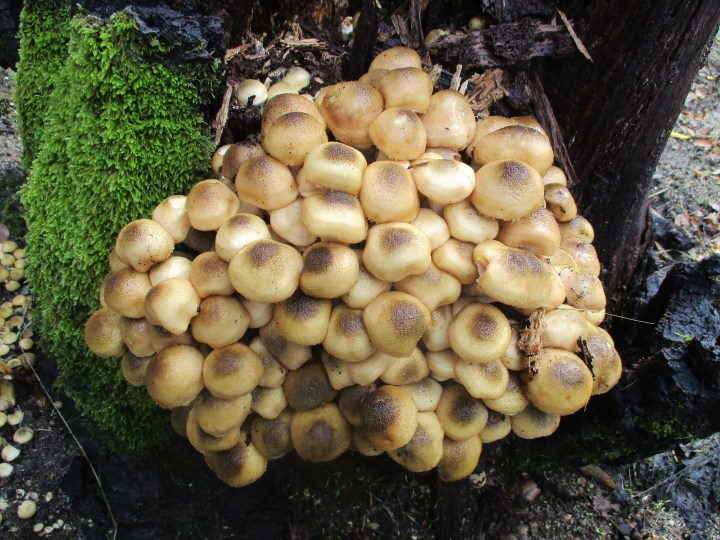 Is this Armillaria mellea, the dreaded oak root rot fungus? I really do not know. All the elements are here. The stump is that of a coast live oak. Bellow the stump there are the remains of roots. Those necrotic roots are undoubtedly decomposing as a result of rot. That rot is undoubtedly associated with this fungus. Furthermore, it fits the description of oak root rot fungus. The toasted spots were probably caused by weathering as the mushrooms started to develop while the weather was still warm and dry.
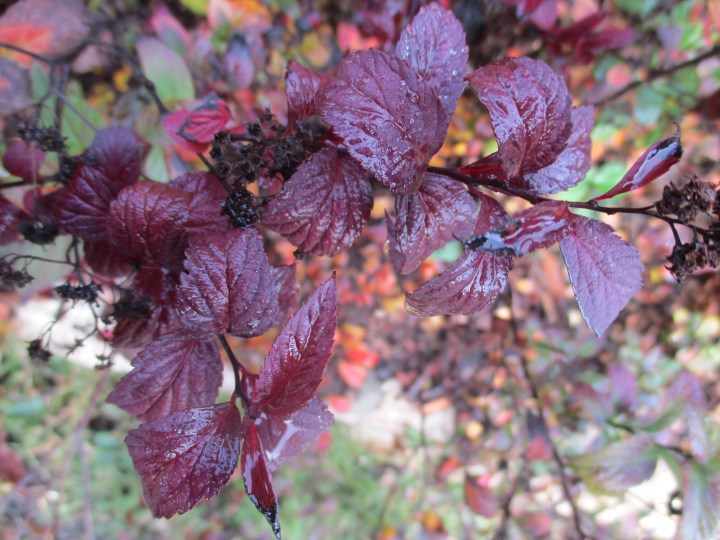
 It is certainly not my favorite small tree. Actually, in most situations, I rather dislike it, which is why I sometimes accidentally spell it without the first ‘e’. It is a cop out; a micro tree that too often ends up where a larger and more respectable tree would be more appropriate. They are not shade trees. They are not not big enough for freeway landscapes or to be street trees on wide boulevards. They are not immune to diseases and insect infestations; and they commonly drop honeydew from aphid or scale infestation, and lose their bloom to powdery mildew. They are not ‘low-maintenance’, and really should be pruned more than they are, but will get you in trouble with the neighbors if you prune them as aggressively as they should be pruned.