 There are two terms that I avoid using within the context of my writing:
1. SILICON VALLEY – The name of the main newspaper group that I had been writing for since 1998, almost twenty years ago, is the Silicon Valley Community Newspapers. As much as I enjoyed writing for the small local newspapers of the group, I hate the name. I find the term ‘Silicon Valley’ to be offensive. It exemplifies that which destroyed the idyllic culture and lifestyle of the Santa Clara Valley, which is also known as the Valley of Heart’s Delight. I have never written the term until now.
2. BLOG – It is the contraction of ‘web log’. The ‘log’ in ‘blog’ is not what bother me. It implies a chronological journal, perhaps documenting experiences that are relevant to a designated topic. It is the ‘b’, or more specifically, the ‘web’ in ‘blog’ that is the problem. It implies that information posted on a ‘blog’ gets shared on the World Wide Web. The reason that I avoided sharing my gardening article on the World Wide Web for so long is that they are written very specifically for the Santa Clara Valley. Although some of them are rather universal to gardening, and some are relevant to regions with similar climates and soils, some are not relevant and perhaps inaccurate for other regions.
My gardening column started with the Silicon Valley Community Newspapers, which at that time was ‘fiercely local’. I always thought that was an odd term, but it makes sense. It means that each of the local newspapers features news that is relevant to their specified local communities. Los Gatos Weekly Times was for the news of Los Gatos. Saratoga News was for the news of Saratoga, and so on. When I started writing my gardening column, I wrote about gardening within our local climate and local soils. I could write about local gardening events and even the weather it it happened to be particularly relevant to gardening at the time.
As the gardening column was added to other newspapers in other regions, I was no longer able to write about local events or weather. I was very fortunate early on that all of the newspapers that used the column happened to be within the same climate zones. However, when it was added to the Canyon News of Beverly Hills (in the region of Los Angeles), and a bit later to the related San Francisco News, it became necessary to modify some of the articles to accommodate for differences of climate. Articles that were universally applicable needed no modification. However, those that were too specific to our local climate needed to be edited for the other two climates. For example, when writing about bare root fruit trees, I deleted discussion of apple and pear trees from the copy of the article that was sent to the Canyon News, and replaced it with discussion of bare root plants that are popular and appropriate in that particular region.
Over the years, I realized that my articles became too available online. Not only were they posted within the context of the online versions of the newspapers that had access to it, but they could be inadvertently opened from other related online newspaper . . . or just about anywhere. Someone in Oklahoma, Pennsylvania, Australia or anywhere in the World could click onto one of my articles just as easily as a local article, and could do so without knowing that it was written for a completely different climate or hemisphere!
I explain in my ‘About’ section that the articles are written for the Santa Clara Valley, but I doubt that means much to those who find the articled without seeing that explanation. I will continue to write my article for the newspapers that still use them, and will continue to post those articles, as well as ‘elaborations’ articles on my ‘blog’. Like so many other gardening articles that are out there nowadays, they will be inaccurate for some regions. Those reading them will need to use their own discretion.
What is sad about all this is that I started writing my garden column precisely because I was so frustrated with what was being published in the San Jose Mercury News at the time. It was typically written quite well, and by professional writers, but was very often very inaccurate because those writing it were either writing for other regions, or simply knew nothing about horticulture. I was so pleased with the opportunity to write accurate information about gardening for our region. Yet, after all these years, I feel like I am now doing exactly what I found to be so frustrating twenty years ago.
 It is as scary as it sounds. Well foliated limbs or entire trees really do fall spontaneously during the calmest of warm weather. It never fails to frighten anyone who witnesses it. Those who witness it always express the same difficulty with trying to explain it to those who did not witness it, as if they know that no one will believe them.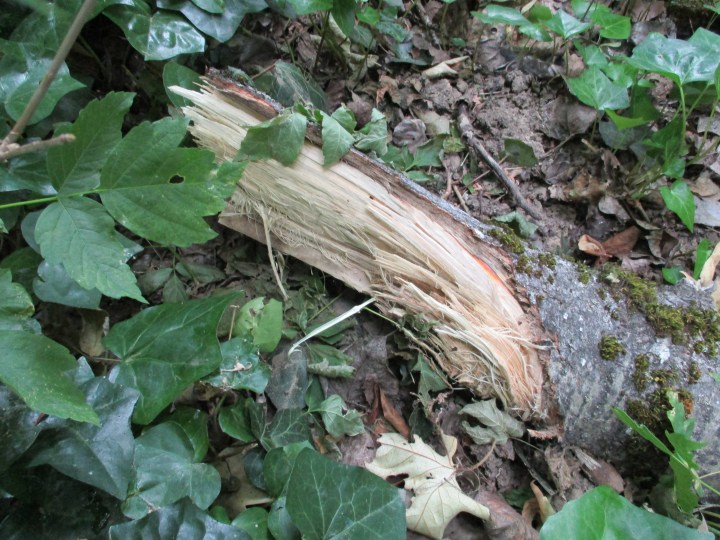

 What are they doing out there, in those two pots in the island of such a vast parking lot? It is hard to say from this distance. They are so isolated. They might be happy and healthy summer blooming annuals. They might just be weeds. They could be plotting World domination. Plants can do some weird things in isolation.




 This is the opposite of the ‘right plant in the right place’. It is something that horticultural professionals should neither promote nor tolerate when feral plants appear in landscapes that they are getting payed to maintain. This example looks like it is more relevant to the topic of ‘Fat Hedges’ from
  That is a term that we do not hear much. There are not many plants that it applies to. Cyclamen is one of the more familiar plants that is summer deciduous. It is from a climate with reasonably mild winters and unpleasantly dry and warm summers. Just like most deciduous plants are dormant through winter to avoid the unpleasantries of the weather, cyclamen defoliates as the weather gets warm in early summer to avoid the expected heat and aridity. It somehow knows how to stay dormant until the weather starts to get cooler in autumn, and is ready to regenerate new foliage and bloom as the rain starts. The active growing season is through autumn, winter and into spring. It is all a matter of taking advantage of the weather while it can, and avoiding the discomforts of severe weather when necessary.




 How can a professional ‘gardener’ leave such a stub on the little California black oak in Felton Covered Bridge Park. It is not as if it is high in the canopy of a large tree, and out of reach to an arborist. This one is right at eye level, exactly where someone getting out of a car parked in the adjacent parking space would run into it. The entire tree needs some major corrective pruning, which would include the removal of significant limbs and portions of the canopy, but that is only because of years of neglect, and is another story. Right now, we are focusing on the eye-level stub.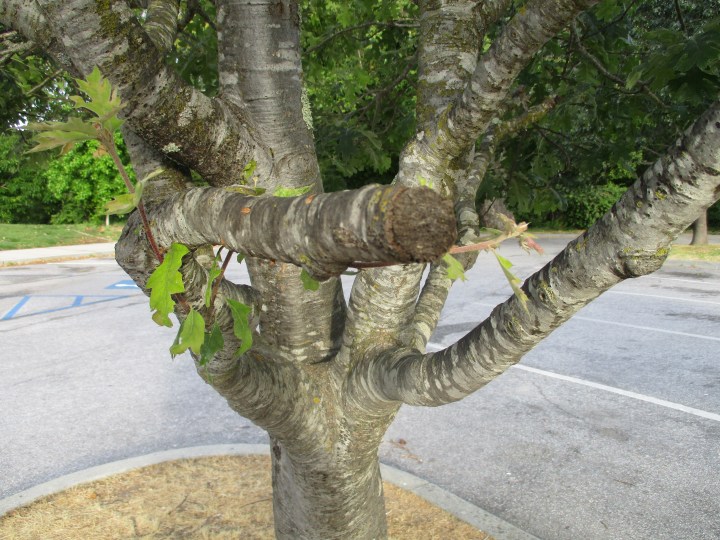

 Astrology is an interesting concept. It is amazing how accurate the various zodiacs are. In fact, they are so accurate, that all twelve of the zodiacs can apply to just about anyone, regardless of their respective birthday.
