Median Landscapes

P80311Medians are nice on the widest of boulevards. They break up the expansiveness of otherwise contiguous lanes. They make a four lane boulevard seem more like a pair of two lane roadways. Berms and other obstacles within medians limit the potential for head on collisions with traffic from opposite sides of the medians. Trees shade and cool some of the pavement when the weather gets warm. Besides all that, medians that are modestly landscaped simply look nice.

Notice that I said ‘modestly’ landscaped. There really is no need to get carried away with landscapes in medians. No one is really looking too closely at them anyway. People are driving past them, and really should be paying more attention to the road ahead rather than what is blooming to the side. Even passengers who are not driving probably are not seeing much of what goes into median landscapes. Color in such landscapes is nice; but no one cares if the color is provided by plants that are expensive and consumptive to maintain, or plants that can more or less survive on their own. It other words, resources should not be wasted on medians. Expensive and consumptive public landscapes should be installed only in parks or other places where they can be seen and appreciated.

Then there are those who must perform the maintenance. It is not safe for them. It will of course be necessary for crews to go out to maintain medians sometimes, and sometimes they might need to block a lane to do what needs to be done; but they should be out there as little possible. They should not be out there deadheading roses, pruning wisteria or planting petunias. They certainly should not be mowing lawns that no one can use! High maintenance features, like formal hedges, fountains, espaliers, trellises, arbors and beds of seasonal annuals, have no business out in medians! Such features require too much attention from those who must interact with traffic to attend to the maintenance.

Turf uses too much water anyway. It is useful in parks and athletic fields, but should be limited to situations where it can actually be useful for something. It is not useful in medians.

Trees are perhaps the best features of median landscapes, but even they are often not well thought out. They should be proportionate to the roadways that the get installed into, and get high enough for adequate clearance above truck traffic. Vertical clearance is not important if small trees can fit between the curbs of wide medians, but such wide medians should probably be outfitted with larger and taller trees. Trees in medians should exhibit complaisant roots that are less likely to damage curbs and pavement.

Landscape design takes serious work; and there is a lot to consider when designing landscapes for medians.

Look What The River Washed In!

P80224KWhat is it?!?

Is it alive?

Was it alive?

Is it moving?

Should we roll it back into the river?

Can we eat it? Someone actually asked that.

It really is as big and ugly as it looks. That is a size 11 boot next to it to demonstrate how big it is. We can not eat it. There is no need to put it back into the river. It is not moving. It was alive, and still is. It is the distended tuberous root of a wild cucumber, of the genus Marah, which is also known as ‘manroot’ because of how big it can get. That stub protruding from the top (toward the top of the picture) is the remnant of a stem. A few thin roots protrude from the lower half, with thicker root stubs at the bottom.

This picture was taken last winter after the San Lorenzo River flooded and then receded. There has not been enough rain this year to wash more than leaves and a few pinecones downriver.

If this tuberous root had not been unearthed and scoured clean by floodwater, it would have been actively growing through winter. The surprisingly thin and wiry vines appear in autumn and climb with tendrils over shrubbery and small trees. The palmately lobed leaves are rather fragile, and tear easily. Loose clusters of small pale white flowers are followed by weirdly spiny round fruit that ripens from light green to greenish yellow. Each fruit is about the size of a golf ball, and contains a few big seeds. As the weather gets warm in summer, the vines die completely to the ground, leaving the drying fruit dangling from whatever the vines grew onto earlier.

Why can’t the river bring us something useful?

Six on Saturday: Blackwood Acacia


Blackwood acacia, Acacia melanoxylon, happens to be one of my least favorite trees, but it does happen to be rather interesting. Mature trees have no leaves. Really. I don’t mean that they defoliate through winter and refoliate in spring. Only juvenile growth has bipinnately compound leaves. As growth matures, leaves are smaller, and are outfitted with distinctively winged petioles. As growth progresses, the winged petioles, known as ‘phyllodes’, become more prominent, and lack vestigial leaves. Therefore, once mature trees outgrow their juvenile growth, no leaves remain.

I dislike blackwood acacia because it is an invasive exotic species, like Acacia dealbata, but not as invasive. Mature trees sucker profusely from roots to form groves of several straight and vertical trunks. Where they are not a problem, groves of mature trees are rather handsome, but do not last long before they start to deteriorate. Foliar liter has an herbicidal effect that inhibits weed growth, but also inhibits the growth of desirable plants. It also produces an objectionable aroma.

1. Juvenile leaves are bipinnately compound, like those of Acacia dealbata.P80310
2. Leaves become more diminutive with distinctively distended petioles as growth matures.P80310+
3. Adult foliage is comprised exclusively of phyllodes, without leaves. The phyllodes function and look just like simple leaves.P80310++
4. Blackwood acacia flowers are not much to look at. Even in full bloom, they are grungy yellowish white.P80310+++
5. At least the bark is handsome.P80310++++
6. The best blackwood acacia is a dead blackwood acacia.P80310+++++
This is the link for Six on Saturday, for anyone else who would like to participate:

https://thepropagatorblog.wordpress.com/2017/09/18/six-on-saturday-a-participant-guide/
the Good, the Bad, and they’re both UGLY!

P80307Pollarding and coppicing are bad words to most American arborists. These extreme pruning techniques are considered to be synonymous with topping. Yet, both have been around for centuries, and have actually kept some trees alive and productive significantly longer than they would naturally live.

Rather than redundantly explaining what pollarding and coppicing are, and why they are useful arboricultural techniques, I will provide this link to an article I wrote about them earlier: https://tonytomeo.wordpress.com/2018/02/12/pollarding-and-coppicing-pruning-techniques/

I am one of the rare American arborists who not only condone pollarding and coppicing, but I also use these techniques when necessary. I will be coppicing red twig dogwood soon so that it produces more vigorous red twigs next year, and also because we can not allow it to grow wild as a thicket. Some of my fig trees will get pollarded to make vigorous shoots for cuttings, and also to keep them contained in their minimal space. Both techniques are very effective if done properly.

I must stress the word ‘properly’.

Improperly executed pollarding or coppicing really is disfiguring, and can be disastrous. Yet, it is done quite often by those who get payed to maintain landscapes!

The picture above illustrates a remarkably well pollarded flowering pear tree. It was obviously done by an arborist who knows how to pollard in the English style. Although it is difficult to see in the picture, the knuckles were pruned back cleanly last year, leaving no stubble. The vigorous secondary shoots developed mostly from the knuckles, with only a few stems emerging from lower on the main limbs. When this tree gets pollarded again (and it may have already been pollarded since this picture was taken last week), it should get pruned back to the same knuckles.

The pictures below show some sort of magnolia that was severely disfigured by maintenance ‘gardeners’, probably for no other reason than it was within their reach. A magnolia can not bloom if all of the stems from the previous year get pruned off by pollarding. This magnolia happened to bloom with a few distorted flowers only because the pollarding was so poorly done, that long stubs remain. These flowers are really nothing to look at within the context of all this unsightly disfigured stems. The long stubs can not be compartmentalized as the new growth develops in spring, so will remain as open and decaying wounds as the tree matures.

So, what is the point of this magnolias even being in the landscape? It contribute nothing. It can not bloom. It can not grow into a tree, but is unappealing as shrubbery. It will always be disfigured. The disfigurement will eventually compromise its health. It would be best if it were merely removed, or at least coppiced and allowed to regenerate. Even if it is a grafted tree, and gets coppiced below the graft, the resulting growth would be an improvement, and might actually bloom if the ‘gardeners’ do not ruing it again.P80307+P80307++

Pepe

P80304Coons are not much of a problem in the garden; but they can be a problem around the home. They scatter trash, eat dog and cat food, and can be dangerous to dogs and cats. They get into places we do not want them, including basements, attics, and even our homes. Once inside, they can cause significant damage.

That is why they sometimes need to be trapped. No one wants to do it, but it is sometimes necessary.

One problem that we did not consider when putting out a trap for a coon who was getting into the trash was that we might not actually catch the offending coon. Actually, not catching the coon was not as much of a problem as who we caught instead.

Pepe got to the trap first.

Pepe was none too happy about it.

Neither were we.

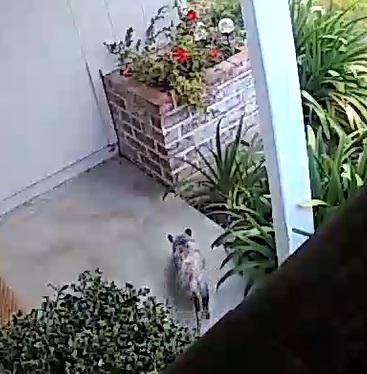
You see, Pepe, who is difficult to see in the picture, is a skunk.

Normally, skunks are more destructive to gardens than coons are. They dig grubs out of lawns, but damage the lawns at least as much as the grubs do. They pull out freshly planted seedlings because insects tend to congregate right underneath. Although they are good at controlling some types of plump insects among tough perennials, they are not very careful about getting to the insects that they pursue in more sensitive young plants and vegetable gardens.

However, this was in a situation where landscaping is minimal, and there is no lawn. Skunks had not been a problem . . . until now.

Once in the trap, we did not know what to do with Pepe. No one wanted to get close enough to open the trap. We could not leave Pepe trapped without food or water. Because Pepe had been harmless, we could have released Pepe on the spot, but instead decided to relocate Pepe nearly a mile away, on the far side of Zayante Creek, where there is more insects and water. It was a good distance between us and Pepe, but not so far that Pepe could not return if Pepe wanted to.

I got close enough to the trap to cover it with a trash bag, and then put the covered trap into a trash bag so that it was wrapped almost all the way around. Surprisingly, Pepe did not seem to mind the procedure, and watched calmly. The bagged trap went into the back of a pickup, and was taken to the relocation site. Of course, no one came with me to help.

Once at the relocation site, Pepe did not want to leave the trap. I had to literally dump Pepe out; and then step aside PROMPTLY. Once on the ground, Pepe, who had seemed to be about as big as a big kitten unfolded into a huge fluffy skunk with a big fluffy tail! I have no idea where all that fluff came from!

I had guessed that Pepe would be thirsty from his incarceration, and would be in a hurry to get down to the brambles near Zayante Creek. Instead, Pepe just stared at me sadly. I tried to explain the situation to Pepe, but my French is lacking. Apparently, Pepe did not understand.

As I turned and started to walk back to the pickup, Pepe ran past me and got there first. Pepe stopped at the open door, and looked back at me as if requesting help getting in. This was not good. I stayed back, which annoyed Pepe, who had been a good sport through this entire procedure so far. Pepe sort of hopped about with his fluffy tail flailing, as if frustrated that the floorboard of the pickup was just out of reach.

I tried to explain in English and really bad French with maybe a bit of Italian and Spanish mixed in where I could not remember the words, that the relocation site should be satisfactory. Eventually, Pepe seemed to agree to give it a try. Pepe slowly waddled away and downhill to Zayante Creek. In the second picture, that black and white blotch to the left of the roots of the alder tree is Pepe, looking back at me sadly.P80304+

Too Much Grapefruit

P80303KThere really is such a thing as too much grapefruit. I know; I have witnessed it more than once.

The most recent occasion was two years ago. We were pruning a few fruit trees for a client in San Jose. One of the trees was an old fashioned ‘Marsh’ grapefruit, which happens to be my all time favorite grapefruit.

As we were pruning, the client was dragging brush away to curbside recycling. Most of our clients prefer to do the ‘cleanup’ to save money. The client asked me if I would like some of the fruit. Of course, surplus fruit is one of the many benefits of our work; and of course, I told the client that I would be pleased to take some of the excellent grapefruit. I then went back to work on a nearby persimmon tree.

While busy with the persimmon tree, I was unaware of what the client was doing with the grapefruit. I knew that there was quite a bit of it. She and her sister bagged it and took it out front. From there, they loaded as much of it as they could into the little Blazer (Roy, the ‘Bravada’. It is a long story. I will explain later.). By the time I finished, the Blazer was FILLED with bagged grapefruit! I really should have gotten a picture.

There was no way I could eat or share all that grapefruit before most of it went bad. However, it would have been rude to leave the fruit there after they had so nicely loaded it into the car. Naturally, I ate a lot of grapefruit. It was excellent! The good news is that I really was able to share all that I could not eat or juice. None of it was wasted.

Six on Saturday: My Favorite Color II – The Sequel!


WHITE!

These are a few more of the flowers I get to work with. The cool season annuals will eventually be replaced with warm season annuals. The English daisies are warm season annuals that replaced cyclamen. Candytuft stays as a perennial. The viola and dianthus are sparse because of the shade from the big redwoods.

If you are easily offended, you should not read this article I wrote earlier about my favorite color: https://tonytomeo.wordpress.com/2017/09/21/white-supremacy/

1. cyclamenP80303
2. violaP80303+
3. dianthusP80303++
4. primroseP80303+++
5. English daisyP80303++++
6. candytuftP80303+++++
This is the link for Six on Saturday, for anyone else who would like to participate:

https://thepropagatorblog.wordpress.com/2017/09/18/six-on-saturday-a-participant-guide/
RAIN!?

10914This is not sequel to ‘SNOW!?’ from yesterday.

Nor is it a sequel to any of the other brief article about rain in the past.

I just recycled the picture because I still find it to be amusing.

If you are a native of California like I am, and are wondering what ‘rain’ is; I have already explained it sufficiently in previous articles. Basically, it is those unfamiliar droplets of water that fall mysteriously from the sky and get everything wet. Look it up if you must.

The article that I posted earlier this morning was recycled from this time last year, long before I started posting articles here. Our rain has actually been very deficient. It has rained only a few times this season.

We tend to talk about rain often here because it is so important to us. So much of California gets such a limited supply. Although our annual rainfall is technically sufficient, and has been sufficient longer than anyone can remember, there are millions of people living here who need the water that it provides. Fluctuations of weather are normal, but are somewhat distressful for those of us who are aware of how weather affects the water supplies that rely on rainfall. Much of the population of California gets water from surprisingly remote sources that are much more reliable than local sources. However, some regions rely on local aquifers that are sustained by local rainfall.

The ‘mostly’ good news for now is that is it raining presently. Seriously! It is raining; and is expected to continue raining through Saturday.

I say that this is ‘mostly’ good news because so much rain within a short time is likely to be disastrous to areas burned by wildfires just a few months ago. Floods and mudslides could, and are actually expected to cause significant damage near Montecito and in other areas of Santa Barbara and Ventura Counties. Highway 101 could be closed again.

We just can’t seem to get it right. If we get enough rain, vegetation in wildlands becomes more combustible. If the combustible vegetation burns, the burned area is more susceptible to mudslides and flooding if we get enough rain again in the subsequent season. So, major wildfires, as well as mudslides and floods, are less likely if we do not get enough rain. If we get enough rain, we are more likely to get a messy situation.

SNOW!?

P80110If you do not know what it is, ‘snow’ is like frozen rain.

If you do not know what rain is, I wrote about it earlier for those of us who are native to the drier parts of California. If you notice strange drops of water falling from the sky tonight, that would be rain. There is no need to be alarmed. It is expected to happen here tonight, and a few times for the next few days. Contrary to former experience, it is normal for this time of year.

Anyway, getting back to snow. Unlike rain, which sometimes happens here, snow does not happen here.

Well, perhaps that is not entirely true. It might have happened as recently as 11,700 years ago, as the Ice Age ended, and again in more recent history, in February of 1976, when an epically humongous snowstorm deposited as much as half an inch of snow over the Santa Clara Valley!

It is difficult to imagine such a huge volume of snow! It must have been disastrous! It would be even more disastrous now, with more than a million people just in San Jose, and many of them driving cars!

In 1976, we third graders did not consider it to be disastrous. We were not old enough to drive. We were perplexed and mystified at first, but rather quickly discovered that snow had serious potential for being fun. Our parents wadded it up into something known as ‘snowballs’ and then threw these snowballs at each other and the neighbors. Yes, I know it sounds crazy. Nonetheless, it looked like fun, so we tried it. It really was fun. We also discovered that we could just as easily throw snowballs at cars driving by, but we were instructed to not do that. We could see that the Santa Cruz Mountains were discolored by snow. They were an almost white hue of very pale blue, speckled with the more typical darker blue.

On very rare occasion, when the ‘smog’* and smoke blew away on clear and cold wintry days, we could see snow on the tops of the highest peaks of the Diablo Range east of the Santa Clara Valley, particularly on Mount Hamilton where Lick Observatory is located. We did not know what it was. Before snow happened in our own neighborhood, we wondered what discolored the peaks like that.

Now that smog rarely obscures the view of the Diablo Range, snow is visible on the group of peaks around Mount Hamilton almost annually. If it gets cold enough, a slight blush of snow might be seen on the lower East Hills in front of the Diablo Range. It is quite scary to think of how close to home snow can be. There happens to be snow up there right now!

I am sorry that I do not have a picture of the snow on Mount Hamilton. I will just recycle this picture of Bill trying to escape snow south of Oklahoma City.

* Historical notation – The East Hills and Diablo Range to the east of the Santa Clara Valley were rarely visible in the olden days because of ‘smog’. If you do not know what smog is, you are fortunate. I have not written about smog yet because it is a part of our history that we would prefer to forget. To be brief, smog was a common form of air pollution. Although there was less smog in winter, there was more smoke from ‘fireplaces’ and burning ‘orchard’ stubble. A fireplace was a primitive heating device that warmed the interiors of homes and other buildings with the combustion of wood. An orchard was a grove of trees that were installed and maintained for the production of fruits, nuts and a few other horticultural commodities. Orchards once occupied vast areas of the Santa Clara Valley. Orchards that were removed to relinquish space for other development provided some of the wood for fireplaces. Perhaps I should write more about these later. I understand that the ancient history of the Santa Clara Valley can be rather baffling at times.

Tent City

P80224KIn the autumn of 1989, small and temporary tent cities appeared in parks and other public spaces around the San Francisco Bay Area and the Monterey Bay Area, where many homes had been damaged or destroyed by the Loma Prieta Earthquake. They were necessary at the time, but were not intended to be permanent features of the landscapes. For a while, they were unpleasant reminders that some people could not go home until their homes were repaired or rebuilt.

In more recent history, ridiculously expensive real estate and rents have increased homelessness in the same regions. Even gainfully employed people are homeless because they can neither purchase nor rent a home, either because of expense or because of a lack of availability. Those who live in homes complain about the unsightliness and other problems associated with the homeless living in homeless encampments and small tent cities.

We get it. Tents are bad.

So then, what is this small tent city on one of the main roadways in town?

Good planning and bad planning.

First the good. Each of the shop spaces in the contemporary retail building behind this tent city needs its own water meter and valve manifold. Each of these meters and manifolds must be easily accessible. Because they are accessible, they are also exposed, so they need to be insulated so that they do not freeze during the very rare occasion (in our mild climate) that the weather gets cold enough to do so. This explains why the water meters are next to the sidewalks, and the upright valve manifolds behind them are covered with these billowed tents.

The bad? Good landscape design should have been considered with the location of these meters and manifolds. A water main line should have been routed so that this whole complex could have been constructed within a utility closet or shed, or even a small utility yard that could have been fenced in a less prominent location. If constructed inside a utility closet or shed, the insulating tents would not be necessary. Now that it is too late for that sort of planning, there is not even enough clearance from the sidewalk for hedging or low fencing to obscure the meters and manifolds without obstructing access. It really would not have taken much of a landscape modification to obscure the view of all this infrastructure, if only more space had been made available where it is needed.

Sadly, landscape design was not a priority on this building. Although the water meters and manifolds are completely exposed, shrubbery obscures window and more appealing features of the buildings, such as ornamental stonework. The view from inside many windows is of the unsightly backsides of pointlessly shorn shrubbery. Trees were crowded and planted directly in front of signs, even though there is plenty of frontage without signs where trees could have been planted. It is amazing what some landscape designers get away with.