Well, since writing this three years ago, and mentioning that I would not likely grow this squash again, . . . I grew it again. It is in the garden right now.
There are not many things that will grow in my zone that I will not at least try to grow if I have the space and resources to do so. I really like to grow fruits and vegetables, particularly those that I am familiar with from when I was young. They are just as productive now as they were then. The only problem is that I do not know how to cook. I can freeze, can or pickle large quantities of produce, but cooking is something that I leave to experts.
I notice that almost all garden columns or blogs include recipes for the produce grown in home gardens. Mine does not. Except for a few recipes for pickles, jams and jellies, I just do not have any recipes that I would share.
When I get big winter squash, I really do not know what to do with them. I…
Palms are not as popular here as they are in Southern California. Furthermore, they are less popular in the Santa Cruz Mountains than they are in the Santa Clara Valley below. There are so many more refined landscapes in the Santa Clara Valley, and they contain many more exotic species. In the Santa Cruz Mountains, cutting trees down is more of a priority than adding more.
Besides, palms look silly with redwoods. Of these palms, which are mostly fan palms, only the Mexican fan palm will get planted as the winter rain starts. The others remain canned for now.
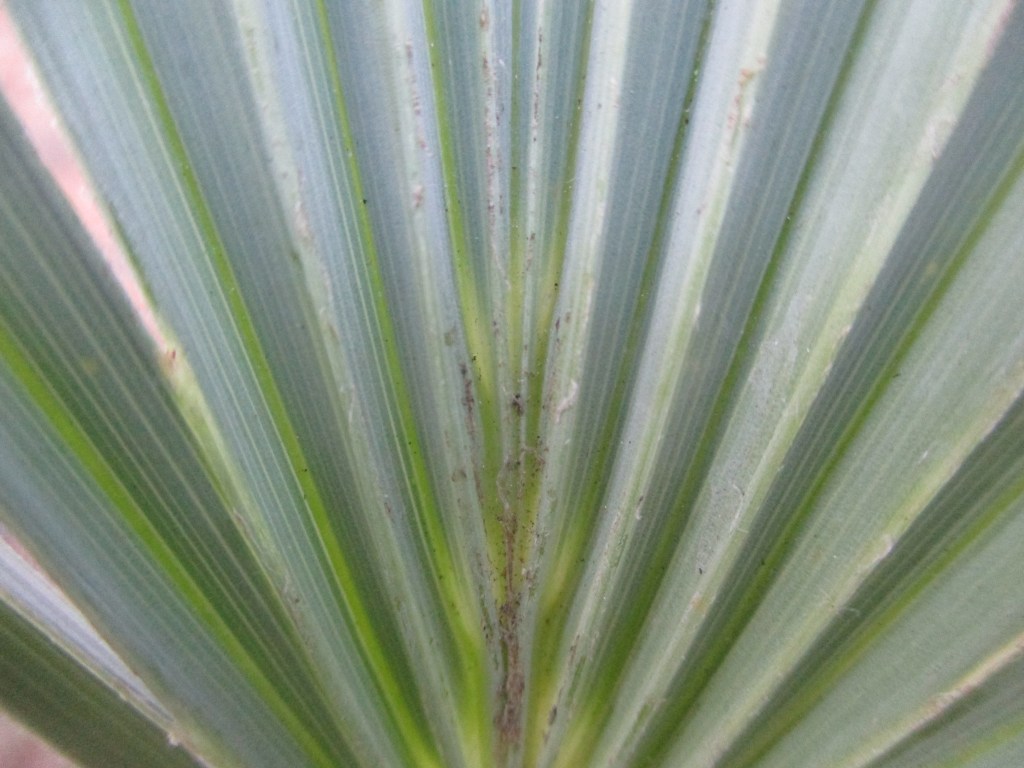
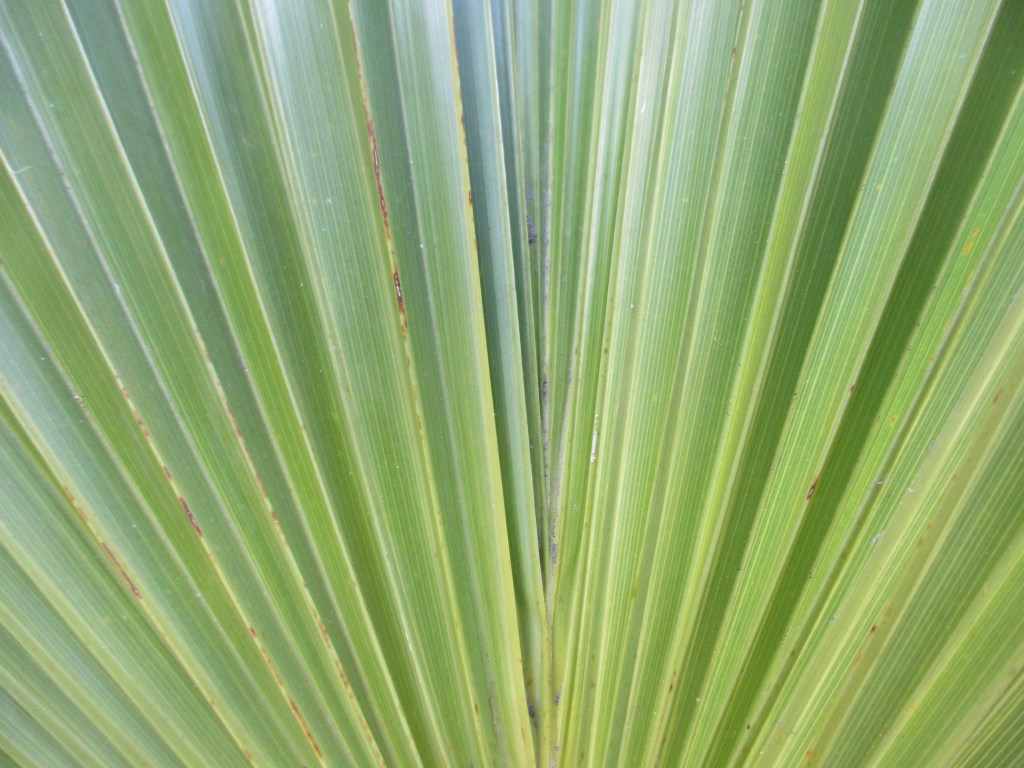
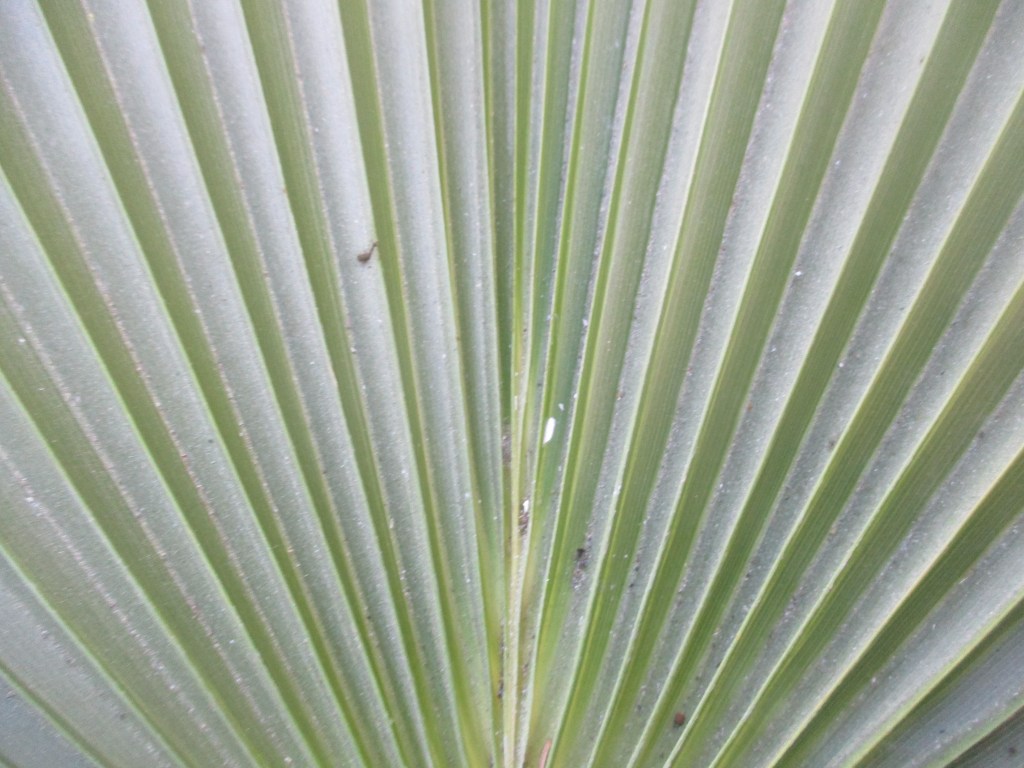
These palms are quite the Fan Club.
1. Arecastrum (Syagrus) romanzoffianum, queen palm – is not eligible for membership in this exclusive Fan Club. It is ‘feather palm’, rather than a ‘fan palm’. Therefore, no queens allowed.
2. Brahea armata, hesper palm – is a most distinguished fan palm. It is quite rare. Like the California fan palm, it prefers warm and dry summers, so can languish if irrigated too frequently.
3. Trachycarpus fortunei, windmill palm – is the opposite. It is quite common, and could be even more common, since it is not at all discriminating, and is proportionate to compact gardens.
4. Washingtonia robusta, Mexican fan palm – had the been the most common palm locally prior to the queen palm fad of the 1990s. Unfortunately, it gets very tall. Notice the lingering ash.
6. ‘A BIG STICK’ was the only ‘club’ I could find for this Fan Club. No one knows what it is, where it came from, . . . or anything about it. I think it is a wheelbarrow or post hole digger handle.
This is the link for Six on Saturday, for anyone else who would like to participate:
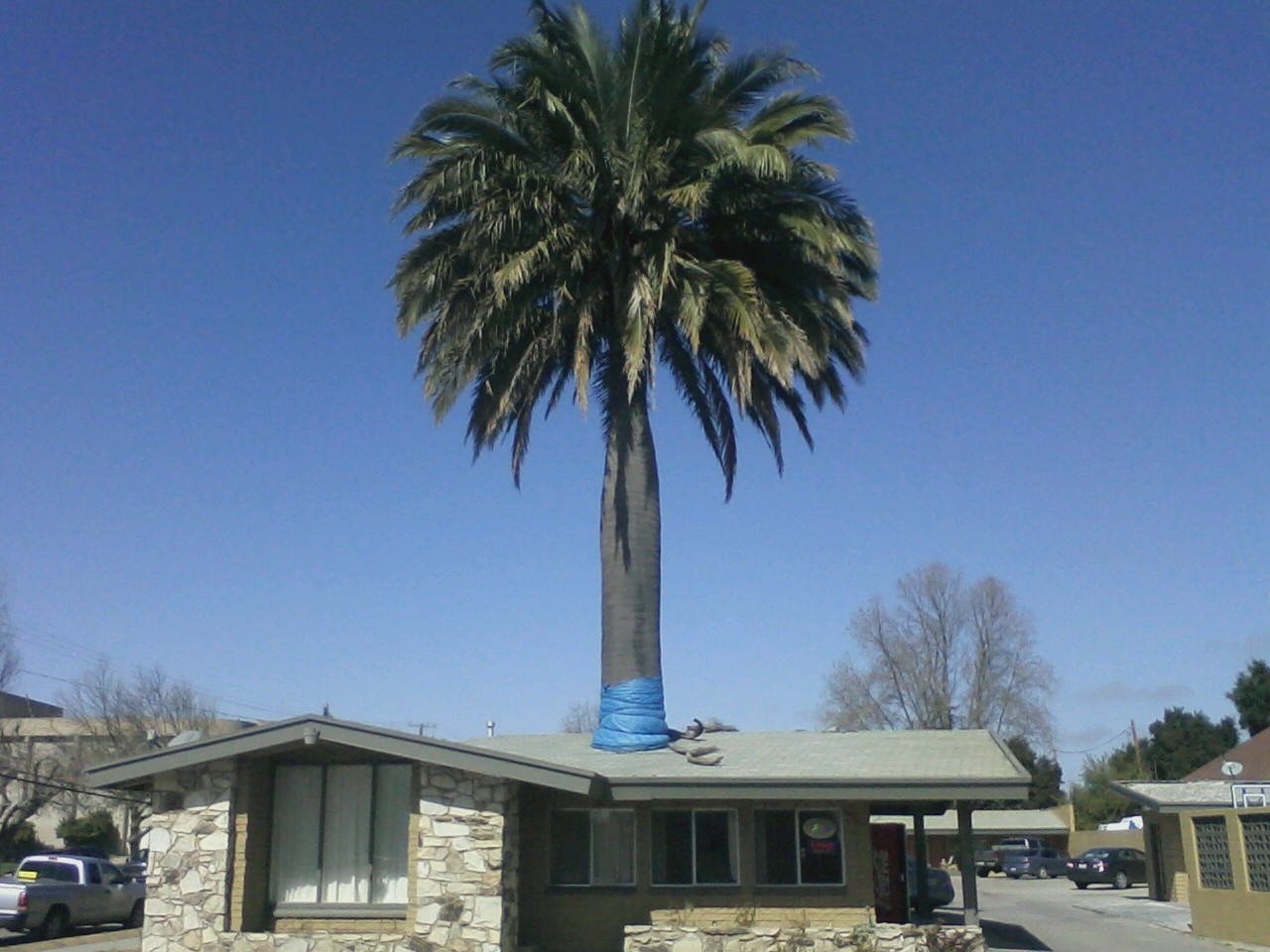
None of the above. It is just weird architecture, designed to preserve a rare Chilean wine palm. The tree was probably planted in the front garden of a Victorian home that was on this site before the site was redeveloped. Chilean wine palms were more popular back then; and this one seems to be about that age. Although it seems to be healthy now, the constriction in the trunk indicates that it had been stressed by the redevelopment, which undoubtedly covered much of the established root system. The time it took for the length of trunk above the constriction to grow coincides with the estimated age of the building below. The tree very likely had better access to rainwater before.
It seems that changes in fashion are sometimes partly motivated by rebellion against what they are changing from. The comfortably loose and pendulous ladies outfits of the 1920s that were so unflattering to the human form while revealing more of it than ever before were probably a rebellion to the impractically uncomfortable and strenuously refined ladies fashions of the late Victorian period that were designed to enhance the ideal of feminine form while also obscuring it. The simple and squared landscapes of the 1950s that were so neatly tailored that they would be considered to be bleak by modern standards were replaced through the 1970s and into the 1980s by a much more relaxed and curvaceous style with sculptural trees, shaggy foliar textures, hills and boulders. Ah, the boulders. They were still cool when Brent and I were studying horticulture at Cal Poly. We had to get some.
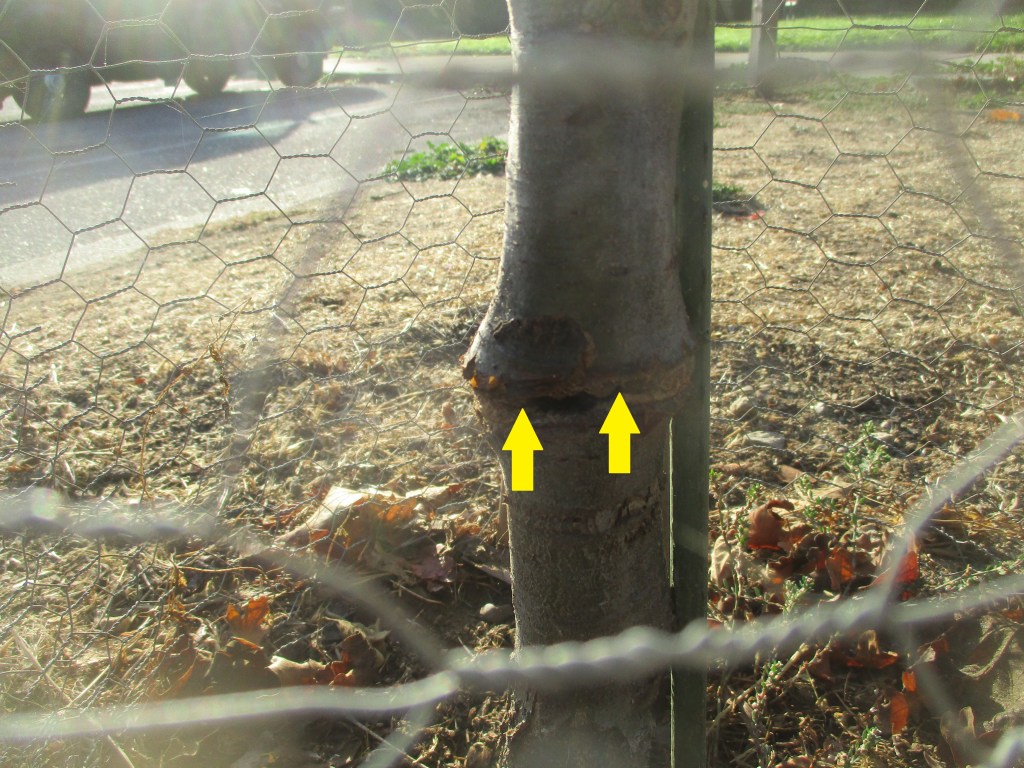
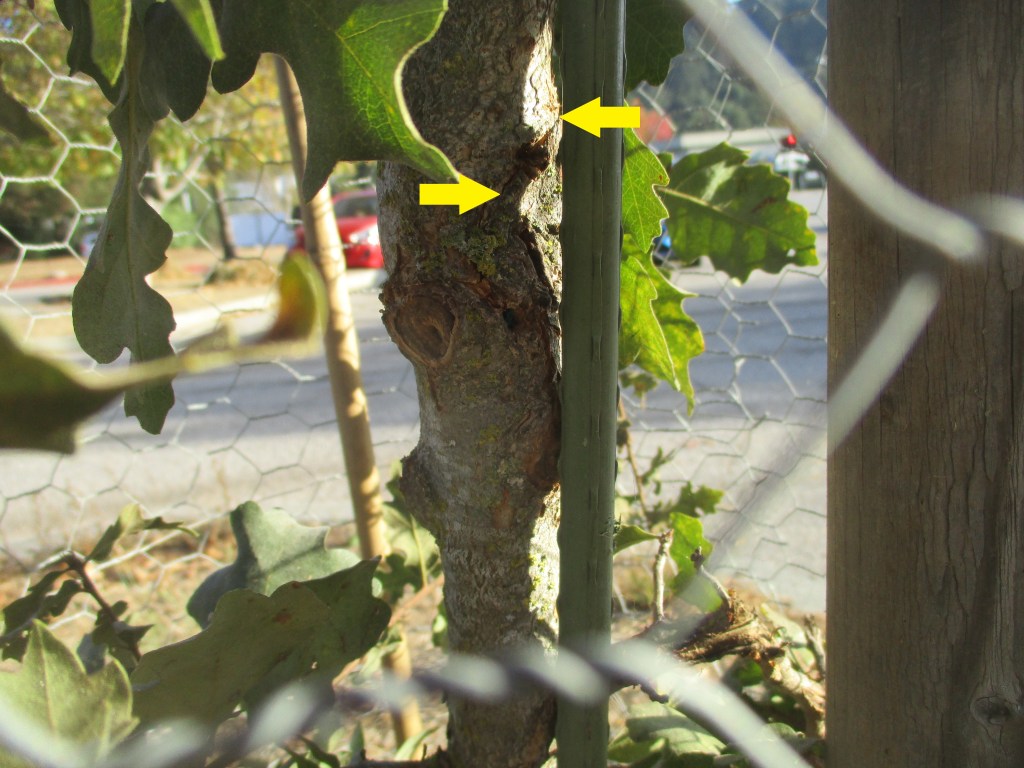
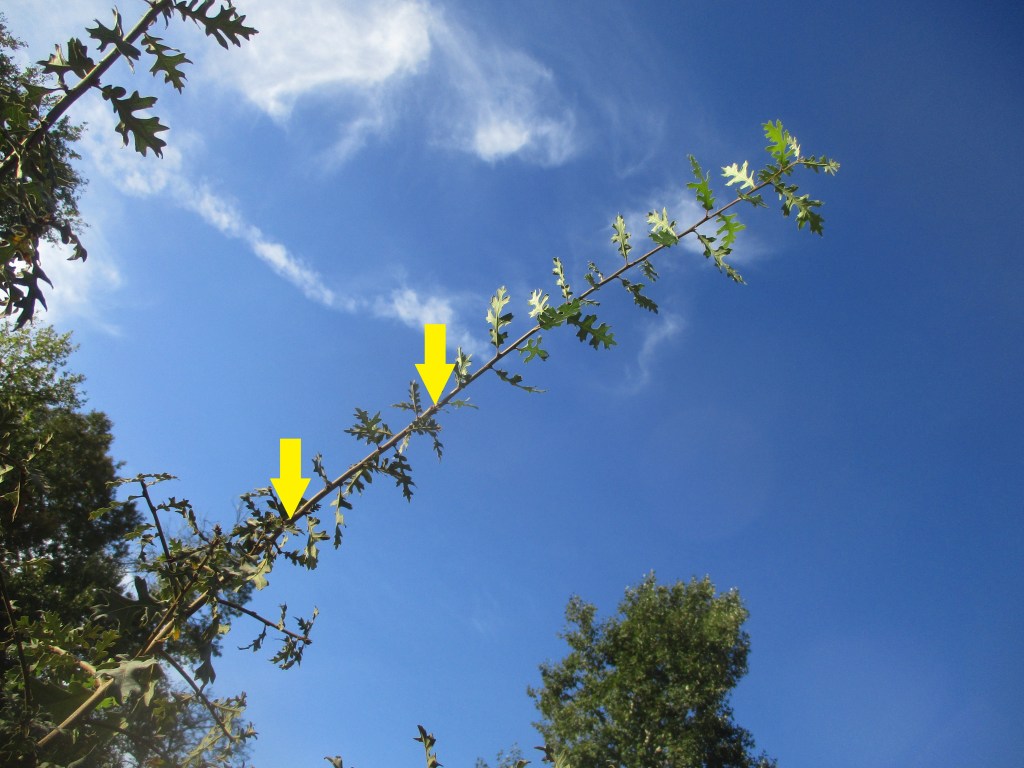
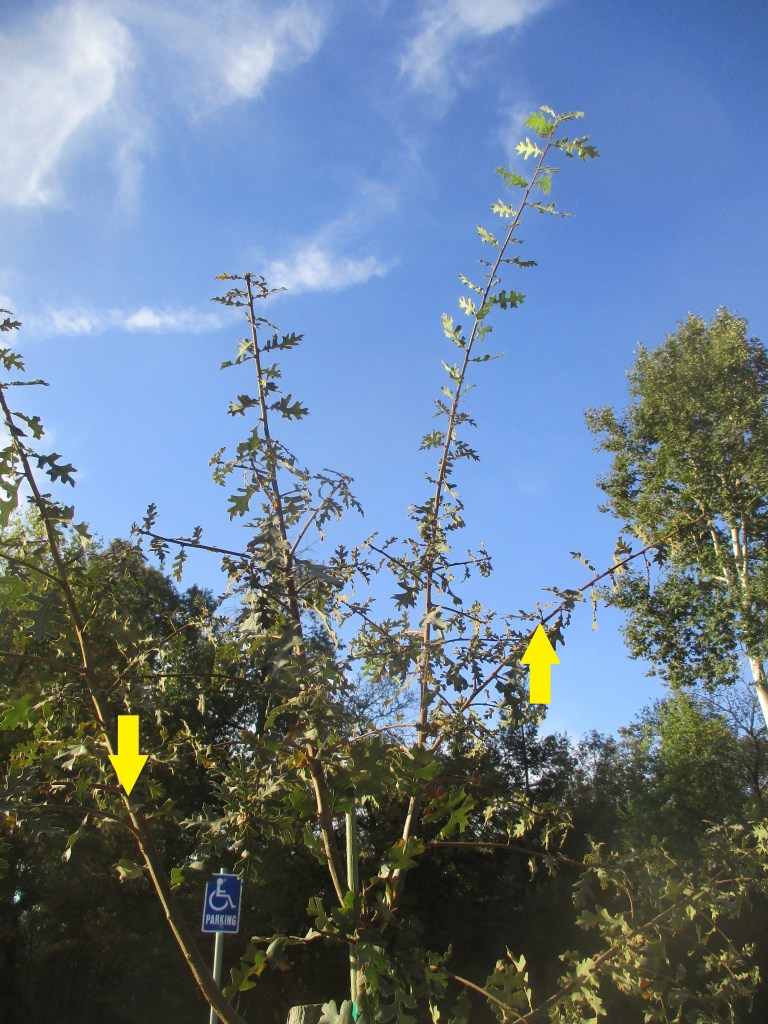
These pictures are from a similar article with the same name at Felton League, which was linked to here last Wednesday. They demonstrate how efficiently the Memorial Tree is recovering from vandalism four months ago. Pointer . . . ‘thingies’ were added to more precisely identify what some of the pictures illustrate. The other two linked-to articles provide more information.
1. A gardener at Felton Covered Bridge Park installed this chicken wire cage around the Memorial Tree after it was vandalized. The protection is minimal, but the gesture is very thoughtful.
2. This now minimal damage is all that remains of of the formerly major vandalism. The worst of the damage to the left and right was very efficiently compartmentalized in just four months.
3. This scar is all that remains of formerly major damage. It is now completely compartmentalized. Growth above not only continued, but was unusually accelerated for so late in the season.
4. This damage was compartmentalized so efficiently that the scar is barely visible. Actually, I am not even certain if this is a scar. I remember only that the trunk was sliced in three places.
5. Growth for the season was adequate prior to the vandalism. The marker to the lower left shows where growth started early last spring. The marker to the upper right, near the center of the picture, shows where growth was decelerating and expected to blind out by the middle of summer. However, growth accelerated vigorously past that, as if stimulated by the vandalism.
6. Growth was unusually vigorous, especially for late summer. During winter, the stem designated by the marker to the left should be removed so that it does not develop into another major trunk. The stem designated by the marker to the right should probably be pruned back so that it does not compete with the two upper stems that are developing into the main lower limbs.
This is the link for Six on Saturday, for anyone else who would like to participate:
The CZU Lightning Complex Fire started two and a half months ago, and finished five and a half weeks ago. I was already away in the Santa Clara Valley when the region here was evacuated ahead of the fire, and could not return for several days, but found that the fire got no closer than a mile and a half from here. Smoke from other fires continued to darken the skies for weeks.
Life here is very different is some ways, but surprisingly unchanged in others. I had managed to avoid two of my properties that are within the burn zone. I finally saw them last week. They are completely undamaged. However, some of the homes in the neighborhood are completely gone. It is so disheartening. There was nothing to lose on my properties, but they did not burn.
One of the properties is unused. It is inhabited by a circular clonal colony of redwoods, a few solitary redwoods, a few tan oaks, and very few miscellaneous trees such as bays and madrones. All of the trees that are not redwood should have been harvested for firewood. Vegetation management on a much larger scale decreases combustibility of formerly clear cut forests like this.
The other property is naturally inhabited by several mature tan oaks and many of their offspring, as well as a few bays, very few canyon live oaks, and only a few big redwoods. Exotic plants were added because it is a good place to grow them before relocating them to other gardens. I would prefer to harvest all trees that are not redwoods, for firewood, as for the other property.
With proper vegetation management, this second parcel could be used to grow bare root commodities, such as sycamores to be planted as street trees in Los Angeles. Fourteen or so fig stock trees already live there. They provide cuttings for propagation. A few are culturally significant cultivars of the Santa Clara Valley. A few species that I brought from Oklahoma live there too.
Nonetheless, these six pictures show a bit of how the neighborhood appears now. There is certainly not much remaining to see. Actually, there was not much to see prior to the fire. It is easy to see the forest, but not the trees. (That sounds backward.) I posted these pictures because a few readers had asked about the situation here. There is too much missing now for six pictures.
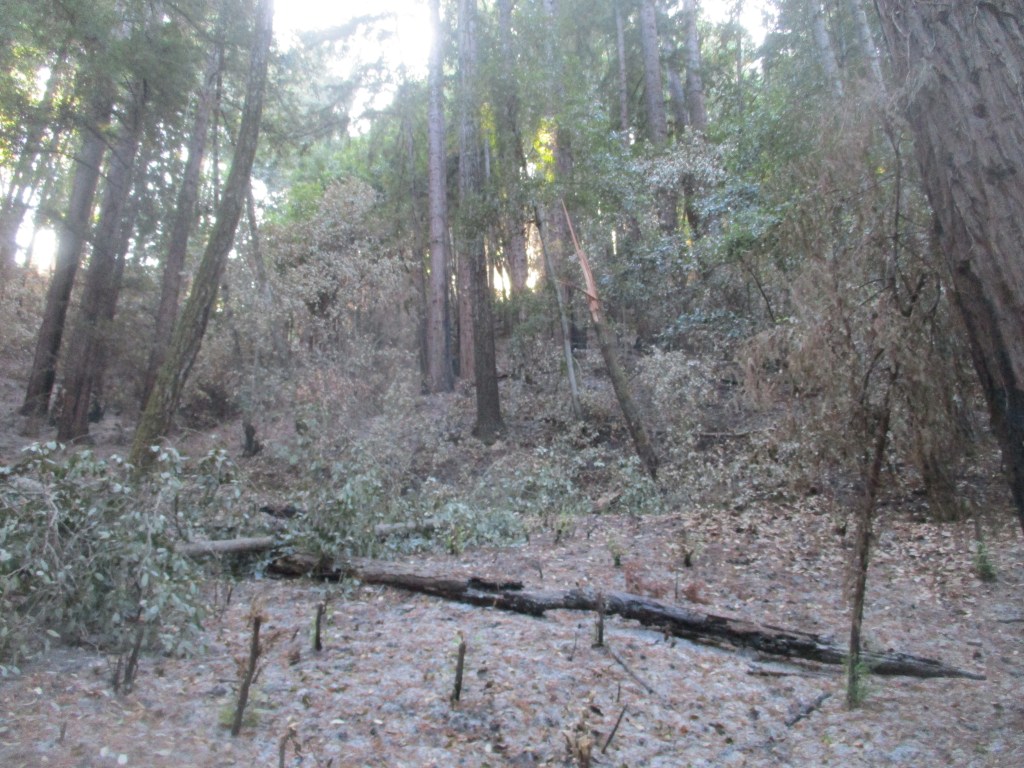
1. Below the middle of this picture, a road is barely visible. The parcel in the foreground burned. The foliage to the lower left is that of a tan oak that broke and fell across the road afterward. The scrawny stumps remain from burned tan oak saplings. I do not know who cut them, or why they were cut already. My property across the road did not burn, but is very ashy and gray. A home that was up on the ridge in the distant background, about where the sun shines through, is now gone. I do not know the condition of several homes beyond that. I did not go up there.
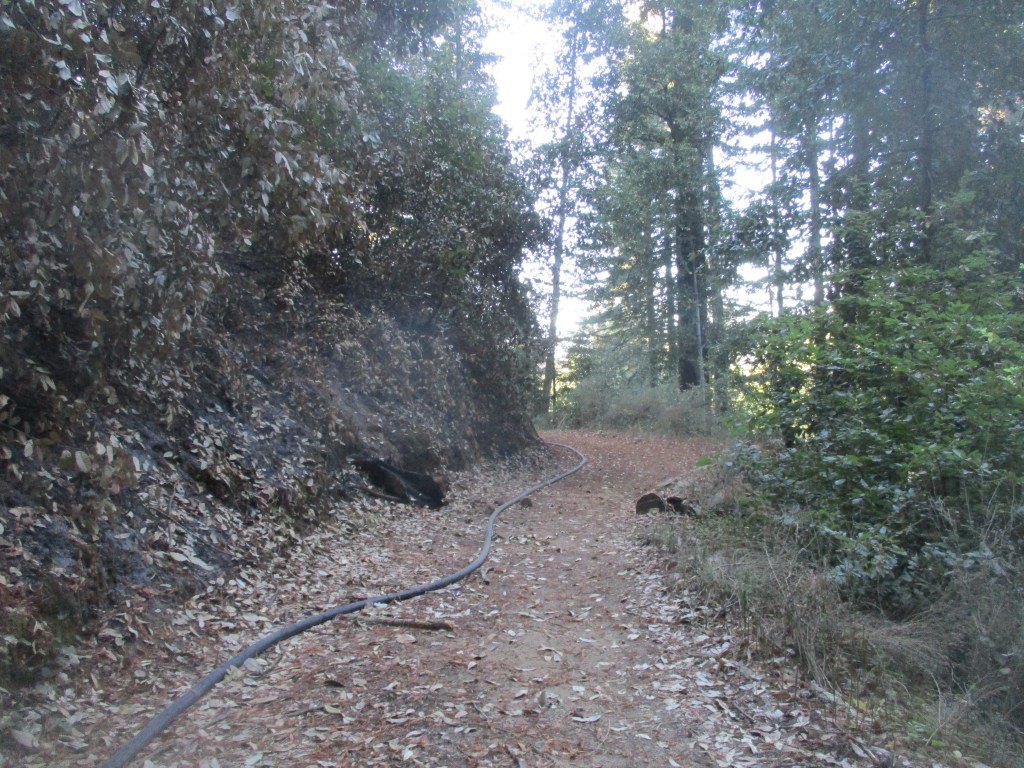
2. Tan oak saplings to the left were roasted but not incinerated as bramble burned below them. My property to the right did not burn. Only the rhubarb, which my great grandfather gave to me before I was in kindergarten, is missing. It might have been trampled by firefighters, or whomever installed these odd flexible water pipes that deliver water to surviving homes. Original pipes and associated infrastructure were damaged. If the rhubarb will not regenerate, I can get copies of the same from other gardens. This is the sunnier property where I can grow things.
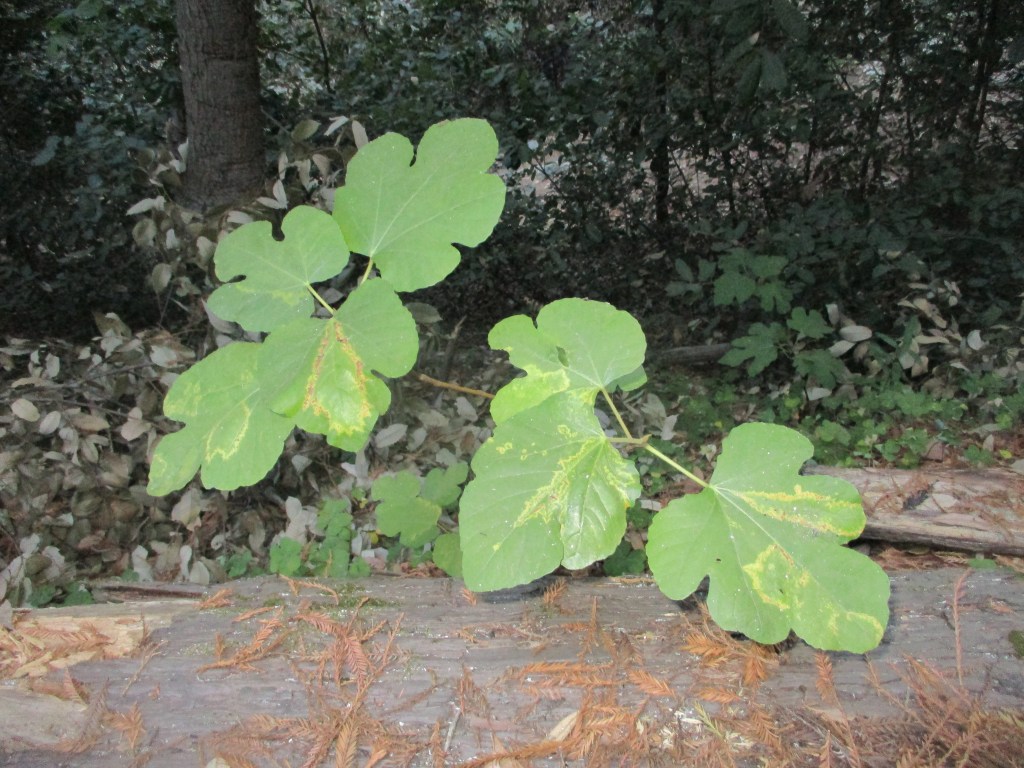
3. Fig stock trees did not even wilt! The stock tree in the background to the right is one of the culturally significant cultivars of the Santa Clara Valley. I believe it is a ‘Honey’ fig of some sort. I should remove all the tan oaks and their many offspring from this site, both to decrease combustibility, and also to increase sunlight for the stock trees and other desirable vegetation here.
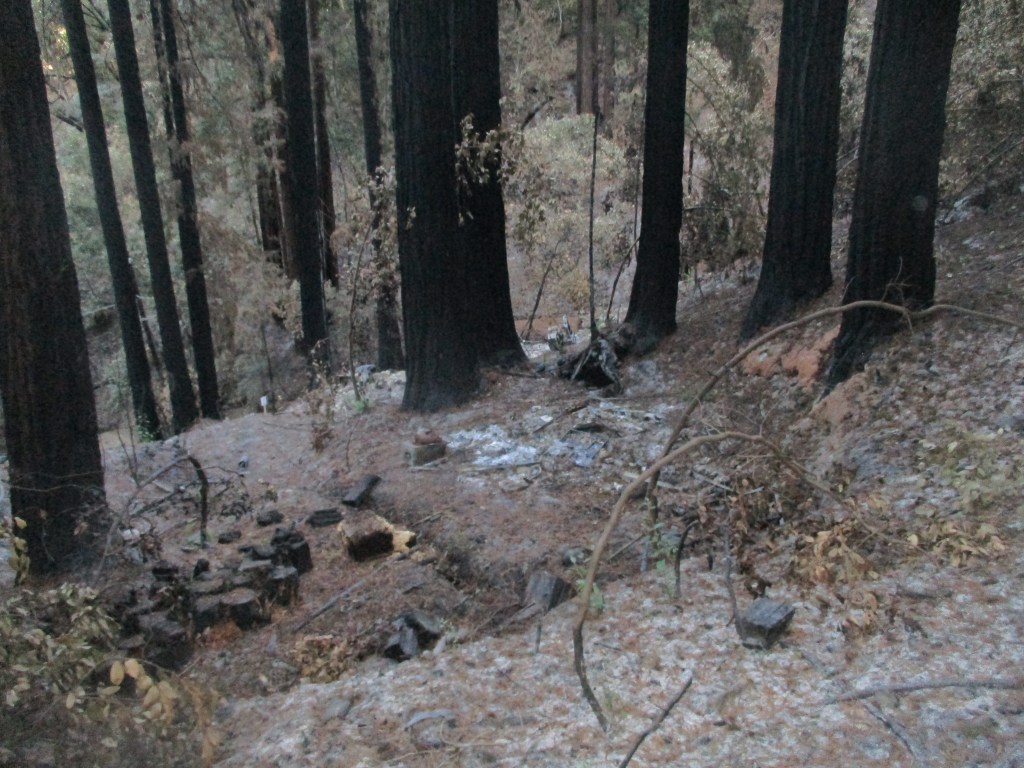
4. Stumps of burned tan oak saplings are already regenerating on another property. They do so very efficiently after fire. They will be combustible before the end of fire season of next year.
5. A neighbor lived here. Ironically, all that remains of his home is the unburned firewood to the left. Because the home was an old non-compliant lumberjack’s cabin, replacement is unlikely.
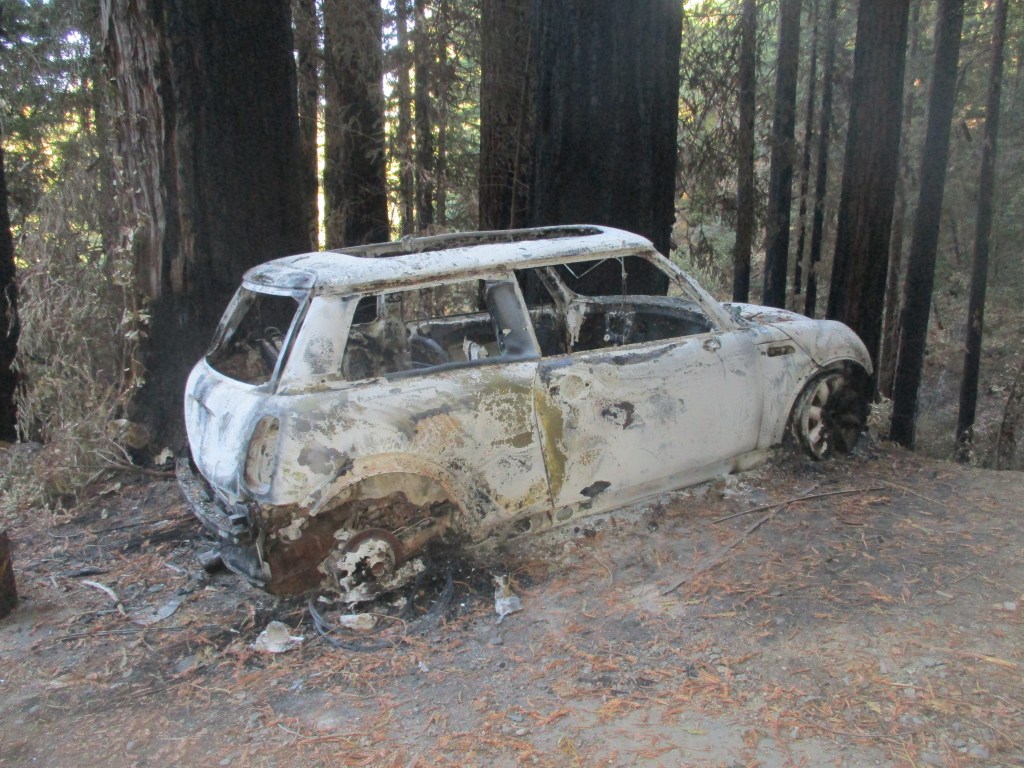
6. This is what remains of the same neighbor’s car. He must have been away prior to evacuation, like I was, but without the car. This was directly across the road from unburned vegetation.
This is the link for Six on Saturday, for anyone else who would like to participate:
Everyone wants a log You’re gonna love it, log Come on and get your log Everyone needs a log log log log
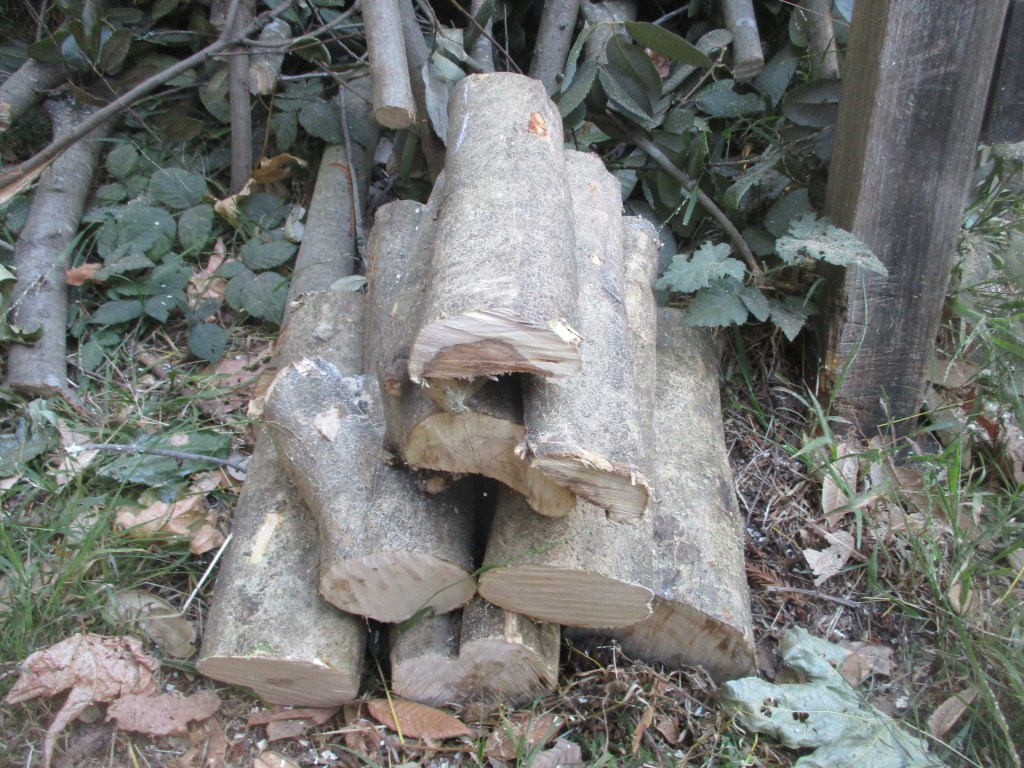
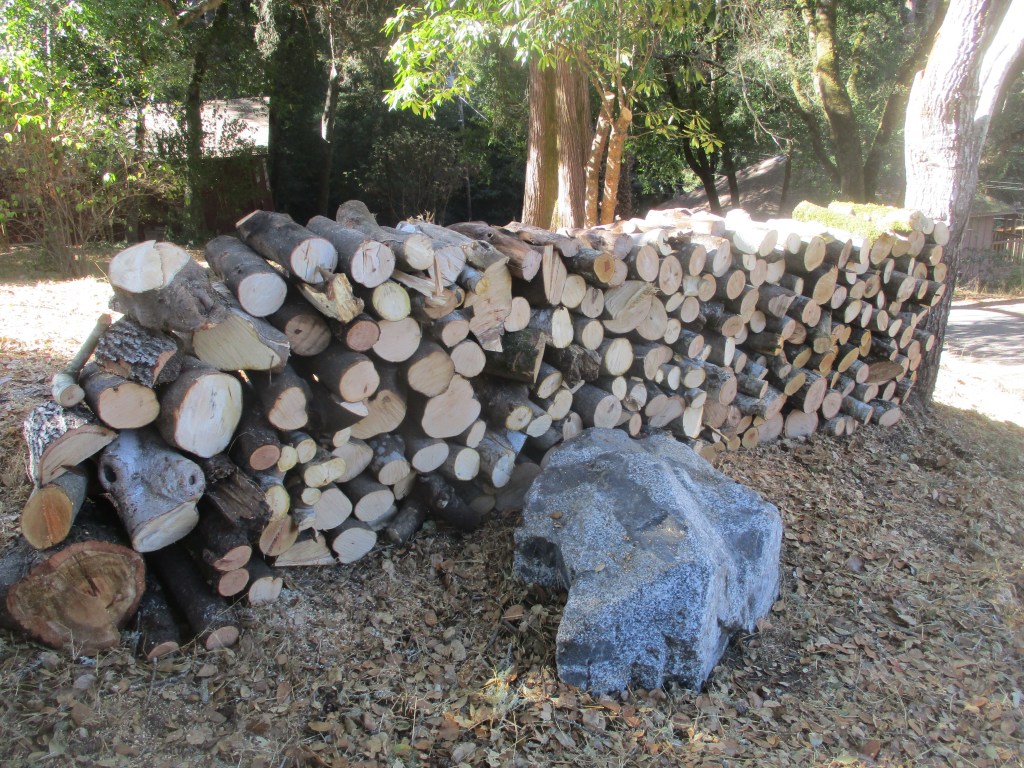
Hopefully, no one remembers this. Anyway, vegetation management has become something of a priority recently, and has been generating a bit of firewood.
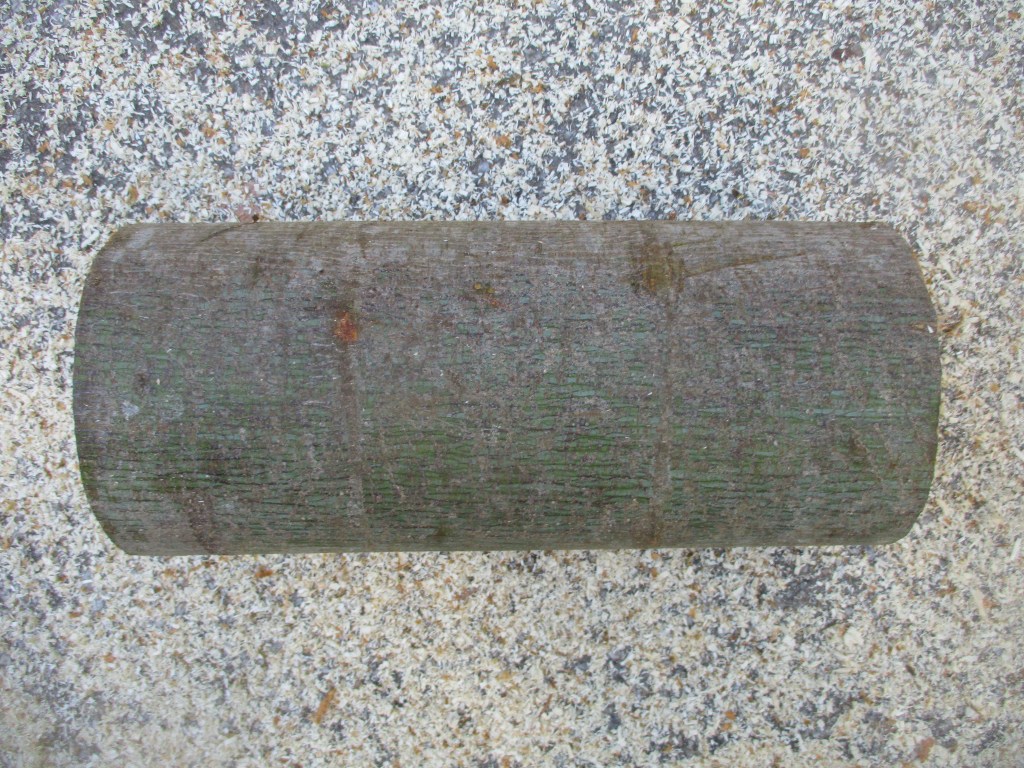
1. LOG! From Blammo! Actually, this one is from a bigleaf maple, Acer macrophyllum. It is an exemplary specimen, artfully displayed against a backdrop of sawdust scattered over asphalt.
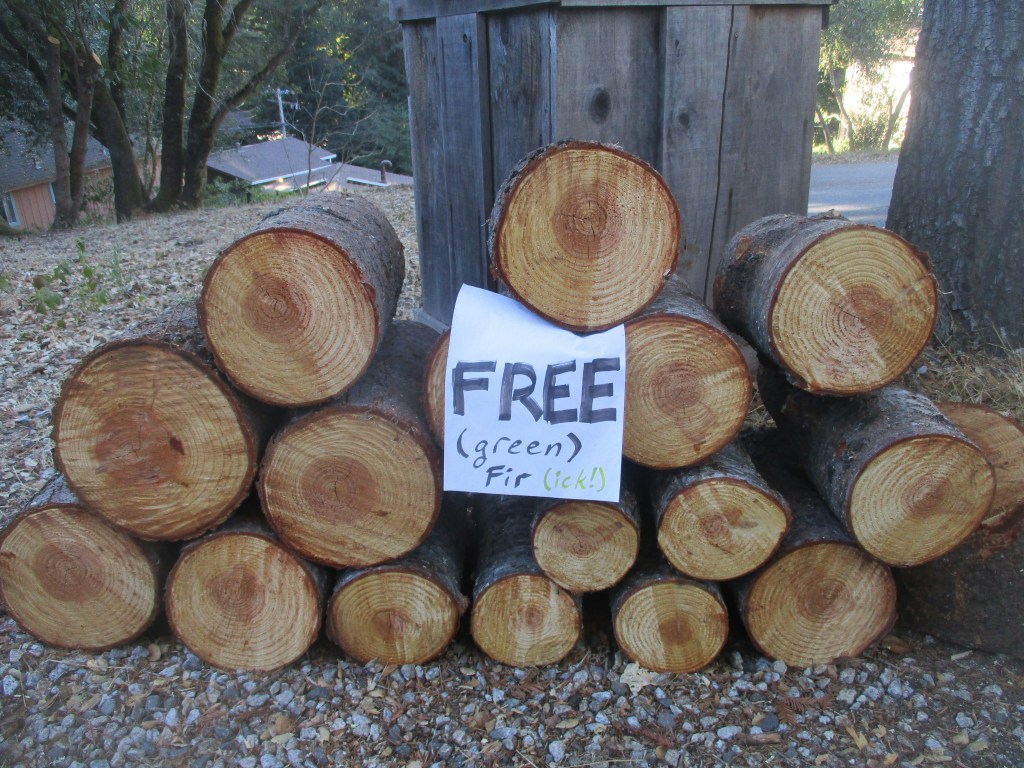
2. Pseudotsuga menziesii, Douglas fir is cruddy firewood that can ruin carpet inside a car if moved while green and sappy, but most was gone by the time I got this picture. It is all gone now.
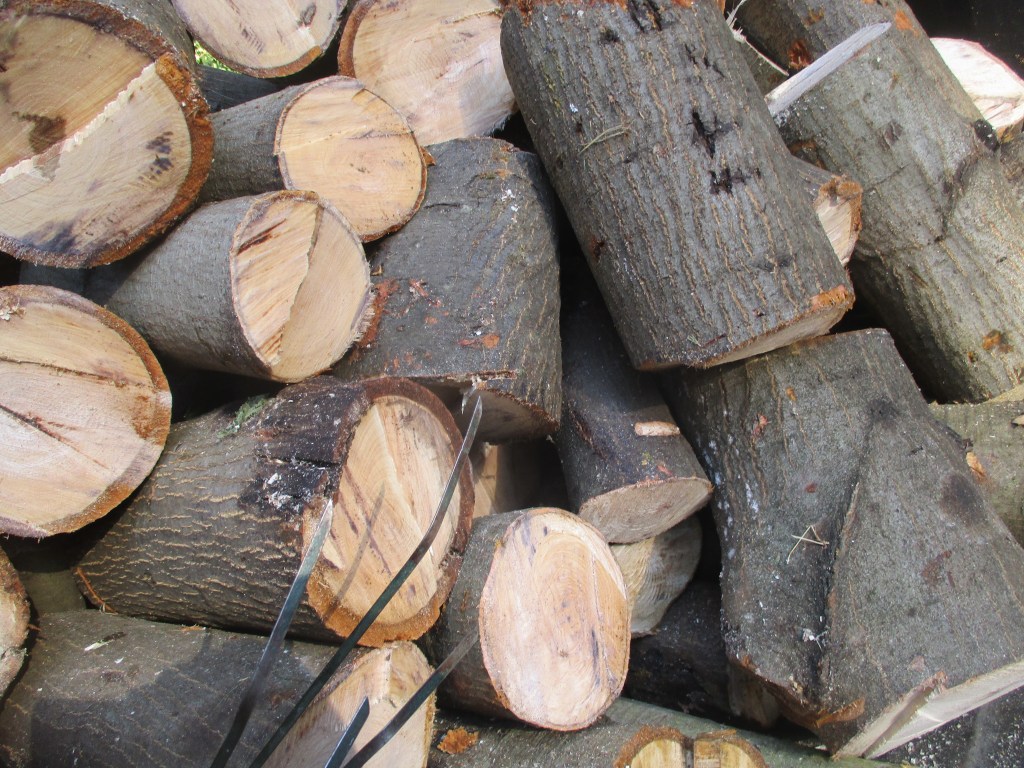
3. (Notho)lithocarpus densiflorus, tanoak is much better firewood. It is also my least favorite of native trees here. It smells like bad salami while in bloom, and produces irritating tomentum.
4. Ligustrum japonicum, waxleaf privet is not native. It was likely a remnant of a prehistoric landscape, rather than self sown. The few logs are nothing to brag about, but will burn like olive.
5. Umbellularia californica, California bay was claimed before it was stacked, so was outfitted with a sign that read, “This bay is not free. (This ain’t FREEBAY!) LOL – LOL”. It smell badly!
6. Acer macrophyllum, bigleaf maple, according to the sign, is for Aunt Jemima. It is one of my favorite native species, but is notably uncommon, so I am none too keen on cutting any down.
This is the link for Six on Saturday, for anyone else who would like to participate:
The last three of these six are rather embarrassing. Perhaps I should have omitted them. Some might find them to be amusing. Some of the buildings here are more than a century old. Even more originally lacked electricity. Much of the wiring is substandard by modern regulations. Some is downright shoddy, and susceptible to damage from . . . vegetation management.
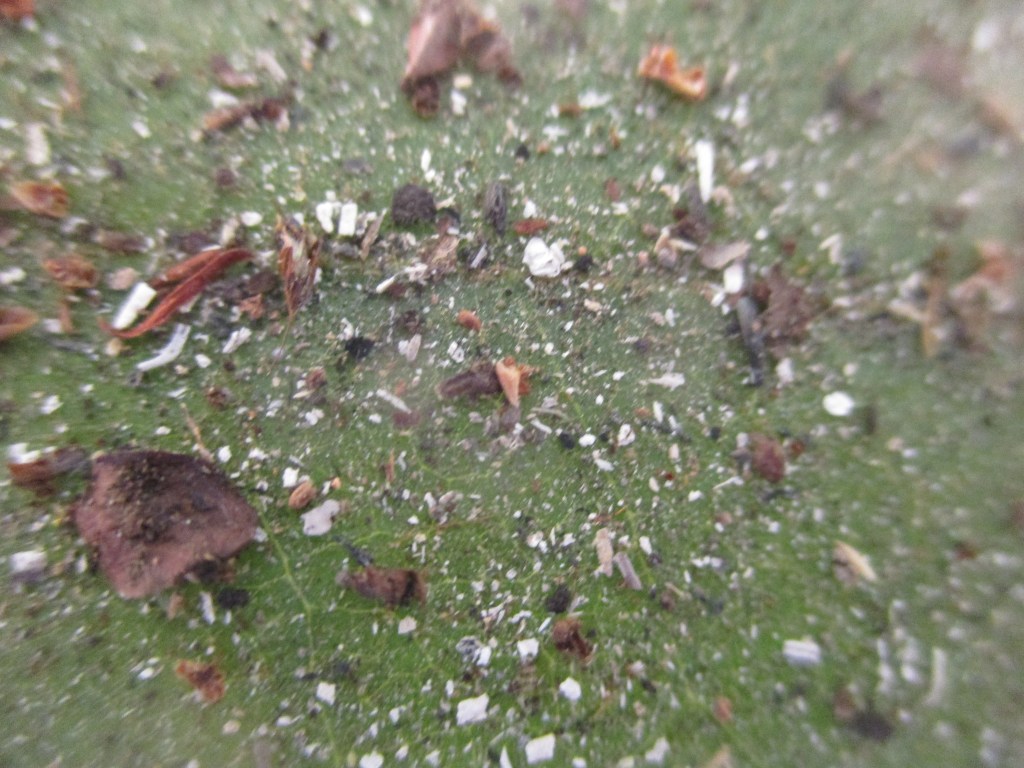
1. Ash is STILL everywhere! Even without rain, it should have blown away in any breeze. Instead, it is a constant reminder of why we must be more diligent about vegetation management.
2. Strangely atypical foliar scorch damaged several rhododendron and a few other plants during evacuation. Sheltered foliage is as scorched as exposed foliage. There is no time for grooming.
3. Volunteers are helping with vegetation management at cabins that are inhabited by some who lost their homes. Even if it were not green, resulting ‘fire’wood is unlikely to be popular here.
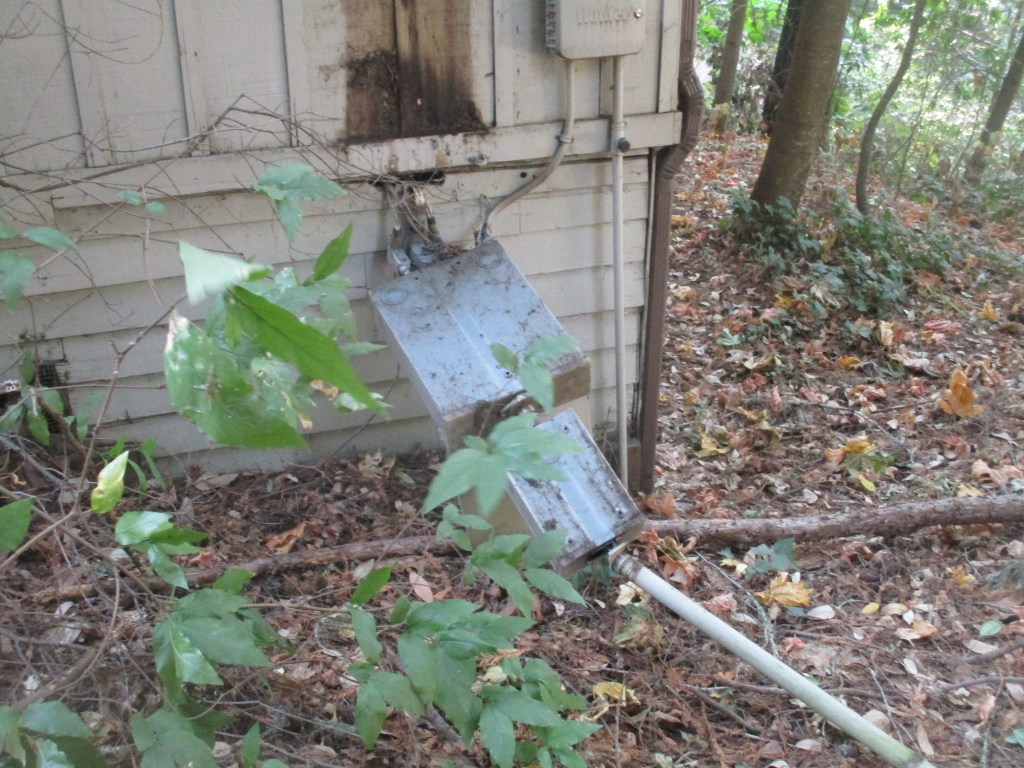
4. Before I continue, I should point out the cruddy pipe clamp that is barely attached to weathered trim by only a short screw. It is right there in the middle. Its other short screw is missing.
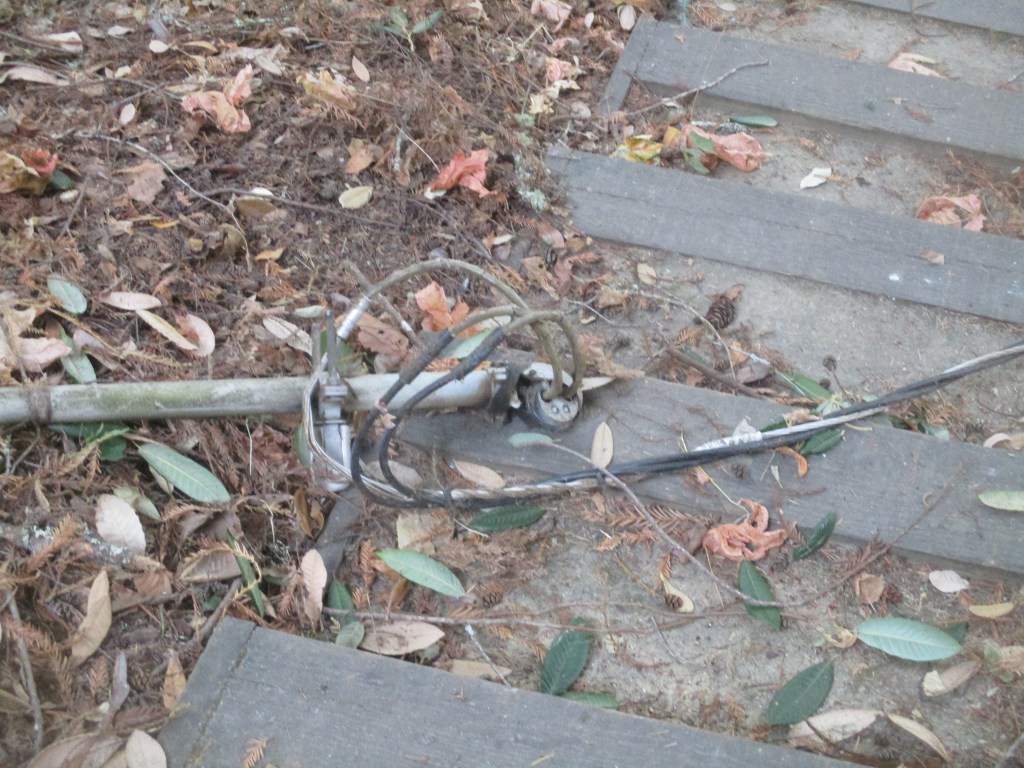
5. This is what the pipe clamp was supporting. The large box leaning out from the wall is the fuse box. The smaller box is the electrical meter. The pipe to the lower right is electrical conduit.
6. Something so important and potentially hazardous should have been secured by more than two small screws. It should not have been so easily dislodged by a smack from the top two feet of a bay tree. This thing made major sparks when it hit the ground. It could have started another fire! Anyway, the tree was removed. We are actually careful about vegetation management.
This is the link for Six on Saturday, for anyone else who would like to participate:
Getting there is half the fun, but only half of that fun was illustrated last week. This it the remaining half of half the fun, . . . which is technically a ‘quarter’. The pictures are not very colorful. Mine are very often like that for Six on Saturday. I am sorry that I got no picture of Rhody.
1. Rhody’s meadow next door was a baseball field. It may eventually be restored. For now, compost piles occupy the edge of right field. The railroad bridge of last week is in the background.
2. Toasted leaves remain evident in undisturbed areas. There has been no rain to accelerate decomposition. It is disconcerting to see so many amongst combustible dried vegetation like this.
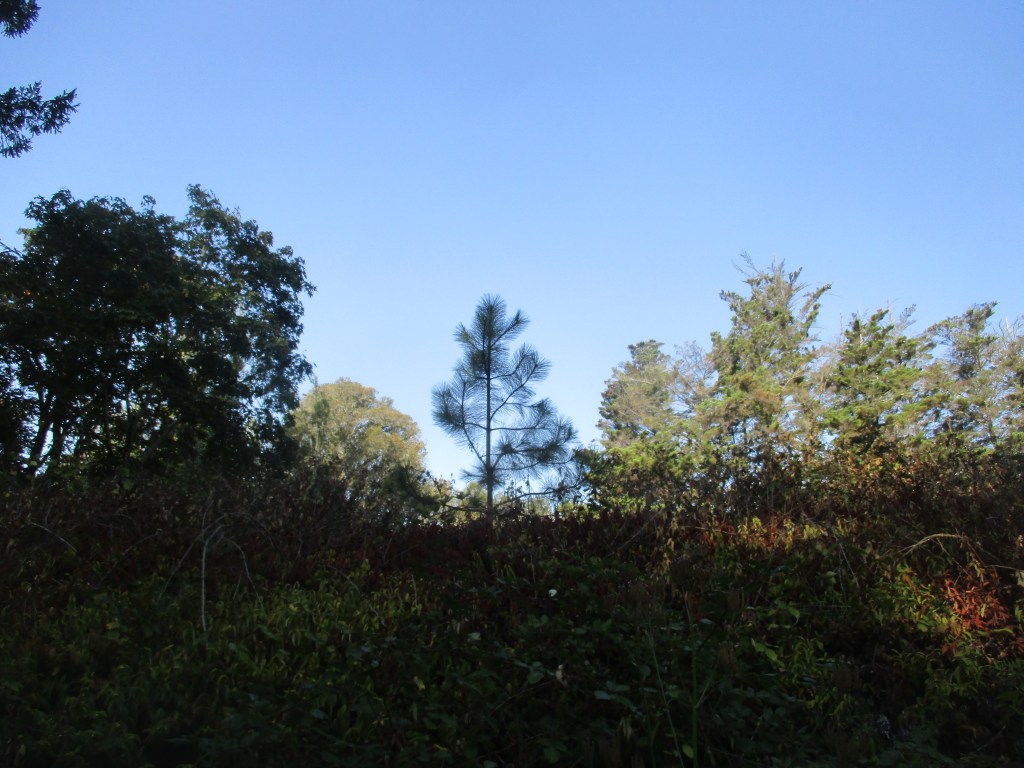
3. Charlie Brown’s Christmas Tree lives here. It is a baby ponderosa pine, which seems out of place among redwood forest. Those are sickly Monterey cypress in the background to the right.
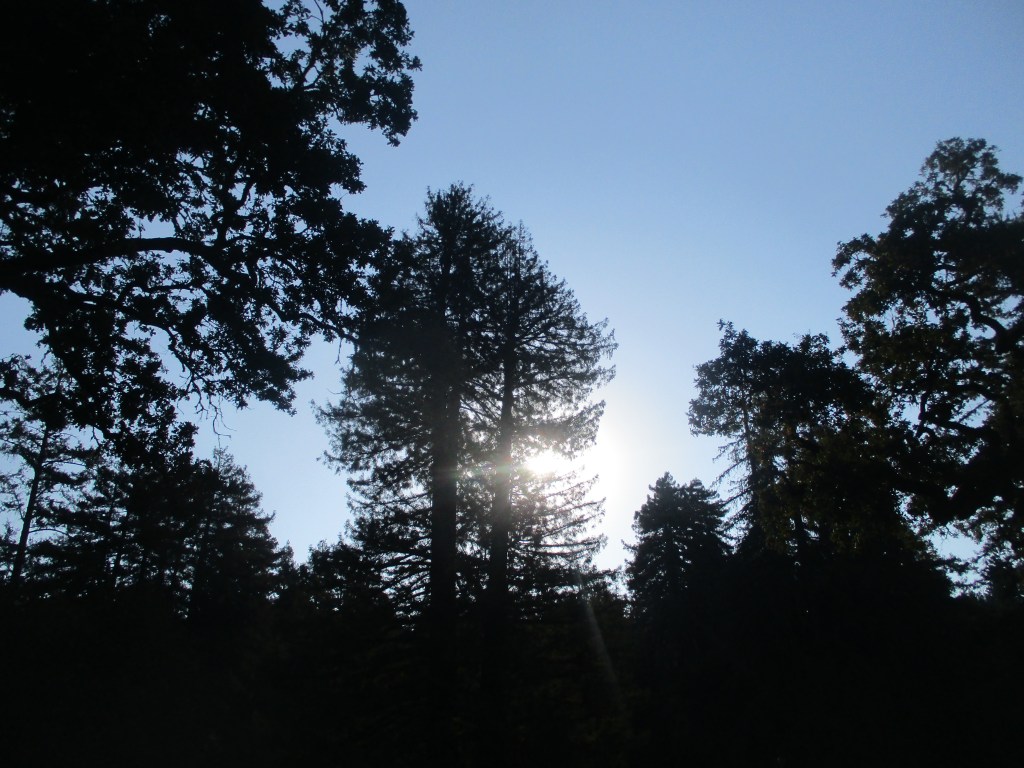
4. Trinity Tree was about this tall in historic pictures from more than a century ago. It is only plumper now. It may have been rejected from earlier harvest because it is so thickly branched.
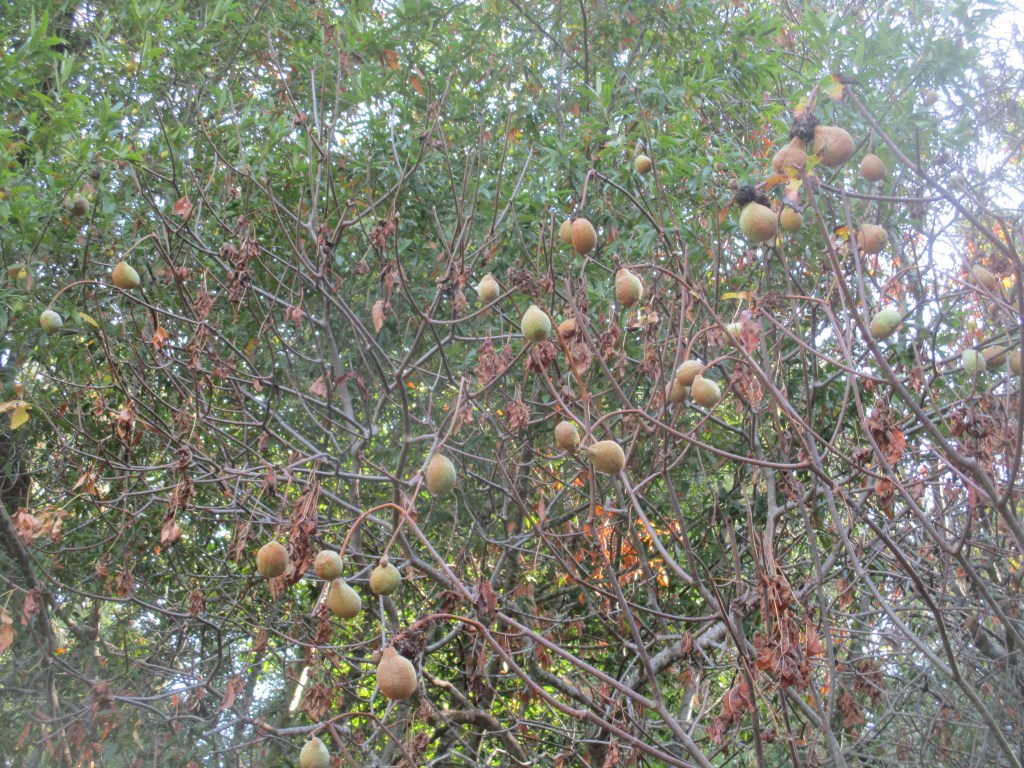
5. California buckeye seed pods, or whatever they are, look even sillier than what the English know as conkers of red horse chestnut, because they linger after summer defoliation. This is an odd species that defoliates during the arid warmth of summer, refoliates for late autumn, and defoliates again after it gets frosted in winter, only to foliate late in winter to repeat the process.
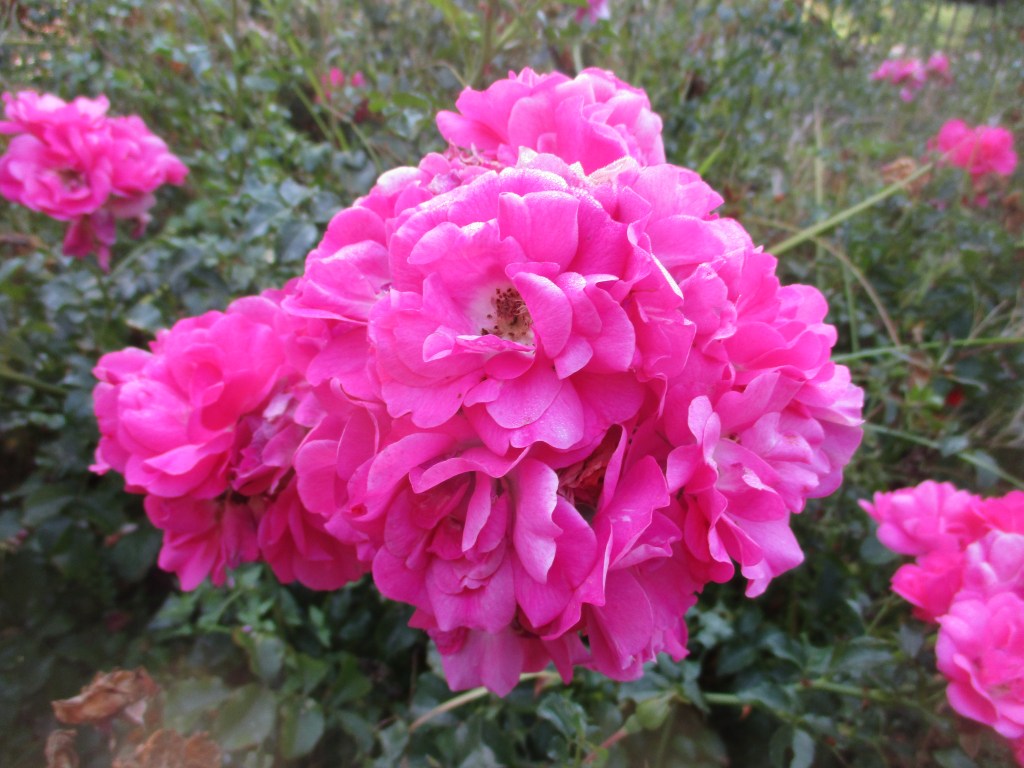
6. Yuck! I detest carpet roses. Besides this pink colony at the Depot, there is a red hedge in another landscape. Without a picture of Rhody, it seems polite to add at least one colorful picture.
This is the link for Six on Saturday, for anyone else who would like to participate:

 There are not many things that will grow in my zone that I will not at least try to grow if I have the space and resources to do so. I really like to grow fruits and vegetables, particularly those that I am familiar with from when I was young. They are just as productive now as they were then. The only problem is that I do not know how to cook. I can freeze, can or pickle large quantities of produce, but cooking is something that I leave to experts.

 Is this a bad idea for a green roof?