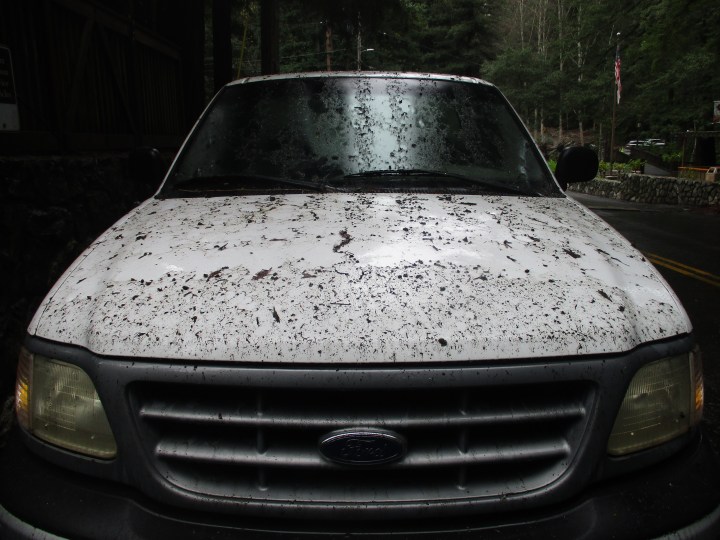
 Blowers put the ‘blow’ in ‘mow, blow and go’. They really blow! The only power tool used by so-called ‘gardeners’ that is more detestable to the rest of us is the power hedge shears, and that claim is contestable. Some consider blowers to be worse because they are so obnoxiously noisy, and generate so much dust. Some municipalities have outlawed the use of the noisiest sorts.
The mess on the hood and windshield in the picture above was not actually caused by blowers. The picture below shows the bridge that was power washed above. Oops. I should have been suspicious that no one wanted that parking space. Anyway, this picture was just too funny to not share; . . . and I happen to lack pictures of the sorts of dusty messes that blowers can stir up.
Where I lived in town, the so-called ‘gardeners’ who ‘maintained’ the apartment buildings on either side used blowers. There is a noise ordinance there, but we never bothered to enforce it. We did not want to interfere with what needed to be done. There was a lot of pavement, and we wanted it to be kept clean. We could not expect it all to be quietly swept like I swept mine.
To the north, the blowers were either off or on full-throttle. There was nothing in between. The cars in the carport collected all the dust that was stirred up. If the door to the washroom was left open, debris got blown in, and the pilot light for the only water heater in the building got blown out. Most of the debris got blown to the southeast corner, and under a fence into my yard.
The same happened to the south, but the water heater was less exposed, and there was much more debris. The largest valley oak around lived there, and dropped leaves for several months. I replaced the kickboard at the base of the fence in their northeast corner a few times, but it was just as regularly kicked out and removed so that debris could continue to be blown under!
In other neighborhoods, so-called ‘gardeners’ are notorious for blowing debris out into roads, where it gets dispersed by traffic. Even if they do not blow it away just to become a problem somewhere else, they are likely to blow too much of it into shrubbery, along with any mixed litter. It accumulates faster than it decomposes to benefit the soil and roots below. What a mess!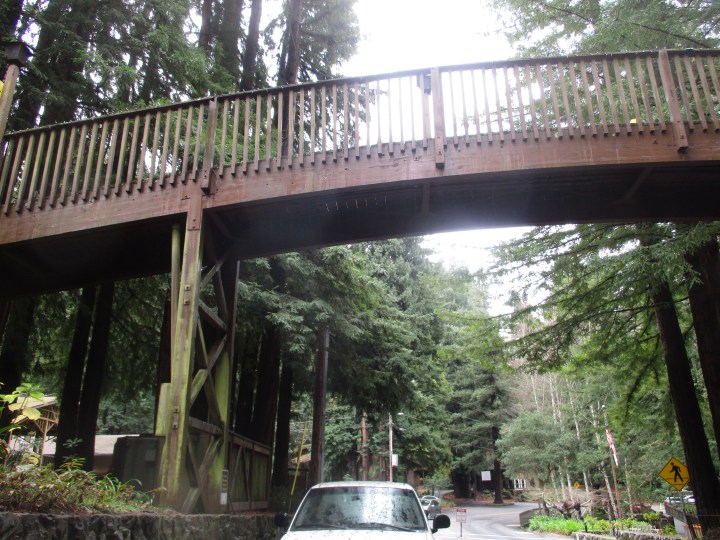
 English holly is politely naturalized here. This means that, although naturalized, it is not aggressively invasive, and does not seem to be too detrimental to the ecosystem. It is only annoying to see out in forests, far from the landscapes that the seed escaped from, and wonder if it has potential to significantly compete with native vegetation. It would be better if it were not there.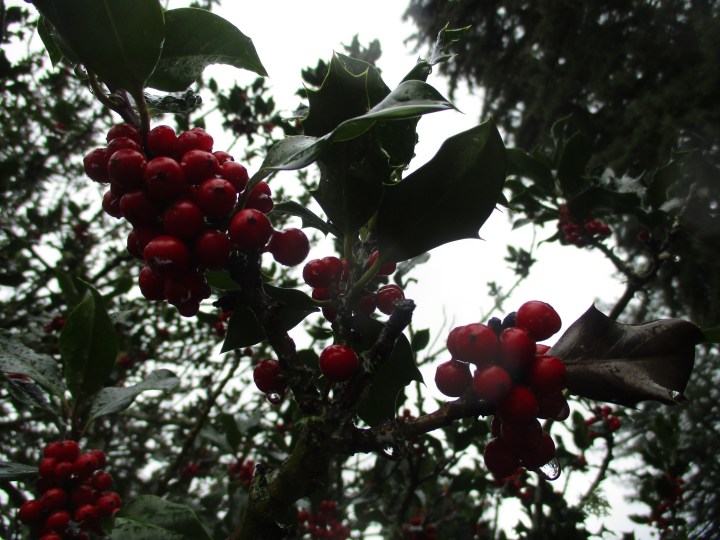
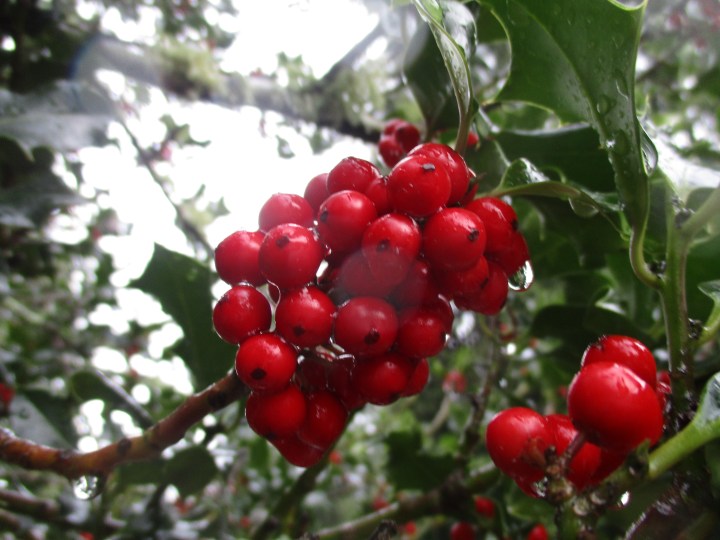
 Spruce happen to very compatible with the landscape style here. They fit in nicely with surrounding redwoods, but are more proportionate to sunny spots of some of the refined landscapes. We intend to add a few into some of the landscapes as they get renovated. They will stay branched to the ground, like big dense shrubbery, with the personality of distinguished forest trees.


 Roots hold up trees. That is part of their job. They grow along with the trees they support, and disperse as necessary to maintain stability. Trees grown within the confinement of cans (pots) or boxes, and then installed into a landscape, are typically staked temporarily until their roots adequately disperse and stabilize. Once unnecessary,
 Fruit trees, with few exceptions, have been extensively bred to produce the quality of fruit that we expect from them. Some are consequently genetically unstable, or at least less genetically stable than their wild ancestors were. Even if they never mutate or try to revert to a more stable state, they are very unlikely to produce seed that can develop into genetically similar trees.




 Cher explained a long time ago that a half-breed is nothing to brag about. Some of us just don’t get it. A few clients still introduce me to their weirdly bred stone fruit trees as if they are both justification for great pride, as well as something that a professional horticulturist of the Santa Clara Valley has not already encountered a few thousand times. I at least try to act impressed.
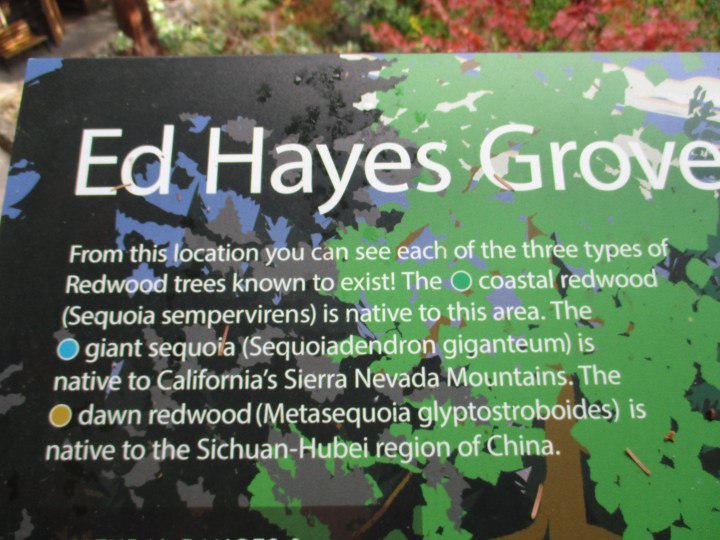
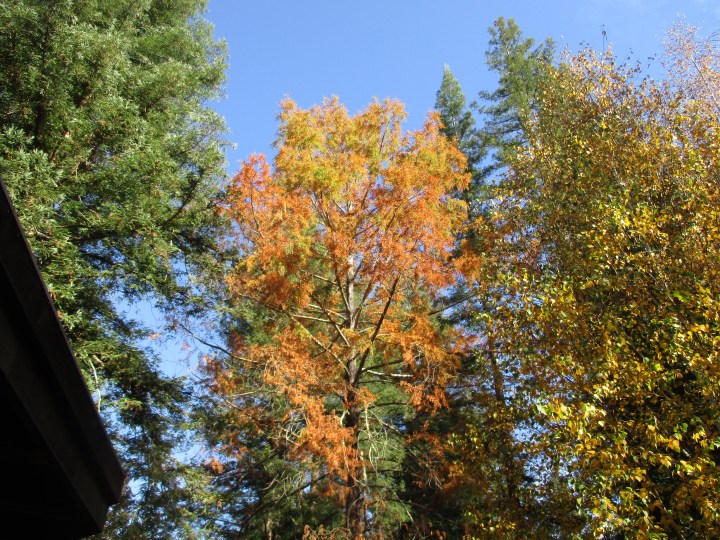 Well, that is certainly a contradiction of terms. One might say it is an oxymoron. Decades ago, it really was how we classified what we now know more simply as ‘deciduous conifers’. There are not many of them. Ginkgo is a gymnosperm like conifers are, but is not really a conifer. Otherwise, there are only five other types of deciduous conifers, which defoliate through winter.
 Tony Tomeo