Six on Saturday: No Silver


We have bronze, and we have gold, but we have no silver, at least not in these six pictures. I suppose I could have posted a picture of Eucalyptus cinerea or Echeveria glauca. I thought it would be more interesting to contrast two different cultivars of each of these three species. Only two are truly bronze. Only one is truly gold. They contrast nicely anyway.

1. Bronze smoke tree – Cotinus goggygria – Modern cultivars with richer color like this are now considered to be ‘purple’. When I studied it in the 1980s, the old fashioned bronze cultivars were still available.P90713

2. Gold smoke tree – These might not have been available back in the 1980s. I do not remember every seeing one. I am not often impressed with their vigor; but I have seen them doing quite well in some situations.P90713+

3. Bronze canna – Canna spp. – I believe this is the cultivar ‘Wyoming’, with bronze foliage and rich orange bloom. The bronze color does not show up well here. Other cultivars are much darker purplish bronze.P90713++

4. Gold canna – Just as the bronze cannna is more bronze than it looks here, this one is more golden, particularly when the foliage is new. Obviously, it is variegated as well. The foliage is as interesting as the bloom.P90713+++

5. Bronze New Zealand flax – Phormium tenax – It might be known by a cultivar name rather than the species name of ‘tenax‘ followed by a cultivar name. Weird modern hybridization complicates nomenclature.P90713++++

6. Gold New Zealand flax – I really though that this one was ‘Yellow Wave’, but it does not look like that here. The variegation is more white than yellow. Could this variegation instead be classified as silvery?P90713+++++

This is the link for Six on Saturday, for anyone else who would like to participate:

https://thepropagatorblog.wordpress.com/2017/09/18/six-on-saturday-a-participant-guide/

Horridculture – Parking Lot Islands

P80120kWhat a waste of space! What a waste of water! What a waste of time for the mow-blow-and-go ‘gardener’ who charges money to mow and edge it, but are too inept to suggest planting something that might actually be pretty, or shade the parking lot. There are a few of these between parking spaces marked for ‘compact’ cars, because it is cool to discriminate against full size cars that can not pull far enough forward to get out of the way.
Even between a Buick and a Chrysler, it is nothing to look at. It looks like something went seriously wrong with a grave site that was supposed to get a slab ‘over’ it (not ‘around’ it). It could be a Chia Pet litter box. There are much better spots to picnic at the park down the road. Whatever it is, it is not much better than the swales that are required in modern parking lots. It has potential to be a tripping hazard, but is not quite as dangerous.

I would make one of only two suggestions.

1 Pave over it. If there is not some building code that limits the area that can be paved, this might be thee most practical long term solution.

2. Landscape it responsibly. Yes; ‘responsibly’. Turf grass is just lame. Those trendy carpet roses that mow-blow-and-go ‘gardeners’ typically plant snag the clothing of those coming and going from the cars they park there. Since parking lots get warm, I would recommend shade trees with complaisant roots that are compatible with pavement. Such shade trees also should get tall enough to not obscure the signs on the buildings.

Parking lot islands contain some of the most deplorable landscapes. Trees commonly get hacked down below signs rather than pruned up and over them. Even if they get properly pruned with up-dos, their canopies must be carve around security lighting. Most problems result from negligent maintenance. Some problems result from design glitches. Realistically though, parking lot islands are very difficult to landscape well.

Epiphyllum Surprise

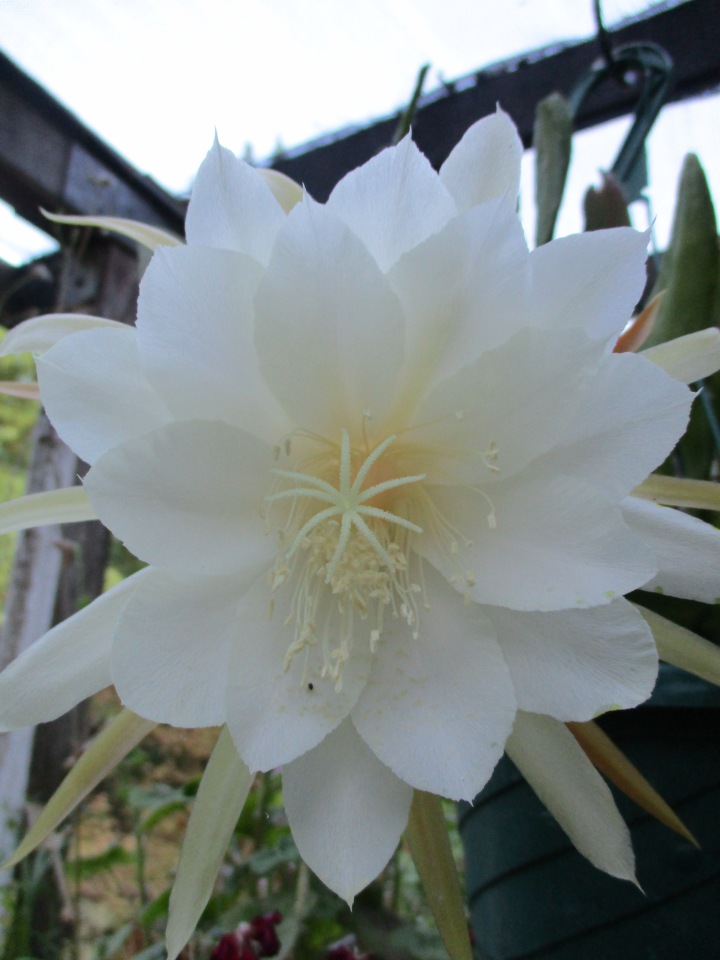
80808Epiphyllum oxypetalum was my very first epiphyllum. A friend’s mother gave me three long cuttings, which were cut in half to make six cuttings. They grew like weeds, and I was quite pleased with them. At the time, they were the only epiphyllum that I wanted. The wide nocturnal flowers are strikingly pure white and nicely fragrant, and stay open late into the morning if the weather is right. Since white is my favorite color, I craved no more.

Then I got bits of another epiphyllum from one of my clients. I do not know if it really is a species of epiphyllum, but it grows just like one, with the exception of the bloom. Rather than only a few huge nocturnal flowers, it blooms with many smaller pink flowers that remain open all day. It lacks fragrance. It is not as impressive as Epiphyllum oxypetalum, but it is colorful for a longer time. Besides, now that I got it, I must continue to grow it.

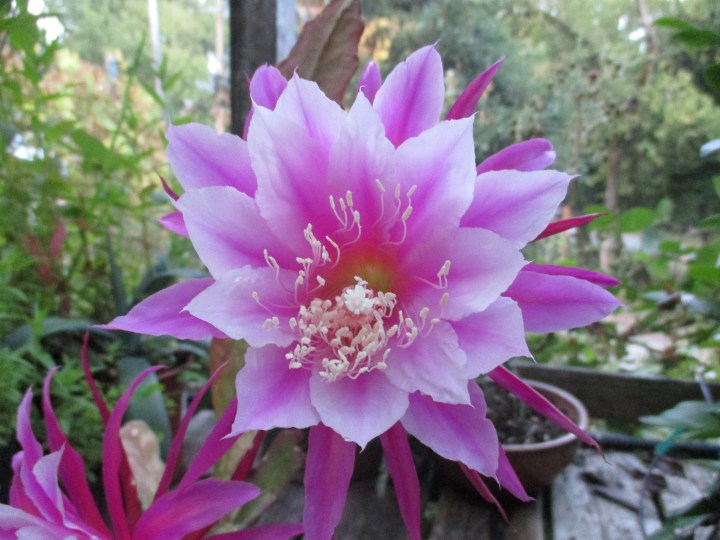
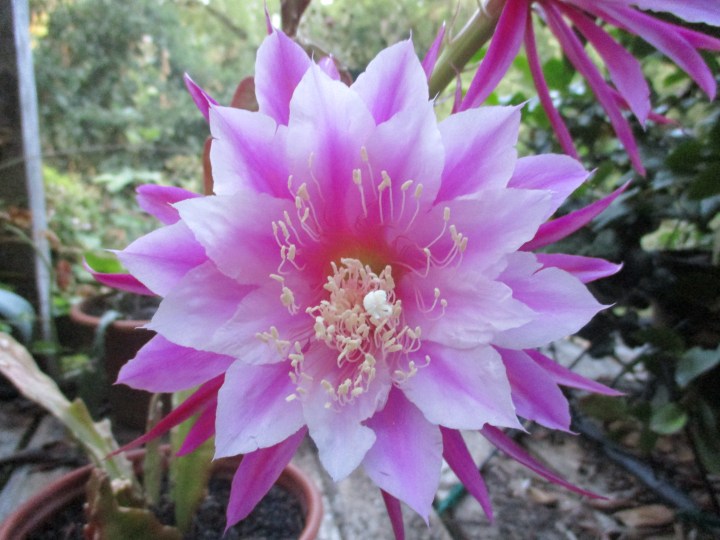
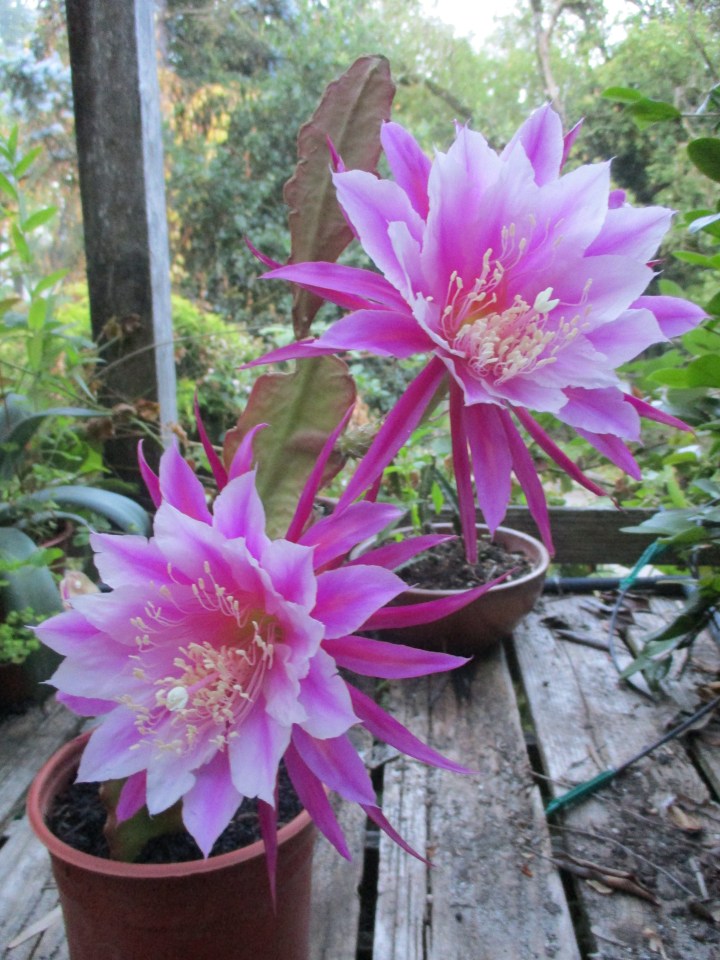
Shortly afterward, I acquired a bit of another epiphyllum from another client. I expected it to bloom with a bright red flower, but it did nothing. In fact, it sat around for a few years without doing anything. Finally, it bloomed for the first time this year. That is the surprise.P80714+++++

This red epiphyllum that bloomed last year is not mine. It belongs to a colleague who hangs it in public garden at work while it is blooming. This is what I expected mine to look like. I sort of believe that it happens to be one of the more popular cultivars of epiphyllum.

What I got instead was these intriguing pink blooms! I don’t know what to think. The clear whit Epiphyllum oxypetalum is still my favorite, and I really like the rich red, but these pink flowers are totally rad too!P90707P90707+P90707++

Trona

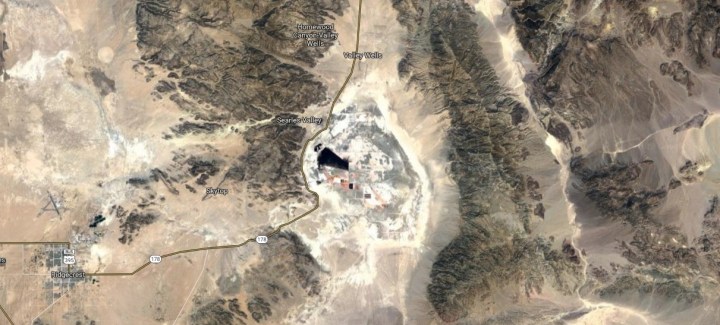
P90706KTrona is not as obscure as it seems. I would have needed to zoom in a bit more for it to appear on ‘Google Maps’, but it is there, just to the northwest of what seems to be a big crater of some sort in the middle, right where the map is labeled ‘Searles Valley’. You might have seen Trona before, from more flattering, or at least more realistic perspectives, in movies such as ‘Star Trek V’, ‘Planet of the Apes’ (2001), ‘Land of the Lost’ and ‘Holes’.

Earlier this morning, I posted an old brief article from March 21, 2018, Na2CO3•NaHCO3•2H2O. It was about some of what I find to be appealing, or at least compelling about Trona. Please excuse the euphemisms, such as ‘flattering’ for ‘realistic’, and ‘appealing’ for ‘compelling’. I happen to be rather fond of Trona, even though I have never been there before. I find that I appreciate it more as I learn more about the Community there.

Suddenly, Trona is in the news. A moderate earthquake occurred just west of town two days ago on the Fourth of July, and a stronger, although still ‘moderate’ earthquake occurred just yesterday morning. There were a few significant foreshocks, and the countless aftershocks, some of which are quite significant, will continue for a long time. Most of the damage was in Ridgcrest to the west, but only because there is more to damage there.

Earthquakes are nothing new here. We all know that they are more common here than in most other places. At one time or another, many of us here have experienced a moderate earthquake such as these. Of course, that does not make earthquakes any easier when they happen. Cleaning up the mess, repairing damage and recovering from an earthquake is a long process.

Six on Saturday: Under And Over


These are some of the bridges in the neighborhood where I work. There are several others that I did not get pictures of, as well as several more closer to town. Bean Creek happens to flow into Zayante Creek here, and Zayante Creek flows into the San Lorenzo River just a short distance away. Bean Creek flows through the farm a few miles upstream. Zayante Creek flows right past my home.

If you happen to know who Miley Cyrus is, she was photographed in the waterfall where Ferndell Creek flows into Bean Creek, which is literally just a few feet upstream from where Bean Creek flows into Zayante Creek. I do not know who she is, but I can understand why she came here to have her photograph taken.

1. Under the Conference Drive Bridge over Zayante Creek, East Zayante Road, Roaring Camp Road, Roaring Camp Railroad, and an access road to a (Rhody’s) baseball field, one would not guess that this bridge covers so much territory. The two roads below are on opposite sides of Zayante Creek. I posted pictures of this bridge before, but during winter while the box elders were bare. One box elder off to the left fell not too long ago.P90706

2. Over Zayante Creek, just a short distance upstream and around a bend to the east, this small pedestrian bridge is closed until it can be repaired or replaced. Rhody does not seem to mind. Except for the light green box elders off in the distance, the trees to the left are some rather nice specimens of white alder. The foliage to the right is that of California buckeye, which is a weirdly ‘twice deciduous’ species that can defoliate during summer.P90706+

3. Under Roaring Camp Railroad Bridge over Zayante creek, just another short distance upstream from the pedestrian bridge (#2), we can see some more white alders, as well as some coast live oaks in the background. The lighter foliage to the left is likely box elders. This railroad passes under the significantly higher Conference Drive Bridge (#1) just a short distance in the opposite direction. They are almost perpendicular to each other.P90706++

4. Over a nicely landscaped section of Ferndell Creek, this small pedestrian bridge is probably the best place to see most of the rhododendrons when they bloom. Most are off the left, but that unrecognizable shrub to the right is one of the biggest. It is about ten feet above the bridge, and about twelve feet below! The big camellia that was killed by gophers earlier was just to the left at the far end of this bridge, just in front of the redwoods.P90706+++

5. Under another pedestrian bridge just a very short distance downstream from the bridge pictured above (#4), recently planted Boston ivy is beginning to climb the pair of pillars in the background. Now that we know it does well here, we will eventually add more to climb the closer pair of pillars, after the English ivy gets removed. The site from which I removed sedge earlier is just upstream to the left, between the two pedestrian bridges.P90706++++

6. Over Conference Drive, and a short distance up the road form the Conference Drive Bridge (#1), this small pedestrian bridge was built at a time when Conference Drive carried much more traffic. The road was closed to through traffic and bypassed in 1968. I like how the bridge leaps up into the redwoods and back down again on the far end. I need to prune these redwoods for clearance, but try to leave them cozily close to the bridge.P90706+++++

This is the link for Six on Saturday, for anyone else who would like to participate:

https://thepropagatorblog.wordpress.com/2017/09/18/six-on-saturday-a-participant-guide/

Horridculture – Tree Removal Permits

P90703There are mixed emotions about tree removal permits that so many municipalities need to issue in order for a ‘heritage’ tree to be cut down legally. Most of us want to believe that in America, we have certain rights to do what we want to on the properties that we own. Obviously, that makes the most sense. However, if it were that simple, many more prominent trees that are collective assets to the larger communities would be removed.
As an arborist who writes the reports needed to procure these permits, I see it both ways. There are many trees that are worth preserving for the Community, and there are probably many more that must be removed for the safety of those who live around them.
I sometimes hear of common homeowners who get fined for removing a tree without a permit, just because they were not aware that it was protected by an ordnance. Most have lived in their homes longer than such ordinances existed. Most planted the tree that they were fined for removing.
Conversely, I also hear about developers who just remove whatever trees get in the way of their developments, and then just pay the necessary fines. It is nothing to them because they make so much money from the development.
The picture above is a site that one of my former employers worked on just before I left my job because it was too morally challenging. You can see that there are no significant trees. The tree crew removed all of them.
I was not aware of it of course. The Home Owners Association did not want to pay for my inspections and reports, or for the permits to remove all the big sycamores in the front gardens there. Nor did they want to replace the removed trees with something more proportionate, as the local municipality would have required. They were not worried about getting caught, since everyone there wanted the trees gone.
Now realistically, I would have had no problem writing reports recommending the removal of all the trees, because they were ridiculously disproportionate to their particular application. You can see how tiny the front gardens are. It was just easier and less expensive to cut the trees down illegally, and then not be required to replace them with trees that would have later died ‘accidentally’ anyway. (The tree crew excelled at that too.)
In the end, it is disgraceful that the trees that were required as a contingency when the site was developed years earlier are now completely gone, and will not be replaced, . . . and that no one seems to care.

Boom! Zap! Wow! Bam! Zing!

P90630P90630+P90630++P90630+++P90630++++Batman and Robin were here!
. . . well, not quite. It is decoration for summer camp. We never know what we will find in the landscapes that we maintain here. Those who work at camp arrive before guests, so that they can get ready, and of course, to decorate. Guests only started to arrive two weeks ago. It makes our work more interesting, as we try to work around the traffic and events, but it is SO gratifying to see so many guests enjoy the facilities that we maintain!
Those who work at camp enjoy being here too. It is obvious in all the work they put into preparation. It gets pretty wild and colorful, as I was reminded when I found what had been done in a grove of coast live oak just outside of one of the main auditoriums. Last year, I pruned and groomed the trees to expose their naturally sculptural trunks. I thought they were rather exemplary; but apparently, there was some room for improvement.
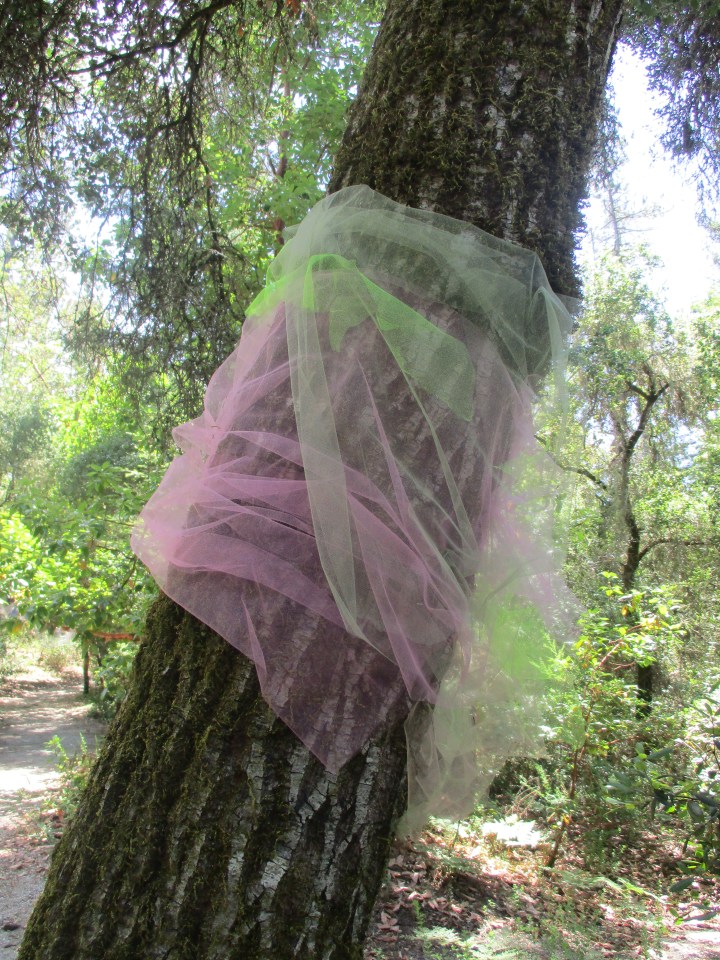
There is more to the wardrobe of a well rounded tree than mere ‘trunks’. One might select stylish attire such as this. Really though, I am not certain if this tree is feeling ‘Absolutely Fabulous’ or totally embarrassed.P90630+++++
This one went for an old fashioned veil.P90630++++++
English ivy on the ground below the grove is wearing too much makeup.P90630+++++++
It is not really makeup of course. It is paint from this mysteriously hovering door . . . as if that somehow makes more sense. It was locked.P90630++++++++
This one is more my style, and it has a window. There is no need to open it to see what is outside . . . or inside.P90630+++++++++
If neither of those are good enough, there are plenty of others to choose from.P90630++++++++++

Beehive

P90629KKIncandescent light bulbs were the standard form of electric lighting for more than a century after their invention. It took a while for fluorescent and halogen lamps to become popular; and by the time they did, high intensity discharge (HID) lamps had already become available. Nowadays, light emitting diode (LED) lamps seem to be replacing all sorts of electric lighting.
For a brief time in the late 1980s, high intensity lamps that were being used for large scale applications and street lamps became a fad for exterior household lighting. They worked nicely for driveways, so many of us believed that they would work just as nicely for night lighting of home gardens and patios.
By that time, most of us had realized that the sickly yellowish glare of the sodium vapor type of high intensity lamps that were so common as street lamps was not at all appealing around the home, and was downright unflattering for foliage and flowers in the garden. Mercury vapor high intensity lamps became more popular for such applications instead, even though their slightly bluish bright glare is no more inviting.
During this time, while the renowned landscape designer Brent Green and I were still studying horticulture at Cal Poly in San Luis Obispo, his father had a rather fancy mercury vapor lamp installed in his backyard.
Of course, Brent was furious! He had put so much effort into cultivating a remarkably inviting outdoor living space, only to have it illuminated at night like an industrial warehouse. When turned on, the lamp made a constant buzzing hum. It hung from a wall like a big glowing paper wasp nest. Brent referred to it at the ‘beehive’.
The quality of light produced by modern electrical light sources has fortunately improved since then. Nonetheless, contraptions such as this street lamp suspended on an otherwise exemplary ponderosa pine are not easy to warm up to.

Six on Saturday: Rhody In Pictures


All I wanted was just one good picture of Rhody in the weeds for an illustration for the gardening column. I wrote about weed seeds, such as foxtail and burclover, that are dangerous to pets. That article will post on Monday, but can be found now at the Canyon News.

Anyway, Rhody would not cooperate. His defiance was so annoying, . . . but also adorable. I used a picture of another terrier on the lawn at Felton Covered Bridge Park instead. (The article in the Canyon News does not use the thumbnail image.) These are a few of the pictures of Rhody that I did not use.

Even though they are irrelevant to horticulture, I posted these pictures here because they are too amusing to delete without sharing. My primary ‘Six on Saturday‘ article was posted separately.

1. Rhody really can be cute until he realizes that I want to get a picture of him.P90629K

2. Then he gets pompous.P90629K+

3. He briefly considered trying to cooperate.P90629K++

4. He did not consider it for longP90629K+++

5. Then he got annoyed that I was still trying to talk him into being cute for pictures that he wanted no part of.P90629K++++

6. By this time, it was obvious that I needed to turn the camera off.P90629K+++++

This is the link for Six on Saturday, for anyone else who would like to participate:

https://thepropagatorblog.wordpress.com/2017/09/18/six-on-saturday-a-participant-guide/

Six on Saturday: Sedge Removal


What a nasty job! We know this sedge, or whatever it is, as ‘razor grass’ because it cuts like razors. It is difficult to pull from the rocky creek bottom and bank with the creeping stolons still attached. The creek is mucky. The water is wet. The gloves I wear to avoid getting slashed obviously get just as mucky and wet.

It was such a miserable job last autumn that we postponed most of it for winter. I figured that I could wait for the dangerous foliage to die back, and then just pull up the stolons below the dead foliage. It might have been a good idea, if only we had returned to actually execute our plan. By the time we got back, new foliage was already maturing.

I was so dreading returning to this job, but then found that the fresh new foliage was not nearly as dangerous as the more mature foliage that we pulled late last summer and autumn Furthermore, the new rosettes had not dispersed their roots quite as firmly as expected. They were suspiciously easy to pull, with the stolons still attached. Dead old rosettes seemed to be completely necrotic and decayed. It was too easy.

I expect at least a few new rosettes will develop later. There were likely some down under the muck that were not up when I was there. I also expect that some will grow from bits of stolon that were left behind. However, nothing has been seen in the past three weeks or so since we did this. (I would have shared these pictures sooner, but there were other pictures to share instead.)

Speaking of other pictures to share, there are six more on my secondary ‘Six on Saturday‘ post. I did not want to save them for later because they are almost irrelevant to horticulture, but I did not want to delete them without first sharing either.

1. Sedge, or whatever it is, is difficult to handle, and is even more difficult to handle when trying to separate the stolons from the stones on the bank of the creek.P90629

2. It did not take long to fill each of these plastic bins. I did not leave any foliage hanging over the edge, because I did not want to get cut when picking up the bins.P90629+

3. These bins can be used as a flotation device. Actually, it was rather annoying that they kept floating away until they got filled. It was a nice day to be in the creek.P90629++

4. This acorus grass was mostly overwhelmed by the sedge, or whatever it is. I should have gotten a ‘before’ picture. It looks great now, and is happy in the muck.P90629+++

5. While pulling sedge, I found these two knees developing from the roots of one of our two bald cypress. This particular tree was supposed to be a dawn redwood.P90629++++

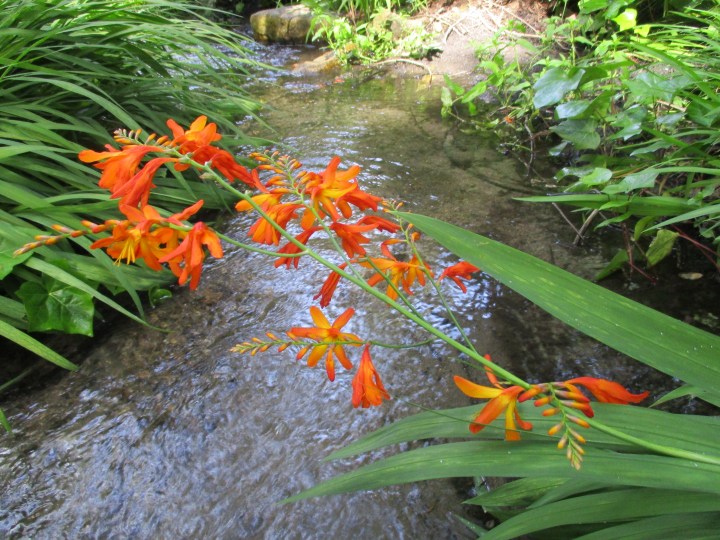
6. I also noticed that the montbretia was blooming more than it normally does down in the deep shade. It is a voracious weed too, but inhibits even worse weeds.P90629+++++

This is the link for Six on Saturday, for anyone else who would like to participate:

https://thepropagatorblog.wordpress.com/2017/09/18/six-on-saturday-a-participant-guide/