The “Poly” in Cal Poly is for “Polytechnic”, as in there are multiple schools within “California Polytechnic State University” at San Luis Obispo. There were seven school when I was there between 1985 and 1990. I was a student of the “School of Agriculture”. “Horticulture” was my “Major”, or major realm of study within this school. Within this major, I selected “Floriculture and Nursery Production” as my “Concentration” of study. That certainly is a lot of quotation marks.
While majoring in horticulture at Cal Poly, I studied with students whose concentrations of study were within “Landscaping” or “Floral Design”. Withing the School of Agriculture, we studied with students who majored in “Crop Science” or “Animal Science” and so on. Like horticulture, each of those other majors was divided into other concentrations.
Then there were all those students of the other six schools, which I will not even get into because…
Like something from an old fashioned science fiction movie, this anomaly appeared in a roadway overnight. There are several more in other roadways and elsewhere about town. They are quite wet. In fact, they are composed almost completely of water. What is even weirder is that the water that they are composed of actually fell mysteriously from the sky overnight as many countless droplets all over town! Many of these droplets migrated into low spots such as this one to form what we now see in this picture.
People in other climates where these mysterious droplets are not so rare might be familiar with this sort of phenomenon. The droplets of water are known as ‘rain’. They precipitate out of the atmosphere as it cools and can not contain as much water vapor as it did when it was warmer. As the droplets migrate into low spots in roadways and…
Merry Christmas! Okay, perhaps not. This posted at midnight, precisely as Christmas Day ended. These are not exactly Christmas flowers anyway. They are not even Christmas colors. The pictures are actually from the previous week. I knew then that I would not likely want to go out to get pictures last week. Until now, Christmas was the priority. There was no work to go to.
My six are very limited this week. There are only two genera and three species. There could be more if the Osteospermum have species designations. I know them only as ‘hybrids’. If there are any cultivar names, I do not know what any of them are.
1. Lantana montevidensis – grows as a ground cover. The color range of the bloom is limited. This color is common, but I thought that individual flowers more commonly have white centers.
2. Lantana camara – is the ‘other’ lantana. It is shrubbier and better foliated. Floral color is more variable and generally more brightly colored. Bloom is not as extensive, but is more prolific.
3. Lantana camara – likes this particular landscape where I got these pictures. Another solitary specimen down the road and at a lower elevation already looks shabby from cooling weather.
4. Osteospermum – within this landscape are all modern hybrids. If anyone knows who their parents are, they do not share such information anymore. I think this color might be ‘lavender’.
5. Osteospermum – looks more purplish than the previous picture. I am no good with colors. Despite the attributes of modern hybrids, I still prefer old fashioned Osteospermum fruticosum.
6. Osteospermum – colors are not easy to describe. Is this one light burgundy red or ruddy pink? There might be six or so cultivars here. This unidentifiable color happens to be my favorite.
This is the link for Six on Saturday, for anyone else who would like to participate:
Sctoch moss resembles Irish moss, but is lighter yellowish green rather than dark green.
Too much water can be as much of a problem as not enough. Too much direct sun exposure can likewise be as much of a problem as not enough sunlight. Scotch moss, Sagina subulata ‘Aurea’, wants regular but not excessive watering, and only a bit of shade without darkness. To propagate, pieces with roots can be torn from healthy plants and ‘plugged’ (planted) as new plants where more are desired in early spring or autumn.
The remarkably finely textured and dense foliage makes a nicely refined ground cover for confined spots, or fills in the spaces between stones in a wall or walkway. It gets only about an inch deep, with tiny and obscured stems that get no longer than four inches. Stems develop roots where they touch the ground to creep any farther. The tiny and narrow leaves do not get much longer than a quarter inch. Tiny white flowers that bloom late in spring may not get noticed. What distinguishes Scotch moss from richly deep green Irish moss is that it is instead yellow or almost chartreuse.
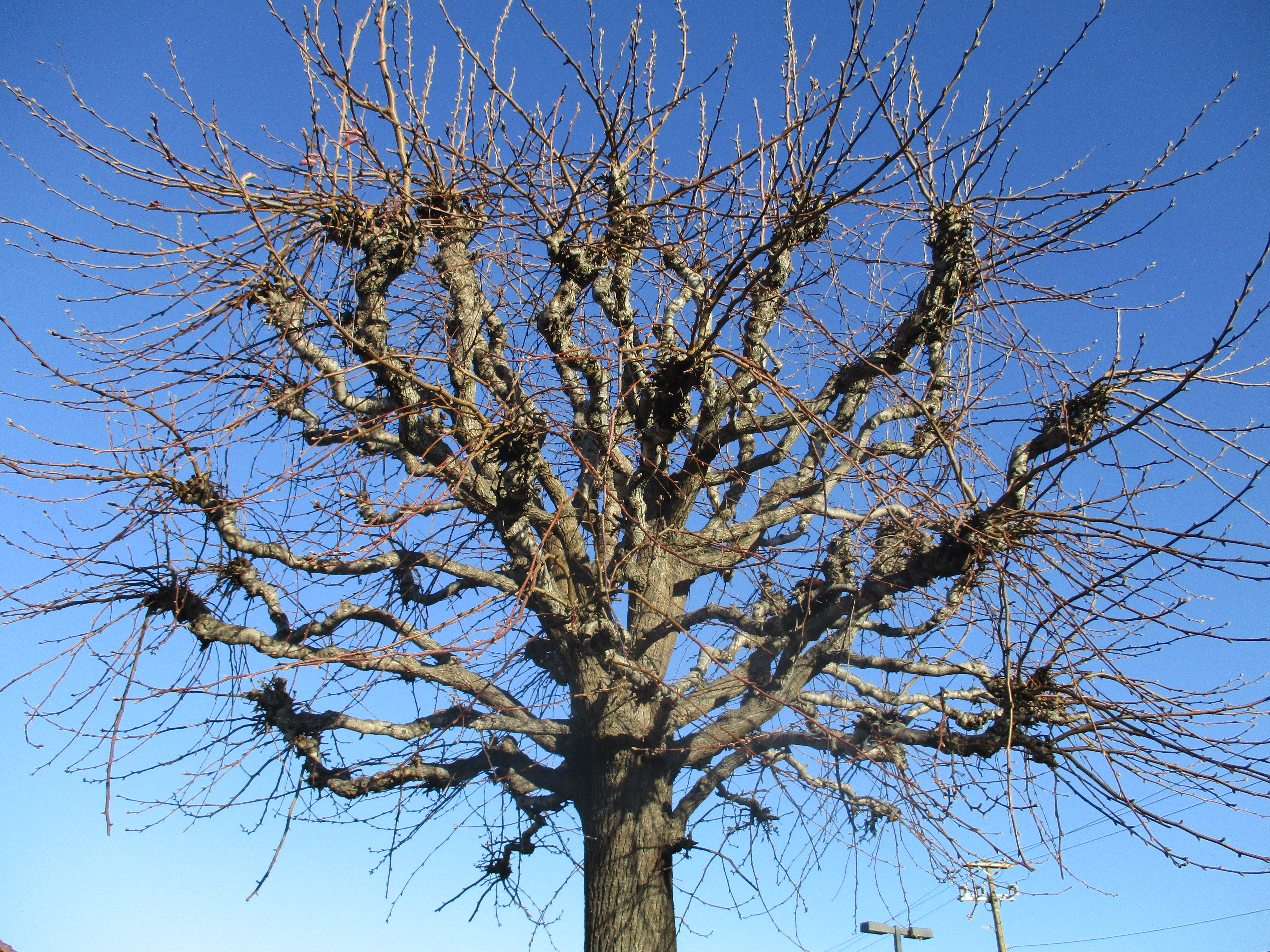
Dormant fruit trees should be pruned aggressively.
After centuries of breeding for abundant production of unnaturally large fruit, deciduous fruit trees have become dependent on specialized pruning while they are dormant through winter. Without pruning, most eventually become overgrown and overwhelmed by their own fruit. The weight of excessive fruit disfigures and breaks limbs. Pathogens proliferate within distressed foliage, crowded fruit and surplus fruit that falls to the ground.
Pruning not only improves the structural integrity of the limbs, but also limits the production and weight of the fruit that will be produced. Limiting production concentrates resources, so that there are fewer, but considerably better fruits, instead of too many inferior fruits. Concentrating the growth of the fewer new stems that develop in spring promotes vigorous growth that is more resistant to pathogens. Ideally, pruning also limits the height of fruit trees, so that much of the fruit develops closer to the ground.
Peaches, nectarines, apricots, plums, prunes, and cherries are all relates ‘stone’ fruits (of the genus Prunus), so require various degrees of similar pruning. Peach trees produce the heaviest fruit, so need the most aggressive pruning. Cherries trees produce significantly lighter and smaller fruit, so get pruned relatively minimally. Almonds (which are actually the ‘pits’ of a similar type of stone fruit) get shaken from their trees, so there is no advantage to keeping production close to the ground.
The ‘four Ds,’ which are ‘Dead, Dying, Diseased and Damaged’ stems should be pruned out first. Then the vigorous stems that grew last year should be thinned and cut back, but not removed completely. They are the stems that will bloom and develop fruit the following year. Pomme fruits, such as apples, pears and quinces, develop on similar newer stems that should likewise be pruned down, but many also develop on lower ‘spur’ stems that elongate so slowly that many spurs may never need to be pruned.
Most young deciduous fruit trees will need more pruning each year as they grow. Fortunately, pruning becomes more familiar with experience. Because pruning fruit trees is so specialized and important, it is worth studying more thoroughly.
For this Wednesday, I will not even try to comply with the ‘Horridculture’ meme. As I reblog old articles, I take what I can get. I could complain about the subdued autumn foliar color here, but I happen to appreciate our mild climate that does not get cool enough for better color.
I do not know where they went. There are plenty that are not worth getting pictures of, but the pretty and colorful ones that I wanted to show off in the ‘Six on Saturday’ post are gone. I suppose that they are still out there. They just are not as pretty and colorful as they were earlier.
Pistache leaves deteriorate quickly. They were very colorful while still in the trees, but were not much to look at by the time they were on the ground.
Ginkgo colored well too, but after I got that one picture of the single leaf, I could find no others. The tree that sent that leaf is not in the neighborhood. ( https://tonytomeo.wordpress.com/?s=birthday )
I suppose that I could have gotten a good picture of a colorful sweetgum leaf. I just did not bother with them. Nor did I bother with flowering pear.
Flowering dogwood, Cornus florida has something in common with Poinsettia. The most colorful component of their bloom is not floral, but is instead foliar. What appears to be petals are colorful leaves known as bracts. Exactly four bracts surround each small cluster of tiny and unimpressive pale green real flowers. These bracts are most popularly white, but can be pink or rarely brick red.
The deciduous trees are bare now, but bloom spectacularly in early spring. Any necessary pruning should happen after bloom, and preferable after new foliage matures somewhat. Floral buds for next year are already prominent on the tips of bare twigs. Dormant pruning would eliminate some of the buds prior to bloom. For now, only minor grooming of unbudded interior growth is practical.
Mature flowering dogwood trees can be twenty feet tall, but typically stay lower. As understory trees, they prefer a bit of shelter from larger trees. Foliage can scorch if too exposed. Some cultivars have variegated foliage. All can develop vibrant orange and red foliar color for autumn, even with minimal chill. Floral debris resembles fallen leaves that fall just as new and real foliage develops.
Pomegranate trees appreciate major specialized pruning.
Plants are unable to migrate to warmer climates for winter like so many migratory birds do. They are immobile for their entire lives. Only potted plants can move to more sheltered situations when the weather gets too cool for them. Some get to live inside as houseplants. Otherwise, they all must contend with seasonally changing weather. Most are impressively efficient with how they do so.
Most that do not adapt efficiently to cool winter weather are tropical species. Tropicals that are native to high elevations can tolerate cold weather. However, many of the familiar tropical species are from low elevations where they never experience cold weather. Frost damages or kills them. Warm season annuals do not tolerate cool weather either. They just die at the end of their season.
Otherwise, almost all other plants go dormant through winter, at least to some degree. Even evergreen plants, which may not seem to go dormant, grow much slower during winter, or do not grow at all. Deciduous plants are much more obvious about their dormancy, because they defoliate. While bare, they are less susceptible to damage from wintry weather. Dormancy is like hibernation.
This is why winter is the best time for pruning most plants. While dormant, they are less susceptible to distress associated with pruning. Some plants expect some degree of damage from wintery weather during their dormancy anyway. They wake in spring, with no idea of what happened while they slept, and resume normal growth. Winter pruning conforms quite naturally to their life cycles.
There are, of course, a few exceptions. Citrus and avocado should not be pruned during winter. Such pruning stimulates new growth, which is sensitive to frost. Maple and birch should have been pruned earlier. They bleed annoyingly if pruned late into winter. Flowering trees that produce no fruit, such as flowering dogwood and flowering cherry, should be pruned after bloom, late in spring.
Deciduous fruiting trees, such as apricot, cherry, plum, peach, apple and pear, require specialized pruning during winter.
Santa Ana Winds are confined to Southern California. Although this region sometimes experiences similar offshore winds, such winds are neither as warm nor as arid as those that come from the Mojave Desert. This article is three years old, so the fires mentioned are old news.
They have been a part of life in Southern California longer than anyone can remember. The Santa Ana Winds have been blowing down from the high deserts to coastal plains long before people arrived in the region. They are arid and usually warm before they leave the Great Basin and Mojave Desert, and they get even warmer as the flow downhill through mountain passes. That is what makes them so dangerous during fire season. Wind alone accelerates wildfire. Warming arid wind desiccates fuel, making it more combustible before wildfire arrives.
Santa Ana Winds are so regular that they affect how tall trees grow within the regions of the mountain passes where Santa Ana Winds move the fastest. Tall Mexican fan palms that grew up straight where sheltered from wind near the ground innately lean with the prevailing wind as they grow up and become more exposed. Those closer to the…
The two pictures above, although not relevant to any symptoms, are important to our Community because the historic Felton Covered Bridge just got a new roof! (https://tonytomeo.wordpress.com/2017/12/02/felton-covered-bridge/) Dead box elders that are already starting to destabilize and collapse are now leaning onto the edge of the new shingles! They really need to be removed before winter storms move them around, and they dislodge any shingles.
The first of the two pictures below show basidiocarps associated with fungal decay of the trunks and roots. This decay destabilized and compromised the structural integrity of the necrotic trees with remarkably efficiency. The trees died only last spring, and…